


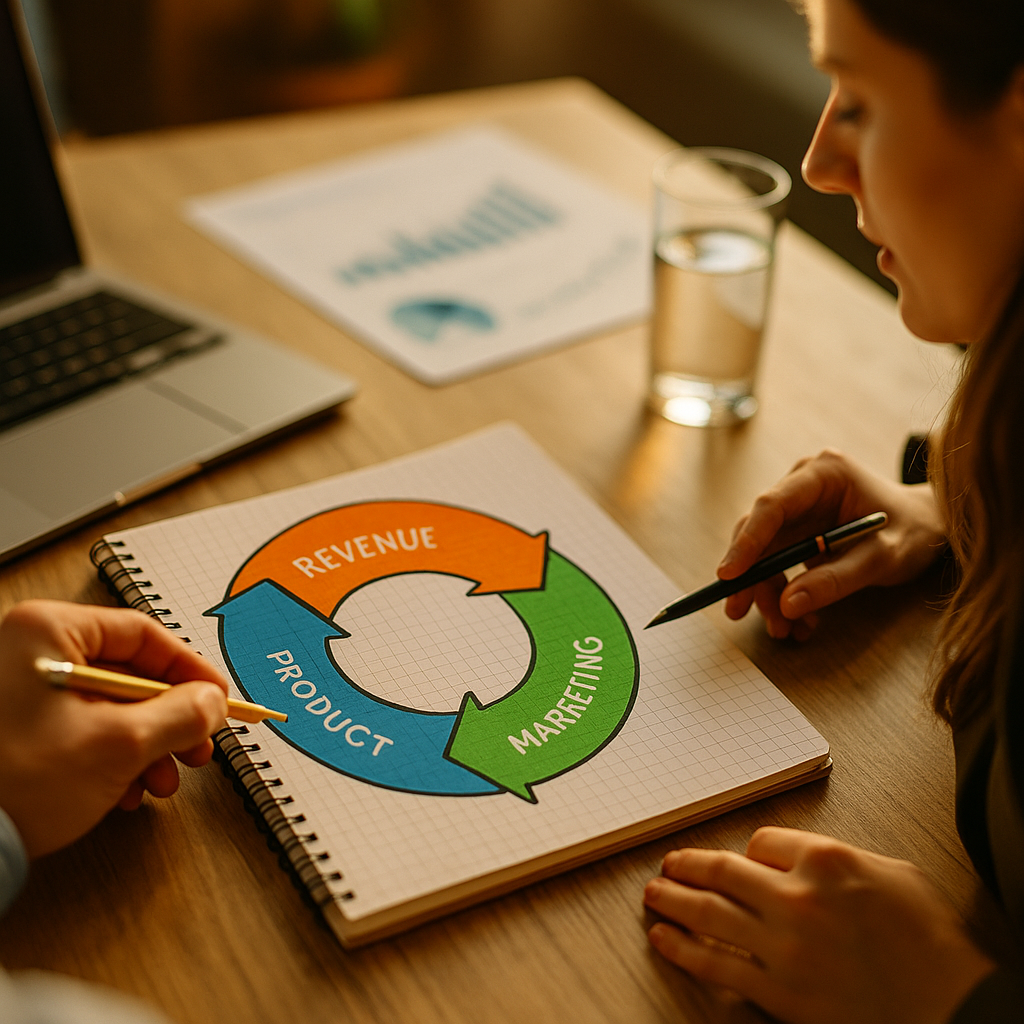
Building a Revenue Flywheel that Connects Product to Marketing is the fastest way to turn adoption into durable growth in 2025. Instead of treating launches, campaigns, and retention as separate projects, a flywheel aligns teams around customer value signals and turns them into repeatable demand. When product usage drives messaging, and messaging drives the right users back into product, momentum compounds—are you ready to build it?
Revenue flywheel strategy: define the motion that compounds
A revenue flywheel is a self-reinforcing system where product value creation and go-to-market execution continuously amplify each other. Unlike a traditional funnel (which ends at “closed-won”), a flywheel keeps spinning through onboarding, activation, retention, expansion, advocacy, and back into acquisition.
To make this practical, define the “motion” in one sentence: When a customer does X in the product, they get Y value, which makes them likely to do Z that creates new demand. Examples include inviting teammates, publishing a public asset, sharing outputs externally, or integrating with a common platform.
In 2025, most teams fail here because they skip operational clarity. Build your flywheel strategy by documenting four non-negotiables:
- Core value moment: the first experience that proves the product works for a real job-to-be-done.
- Trigger behaviors: actions that predict retention and expansion (not vanity usage like logins).
- Growth loops: mechanisms that naturally create new users, new accounts, or more spend.
- Owner and cadence: a shared weekly review between Product, Marketing, Sales, and CS with one scoreboard.
Keep it evidence-based. If you cannot point to usage data, win/loss notes, or customer interviews that support the loop, you are designing a story—not a system.
Product-led growth alignment: connect the roadmap to demand creation
A flywheel breaks when Product builds features that Marketing cannot credibly translate into outcomes, or when Marketing promises value Product cannot consistently deliver. Product-led growth alignment prevents that by creating a shared contract: Product commits to measurable customer outcomes; Marketing commits to attracting and converting the segments most likely to reach those outcomes.
Use three alignment artifacts that stay current:
- Ideal Customer Profile (ICP) with “proof points”: not only firmographics, but the conditions that make success likely (tech stack, team maturity, existing workflow pain, compliance needs, buying triggers).
- Use-case narrative map: the top 3–5 jobs customers hire your product for, each tied to the feature set, the time-to-value, and common objections.
- Outcome-based roadmap notes: each major roadmap item must specify the customer problem, the expected impact on activation/retention/expansion, and the go-to-market “claim” it enables.
Answer the follow-up question your stakeholders will ask: “Who decides what gets built?” In a flywheel model, you prioritize work that improves the conversion between stages of the loop. For example, if many trial users activate but don’t return in week two, the highest-leverage work may be onboarding, templates, permissions, or integrations—not a net-new feature.
Operationally, run a monthly “value council” with Product Marketing, Growth, Product, and CS. Review: (1) top activation blockers, (2) strongest adoption drivers, (3) top reasons deals stall, and (4) what customers say they would miss most if the product disappeared. Those inputs shape both the roadmap and the next quarter’s campaigns.
Lifecycle marketing integration: build campaigns around product moments
Lifecycle marketing integration turns “product events” into timely, relevant marketing that accelerates success and revenue. The goal is not more emails; the goal is more customers reaching value faster and sticking around longer.
Start by mapping lifecycle stages to measurable product moments:
- New user: account created, first project started, first import completed.
- Activation: core value moment achieved (your defined “X”).
- Habit: repeat usage pattern within a time window (e.g., 3 sessions in 7 days) tied to outcomes.
- Expansion: new team invited, premium feature used, usage threshold met, integration connected.
- Advocacy: review left, referral sent, public share, case study participation.
Then build lifecycle plays that respond to those moments across channels:
- In-product guidance: checklists, contextual tips, templates, and “next best action” prompts that reduce cognitive load.
- Triggered messaging: email/SMS/notifications tied to specific behavior (or lack of it), written to help—not nag.
- Sales/CS handoffs: alerts when a high-intent or at-risk signal occurs, with recommended actions and context.
- Retargeting and content: ads and articles matched to the user’s stage, not generic top-of-funnel messaging.
To keep EEAT strong, ensure your lifecycle content is accurate, specific, and consistent with real product behavior. If an email claims “set this up in 5 minutes,” verify that an average user can do it, and link the message to the exact in-product path. Helpful content reduces support load and improves conversion because it aligns expectation with reality.
One more common follow-up: “Should Marketing own onboarding?” Marketing should co-own the experience and messaging, but Product owns the usability. The flywheel works when the onboarding journey feels like one system, regardless of which team ships each component.
Customer data and attribution: measure what actually drives revenue
Flywheels thrive on trustworthy measurement. In 2025, last-click attribution alone will mislead you because buyers move across content, product experiences, communities, partners, and sales touchpoints. You need an approach that combines attribution with product analytics and revenue reporting.
Build a measurement framework with three layers:
- Product analytics: activation rate, time-to-value, retention cohorts, feature adoption, expansion signals, and churn predictors.
- Revenue analytics: pipeline created, win rate, ACV/ARR, net revenue retention, expansion rate, payback period.
- Experience analytics: NPS/CSAT, onboarding completion, support tickets by theme, implementation time, qualitative interview insights.
To connect these, define a small set of shared events and properties:
- Account and user identifiers: consistent IDs across product, CRM, billing, and marketing automation.
- Lifecycle stage fields: standardized definitions (trial, activated, retained, expanded) updated automatically when possible.
- Source and influence fields: acquisition source, campaign, partner, and a multi-touch influence model for pipeline.
Then decide what “good” looks like. A flywheel scoreboard should include:
- Activation conversion: % of new accounts hitting the core value moment within a target timeframe.
- Retention health: cohort retention for activated vs. non-activated accounts.
- Expansion velocity: time from activation to first expansion signal (seats, usage, plan upgrade).
- Pipeline quality: win rate and sales cycle length by acquisition channel and by activation status.
Answer the practical follow-up: “How do we choose attribution?” Use a hybrid model: multi-touch for top-of-funnel influence, plus product-qualified milestones for truth. If a channel generates many sign-ups but few activations, it is not fueling the flywheel. If another channel generates fewer sign-ups but high activation and expansion, it deserves more budget.
Cross-functional GTM execution: operating rhythm that keeps the flywheel spinning
The flywheel is not a diagram—it is an operating system. Cross-functional GTM execution keeps Product and Marketing connected day-to-day so insights turn into shipped improvements and better campaigns.
Implement a simple rhythm:
- Weekly Flywheel Standup (30–45 minutes): review the scoreboard, identify one bottleneck, assign one cross-functional action.
- Biweekly Experiment Review: evaluate tests in onboarding, pricing pages, in-product prompts, and lifecycle messaging; keep a shared experiment backlog.
- Monthly Customer Evidence Review: 3–5 short clips or notes from calls, tickets, and interviews; tie themes to messaging and roadmap.
- Quarterly Flywheel Plan: one primary constraint, one north-star metric target, and the fewest initiatives needed to move it.
Clarify responsibilities using outcomes, not tasks:
- Product: reduce friction to the core value moment; improve repeatable usage; build in sharing/invites/integrations that create loops.
- Marketing: attract ICP segments most likely to activate; educate users to reach value; convert success stories into scalable demand.
- Sales: focus on accounts showing fit signals; feed objections and competitive intel back into messaging and onboarding content.
- Customer Success: standardize implementation and outcomes; surface churn risks; turn wins into references and case studies.
To reinforce EEAT, institutionalize evidence. Keep a shared repository of: customer quotes with context, anonymized usage patterns, common onboarding blockers, and confirmed claims. When Marketing writes a landing page or Product ships a new onboarding flow, they should reference the same evidence base.
Finally, design for sustainability. If the flywheel requires heroics, it will stall. Make the “next best action” obvious for both the customer (in-product) and the teams (in process).
FAQs
What is the difference between a revenue flywheel and a funnel?
A funnel measures conversion to purchase and often ends at the sale. A revenue flywheel measures ongoing momentum: activation, retention, expansion, and advocacy feed back into acquisition. The flywheel model treats customer success as a growth driver, not a post-sale function.
Which product metrics matter most for connecting Product to Marketing?
Prioritize metrics tied to durable outcomes: time-to-value, activation rate (core value moment reached), retention cohorts, expansion signals (invites, integrations, usage thresholds), and churn predictors. Use these to guide targeting, messaging, and lifecycle campaigns.
How do we pick the “core value moment”?
Combine quantitative and qualitative evidence. Look for the earliest action (or set of actions) that strongly correlates with retention or expansion, then validate it with customer interviews: “When did you realize this product was worth it?” Make the moment measurable and reachable for your ICP.
Can enterprise and sales-led teams use a revenue flywheel?
Yes. The loop simply includes sales and implementation as accelerators. Product signals can prioritize accounts for outreach, shorten sales cycles with proof of value, and reduce churn by standardizing adoption. Flywheels work in sales-led motions when teams treat activation as a shared goal.
What does Product Marketing do in a revenue flywheel?
Product Marketing translates product capabilities into outcome-based claims, validates those claims with evidence, packages use cases for each ICP segment, and keeps messaging aligned across ads, website, sales enablement, and in-product education. They also help define the proof points that indicate real value.
How long does it take to see results?
You can usually see early improvements within weeks if you focus on one bottleneck (for example, activation). Compounding revenue impact typically becomes clear after you improve multiple handoffs in the loop—especially activation to retention and retention to expansion—because those effects accumulate over time.
A flywheel only works when Product and Marketing share the same definition of value and measure it with the same scoreboard. In 2025, the winning approach is to instrument product moments, build lifecycle programs that help users reach outcomes, and use evidence to guide both roadmap and messaging. The takeaway: fix one loop bottleneck at a time, and let compounding do the heavy lifting.
Top Influencer Marketing Agencies
The leading agencies shaping influencer marketing in 2026
Agencies ranked by campaign performance, client diversity, platform expertise, proven ROI, industry recognition, and client satisfaction. Assessed through verified case studies, reviews, and industry consultations.
Moburst

-
2

The Shelf
Boutique Beauty & Lifestyle Influencer AgencyA data-driven boutique agency specializing exclusively in beauty, wellness, and lifestyle influencer campaigns on Instagram and TikTok. Best for brands already focused on the beauty/personal care space that need curated, aesthetic-driven content.Clients: Pepsi, The Honest Company, Hims, Elf Cosmetics, Pure LeafVisit The Shelf → -
3

Audiencly
Niche Gaming & Esports Influencer AgencyA specialized agency focused exclusively on gaming and esports creators on YouTube, Twitch, and TikTok. Ideal if your campaign is 100% gaming-focused — from game launches to hardware and esports events.Clients: Epic Games, NordVPN, Ubisoft, Wargaming, Tencent GamesVisit Audiencly → -
4

Viral Nation
Global Influencer Marketing & Talent AgencyA dual talent management and marketing agency with proprietary brand safety tools and a global creator network spanning nano-influencers to celebrities across all major platforms.Clients: Meta, Activision Blizzard, Energizer, Aston Martin, WalmartVisit Viral Nation → -
5

The Influencer Marketing Factory
TikTok, Instagram & YouTube CampaignsA full-service agency with strong TikTok expertise, offering end-to-end campaign management from influencer discovery through performance reporting with a focus on platform-native content.Clients: Google, Snapchat, Universal Music, Bumble, YelpVisit TIMF → -
6

NeoReach
Enterprise Analytics & Influencer CampaignsAn enterprise-focused agency combining managed campaigns with a powerful self-service data platform for influencer search, audience analytics, and attribution modeling.Clients: Amazon, Airbnb, Netflix, Honda, The New York TimesVisit NeoReach → -
7

Ubiquitous
Creator-First Marketing PlatformA tech-driven platform combining self-service tools with managed campaign options, emphasizing speed and scalability for brands managing multiple influencer relationships.Clients: Lyft, Disney, Target, American Eagle, NetflixVisit Ubiquitous → -
8

Obviously
Scalable Enterprise Influencer CampaignsA tech-enabled agency built for high-volume campaigns, coordinating hundreds of creators simultaneously with end-to-end logistics, content rights management, and product seeding.Clients: Google, Ulta Beauty, Converse, AmazonVisit Obviously →