


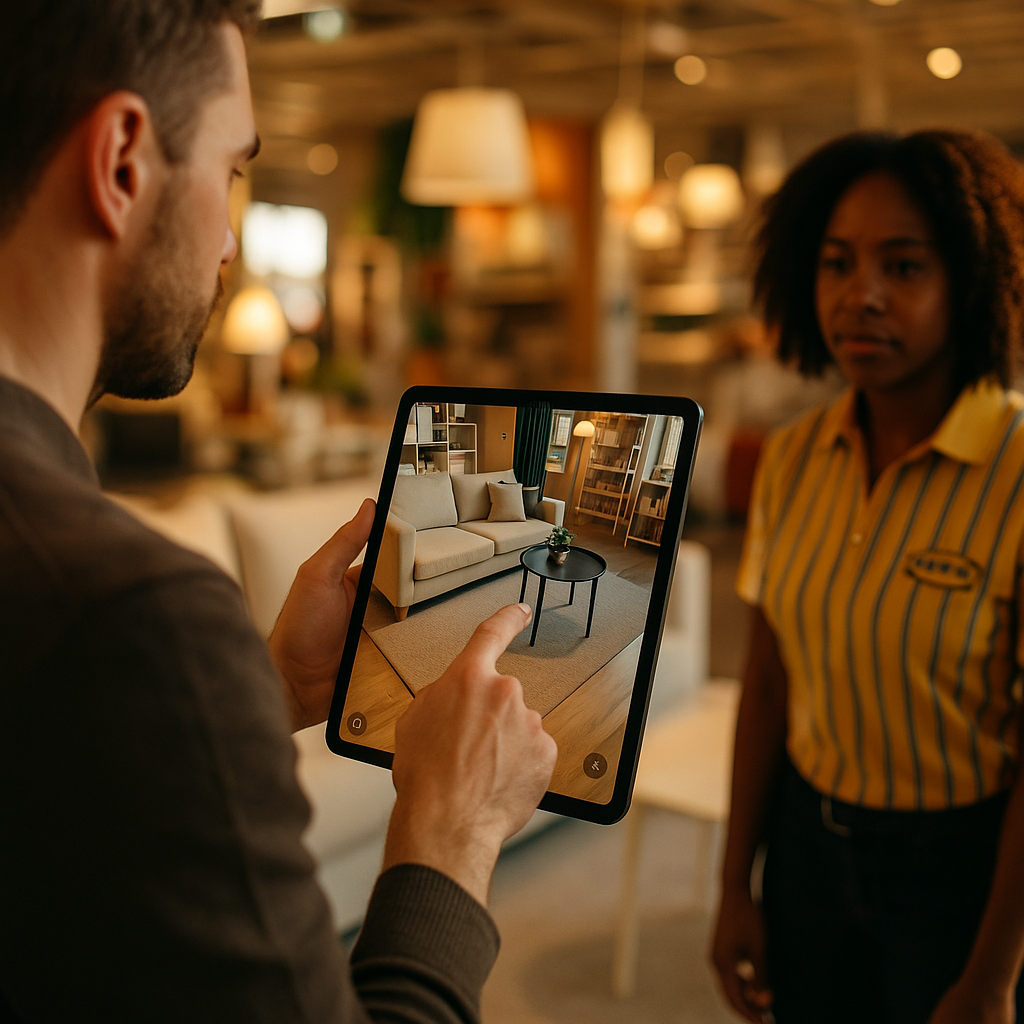
In 2025, shoppers expect to plan, visualize, and buy without friction. This case study shows how IKEA Kreativ turned immersive room visualization into measurable business impact by bridging inspiration and checkout. You’ll see what changed, why it worked, and how the approach scales across channels. The result is a repeatable playbook for retailers seeking growth—starting with one key shift.
AR planning tool: what IKEA Kreativ is and why it matters
IKEA Kreativ is an augmented reality planning experience designed to help customers visualize furniture and décor in their own spaces. Instead of relying on imagination, shoppers can map a room, remove existing items digitally, and try IKEA products in context. That shift from “browse” to “plan” matters because home furnishing purchases are high-consideration and error-prone: wrong size, wrong style, wrong fit with existing pieces, or uncertainty about how a room will feel.
From a customer perspective, Kreativ solves three planning problems at once:
- Confidence: Customers can see scale, placement, and styling before purchase.
- Clarity: They can compare multiple options quickly, reducing decision fatigue.
- Continuity: The planning journey links to products that are purchasable, not just inspirational.
From a business perspective, AR planning changes the economics of conversion. When customers plan with intention, they tend to:
- Build larger baskets (because they design “a room,” not “an item”).
- Commit faster (because uncertainty drops).
- Return fewer items (because fit and look are validated earlier).
That is the foundation of how AR planning becomes revenue: it moves the customer from passive browsing to active decision-making, while keeping the experience anchored to SKU-level purchasing.
Digital showroom experience: the customer journey that drives conversion
The most important transformation wasn’t “adding AR.” It was redesigning the journey so AR planning acts like a digital showroom that supports real shopping behaviors. IKEA Kreativ typically follows a flow that mirrors how people actually furnish homes:
- Capture the room: Customers map their space using supported devices, creating a usable canvas.
- Stage and edit: They can visualize without existing clutter by digitally removing items and resetting the scene.
- Try products in context: They place furniture and adjust layouts, checking proportion and circulation space.
- Build a cohesive solution: They add complementary items (rugs, lighting, storage, textiles) to complete the room.
- Move to purchase: Items link to product detail pages and the cart, preserving intent.
This experience reduces drop-offs in two critical moments: when a shopper feels overwhelmed by options, and when they feel uncertain about fit. The “digital showroom” approach also answers likely follow-up questions customers have during planning, inside the experience itself:
- Will this sofa block the walkway? The visualization makes spacing obvious.
- Does this color work with my floor? The product is seen in the actual room lighting and context.
- What else do I need to finish the room? The planning mindset naturally expands the basket beyond one SKU.
By keeping the journey continuous—from inspiration to placement to purchase—Kreativ avoids a common AR pitfall: impressive demos that fail to translate into buying actions.
3D room design: the product and data choices behind realism
To turn visualization into revenue, the experience must be believable and usable. That requires strong 3D assets, accurate scale, and practical interaction design. A shopper won’t trust the plan—or act on it—if the products look wrong, the sizes feel off, or the interface slows them down.
Key capability areas that make 3D room design commercially effective include:
- High-quality 3D models tied to real SKUs: Visual accuracy matters, but so does maintainability. Each item needs to map cleanly to purchasable inventory and variants.
- Reliable dimensions and placement: Furniture planning fails when measurements are inconsistent. A “looks right” experience becomes “is right” when sizing is trustworthy.
- Lighting and materials that support decisions: The goal is not cinematic rendering; it is decision-grade realism that helps customers compare finishes and styles.
- Performance and accessibility: Planning requires iteration. Fast loading, responsive controls, and simple editing keep customers engaged long enough to reach purchase.
There is also a quiet data advantage: AR planning interactions create signals about intent. When a customer tries multiple rugs, rotates a sofa, or rearranges storage, they reveal preferences that can improve recommendations, merchandising, and onsite navigation—so long as the retailer treats the data responsibly and transparently.
In 2025, trust is part of the product. Clear privacy choices and straightforward explanations of what is captured and why can support adoption. When customers feel in control, they are more likely to complete a room scan and return to their saved plan later—both behaviors that correlate with stronger purchase intent.
eCommerce conversion: how AR planning turns engagement into revenue
AR planning becomes revenue when it improves the core levers of commerce: conversion rate, average order value, and customer lifetime value. IKEA Kreativ supports those levers by making it easier to decide, easier to add complementary items, and easier to complete checkout with confidence.
Here is the practical mechanism:
- Lower uncertainty increases conversion: When customers can see fit and style in their own home, fewer sessions end in “I’ll think about it.” The plan itself becomes a commitment device.
- Room-first planning increases basket size: Customers naturally add matching items when they can see the whole room—side tables, lamps, storage, textiles—because the gaps become visible.
- Fewer surprises reduce returns: While return outcomes depend on many factors (delivery, assembly, materials, expectations), visualization can reduce basic mismatch issues like scale and layout conflicts.
- Saved plans create re-engagement: If the experience supports saving and revisiting, it creates a reason to return, share with household members, and finalize a purchase later.
To make that conversion impact consistent, the path from plan to purchase must stay intact. The highest-performing AR commerce experiences typically include:
- Persistent product lists: A clear, editable list of items in the room with quantities and variants.
- Direct links to availability and delivery options: Planning without fulfillment clarity can stall decisions.
- Cart-ready handoff: Minimal friction between the AR environment and the eCommerce cart.
- Contextual guidance: Tips about spacing, pairing, and common room layouts that help customers proceed confidently.
For leaders evaluating ROI, the most useful approach is to compare cohorts: planners vs. non-planners. Track not only immediate conversions, but also delayed conversions from saved plans, and basket composition changes (single-item vs. multi-item orders). This reframes AR from a marketing novelty into a measurable conversion tool.
omnichannel retail: linking online planning to store and delivery
IKEA’s strength has long been the connection between inspiration, showroom navigation, and take-home logistics. IKEA Kreativ extends that logic into an omnichannel retail world where customers fluidly switch between mobile, desktop, and stores.
AR planning supports omnichannel performance in several ways:
- Better store visits: Customers arrive with a plan, a product list, and clearer intent. That can reduce wandering and increase purposeful purchasing.
- More effective associate support: When a customer can show a saved room plan, conversations become more specific—dimensions, layout, and alternatives—rather than vague preferences.
- Faster delivery decisions: Large furniture often requires delivery planning. A completed room plan helps customers commit to delivery schedules and accessory add-ons.
- Cross-device continuity: A plan started on a phone and refined on a larger screen keeps momentum and reduces abandonment.
Retailers often ask a follow-up question: Does AR reduce the need for stores? In practice, the stronger strategy is to make stores work better. When customers plan at home first, store time becomes confirmation and completion, not exploration from scratch.
To maximize this effect, the experience should support practical omnichannel needs:
- Shareable plans: Easy sharing with family members to align on decisions.
- Shopping list export: A clean list for in-store pickup or associate assistance.
- Inventory awareness: Visibility into stock and lead times to prevent plan-to-purchase breakdowns.
AR ROI metrics: what to measure and how to replicate the playbook
The most useful lesson from IKEA Kreativ is that AR ROI is not a single metric. It is a chain of measurable improvements across the funnel, tied to commerce outcomes. In 2025, the expectation for new digital experiences is accountability: leadership teams want to know what changed and how it impacts revenue and cost.
Measure AR planning with a balanced scorecard:
- Adoption and activation: % of visitors who start planning, complete a scan/canvas, and place at least one item.
- Engagement quality: Items placed per session, time-to-first-placement, number of layout iterations, and saved-plan rate.
- Commerce impact: Conversion rate for planners vs. non-planners, average order value, attachment rate (add-ons per primary item), and checkout completion.
- Operational impact: Return rates for categories where visualization addresses common issues, and customer support contacts related to fit or “not as expected.”
- Omnichannel influence: Store visit uplift among planners, buy-online-pickup-in-store usage, and delivery scheduling completion.
Replication requires discipline. Teams that succeed typically do the following:
- Start with one high-value room type: Living rooms and bedrooms often show clear basket expansion potential.
- Prioritize top-selling, high-consideration SKUs: Build 3D coverage where uncertainty is highest and margin impact is meaningful.
- Design for purchase handoff from day one: Don’t treat shopping as a separate step; integrate it into the planning flow.
- Test and iterate weekly: Improve activation steps, guidance, and performance to reduce early abandonment.
- Document trust and privacy choices: Clear disclosures reduce hesitation and support long-term adoption.
EEAT best practices apply here as much as anywhere: demonstrate domain expertise with specific measurement frameworks, provide transparent assumptions, and prioritize user benefit. When AR planning is built to help customers make better decisions—not to impress—it is easier to defend budget and prove revenue impact.
FAQs: IKEA Kreativ and revenue impact
What is IKEA Kreativ used for?
IKEA Kreativ is used to visualize IKEA furniture and décor in a customer’s real room. It supports room planning by letting shoppers place items, test layouts, and build a shoppable list tied to real products.
How does AR planning increase sales for furniture retailers?
AR planning increases sales by reducing uncertainty (improving conversion), encouraging room-level purchasing (raising average order value), and supporting confident decisions that can reduce avoidable returns.
What metrics prove AR ROI in eCommerce?
Track planner vs. non-planner conversion rate, average order value, attachment rate, saved-plan return conversions, and category-level return rates. Include activation metrics like scan completion and time-to-first-placement to diagnose drop-offs.
Does AR replace in-store shopping?
No. Strong AR planning typically improves store visits by making them more purposeful. Customers arrive with a plan and product list, which can increase purchase intent and reduce time spent searching.
What are the main risks of AR planning programs?
The biggest risks are poor realism or inaccurate scale, a broken handoff to the cart, limited 3D catalog coverage, and unclear privacy practices. Any of these can reduce trust and prevent planning sessions from translating into purchases.
How can a retailer start building an AR planning experience in 2025?
Start with one room category and a focused set of high-consideration SKUs. Build decision-grade 3D assets, integrate product availability and cart handoff, then run ongoing A/B tests to improve activation, performance, and basket-building features.
In 2025, IKEA Kreativ demonstrates a clear pattern: AR succeeds when it is built as a planning-to-purchase system, not a standalone feature. By delivering decision-grade visualization, keeping products shoppable, and measuring planners against non-planners, IKEA turns engagement into commerce outcomes. The takeaway is simple: connect AR planning to the cart, the store, and fulfillment—or it won’t earn revenue.
Top Influencer Marketing Agencies
The leading agencies shaping influencer marketing in 2026
Agencies ranked by campaign performance, client diversity, platform expertise, proven ROI, industry recognition, and client satisfaction. Assessed through verified case studies, reviews, and industry consultations.
Moburst

-
2

The Shelf
Boutique Beauty & Lifestyle Influencer AgencyA data-driven boutique agency specializing exclusively in beauty, wellness, and lifestyle influencer campaigns on Instagram and TikTok. Best for brands already focused on the beauty/personal care space that need curated, aesthetic-driven content.Clients: Pepsi, The Honest Company, Hims, Elf Cosmetics, Pure LeafVisit The Shelf → -
3

Audiencly
Niche Gaming & Esports Influencer AgencyA specialized agency focused exclusively on gaming and esports creators on YouTube, Twitch, and TikTok. Ideal if your campaign is 100% gaming-focused — from game launches to hardware and esports events.Clients: Epic Games, NordVPN, Ubisoft, Wargaming, Tencent GamesVisit Audiencly → -
4

Viral Nation
Global Influencer Marketing & Talent AgencyA dual talent management and marketing agency with proprietary brand safety tools and a global creator network spanning nano-influencers to celebrities across all major platforms.Clients: Meta, Activision Blizzard, Energizer, Aston Martin, WalmartVisit Viral Nation → -
5

The Influencer Marketing Factory
TikTok, Instagram & YouTube CampaignsA full-service agency with strong TikTok expertise, offering end-to-end campaign management from influencer discovery through performance reporting with a focus on platform-native content.Clients: Google, Snapchat, Universal Music, Bumble, YelpVisit TIMF → -
6

NeoReach
Enterprise Analytics & Influencer CampaignsAn enterprise-focused agency combining managed campaigns with a powerful self-service data platform for influencer search, audience analytics, and attribution modeling.Clients: Amazon, Airbnb, Netflix, Honda, The New York TimesVisit NeoReach → -
7

Ubiquitous
Creator-First Marketing PlatformA tech-driven platform combining self-service tools with managed campaign options, emphasizing speed and scalability for brands managing multiple influencer relationships.Clients: Lyft, Disney, Target, American Eagle, NetflixVisit Ubiquitous → -
8

Obviously
Scalable Enterprise Influencer CampaignsA tech-enabled agency built for high-volume campaigns, coordinating hundreds of creators simultaneously with end-to-end logistics, content rights management, and product seeding.Clients: Google, Ulta Beauty, Converse, AmazonVisit Obviously →