


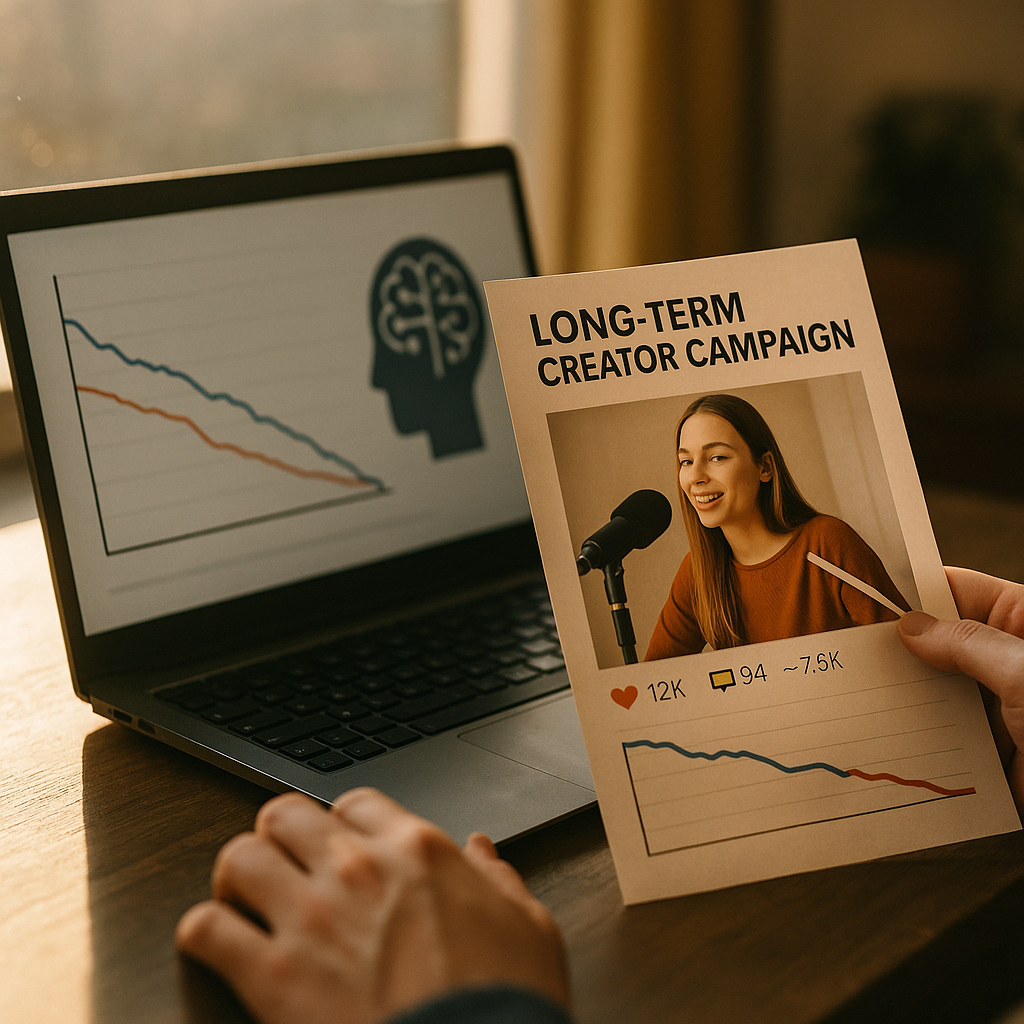
In 2025, long-running creator partnerships win trust when every post reinforces the same promise. But across months of briefs, trends, and team changes, the storyline can quietly shift. Using AI to Detect Narrative Drift in Long Term Creator Campaigns helps brands spot subtle misalignment early—before audiences notice contradictions or fatigue. The question isn’t whether drift happens; it’s how fast you can catch it.
Brand narrative consistency: what narrative drift looks like in creator marketing
Narrative drift is the gradual deviation from the campaign’s intended story, positioning, or value proposition across time. It rarely appears as a single “wrong” post. Instead, it shows up as small changes that add up: different claims, a new tone, a shifting target audience, or an evolving problem-solution framing that no longer matches what the brand sells.
Common drift patterns in long-term creator campaigns
- Message substitution: the creator replaces brand differentiators (e.g., “clinically tested”) with generic benefit talk (“feels nice”).
- Audience slide: content starts addressing a different user type than the campaign persona, often driven by algorithmic incentives.
- Tone migration: the voice becomes harsher, more sarcastic, or more sensational than the brand’s style guidelines allow.
- Claim creep: benefits become broader and less defensible as creators try to keep posts fresh.
- Competitive contamination: adjacent sponsorships introduce contradictory comparisons or “category” claims that dilute positioning.
Drift is not always harmful. Some evolution signals learning and improved creator-brand fit. The issue is unmanaged drift—when the campaign story changes without deliberate strategy, internal approval, or compliance review. AI is useful because it tracks patterns at scale, across dozens of creators and hundreds of assets, without relying solely on manual spot checks.
AI content analysis: how models detect drift across months of posts
AI detects narrative drift by turning creative output into measurable signals: themes, claims, sentiment, tone, and brand alignment. The most reliable systems combine rule-based brand requirements (what must or must not be said) with machine learning that captures nuance (how the story is being told).
Core detection methods teams use in 2025
- Semantic similarity to a “campaign north star”: you provide a reference set (approved scripts, key messages, positioning statements, and high-performing on-brief posts). AI compares new content against that reference using embeddings to flag divergence.
- Topic and theme tracking: models identify recurring themes (e.g., “speed,” “simplicity,” “eco”) and measure how their frequency changes over time or by creator cohort.
- Claim extraction and validation: AI pulls explicit claims (e.g., “reduces acne in 7 days”) and checks them against an approved claims library and required qualifiers or disclosures.
- Tone and style scoring: classifiers estimate tone attributes such as warmth, assertiveness, humor intensity, controversy risk, and “brand voice” proximity.
- Visual and audio alignment: computer vision and speech-to-text analyze overlays, on-screen text, logos, product usage depiction, and spoken messaging—useful when the caption is compliant but the video isn’t.
What to feed the system for better accuracy
- Brand narrative: mission, positioning, category truths, forbidden comparisons, and regulated language.
- Creative guardrails: tone rules, banned phrases, required disclosure language, and approved product usage scenarios.
- Campaign strategy: target persona, primary problem, proof points, and desired call-to-action.
- Context: creator niche, platform norms, and content format (UGC tutorial, day-in-the-life, review, livestream).
AI works best as an early warning system, not an automated judge. The goal is to triage: highlight posts that deserve a human review and explain why they look off-brief, with citations to the exact timestamp, sentence, or frame that triggered the flag.
Long-term influencer campaign monitoring: building a drift dashboard that teams actually use
A drift program succeeds when it is operational, not theoretical. That means a dashboard built around decisions your team already makes: approve, request edits, update brief, or intervene in creator coaching.
Key metrics for narrative drift monitoring
- Alignment score: similarity to the approved narrative reference set, tracked per creator and per month.
- Key message coverage: whether required messages appear, and whether they appear in the first seconds/lines where attention is highest.
- Claim risk score: likelihood of unapproved, exaggerated, or unsubstantiated claims; include missing qualifiers and disclosure issues.
- Tone drift index: distance from brand voice attributes (e.g., “calm,” “expert,” “playful”) and platform-appropriate thresholds.
- Concept repetition and fatigue: detection of overly similar hooks, structures, or talking points that reduce incremental reach.
- Competitive adjacency alerts: flags when recent posts include competitor mentions or conflicting sponsorships that erode positioning.
Workflow integration that reduces friction
- Pre-flight: creators upload a draft; AI provides instant, specific suggestions tied to your brief (not generic writing tips).
- Post-flight: once published, AI re-checks the live version (including overlays and spoken words) and logs outcomes.
- Weekly narrative review: a 30-minute meeting reviews top drift drivers and decides whether to coach creators, revise messaging, or adjust targeting.
To ensure adoption, avoid a single “overall score” that no one trusts. Provide transparent drivers: “Missing required proof point,” “Tone shifted toward sarcasm,” “New theme: price-first framing,” and show examples from the content itself. This supports EEAT by making decisions auditable and reducing subjective back-and-forth.
Creator brief optimization: using drift insights to improve performance without killing authenticity
Creators perform best when they can translate a brand idea into their own language. Over-control causes flat content; under-control causes drift. AI helps you find the middle by identifying which guardrails matter and which ones can flex.
How to turn drift signals into better briefs
- Rewrite the brief around a single “promise”: if AI shows multiple competing themes, consolidate into one primary promise and two supporting proof points.
- Provide “say this, not that” examples: use AI to surface creator phrases that consistently lead to claim creep, then offer safer alternatives that keep the creator’s tone.
- Offer modular story blocks: hook options, product demo beats, proof point phrasing, and CTA variations that creators can mix and match.
- Calibrate by creator archetype: drift may be higher for comedic creators than educational creators; use different guardrails, not one-size-fits-all rules.
- Update the narrative intentionally: if the audience responds to a new theme, codify it through approvals and testing rather than letting it spread informally.
Answering the obvious concern: will AI make content feel robotic?
Not if you use it to protect the story, not to write the post. The best approach is “creator-first language, brand-safe meaning.” You evaluate whether the content communicates the intended narrative and avoids risky claims, while allowing creators to keep their pacing, humor, and lived experience. In practice, AI reduces unnecessary revisions by catching specific misalignments early—before they become a rewrite.
Compliance and brand safety AI: reducing risk while maintaining trust
Long-term campaigns carry compounding risk: one off-message post can conflict with earlier claims, confuse buyers, or invite regulatory scrutiny. AI supports compliance by consistently checking every asset against policies, disclosures, and claim libraries—especially when the volume of content outpaces human review capacity.
High-impact compliance use cases
- Disclosure checks: confirm clear, platform-appropriate sponsorship disclosures are present and correctly formatted.
- Regulated claims screening: identify health, financial, environmental, or performance claims that require substantiation or specific wording.
- Before-and-after and testimonial risk: detect implied guarantees, unrealistic outcomes, or missing context.
- Misuse depiction: flag visuals showing unsafe or off-label product use that could create liability.
- Brand safety adjacency: spot sensitive topics, hate speech proximity, or polarizing frames that contradict brand values.
EEAT best practices for responsible AI in this context
- Human review for high-risk flags: treat AI as triage; humans decide and document outcomes.
- Explainability: require tools to point to the exact line, timestamp, or frame that triggered the alert.
- Audit trails: store versions of briefs, approvals, and AI outputs to show consistent governance.
- Privacy and permissions: ensure creators know what is analyzed, how data is stored, and who can access it.
This approach protects trust with audiences and creators. It also protects internal teams by creating a repeatable standard for what “on narrative” means—reducing subjective debates and last-minute escalations.
Measurement and governance: proving narrative alignment improves ROI over time
Stakeholders will ask whether drift detection changes outcomes beyond “feeling safer.” You can answer by connecting alignment signals to performance and by setting governance rules that keep the program credible.
How to link narrative alignment to business impact
- Correlate alignment with conversion signals: compare alignment scores to tracked link performance, promo code usage, or assisted conversions where measurement is available.
- Track brand lift proxies: monitor comment sentiment around key messages, confusion signals (“Is this the same product?”), and repeated objections.
- Identify durable messages: use AI to find which proof points stay consistent across creators and correlate with saves, shares, and longer watch time.
- Measure efficiency: quantify reductions in revision cycles, time-to-approval, and post-publication fixes.
Governance rules that keep the system trustworthy
- Define drift thresholds: set clear ranges for “monitor,” “review,” and “intervene,” tuned by category risk.
- Refresh the north star set: update reference assets when the campaign strategy changes, not when performance dips for unrelated reasons.
- Separate learning from enforcement: use drift insights to coach creators and improve briefs; reserve hard enforcement for compliance and safety.
- Run periodic calibration: sample flagged and unflagged posts, compare to human judgments, and adjust models or rules.
When you operationalize governance, AI becomes part of campaign management rather than a novelty tool. It helps you scale creator partnerships without letting the narrative erode as the calendar fills up.
FAQs: AI narrative drift detection in creator campaigns
What is narrative drift in a long-term creator campaign?
Narrative drift is the gradual shift in messaging, tone, claims, or target audience away from the approved campaign story. It typically happens in small increments across many posts, especially when creators adapt to trends or when briefs evolve informally.
Can AI analyze video and audio, or only captions?
Yes. Modern workflows use speech-to-text for spoken content, computer vision for on-screen text and product depiction, and caption analysis for written messaging. This matters because drift and compliance issues often appear in what’s said aloud or shown on screen.
How do you create a “north star” reference for AI comparisons?
Use a small set of approved assets: the positioning statement, key messages, claim library, brand voice guidance, and 10–30 examples of high-performing on-brief posts. Keep it versioned so you can prove what the narrative was at any point in the campaign.
Will AI replace human creative strategists or influencer managers?
No. AI speeds up detection and triage, but humans decide what to change and why. Strategists interpret insights, balance authenticity with brand requirements, and coach creators in a way that preserves performance.
How do you avoid over-policing creators and hurting authenticity?
Focus AI on meaning and risk, not on forcing identical wording. Allow multiple creator-native ways to express the same approved promise. Use drift insights to improve briefs and provide flexible story modules rather than rigid scripts.
What are the biggest risks if you ignore narrative drift?
Audience confusion, weaker differentiation, inconsistent claims, brand safety incidents, and cumulative performance decline. Over time, the campaign can turn into disconnected posts rather than a coherent story that builds trust and recall.
AI-driven drift detection gives long-term creator programs a practical advantage: consistent storytelling without slowing creators down. When you translate narrative into measurable signals—themes, claims, tone, and alignment—you can intervene early, coach with specificity, and keep compliance tight. The takeaway is simple: treat narrative like an asset you monitor, not a document you file away, and results follow.
Top Influencer Marketing Agencies
The leading agencies shaping influencer marketing in 2026
Agencies ranked by campaign performance, client diversity, platform expertise, proven ROI, industry recognition, and client satisfaction. Assessed through verified case studies, reviews, and industry consultations.
Moburst

-
2

The Shelf
Boutique Beauty & Lifestyle Influencer AgencyA data-driven boutique agency specializing exclusively in beauty, wellness, and lifestyle influencer campaigns on Instagram and TikTok. Best for brands already focused on the beauty/personal care space that need curated, aesthetic-driven content.Clients: Pepsi, The Honest Company, Hims, Elf Cosmetics, Pure LeafVisit The Shelf → -
3

Audiencly
Niche Gaming & Esports Influencer AgencyA specialized agency focused exclusively on gaming and esports creators on YouTube, Twitch, and TikTok. Ideal if your campaign is 100% gaming-focused — from game launches to hardware and esports events.Clients: Epic Games, NordVPN, Ubisoft, Wargaming, Tencent GamesVisit Audiencly → -
4

Viral Nation
Global Influencer Marketing & Talent AgencyA dual talent management and marketing agency with proprietary brand safety tools and a global creator network spanning nano-influencers to celebrities across all major platforms.Clients: Meta, Activision Blizzard, Energizer, Aston Martin, WalmartVisit Viral Nation → -
5

The Influencer Marketing Factory
TikTok, Instagram & YouTube CampaignsA full-service agency with strong TikTok expertise, offering end-to-end campaign management from influencer discovery through performance reporting with a focus on platform-native content.Clients: Google, Snapchat, Universal Music, Bumble, YelpVisit TIMF → -
6

NeoReach
Enterprise Analytics & Influencer CampaignsAn enterprise-focused agency combining managed campaigns with a powerful self-service data platform for influencer search, audience analytics, and attribution modeling.Clients: Amazon, Airbnb, Netflix, Honda, The New York TimesVisit NeoReach → -
7

Ubiquitous
Creator-First Marketing PlatformA tech-driven platform combining self-service tools with managed campaign options, emphasizing speed and scalability for brands managing multiple influencer relationships.Clients: Lyft, Disney, Target, American Eagle, NetflixVisit Ubiquitous → -
8

Obviously
Scalable Enterprise Influencer CampaignsA tech-enabled agency built for high-volume campaigns, coordinating hundreds of creators simultaneously with end-to-end logistics, content rights management, and product seeding.Clients: Google, Ulta Beauty, Converse, AmazonVisit Obviously →