


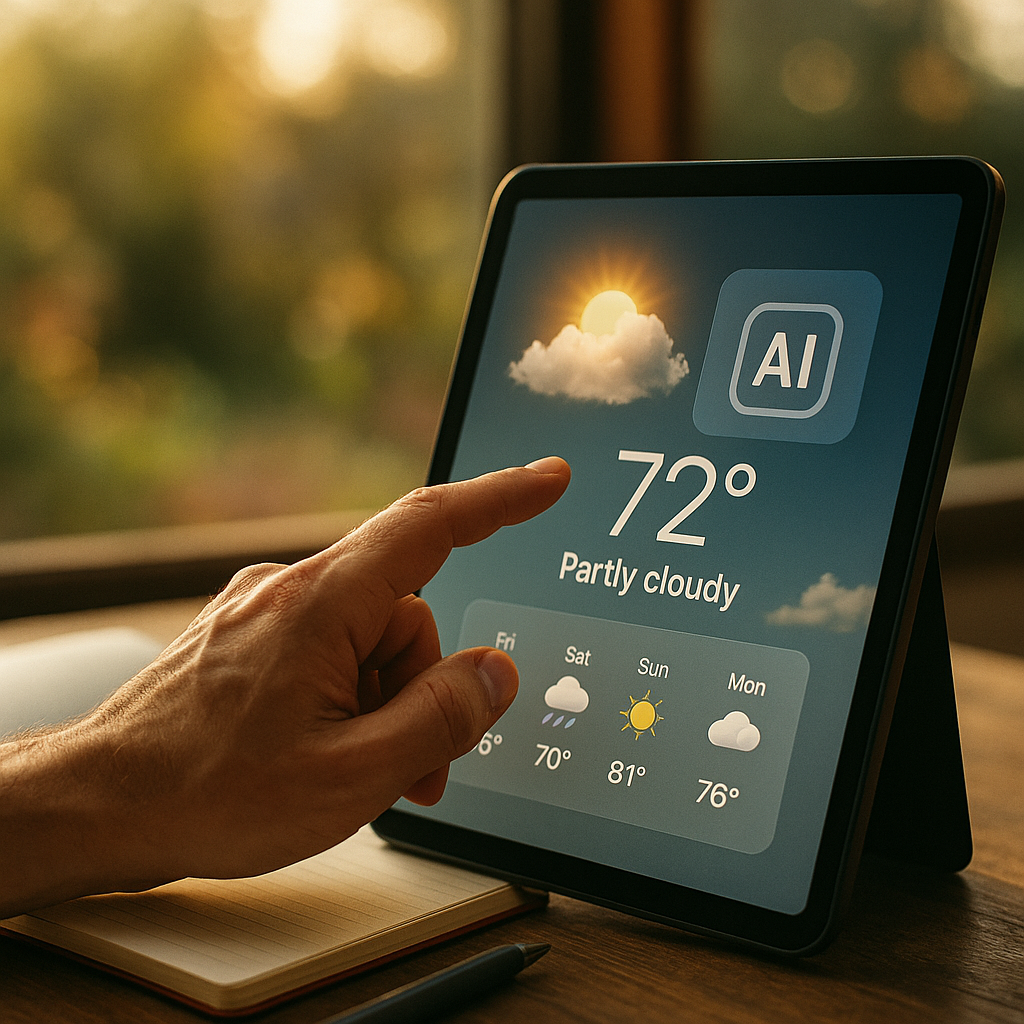
Using AI to Personalize Dynamic Creative Based on Live Weather Data is changing how brands earn attention in crowded feeds. Instead of guessing what people need, marketers can match messages to real conditions in real time, from heatwaves to downpours. When weather triggers creative automatically, relevance increases and waste drops. The next question is simple: how do you do it well?
AI-driven dynamic creative optimization: what it is and why weather matters
AI-driven dynamic creative optimization (DCO) uses machine learning to assemble, prioritize, and serve ad variations based on signals such as location, device, audience context, and performance feedback. When you add live weather inputs, you move from generic personalization to situational relevance. A jacket ad during a cold snap, a hydration message during a heat alert, or a delivery discount when storms disrupt errands can feel useful rather than intrusive.
Weather is a strong trigger because it changes needs quickly and predictably. It also creates natural creative angles without requiring sensitive personal data. Unlike many behavioral signals, weather is shared context: it affects entire regions at once, which makes it scalable for national and multi-market campaigns.
To make this work, AI typically handles three tasks:
- Decisioning: selecting which creative variant to show given conditions (e.g., “rain + commute hours”).
- Generation: producing or adapting copy, images, and calls-to-action within brand rules.
- Optimization: learning which weather-triggered combinations drive outcomes by channel, audience, and market.
Marketers often ask whether weather targeting is “just a gimmick.” It is not, if you tie triggers to concrete customer needs and measure incremental lift. Done poorly, it becomes random message switching. Done well, it becomes an always-on relevance layer across your creative system.
Live weather data integration: choosing sources, granularity, and governance
Live weather data integration starts with selecting reliable data sources and defining how frequently you update decisions. In 2025, most implementations pull from a weather API (commercial provider or public datasets) and map it to ad-serving contexts such as DMA, city, ZIP/postal code, or device-derived location (where consent allows).
Key integration choices that affect performance and trust:
- Granularity: City-level is often sufficient for brand and retail; hyperlocal can help quick-service, delivery, and outdoor categories but increases complexity and the risk of mismatched conditions.
- Refresh rate: Hourly updates fit many use cases; severe alerts and fast-moving storms may require more frequent polling and shorter caching.
- Condition taxonomy: Standardize categories (e.g., temperature bands, precipitation type, wind, UV index, pollen where available) so creative rules stay consistent across providers.
- Fallback logic: If the API fails or location is unknown, serve a safe default creative rather than blocking delivery.
- Data governance: Document data lineage, retention, and access controls. Treat location and context signals as potentially sensitive, even when they are not directly identifying.
Operational best practice: align weather triggers to business operations. If you promise “same-day delivery in storms,” confirm logistics capacity. If you promote “cooling products during heat alerts,” ensure inventory and fulfillment can meet demand. Helpful content is consistent; broken promises reduce trust and campaign efficiency.
EEAT note: Build an internal “weather playbook” that records trigger definitions, creative rules, test results, and known edge cases (microclimates, inaccurate geolocation, and seasonal shifts). This creates organizational expertise you can reuse and audit.
Weather-triggered personalization: building creative rules that feel helpful
Weather-triggered personalization works best when the message matches an immediate, reasonable need. Avoid forced puns and focus on utility, clarity, and brand alignment. Strong weather logic connects conditions to user intent and removes friction.
Examples of high-intent weather use cases:
- Retail apparel: “Temperature under 45°F” prioritizes coats and layering; “rain probability above 60%” prioritizes waterproof footwear.
- CPG beverages: Heat index bands trigger hydration-focused messaging; cold snaps shift to hot drinks or soup.
- Travel and mobility: Storm alerts emphasize flexible booking; snow conditions emphasize safety features or transit alternatives.
- Home services: High wind triggers gutter checks; freezing temperatures trigger pipe protection services.
- Food delivery: Heavy rain triggers free delivery thresholds or “stay in” bundles, if operations support it.
How to structure your rule set:
- Start with 6–10 weather states: Keep it manageable (e.g., hot, cold, mild, rain, snow, wind, severe alert).
- Map each state to a product set and value proposition: One clear promise per state.
- Add time and context modifiers carefully: For example, “rain + evening” can emphasize convenience; “heat + weekend” can emphasize outdoor activities.
- Write copy in modular blocks: Headline, subhead, CTA, and disclaimers should swap cleanly without creating contradictions.
Readers often worry that personalization will feel “creepy.” Weather is one of the safest contextual signals because it does not require inferring personal traits. Even so, avoid language that implies surveillance (e.g., “We see it’s raining where you are”). Prefer neutral phrasing like “Rainy-day essentials” or “Built for wet weather.”
Generative AI for creative variation: brand safety, quality control, and compliance
Generative AI for creative variation can accelerate production of weather-specific copy and visual adaptations, but it needs guardrails. The goal is not infinite variants; it is controlled variety with consistent brand voice and accurate claims.
Practical guardrails that support EEAT in 2025:
- Brand voice prompts and style rules: Maintain a concise “voice spec” that defines tone, prohibited phrases, and required elements (e.g., legal lines, offer terms).
- Claim validation: If AI suggests performance claims (“stays dry all day”), require a pre-approved claims library or human approval workflows.
- Local compliance checks: Promotions, pricing, alcohol, health, and financial products may require jurisdiction-specific disclosures. Build templates with mandatory fields.
- Asset constraints: Limit AI to approved images, product renders, and typography. If you use AI-generated imagery, define what is allowed and document provenance.
- Human-in-the-loop review: Approve the initial set of variants and any new “state expansions” (e.g., adding severe weather messaging) before scaling.
Quality control workflow: create a “creative matrix” where each weather state has pre-approved modules. Let AI choose combinations and micro-copy within boundaries rather than generating everything from scratch. This approach improves consistency, speeds approvals, and reduces the risk of off-brand or insensitive messaging during severe conditions.
Ethical considerations: Avoid exploiting emergencies. If severe alerts are active, prioritize safety-forward messaging, service updates, or pausing promotions. Brands build trust by showing restraint when conditions are dangerous.
Real-time campaign orchestration: channels, latency, and decisioning architecture
Real-time campaign orchestration connects weather signals to activation across paid social, programmatic, search, onsite personalization, email, and push. Each channel has different latency and creative constraints, so your architecture should support fast decisions without fragmentation.
Common architecture patterns:
- Rules-first with AI optimization: Start with deterministic rules (weather state → eligible creative set), then allow AI to optimize within the eligible set.
- Central decision service: A lightweight API that receives location and time, queries weather, returns a creative “state” and parameters. This reduces inconsistent logic across platforms.
- Edge caching: Cache weather-state decisions by region for short intervals to reduce API calls and improve ad-load speed.
- Platform-native DCO: Use built-in DCO where available, but keep your taxonomy consistent so reporting aligns.
Latency matters: if your decision takes too long, the ad may default to a generic variant or lose auction competitiveness. Aim for a fast path: precompute weather states for key geographies and update on a schedule, then do minimal work at request time.
Onsite and CRM alignment: Weather-aware creative should not stop at the ad. If the ad promotes “rain gear,” the landing page should feature waterproof categories and a frictionless path to purchase. In email and push, use weather personalization sparingly and only when it improves usefulness, such as product recommendations, store hours during storms, or service advisories.
Measurement and experimentation: proving lift, avoiding bias, and scaling responsibly
Measurement and experimentation determine whether weather-driven AI is creating true incremental value. Because weather affects demand, you need testing methods that separate “weather made people buy” from “your creative made people buy.”
Recommended measurement framework:
- Define primary outcomes: conversions, revenue, ROAS, cost per acquisition, store visits, or qualified leads. Align to business goals, not just click-through rate.
- Use geo-holdouts or randomized creative holdouts: Run a control group that receives non-weather creative under the same conditions. This isolates the creative effect.
- Normalize by baseline demand: Compare performance within the same weather bands to avoid attributing demand spikes to creative.
- Track state-level performance: Measure which weather states and thresholds drive lift; prune low performers.
- Monitor fatigue and instability: Frequent variant swapping can reduce learning. Set minimum impression thresholds before making major shifts.
Attribution and data integrity: document how location is determined and how weather is matched. Mismatches (e.g., VPN users, commuters, microclimates) can dilute performance and create misleading conclusions. Add reporting for “match confidence” and error rates.
Scaling plan: once you prove lift in a few markets and a limited set of weather states, expand by category and channel. Keep governance tight: update the playbook, version your rules, and require re-approval for new claims and severe-weather messaging.
Answering the common follow-up: “How many variants do we need?” Most teams succeed with 20–60 total permutations per campaign (across weather states and formats), not hundreds. Scale only where you see measurable lift.
FAQs
What weather signals are most useful for dynamic creative?
Temperature bands, precipitation probability/type, humidity or heat index, wind, UV index, and severe weather alerts are the most actionable. Start with temperature and precipitation because they map cleanly to needs and product relevance, then add other signals if you can support them with meaningful creative differences.
Do I need user-level location data to use weather-based personalization?
No. Many campaigns work with coarse location such as city, DMA, or region, which reduces privacy risk and operational complexity. If you use precise location, ensure you have appropriate consent and clear governance, and provide a safe default when location is unavailable.
How often should creatives update based on live weather?
Hourly updates are a strong baseline for most categories. For severe alerts or fast-moving storms, consider shorter refresh intervals, but prioritize stability and avoid constant swapping that can hurt learning and confuse audiences.
Can generative AI write weather-specific ad copy safely?
Yes, if you constrain outputs with brand voice rules, a claims library, required disclosures, and human approval for new variants. Treat AI as a controlled creative assistant, not an autonomous publisher, especially for regulated industries or emergency conditions.
What channels benefit most from weather-triggered dynamic creative?
Programmatic display/video and paid social tend to benefit quickly because they support rapid creative rotation and broad reach. Onsite personalization can amplify results by matching the landing experience to the ad. Search can work well when you align weather states to keyword themes and ad extensions.
How do I prove incremental impact from weather-based creative?
Use holdout tests: either geo-based controls or randomized creative controls within the same weather conditions. Compare performance within identical weather bands to avoid confusing weather-driven demand shifts with creative effectiveness.
What are the biggest risks to watch for?
The main risks are inaccurate weather-to-location matching, off-brand or insensitive messaging during severe events, unverified product claims, and operational gaps such as out-of-stock items promoted during spikes. Mitigate these with strong fallback logic, brand-safe templates, and inventory/service checks.
AI-powered weather personalization turns live conditions into creative decisions that feel timely and useful. In 2025, the winning approach combines reliable weather APIs, a small set of well-defined weather states, and controlled generative variation within strict brand and compliance rules. Measure lift with holdouts, align ads to landing experiences, and scale only what performs. Relevance is the payoff when the system stays disciplined.
Top Influencer Marketing Agencies
The leading agencies shaping influencer marketing in 2026
Agencies ranked by campaign performance, client diversity, platform expertise, proven ROI, industry recognition, and client satisfaction. Assessed through verified case studies, reviews, and industry consultations.
Moburst

-
2

The Shelf
Boutique Beauty & Lifestyle Influencer AgencyA data-driven boutique agency specializing exclusively in beauty, wellness, and lifestyle influencer campaigns on Instagram and TikTok. Best for brands already focused on the beauty/personal care space that need curated, aesthetic-driven content.Clients: Pepsi, The Honest Company, Hims, Elf Cosmetics, Pure LeafVisit The Shelf → -
3

Audiencly
Niche Gaming & Esports Influencer AgencyA specialized agency focused exclusively on gaming and esports creators on YouTube, Twitch, and TikTok. Ideal if your campaign is 100% gaming-focused — from game launches to hardware and esports events.Clients: Epic Games, NordVPN, Ubisoft, Wargaming, Tencent GamesVisit Audiencly → -
4

Viral Nation
Global Influencer Marketing & Talent AgencyA dual talent management and marketing agency with proprietary brand safety tools and a global creator network spanning nano-influencers to celebrities across all major platforms.Clients: Meta, Activision Blizzard, Energizer, Aston Martin, WalmartVisit Viral Nation → -
5

The Influencer Marketing Factory
TikTok, Instagram & YouTube CampaignsA full-service agency with strong TikTok expertise, offering end-to-end campaign management from influencer discovery through performance reporting with a focus on platform-native content.Clients: Google, Snapchat, Universal Music, Bumble, YelpVisit TIMF → -
6

NeoReach
Enterprise Analytics & Influencer CampaignsAn enterprise-focused agency combining managed campaigns with a powerful self-service data platform for influencer search, audience analytics, and attribution modeling.Clients: Amazon, Airbnb, Netflix, Honda, The New York TimesVisit NeoReach → -
7

Ubiquitous
Creator-First Marketing PlatformA tech-driven platform combining self-service tools with managed campaign options, emphasizing speed and scalability for brands managing multiple influencer relationships.Clients: Lyft, Disney, Target, American Eagle, NetflixVisit Ubiquitous → -
8

Obviously
Scalable Enterprise Influencer CampaignsA tech-enabled agency built for high-volume campaigns, coordinating hundreds of creators simultaneously with end-to-end logistics, content rights management, and product seeding.Clients: Google, Ulta Beauty, Converse, AmazonVisit Obviously →