


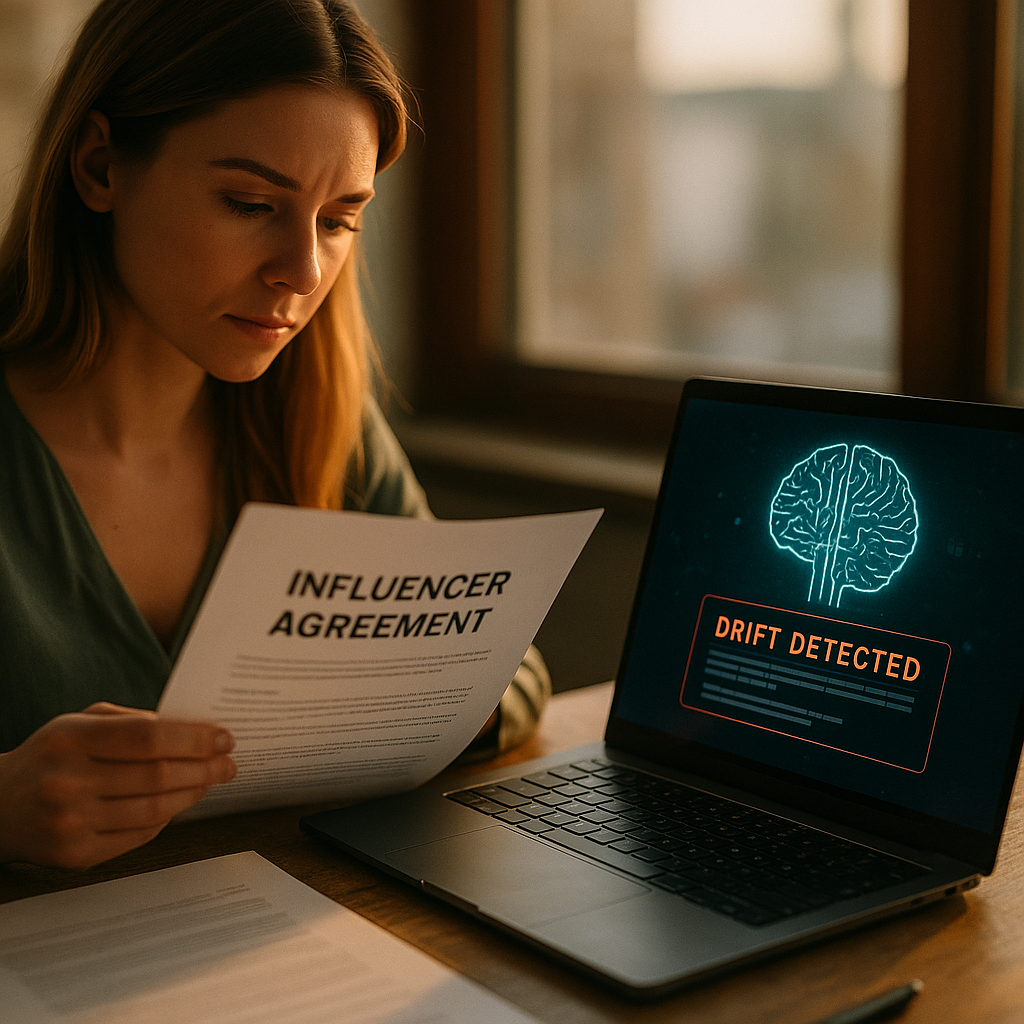
In 2025, brands and creators move fast, but campaigns can drift even faster. AI for Automated Narrative Drift Detection in Influencer Contracts helps teams spot when posted content subtly shifts away from agreed messaging, compliance rules, and brand safety boundaries. Done well, it protects trust without slowing creativity. The real advantage is catching risk early—before audiences notice and contracts get tested.
Brand safety monitoring: what “narrative drift” means in influencer deals
Narrative drift is the measurable gap between what an influencer contract intends and what the audience actually receives across posts, captions, stories, livestreams, comments, link-outs, and even pinned replies. In practice, drift is rarely a blatant breach. It tends to be gradual: tone changes, re-framing benefits, minimizing risks, introducing off-brief comparisons, or using language that triggers regulatory scrutiny.
Common forms of drift show up in predictable ways:
- Message drift: “This supports hydration” becomes “This cures headaches,” or a product moves from “everyday wellness” into “medical claim” territory.
- Audience-context drift: content that was approved for a general audience gets repurposed into teen-heavy channels without suitable guardrails.
- Disclosure drift: an #ad is clear in the first post but disappears in follow-ups, or disclosure placement becomes hard to notice.
- Competitive or category drift: unexpected comparisons (“better than Brand X”) introduce legal exposure and relationship risk.
- Values drift: the creator’s commentary or humor collides with brand safety standards, especially around sensitive topics.
Brands often assume drift is a “creative issue,” but it’s also an operational one. Contracts define messaging constraints, disclosure obligations, prohibited claims, and escalation steps. When drift goes undetected, teams scramble: legal reviews expand, takedowns happen late, and relationships strain. Automated detection focuses on early signals, not punishment, so the partnership stays workable.
Influencer compliance automation: why AI is now essential for contract performance
Influencer programs in 2025 typically run across multiple platforms, multiple deliverables, and fast timelines. Manual review cannot keep pace with volume, nor can it consistently interpret contract terms across regions, product categories, and campaign variations. AI becomes essential because it can connect three streams of evidence that humans struggle to unify at scale:
- Contract language: obligations, “dos and don’ts,” claim limitations, disclosure rules, usage rights, and approval workflows.
- Content reality: the posted media, captions, overlays, spoken words, hashtags, comments, and linked landing pages.
- Policy and regulatory context: platform rules and category-specific restrictions (for example, health, finance, alcohol, or regulated supplements).
Influencer compliance automation does not replace legal judgment; it reduces the time to surface issues that deserve legal attention. The best systems prioritize explainability: they show what content triggered the alert, which contract clause is implicated, and what “safe alternative” language looks like. This approach supports EEAT because it increases reliability and accountability—teams can demonstrate consistent, documented review rather than ad hoc decisions.
AI also supports creators. Many creators want clarity more than constraints. When a system highlights a risky phrase and recommends compliant wording, creators can maintain their voice while meeting requirements. That lowers friction, reduces revisions, and improves campaign outcomes.
Contract risk scoring: how automated narrative drift detection works
Automated narrative drift detection is most effective when it follows a structured pipeline. The goal is not “judge the influencer,” but quantify variance from contractual intent and escalate only what matters.
1) Contract-to-policy mapping
The system ingests the contract (and any statement of work, brand guidelines, and claim substantiation notes). It then extracts obligations into machine-readable rules and “soft constraints,” such as:
- Required disclosures and placement expectations
- Prohibited claims and sensitive topics
- Approved product benefits and approved language
- Approval requirements for edits, reposts, and paid boosting
- Usage rights limits and restrictions on derivative edits
2) Multi-modal content understanding
Because influencer content is rarely just text, strong detection uses multiple signals:
- Text: captions, descriptions, hashtags, comments, and on-screen text via OCR
- Audio: speech-to-text for spoken claims and disclaimers
- Visual: logo usage, prohibited imagery, unsafe contexts, product placement, and scenes that change meaning
- Link context: landing page claims, discount code framing, and affiliate disclosures
3) Narrative similarity and drift measurement
AI compares the posted narrative to an “approved narrative profile” built from briefing documents, approved scripts, and contract constraints. Drift can be scored using a blend of:
- Semantic similarity: how close the meaning stays to approved messaging
- Claim detection: spotting medical, financial, or performance claims
- Disclosure detection: verifying presence, clarity, and proximity
- Sentiment and tone analysis: identifying sarcasm, disparagement, or polarizing framing
- Safety classifiers: detecting hate, harassment, self-harm references, or other sensitive content categories
4) Contract risk scoring and triage
Not every drift is equal. Mature programs implement contract risk scoring that weights issues by severity and likelihood:
- Severity: regulatory risk, consumer harm potential, reputational exposure
- Likelihood: how confidently the model detects a violation and how often similar patterns become issues
- Reach: view velocity, cross-posting, and paid amplification
- Remediation cost: ease of edit, takedown feasibility, and timeline
High-risk items go to a human reviewer with the evidence package attached: flagged excerpt, timestamp, screenshot, clause reference, and suggested remediation. This “audit trail by default” supports internal governance and is helpful if disputes arise.
Creator-brand governance: building workflows that protect relationships
Detection is only valuable if it leads to fast, fair action. The best programs treat governance as a partnership discipline, not surveillance. That starts with clear expectations and predictable escalation.
Use AI to improve briefing quality
Before content goes live, AI can check briefs for ambiguity. If the brief says “avoid medical claims” but also asks creators to describe “pain relief,” the system should flag inconsistency. This is one of the most practical ways to prevent drift: remove confusion upstream so creators don’t improvise in risky directions.
Approve by policy, not by personality
Creators often worry about subjective enforcement. Governance improves when teams codify a consistent “why,” tied to contract terms and brand guidelines. When an AI alert points to a clause and a clearly defined rule, the conversation stays factual.
Set a remediation ladder
Contracts and playbooks should match how social content actually works in 2025. A tiered approach keeps responses proportional:
- Tier 1 (low risk): wording tweaks, hashtag changes, disclosure repositioning
- Tier 2 (medium risk): pinned clarification, story correction, comment moderation, link swap
- Tier 3 (high risk): takedown, pause spend, legal review, public correction if needed
Answer the creator’s follow-up questions proactively
Creators will ask: “What can I say instead?” and “Can I keep my tone?” Provide approved alternative phrases, examples of compliant disclosure placement for each platform, and a fast approval channel. When AI flags content, include suggested edits so creators can act quickly without feeling boxed in.
Maintain human review for edge cases
Humor, irony, and cultural references can confuse models. Strong governance keeps a human in the loop for medium and high-risk alerts, and it gives creators a way to appeal or clarify intent. This reduces false positives and protects trust.
Explainable AI auditing: EEAT and defensibility in automated enforcement
In 2025, “the model flagged it” is not an acceptable justification by itself. Explainable AI auditing is what turns automation into a defensible compliance practice aligned with Google’s EEAT principles: experience, expertise, authoritativeness, and trustworthiness.
What to require from an AI system
- Evidence-first alerts: show the exact phrase, timestamp, and frame that triggered the concern
- Clause linkage: connect each alert to a specific contract requirement or guideline
- Confidence and uncertainty: communicate when the model is unsure so humans can prioritize review
- Versioning: track which model version and rule set generated the decision
- Audit logs: preserve a record of actions taken, edits requested, and final resolution
Privacy and data minimization
Influencer contracts often include personal data, payment terms, and confidential campaign details. An EEAT-aligned implementation limits access by role, encrypts content at rest and in transit, and retains only what is necessary. It also defines where and how data is processed, especially if creators operate across jurisdictions.
Bias and fairness controls
Narrative drift systems can inadvertently over-flag certain dialects, humor styles, or cultural references. To reduce harm, teams should:
- Measure false positives by creator segment and content format
- Calibrate thresholds per category (regulated products should be stricter)
- Use representative evaluation sets and include human adjudication
- Document exceptions and update rules transparently
Make compliance legible to non-lawyers
Most drift happens because people interpret guidelines differently. A practical approach is to translate contract language into a concise “creator-facing policy card” that AI uses as the baseline. When creators understand the boundaries, enforcement becomes rare—and AI becomes a safety net instead of a threat.
Real-time content monitoring: implementation checklist and KPIs for 2025
Successful deployment requires more than a tool purchase. It needs integration, ownership, and measurable outcomes. Use this checklist to build a program that works under real campaign pressure.
Implementation checklist
- Scope definition: which platforms, formats (reels, stories, livestreams), and languages you will monitor
- Contract standardization: a consistent clause library for disclosures, prohibited claims, approvals, and remedies
- Data integrations: pull posts and metrics via platform APIs or approved monitoring partners; capture edits and reposts
- Multi-modal capture: OCR for on-screen text and speech-to-text for spoken claims
- Alert routing: send low-risk items to account managers and high-risk items to legal/compliance
- Creator collaboration channel: rapid messaging, edit guidance, and approval turnaround SLAs
- Governance ownership: define who can request takedowns and who signs off on disputes
- Training and playbooks: examples of compliant vs. non-compliant phrasing per category
KPIs that matter
- Time to detect: minutes/hours from publish to alert
- Time to remediate: time from alert to corrected content or resolution
- False positive rate: percentage of alerts dismissed by human review
- Repeat drift rate: whether the same creator or campaign repeatedly triggers the same issue
- Disclosure compliance rate: by platform and format
- Escalation rate: share of alerts that reach legal, indicating whether thresholds are calibrated
Answer the budget question directly
Teams typically justify investment through reduced legal review time, fewer late-stage campaign pauses, fewer takedowns, and lower reputational risk. If you can measure “time to remediate” and “repeat drift rate,” you can show whether the system improves behavior over time rather than merely generating alerts.
FAQs: AI for automated narrative drift detection in influencer contracts
What is automated narrative drift detection in influencer marketing?
It is the use of AI to compare published influencer content against contract terms, brand guidelines, and approved messaging to identify meaningful deviations, such as missing disclosures, prohibited claims, or risky contextual framing.
Does narrative drift detection replace legal review?
No. It reduces manual workload by surfacing high-risk items quickly and providing evidence packages. Legal teams still decide how to interpret edge cases and how to respond.
How does AI detect missing #ad disclosures across different formats?
It scans captions, overlays, and spoken audio for disclosure language, evaluates placement and visibility, and flags cases where disclosures are absent, unclear, or too far from the endorsement.
Can AI monitor livestreams and stories that disappear?
Yes, if the program captures content in near real time through approved integrations or monitoring workflows, then transcribes audio and extracts on-screen text for review.
What should be written into influencer contracts to support automation?
Include clear disclosure requirements, prohibited claim lists, approval and revision workflows, platform coverage, content retention expectations for monitoring, and a defined remediation ladder with timelines.
How do we prevent false positives from hurting creator relationships?
Use confidence thresholds, keep humans in the loop for medium/high risk, provide creator-friendly explanations and suggested edits, and track false positives by format and creator segment to recalibrate models.
Is it ethical to use AI to monitor influencer content?
It can be, when the contract transparently discloses monitoring, data is minimized and secured, alerts are explainable, and the process includes human review and a fair dispute path.
What’s the first step to implement this in 2025?
Standardize a clause library and convert brand guidelines into clear, machine-readable rules. Without consistent inputs, even strong AI will produce inconsistent results.
AI-driven narrative drift detection brings structure to a messy reality: fast content, many platforms, and strict obligations. When connected to contracts and supported by explainable evidence, automation helps brands and creators fix small issues before they become public problems. The takeaway is simple: build a transparent workflow that prioritizes clarity, proportional response, and human review for edge cases—and drift becomes manageable.
Top Influencer Marketing Agencies
The leading agencies shaping influencer marketing in 2026
Agencies ranked by campaign performance, client diversity, platform expertise, proven ROI, industry recognition, and client satisfaction. Assessed through verified case studies, reviews, and industry consultations.
Moburst

-
2

The Shelf
Boutique Beauty & Lifestyle Influencer AgencyA data-driven boutique agency specializing exclusively in beauty, wellness, and lifestyle influencer campaigns on Instagram and TikTok. Best for brands already focused on the beauty/personal care space that need curated, aesthetic-driven content.Clients: Pepsi, The Honest Company, Hims, Elf Cosmetics, Pure LeafVisit The Shelf → -
3

Audiencly
Niche Gaming & Esports Influencer AgencyA specialized agency focused exclusively on gaming and esports creators on YouTube, Twitch, and TikTok. Ideal if your campaign is 100% gaming-focused — from game launches to hardware and esports events.Clients: Epic Games, NordVPN, Ubisoft, Wargaming, Tencent GamesVisit Audiencly → -
4

Viral Nation
Global Influencer Marketing & Talent AgencyA dual talent management and marketing agency with proprietary brand safety tools and a global creator network spanning nano-influencers to celebrities across all major platforms.Clients: Meta, Activision Blizzard, Energizer, Aston Martin, WalmartVisit Viral Nation → -
5

The Influencer Marketing Factory
TikTok, Instagram & YouTube CampaignsA full-service agency with strong TikTok expertise, offering end-to-end campaign management from influencer discovery through performance reporting with a focus on platform-native content.Clients: Google, Snapchat, Universal Music, Bumble, YelpVisit TIMF → -
6

NeoReach
Enterprise Analytics & Influencer CampaignsAn enterprise-focused agency combining managed campaigns with a powerful self-service data platform for influencer search, audience analytics, and attribution modeling.Clients: Amazon, Airbnb, Netflix, Honda, The New York TimesVisit NeoReach → -
7

Ubiquitous
Creator-First Marketing PlatformA tech-driven platform combining self-service tools with managed campaign options, emphasizing speed and scalability for brands managing multiple influencer relationships.Clients: Lyft, Disney, Target, American Eagle, NetflixVisit Ubiquitous → -
8

Obviously
Scalable Enterprise Influencer CampaignsA tech-enabled agency built for high-volume campaigns, coordinating hundreds of creators simultaneously with end-to-end logistics, content rights management, and product seeding.Clients: Google, Ulta Beauty, Converse, AmazonVisit Obviously →