


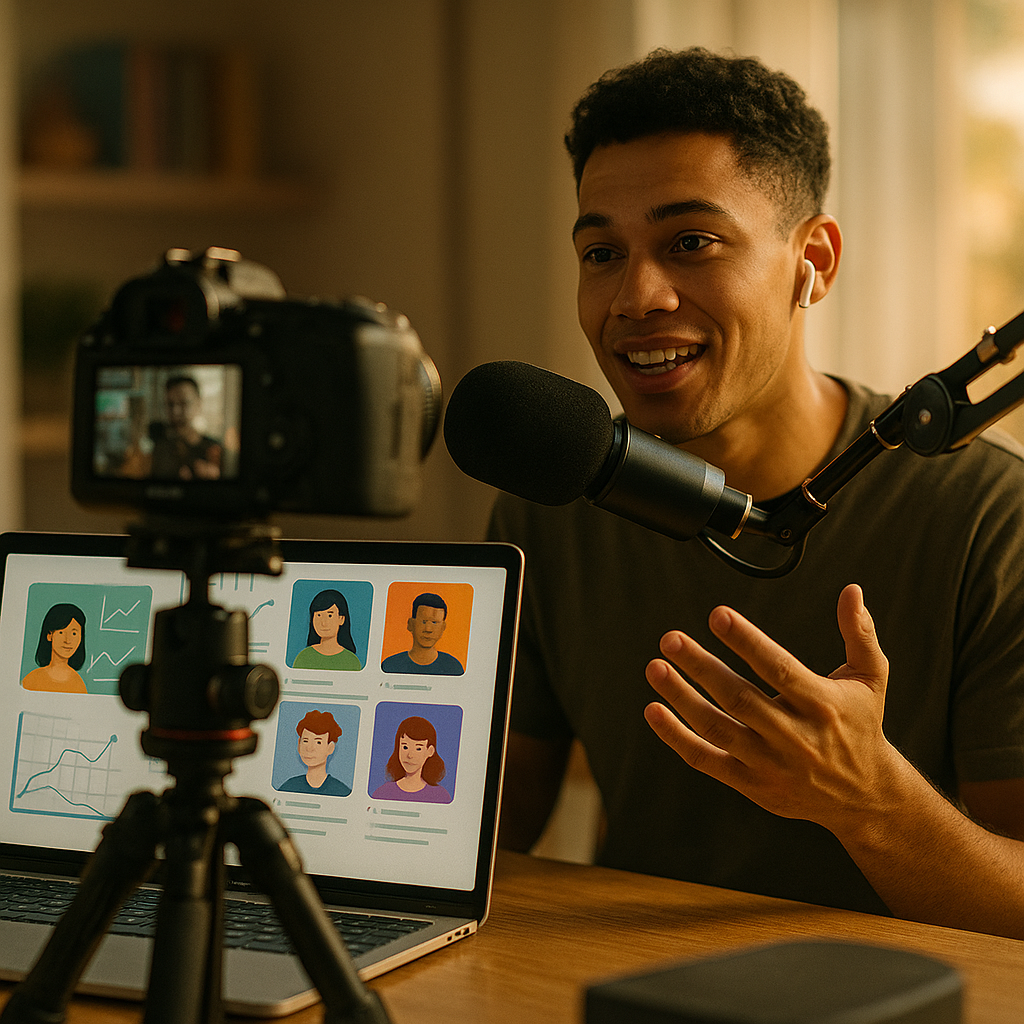
Generative search marketing platforms are quietly rewriting the rulebook on personalization, and the brands still running static A/B tests are already behind. By some counts, over 60% of consumer research now starts in an AI chat interface rather than a traditional search bar, according to eMarketer. The question isn’t whether your brand shows up in these answers. It’s whether the system behind your creator content can adapt fast enough to stay there.
What Generative Search Marketing Actually Means
Strip away the jargon and generative search marketing is the practice of optimizing brand and creator content so it gets surfaced, summarized, and recommended inside AI-generated answers, not just ranked on a results page. That’s a fundamentally different game than classic SEO. A search engine shows you ten blue links. A generative engine picks one answer and decides which brand gets name-checked inside it.
Platforms built for this moment don’t just track keywords anymore. They model intent, simulate how large language models interpret your content, and then adjust creator briefs, product feeds, and ad copy on the fly. That’s the “generative” part. The real innovation, though, is how these tools blend two very different flavors of AI to make it work in real time.
Predictive AI Sets the Stage, Agentic AI Closes the Loop
Predictive models have been in martech for years. They forecast churn, score lead quality, and estimate which creator content format will perform before a dollar gets spent. Think of tools like Salesforce Einstein or Persado’s language engine. They’re good at telling you what’s likely to happen.
Agentic AI is different. It doesn’t just predict, it acts. An agentic layer can take a prediction (“this creator’s audience responds better to UGC-style unboxing than polished studio content”) and automatically trigger a content swap, reroute ad spend, or flag a brief for revision, all without a human clicking approve on every single change.
The platforms winning right now aren’t choosing between predictive and agentic AI. They’re stacking them, using prediction to decide what should happen and agentic execution to make it happen before the moment passes.
This is a meaningful shift for anyone running influencer programs at scale. Historically, “personalization” meant swapping a first name in an email or serving a different thumbnail based on device type. Now it means a creator’s sponsored post can be dynamically resequenced, recaptioned, or re-targeted mid-campaign based on live engagement signals, without a strategist manually rebuilding the media plan. That’s the operational payoff brands actually care about: fewer wasted impressions, faster reallocation of budget, less lag between insight and action.
Real Time Personalization Isn’t Just a Buzzword Anymore
Real time, in this context, means something specific. It’s not “updated nightly.” It’s response times measured in seconds, sometimes milliseconds, as a creator’s content interacts with an AI search interface or a recommendation engine. A shopper asks a chatbot for skincare advice, the model pulls from indexed creator reviews, and the platform behind the scenes has already scored which claims in those reviews are citation-worthy.
This only works if the underlying data is clean. Garbage creator metadata, duplicate UTMs, and mismatched product SKUs will sink even the most sophisticated agentic layer. That’s why the brands seeing real lift are the ones who fixed their data pipeline first. If your creator attribution still runs on spreadsheets and manual exports, no amount of agentic AI is going to save the campaign. Teams tackling this have had success starting with the fundamentals covered in clean creator data work before layering on automation.
There’s also an identity problem hiding underneath all of this. Real time personalization requires knowing it’s the “same” user across a TikTok click, a retargeting ad, and a branded search query days later. Without solid identity resolution, the agentic layer is personalizing based on fragments, not a coherent picture of the customer. That’s how you end up serving the wrong creator’s content to someone who already converted.
Where the Agentic Layer Actually Touches Influencer Programs
Here’s where this gets practical for people running creator budgets. Agentic AI inside generative search platforms is showing up in a few concrete workflows:
- Dynamic brief adjustment: If early engagement data shows a creator’s audience skews toward a specific pain point, the system can rewrite talking points for the next deliverable before the campaign wraps, not after.
- Cross-channel rights activation: Agentic systems increasingly handle usage rights, whitelisting approvals, and paid amplification as a single automated chain rather than three separate manual steps. This mirrors what’s already happening with tools that merge rights and reporting into one pipeline.
- Audience sync without exports: Instead of pulling a creator audience into a spreadsheet and uploading it to an ad platform, newer systems activate directly from the data warehouse, cutting the lag to near zero, a pattern detailed in coverage of warehouse native activation.
- Citation monitoring and response: When an AI engine cites (or drops) a brand mention sourced from creator content, agentic layers can flag the gap and queue a content refresh automatically, tying directly into GEO share of voice tracking.
None of this replaces strategists. It removes the busywork between a good decision and an executed one. That’s the ROI story brands should be telling their CFOs, not “AI is cool,” but “we cut the time between insight and activation from weeks to hours.”
Where This Breaks: Governance Still Lags the Tech
Here’s the uncomfortable part. Agentic systems that act without human review are a compliance risk waiting to happen. An agent that automatically swaps creator messaging mid-flight can just as easily swap it into something off-brand, non-compliant with FTC disclosure rules, or flatly wrong about a product claim.
The FTC’s endorsement guidance doesn’t pause for your automation pipeline. If an agent rewrites a sponsored caption and strips the disclosure language, that’s still a brand liability, regardless of how the copy got generated. Brands adopting these platforms need review gates baked into the agentic workflow, not bolted on afterward. Coverage of review gates for AI-generated copy is worth reading before you let any system touch live creator content unsupervised.
Brand voice drift is the other quiet risk. Predictive models optimize for engagement. Left unchecked, that optimization will happily push creator content toward whatever performs, even if it contradicts brand guidelines. Pairing agentic execution with a defined brand DNA framework keeps the system optimizing within guardrails instead of around them.
Choosing a Platform: What Actually Matters
Vendors will pitch “AI-powered personalization” regardless of whether there’s any real predictive or agentic architecture underneath. Here’s what to actually interrogate during a vendor evaluation:
- Does the predictive layer explain its reasoning? If a platform can’t show why it predicted a specific creator or content variant would perform, you can’t audit it later when something underperforms.
- What’s the human-in-the-loop setting? Can you require approval on high-stakes actions (budget reallocation, messaging changes) while letting low-stakes actions (bid adjustments, scheduling) run autonomously?
- How does it handle attribution across the full funnel? Real time personalization is worthless if you can’t trace it back to revenue. This is the exact gap covered in creator ROI tracing from click to CRM.
- Does it integrate with your existing MarTech stack, or does it require a rip-and-replace? Most mid-market brands don’t have budget for the latter.
- What’s the latency, really? “Real time” claims vary wildly. Ask for actual response benchmarks, not marketing copy.
Platforms like Adobe’s generative suite and emerging GEO-specific tools such as Profound and Scrunch AI are moving fast here, and HubSpot’s research on AI-assisted marketing workflows is a reasonable benchmark for evaluating maturity claims against what’s actually shipping.
The Skills Gap Nobody’s Budgeting For
None of this technology matters if the team running it doesn’t understand what it’s actually doing. Agentic systems that act autonomously require strategists who can read the logic, not just the dashboard. That’s a staffing and training problem as much as a tooling one, and it’s the reason AI literacy is becoming the bottleneck, not the software itself. Brands buying these platforms without investing in that literacy are going to end up with expensive automation nobody trusts enough to actually use.
FAQs
Frequently Asked Questions
What is the difference between predictive and agentic AI in marketing platforms?
Predictive AI forecasts outcomes, such as which creator content will perform best with a given audience segment. Agentic AI takes that forecast and acts on it autonomously, adjusting briefs, budgets, or targeting without requiring a human to execute each step manually.
How does generative search marketing differ from traditional SEO?
Traditional SEO optimizes for ranking position on a results page. Generative search marketing optimizes for being cited or summarized inside an AI-generated answer, which depends more on content specificity and structured data than keyword density.
Is real time personalization actually real time, or just faster batch processing?
It depends on the vendor. True real time personalization responds within seconds based on live signals. Many platforms marketed as “real time” still run on hourly or daily batch updates, so brands should request actual latency benchmarks before buying.
What compliance risks come with agentic AI in influencer marketing?
The biggest risks are stripped FTC disclosure language, off-brand messaging generated without review, and inaccurate product claims pushed live without human sign-off. Review gates and audit trails are essential safeguards.
Do brands need to replace their existing martech stack to adopt these platforms?
Not usually. Most mature generative search marketing platforms are built to integrate with existing CRM, CDP, and ad tech systems rather than requiring a full replacement, though data cleanliness matters more than the integration itself.
The brands that win with generative search marketing won’t be the ones with the biggest AI budget, they’ll be the ones who fixed their data pipeline and built compliance review gates before letting an agent touch a live campaign. Start there, then scale the automation.
Top Influencer Marketing Agencies
The leading agencies shaping influencer marketing in 2026
Agencies ranked by campaign performance, client diversity, platform expertise, proven ROI, industry recognition, and client satisfaction. Assessed through verified case studies, reviews, and industry consultations.
Moburst

-
2

The Shelf
Boutique Beauty & Lifestyle Influencer AgencyA data-driven boutique agency specializing exclusively in beauty, wellness, and lifestyle influencer campaigns on Instagram and TikTok. Best for brands already focused on the beauty/personal care space that need curated, aesthetic-driven content.Clients: Pepsi, The Honest Company, Hims, Elf Cosmetics, Pure LeafVisit The Shelf → -
3

Audiencly
Niche Gaming & Esports Influencer AgencyA specialized agency focused exclusively on gaming and esports creators on YouTube, Twitch, and TikTok. Ideal if your campaign is 100% gaming-focused — from game launches to hardware and esports events.Clients: Epic Games, NordVPN, Ubisoft, Wargaming, Tencent GamesVisit Audiencly → -
4

Viral Nation
Global Influencer Marketing & Talent AgencyA dual talent management and marketing agency with proprietary brand safety tools and a global creator network spanning nano-influencers to celebrities across all major platforms.Clients: Meta, Activision Blizzard, Energizer, Aston Martin, WalmartVisit Viral Nation → -
5

The Influencer Marketing Factory
TikTok, Instagram & YouTube CampaignsA full-service agency with strong TikTok expertise, offering end-to-end campaign management from influencer discovery through performance reporting with a focus on platform-native content.Clients: Google, Snapchat, Universal Music, Bumble, YelpVisit TIMF → -
6

NeoReach
Enterprise Analytics & Influencer CampaignsAn enterprise-focused agency combining managed campaigns with a powerful self-service data platform for influencer search, audience analytics, and attribution modeling.Clients: Amazon, Airbnb, Netflix, Honda, The New York TimesVisit NeoReach → -
7

Ubiquitous
Creator-First Marketing PlatformA tech-driven platform combining self-service tools with managed campaign options, emphasizing speed and scalability for brands managing multiple influencer relationships.Clients: Lyft, Disney, Target, American Eagle, NetflixVisit Ubiquitous → -
8

Obviously
Scalable Enterprise Influencer CampaignsA tech-enabled agency built for high-volume campaigns, coordinating hundreds of creators simultaneously with end-to-end logistics, content rights management, and product seeding.Clients: Google, Ulta Beauty, Converse, AmazonVisit Obviously →