


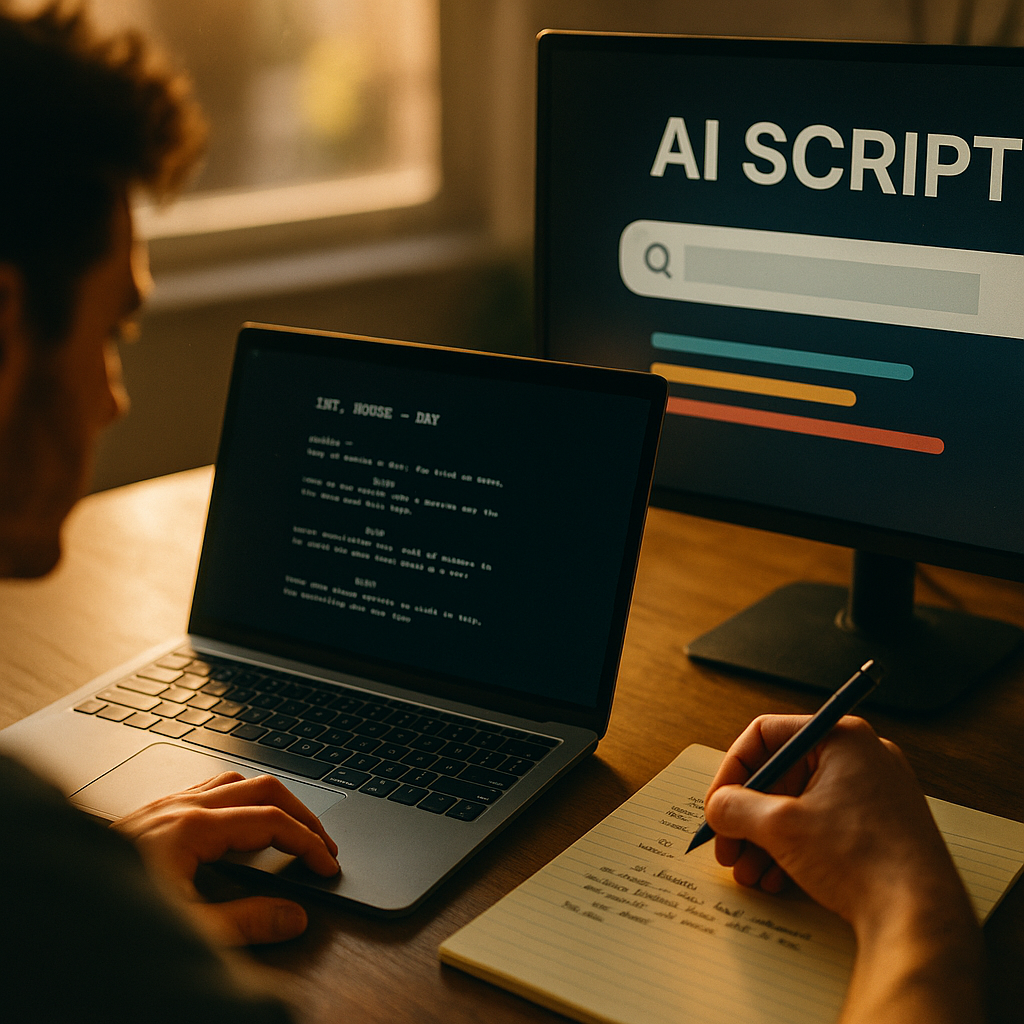
AI powered scriptwriting is changing how brands earn visibility in conversational and generative search. In 2025, people ask complete questions, expect direct answers, and trust assistants that sound confident and clear. To compete, your scripts must guide intent, cite reliable sources, and stay useful even when results are summarized. Want to write for humans and machines at once?
Conversational search optimization: how users ask, and how answers get chosen
Conversational search is driven by natural language: full questions, follow-ups, and implied context. Generative search adds another layer: the system composes answers by selecting, compressing, and synthesizing information from multiple sources. That means your content is less likely to be copied verbatim and more likely to be interpreted. Your script has to make interpretation easy and accurate.
Modern query patterns cluster into three high-intent shapes:
- Task intent: “Write a customer support reply that de-escalates…”
- Decision intent: “Which option is better for X, and why?”
- Exploration intent: “Explain how this works, then give examples.”
Scriptwriting for these patterns requires a shift from keyword stuffing to “answer packaging.” You want to supply:
- Direct answers early (so the model can quote or summarize accurately).
- Clear definitions (so the model doesn’t guess your meaning).
- Boundaries and caveats (so the answer stays safe and credible).
- Action steps (so readers can complete the task without extra searching).
A practical way to structure any script is: Question → Short answer → Context → Steps → Options → Proof. This mirrors how assistants respond and how users evaluate usefulness. If a reader’s follow-up is predictable (pricing, timeline, limitations, examples), include it in the same section rather than forcing another page view.
Generative search content strategy: designing scripts for synthesis, not just ranking
Generative systems don’t just retrieve; they compose. Your script should therefore be “synthesis-ready.” In practice, that means writing in modular blocks that can survive excerpting while retaining meaning.
Use these building blocks throughout your scripts:
- Atomic claims: One idea per sentence when stating facts or recommendations.
- Qualified guidance: “If X, do Y; if not, do Z” to prevent overgeneralization.
- Concrete examples: Short sample lines, not long dialogues that dilute scannability.
- Comparison frames: Pros/cons and “best for” statements to match decision intent.
Also, make your “why” explicit. Generative answers often compress reasoning; when your script includes a transparent rationale, the system can retain it, and users trust it. A simple pattern is recommendation + reason + trade-off.
To reduce the risk of misinterpretation, write with clear referents. Instead of “this improves performance,” specify “this shortens response time” or “this reduces hallucination risk.” When you quote numbers, name the source directly in-text (publisher, study name, and date) so readers can verify it. In 2025, verification is part of the user experience.
EEAT for AI content: building credibility assistants can summarize with confidence
Google’s helpful content systems reward content that demonstrates Experience, Expertise, Authoritativeness, and Trust. For AI-assisted scriptwriting, EEAT is not a “bio box”; it’s visible in the decisions your script makes.
Here’s how to bake EEAT into scripts intended for conversational and generative search:
- Experience: Add operational details that only practitioners include, such as edge cases, realistic timelines, or common failure points. Example: “If the customer repeats the same complaint twice, restate it in your own words before offering options.”
- Expertise: Use correct terminology, define it in plain language, and avoid overstated certainty. If guidance depends on industry constraints (legal, medical, finance), say so and recommend professional review.
- Authoritativeness: Reference recognized standards, frameworks, or primary sources. Name the institution and document, not vague “studies show.”
- Trust: Disclose assumptions, note limitations, and keep claims measurable. Avoid sensational promises like “guaranteed rankings.”
Readers often ask: “Will AI-written scripts be penalized?” In 2025, the practical answer is: quality is evaluated, not the tool. If AI accelerates drafting but the final output shows expertise, transparency, and usefulness, it aligns with EEAT. Treat AI as a collaborator and keep a human accountable for accuracy, voice, and compliance.
Another follow-up: “How do I prove experience?” Include mini-case cues: what you would do differently for small teams versus enterprise, how you’d respond to policy changes, and what metrics you would monitor. These details signal real-world familiarity and improve user outcomes.
Prompt engineering for scriptwriting: workflows that produce consistent, on-brand answers
Effective AI powered scriptwriting depends on a repeatable workflow. Random prompting produces random quality. In 2025, teams that win use templates that lock in intent, voice, constraints, and verification steps.
Use a three-pass process:
- Pass 1: Outline for intent (what question is being answered, who it’s for, and what “done” looks like).
- Pass 2: Draft for clarity (short answer first, then steps, examples, and alternatives).
- Pass 3: Validate (fact-check, remove ambiguity, align with brand voice, add disclaimers where needed).
Below is a prompt pattern you can reuse across channels:
- Role: “You are a senior scriptwriter for [industry] focused on conversational search.”
- Audience + context: “The user is [persona] asking [question] after [trigger].”
- Goal: “Deliver a helpful answer the assistant can summarize without losing accuracy.”
- Constraints: “No exaggerations, include caveats, define terms, keep to 120–180 words for the main answer.”
- Format: “Start with a 1–2 sentence direct answer, then 3 steps, then a short example response.”
- Verification: “Flag any claim that needs a citation; do not invent numbers.”
To keep scripts on-brand, provide the model with a voice sheet: preferred phrases, taboo phrases, reading level, and stance (formal vs. conversational). Then ask it to produce two variants: one optimized for assistants (tight, structured) and one optimized for humans (slightly more nuance). This anticipates how answers are used across devices and interfaces.
When readers ask, “Do I need different scripts for chatbots and generative search?” Often, you need different wrappers around the same core. Keep a single source of truth (a verified knowledge base), then generate channel-specific versions with consistent facts and tone.
Structured content and schema alternatives: making scripts easy to extract and cite
Even without discussing technical markup in detail, you can structure your writing so both crawlers and language models extract it correctly. Think of your scripts like a well-labeled toolkit: each component has a clear purpose.
Use these formatting rules in your content:
- Front-load definitions: Define the key term before expanding into variations.
- Use stepwise lists for processes: Lists reduce ambiguity and improve extraction.
- Separate policies from advice: “Policy” blocks should be explicit to avoid unsafe summarization.
- Include “best for” statements: Helps generative answers map user constraints to options.
For example, when writing a customer support script, separate:
- Goal: what the agent must achieve
- Allowed: what they can offer
- Not allowed: what they must not promise
- Escalation triggers: conditions that require a handoff
For marketing scripts, separate claims into:
- Feature: what it does
- Benefit: why it matters
- Proof: what supports the claim (case study, benchmark, certification)
- Boundary: when it might not apply
This modularity improves extractability and reduces the chance an assistant merges ideas incorrectly. It also supports internal governance: editors can verify “proof” blocks without rewriting the whole script.
Measurement and iteration: KPIs for conversational visibility and generative performance
If you can’t measure performance, you can’t improve it. Conversational and generative search introduce new success signals beyond traditional clicks. In 2025, you should track both visibility and outcome quality.
Useful KPIs include:
- Answer inclusion rate: How often your brand/content is cited, linked, or paraphrased in assistant answers (from available platform reports and brand monitoring).
- Qualified traffic: Sessions that arrive and complete meaningful actions (sign-ups, demo requests, purchases), not just page views.
- On-page task completion: Scroll depth and interaction with step lists, tools, and FAQs.
- Support deflection quality: For service scripts, measure reduction in repeat contacts and escalation rate, not only deflection volume.
- Content accuracy incidents: Track corrections needed after publication to quantify trust risk.
Build an iteration loop that mirrors how assistants learn from feedback:
- Collect: capture real user questions from chat logs, site search, and support tickets.
- Cluster: group them by intent and stage (learn, compare, decide, troubleshoot).
- Rewrite: update scripts with clearer direct answers, stronger boundaries, and better examples.
- Verify: re-check claims, links, and policy alignment.
- Retest: monitor inclusion rate and conversion outcomes after updates.
A common follow-up is: “How often should we refresh?” Refresh when your product, policies, or competitive landscape changes, and set a routine review cadence for high-traffic scripts. The goal is stable accuracy, not constant churn.
FAQs: AI powered scriptwriting for conversational and generative search
-
What is AI powered scriptwriting in the context of generative search?
It is the use of AI to draft and refine scripts (answers, dialogues, explanations, and step-by-step guidance) that are easy for assistants to summarize accurately and useful for people to act on, with human review for accuracy, brand voice, and compliance.
-
How do I write content that generative search can quote without distorting meaning?
Lead with a direct answer, keep claims atomic, define terms, add “if/then” conditions, and include clear boundaries. Structure processes as lists and separate facts from recommendations so summarization doesn’t merge them incorrectly.
-
Do I need citations inside scripts?
If you make factual or statistical claims, yes. Name the source clearly in-text and link to primary or authoritative references where possible. If a claim can’t be verified, rewrite it as an opinion, a hypothesis, or remove it.
-
How do I prevent hallucinations when using AI to draft scripts?
Use a constrained prompt with a verification step, provide a trusted knowledge base, and require the model to flag uncertain claims instead of inventing details. Then have a human editor validate facts, pricing, policies, and legal-sensitive statements before publishing.
-
What types of scripts benefit most from conversational search optimization?
Customer support replies, troubleshooting guides, product comparisons, onboarding instructions, and “how to” explainers. These match how users ask questions and how assistants assemble step-based answers.
-
How can small teams implement this without a large SEO budget?
Start with your top 20 high-intent questions, create a single verified source of truth, generate two versions per script (assistant-ready and human-ready), and track outcomes like conversions, repeat contacts, and inclusion in assistant answers. Scale only after the workflow is reliable.
In 2025, winning visibility in conversational and generative search depends on scripts that are accurate, modular, and built for summarization. Use AI to accelerate outlining and drafting, but rely on human expertise for verification, boundaries, and brand voice. When you package direct answers, clear steps, and credible proof, assistants can cite you with confidence and users can act fast.
Top Influencer Marketing Agencies
The leading agencies shaping influencer marketing in 2026
Agencies ranked by campaign performance, client diversity, platform expertise, proven ROI, industry recognition, and client satisfaction. Assessed through verified case studies, reviews, and industry consultations.
Moburst

-
2

The Shelf
Boutique Beauty & Lifestyle Influencer AgencyA data-driven boutique agency specializing exclusively in beauty, wellness, and lifestyle influencer campaigns on Instagram and TikTok. Best for brands already focused on the beauty/personal care space that need curated, aesthetic-driven content.Clients: Pepsi, The Honest Company, Hims, Elf Cosmetics, Pure LeafVisit The Shelf → -
3

Audiencly
Niche Gaming & Esports Influencer AgencyA specialized agency focused exclusively on gaming and esports creators on YouTube, Twitch, and TikTok. Ideal if your campaign is 100% gaming-focused — from game launches to hardware and esports events.Clients: Epic Games, NordVPN, Ubisoft, Wargaming, Tencent GamesVisit Audiencly → -
4

Viral Nation
Global Influencer Marketing & Talent AgencyA dual talent management and marketing agency with proprietary brand safety tools and a global creator network spanning nano-influencers to celebrities across all major platforms.Clients: Meta, Activision Blizzard, Energizer, Aston Martin, WalmartVisit Viral Nation → -
5

The Influencer Marketing Factory
TikTok, Instagram & YouTube CampaignsA full-service agency with strong TikTok expertise, offering end-to-end campaign management from influencer discovery through performance reporting with a focus on platform-native content.Clients: Google, Snapchat, Universal Music, Bumble, YelpVisit TIMF → -
6

NeoReach
Enterprise Analytics & Influencer CampaignsAn enterprise-focused agency combining managed campaigns with a powerful self-service data platform for influencer search, audience analytics, and attribution modeling.Clients: Amazon, Airbnb, Netflix, Honda, The New York TimesVisit NeoReach → -
7

Ubiquitous
Creator-First Marketing PlatformA tech-driven platform combining self-service tools with managed campaign options, emphasizing speed and scalability for brands managing multiple influencer relationships.Clients: Lyft, Disney, Target, American Eagle, NetflixVisit Ubiquitous → -
8

Obviously
Scalable Enterprise Influencer CampaignsA tech-enabled agency built for high-volume campaigns, coordinating hundreds of creators simultaneously with end-to-end logistics, content rights management, and product seeding.Clients: Google, Ulta Beauty, Converse, AmazonVisit Obviously →