


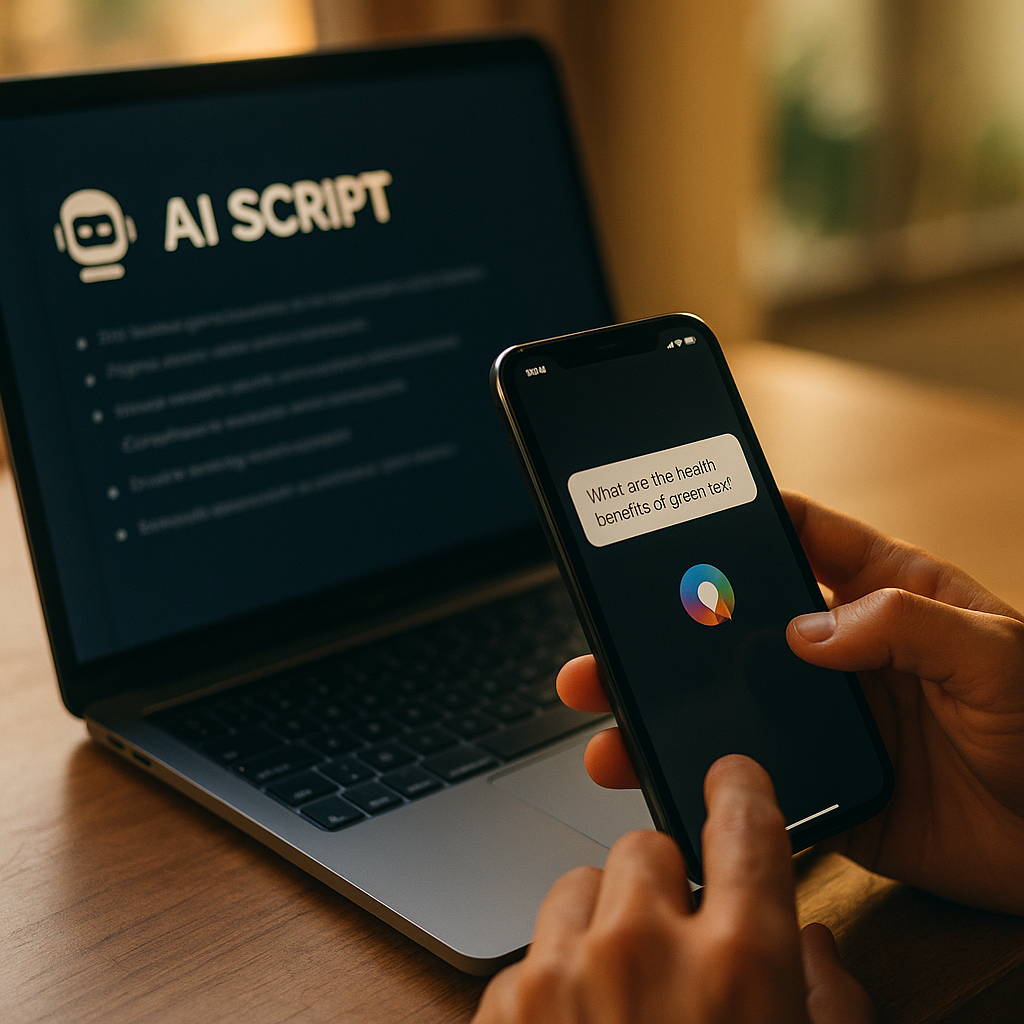
AI Powered Scriptwriting for Conversational and Generative Search is changing how brands plan, write, and optimize content for users who ask full questions and expect direct, trustworthy answers. In 2025, visibility depends on clarity, structure, and intent coverage more than keyword stuffing. This article shows how to build scripts that perform in chat, voice, and AI summaries—while staying accurate, on-brand, and measurable. Ready to write for answers, not clicks?
Conversational search optimization: how intent and dialogue reshape scripts
Conversational search behaves like a dialogue, not a query list. Users ask multi-part questions, refine requests, and expect responses that reflect context. That shifts scriptwriting from “page-first” thinking to “turn-by-turn” thinking: each segment should answer a specific intent, anticipate the next question, and make the path forward obvious.
Start by mapping intent as a sequence. A typical journey includes: discovery (“What is this?”), fit (“Is it right for me?”), proof (“Can I trust it?”), action (“How do I do it?”), and troubleshooting (“What if something goes wrong?”). Your script should mirror that order and remove gaps that cause users to bounce back to search.
Use plain-language questions as headings inside your outline, even if they won’t appear verbatim on the final page. This improves coverage and helps your content align with how users speak to assistants. Then convert those questions into crisp answers with a clear first sentence, followed by supporting detail. When a generative system extracts a passage, the first sentence often becomes the “answer.” Make it accurate and complete.
To strengthen conversational flow, write explicit transitions. Instead of stacking paragraphs, guide the reader: “Next, choose a format,” “If you need a quick summary,” or “For compliance teams.” These cues also help AI systems identify logical sections and retrieve the right chunk for the right prompt.
Follow-up questions to address inside the main script include: “Who is this for?”, “What does it replace?”, “How long does it take?”, “What does it cost?”, “What are the risks?”, and “How do I validate the output?” Answer them proactively to reduce friction.
Generative search visibility: structuring content for AI summaries and snippets
Generative search surfaces synthesized answers. That means your content must be easy to interpret, quote, and verify. Structure is no longer cosmetic; it is retrieval infrastructure. The goal is to make your expertise extractable without losing meaning or introducing ambiguity.
Use a layered answer pattern:
- Direct answer first: one to two sentences that resolve the question.
- Criteria and steps: what to consider, then what to do.
- Edge cases: exceptions and constraints.
- Verification: how to check accuracy and sources.
Write with entity clarity. Name the product, method, audience, and constraints explicitly. Avoid pronouns that require prior context (“it,” “this,” “they”) when starting a new section; generative systems may lift the passage out of context.
Also, reduce “fluff” sentences that sound persuasive but add no information. Helpful content earns trust when it provides definitions, comparisons, decision rules, and realistic limitations. Include measurable specifics where appropriate: turnaround time ranges, what inputs are required, and what “good” looks like.
Support scannability using short paragraphs and tight topic focus. Each paragraph should do one job. If you must include a nuanced explanation, anchor it with a clear claim, then explain. This approach improves both human comprehension and machine extraction.
Make your script quote-ready by ensuring any claim can be defended. When you reference statistics, cite the original publisher and link in your publishing workflow (even if your script is platform-agnostic). Avoid invented numbers, and do not present estimates as facts.
EEAT content strategy: building trust, accuracy, and brand voice with AI
Google’s helpful content expectations reward pages that demonstrate experience, expertise, authoritativeness, and trustworthiness. AI can accelerate drafting, but EEAT depends on your process: who reviews, what evidence you use, and how you handle uncertainty.
Build EEAT into the script itself:
- Experience: include real operational details: common pitfalls, practical checklists, and decision trade-offs. If you have first-hand workflows (e.g., editorial review steps), state them.
- Expertise: use correct terminology, define it briefly, and apply it consistently. Explain “why” alongside “what.”
- Authoritativeness: reference recognized standards, regulations, or widely accepted frameworks relevant to your niche. Keep citations current and specific.
- Trustworthiness: disclose limitations, note when outputs require verification, and avoid absolute claims when context matters.
Maintain brand voice through an explicit style layer. Provide the model with a compact voice guide: reading level, tone, preferred sentence length, banned phrases, and formatting rules. Then require a final “voice pass” by a human editor. AI can mimic tone; only your team can ensure it aligns with legal, compliance, and reputation standards.
Accuracy improves when you constrain the model. Use retrieval-assisted workflows: supply approved sources, product documentation, and up-to-date policy notes. In the script, include a section that explains how claims were validated. Readers may not see your internal process, but your writing will reflect it through precision and restraint.
Answer the implicit reader question: “Can I trust this?” Do it by giving clear boundaries: what your method covers, what it does not, and what readers should double-check before acting.
Prompt engineering for scriptwriting: workflows, templates, and guardrails
Prompting is not a single instruction; it is a workflow that moves from discovery to draft to verification. In 2025, the most reliable approach uses modular prompts and quality gates rather than one large “write me an article” request.
Step 1: Define the output contract. Specify audience, goal, format, length constraints, and required sections. Include the primary query themes and the follow-up questions you want answered. Clarify what the model must not do (e.g., no medical advice, no legal guarantees, no unsupported statistics).
Step 2: Build an intent outline. Ask the model to produce a hierarchical outline that maps to a user journey. Then review it and add missing intents. This step prevents the most common failure: a fluent draft that skips important decision points.
Step 3: Draft in chunks. Generate one section at a time and require: a direct answer lead, a short list of steps or criteria, and a “verification note” that flags where citations are needed. Chunking reduces contradictions and makes editing faster.
Step 4: Apply guardrails. Use constraints such as:
- Source-bound mode: “Use only the provided references; if missing, say ‘needs source.’”
- Risk tagging: require the model to label claims as low/medium/high risk for compliance.
- Terminology lock: provide an approved glossary and enforce it.
Step 5: Run a critical review prompt. Ask the model to critique the draft for ambiguity, missing intents, unsupported claims, and brand voice drift. Then have a human finalize. This pairing produces speed without sacrificing trust.
To keep scripts consistent across channels, create templates for common assets: explainer pages, product comparisons, onboarding scripts, support articles, and voice assistant responses. Each template should define: opening answer, context, steps, examples, and next action.
Multichannel conversational content: voice, chat, video, and on-site assistants
Conversational and generative search do not live in one place. The same user may discover you in an AI summary, then ask follow-up questions in a chatbot, then watch a short product video, then read support documentation. AI-powered scriptwriting works best when you design a “content spine” that can be repurposed without losing accuracy.
Start with a canonical script: the most complete, verified version of the answer. From there, generate channel-specific variants:
- Voice: shorter sentences, fewer clauses, explicit steps (“First… Next… Finally…”). Include confirmation cues (“If that sounds right, here’s the next step”).
- Chat: modular responses with clarifying questions (“Which platform are you using?”). Provide quick options users can choose from.
- Video: a strong opening promise, visual cues, and time-stamped segments that match common questions.
- On-site assistant: safe, policy-aware answers, with links to authoritative pages for details and updates.
Consistency matters. If your chatbot says one thing and your help center says another, users lose trust and generative systems may synthesize conflicting guidance. Maintain a single source of truth and publish updates through it.
Also, design for “answer completion.” If a user only reads the AI summary, they should still get the correct minimum viable answer. If they click through, your page should expand the answer with examples, constraints, and next actions. This layered approach serves both skimmers and deep researchers.
Common follow-up questions to handle across channels include: “Can you show an example?”, “What’s the fastest way?”, “What are alternatives?”, “How do I troubleshoot?”, and “Where can I verify this?” Build those responses once, then adapt them.
Measurement and iteration: KPIs for AI search performance and script quality
You cannot optimize what you do not measure. Traditional SEO metrics still matter, but conversational and generative search add new signals: whether users get satisfied quickly, whether your content is cited or paraphrased accurately, and whether follow-up actions happen.
Track performance using a combined set of KPIs:
- Search visibility: impressions and clicks for long-tail questions, plus coverage across intent clusters.
- Engagement quality: time on page, scroll depth, return-to-SERP behavior, and assisted conversions.
- On-site conversations: chat resolution rate, escalation rate, and top unanswered questions.
- Content integrity: number of corrections, support tickets linked to misunderstanding, and compliance review findings.
Use conversation logs as an editorial goldmine. The questions users ask after reading your content reveal missing sections, unclear phrasing, or mismatched assumptions. Update your canonical script, then regenerate downstream assets.
Establish an update cadence based on risk. High-stakes topics (finance, health, security) require more frequent reviews and tighter evidence standards. Lower-risk topics can iterate faster, but still need a process for corrections and version control.
Finally, test for “extractability.” Review your pages and scripts to ensure each section can stand alone as a correct answer. If a paragraph is quoted in isolation, it should still be accurate. This single habit improves performance in generative environments and reduces brand risk.
FAQs: AI powered scriptwriting for conversational and generative search
What is AI-powered scriptwriting in the context of search?
It is the use of AI tools to plan, draft, and refine content scripts that answer real user questions across conversational interfaces (chat and voice) and generative search results, with human review to ensure accuracy, brand fit, and compliance.
How is writing for generative search different from traditional SEO?
Traditional SEO often optimizes for rankings and clicks. Generative search requires answer-first structure, clear entity context, and passages that can be accurately extracted and summarized. You still optimize for discoverability, but you also optimize for being quoted correctly.
Will AI-generated content hurt EEAT?
Not by itself. EEAT depends on whether your content demonstrates real expertise, includes verifiable claims, reflects hands-on experience, and is reviewed responsibly. AI can speed drafting, but humans must validate facts, add real-world nuance, and maintain accountability.
What are the biggest risks of using AI for scriptwriting?
The main risks are unsupported claims, outdated information, inconsistent guidance across channels, and brand voice drift. Reduce risk with source-bound drafting, claim verification, compliance checks, and a single canonical script as your source of truth.
How do I make my scripts more “quoteable” for AI summaries?
Lead with a direct answer, keep paragraphs focused, define terms, avoid ambiguous pronouns at the start of sections, and include constraints and verification cues. Write so each section can stand alone without losing context.
What should I prioritize first: prompts, tools, or content strategy?
Start with strategy: audience, intents, and trust requirements. Then build templates and guardrails. Choose tools last. Strong process beats any single model, and it makes results consistent even when tooling changes.
In 2025, winning visibility means writing content that answers questions clearly, holds up to verification, and adapts across chat, voice, and AI summaries. AI can accelerate research, outlining, and drafting, but your advantage comes from structure, evidence, and editorial discipline. Build a canonical, intent-complete script, enforce guardrails, and iterate from real conversations. Do that, and generative search becomes a distribution channel you can trust.
Top Influencer Marketing Agencies
The leading agencies shaping influencer marketing in 2026
Agencies ranked by campaign performance, client diversity, platform expertise, proven ROI, industry recognition, and client satisfaction. Assessed through verified case studies, reviews, and industry consultations.
Moburst

-
2

The Shelf
Boutique Beauty & Lifestyle Influencer AgencyA data-driven boutique agency specializing exclusively in beauty, wellness, and lifestyle influencer campaigns on Instagram and TikTok. Best for brands already focused on the beauty/personal care space that need curated, aesthetic-driven content.Clients: Pepsi, The Honest Company, Hims, Elf Cosmetics, Pure LeafVisit The Shelf → -
3

Audiencly
Niche Gaming & Esports Influencer AgencyA specialized agency focused exclusively on gaming and esports creators on YouTube, Twitch, and TikTok. Ideal if your campaign is 100% gaming-focused — from game launches to hardware and esports events.Clients: Epic Games, NordVPN, Ubisoft, Wargaming, Tencent GamesVisit Audiencly → -
4

Viral Nation
Global Influencer Marketing & Talent AgencyA dual talent management and marketing agency with proprietary brand safety tools and a global creator network spanning nano-influencers to celebrities across all major platforms.Clients: Meta, Activision Blizzard, Energizer, Aston Martin, WalmartVisit Viral Nation → -
5

The Influencer Marketing Factory
TikTok, Instagram & YouTube CampaignsA full-service agency with strong TikTok expertise, offering end-to-end campaign management from influencer discovery through performance reporting with a focus on platform-native content.Clients: Google, Snapchat, Universal Music, Bumble, YelpVisit TIMF → -
6

NeoReach
Enterprise Analytics & Influencer CampaignsAn enterprise-focused agency combining managed campaigns with a powerful self-service data platform for influencer search, audience analytics, and attribution modeling.Clients: Amazon, Airbnb, Netflix, Honda, The New York TimesVisit NeoReach → -
7

Ubiquitous
Creator-First Marketing PlatformA tech-driven platform combining self-service tools with managed campaign options, emphasizing speed and scalability for brands managing multiple influencer relationships.Clients: Lyft, Disney, Target, American Eagle, NetflixVisit Ubiquitous → -
8

Obviously
Scalable Enterprise Influencer CampaignsA tech-enabled agency built for high-volume campaigns, coordinating hundreds of creators simultaneously with end-to-end logistics, content rights management, and product seeding.Clients: Google, Ulta Beauty, Converse, AmazonVisit Obviously →