


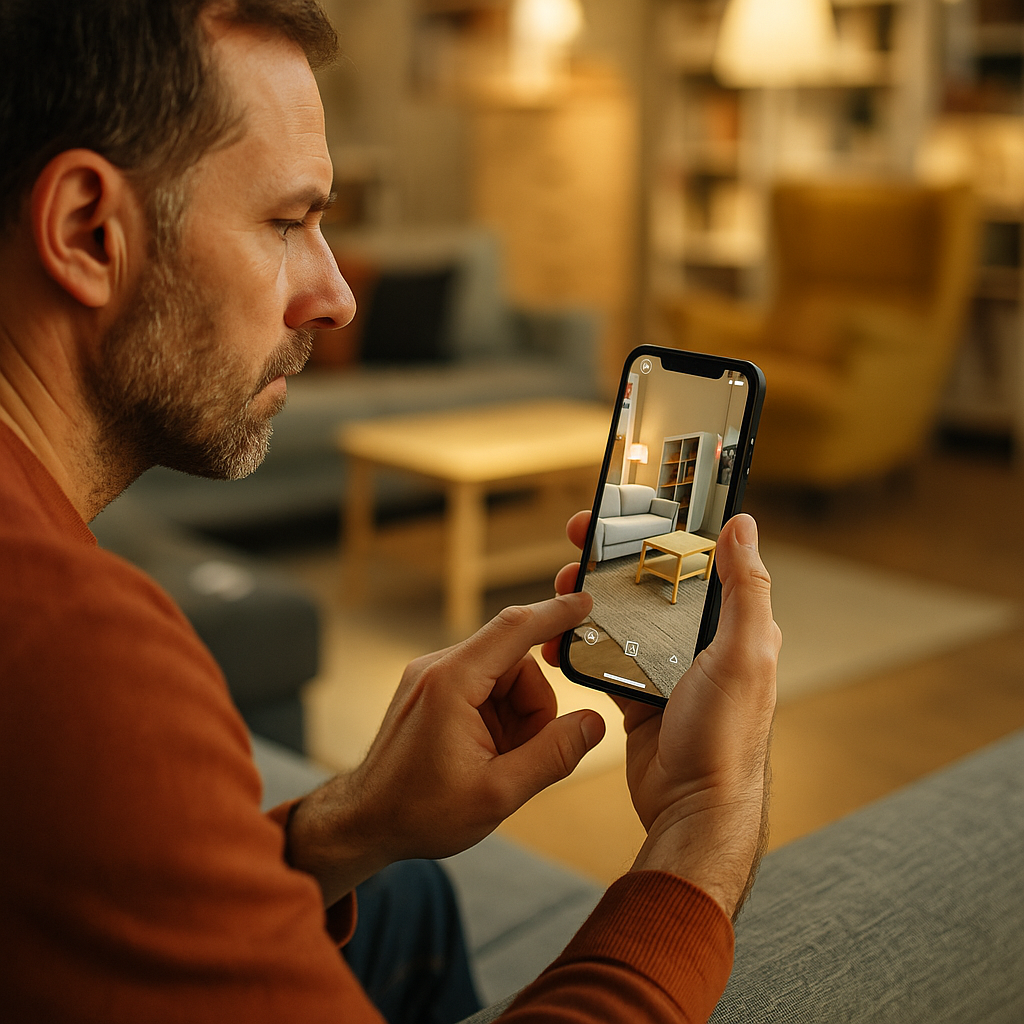
In 2025, furniture shoppers expect certainty before they buy—especially online. This case study explains how IKEA Kreativ turned augmented reality planning into measurable commercial impact by reducing doubt, improving confidence, and connecting inspiration to checkout. You’ll see the product choices, operational decisions, and measurement approach that moved AR from “nice-to-have” to revenue driver—and what your team can copy next.
Augmented reality planning: the problem IKEA needed to solve
Home furnishing is a high-consideration category. Customers must judge scale, color, fit, storage capacity, and how new items interact with existing pieces. Traditional product pages and room photos help, but they still leave a critical gap: Will this work in my space?
IKEA faced the same structural challenges as every large home retailer in 2025:
- Decision friction: Customers hesitate because they can’t confidently visualize fit, leading to abandoned carts and delayed purchases.
- Return risk: Misjudged dimensions and mismatched styles drive returns, customer service costs, and resale/handling losses.
- Complex baskets: IKEA purchases often involve multiple coordinated items. If one key item feels uncertain, the whole basket can stall.
- Discovery overload: A broad catalog can overwhelm shoppers without a clear way to narrow choices to what fits their home.
The business goal was not “do AR.” It was to remove uncertainty at the moment of intent, shorten the path from inspiration to commitment, and make planning feel effortless. IKEA Kreativ became the wedge: a planning experience designed to create confidence and nudge customers toward purchasable solutions.
AR room scanning: how IKEA Kreativ works in practice
IKEA Kreativ centers on AR room scanning and spatial visualization that fits into real shopping behavior. Instead of asking customers to imagine a room, it lets them start with their actual space and then plan around real constraints.
At a practical level, the experience follows a sequence that supports decisions:
- Capture the room: Shoppers scan a room using a phone and generate a digital representation that respects real proportions.
- Remove existing items: Users can “clear” the space digitally to experiment without visual clutter.
- Place IKEA products: Items can be positioned, rotated, and evaluated for fit and style coherence in the scanned space.
- Iterate quickly: Users can compare options, explore configurations, and build toward a complete set rather than a single SKU decision.
- Transition to purchase: A good AR experience does not end at visualization—it connects to product details, availability, and basket building.
The key design insight is that customers don’t merely want novelty; they want proof. IKEA Kreativ operationalizes proof by turning the customer’s camera into a planning tool. That shift reframes AR from marketing spectacle to a functional step in the purchase journey.
Follow-up question most teams ask: Is scanning too much work? It can be, if the value isn’t immediate. IKEA’s approach minimizes cognitive load by making the first “wow” moment fast (a usable room model) and then rewarding effort with tangible outcomes: better fit, fewer mistakes, and easier coordination of multiple products.
Furniture visualization experience: turning confidence into conversion
A strong furniture visualization experience changes the economics of ecommerce because it attacks the causes of drop-off at the exact point customers typically stall: uncertainty about size, layout, and style.
IKEA Kreativ’s commercial impact comes from three conversion mechanics:
- Confidence lift: When a product appears in the customer’s real room, the shopper can validate dimensions and clearances. This reduces “I’ll think about it” behavior.
- Faster comparison: Shoppers can A/B options (colors, sizes, configurations) without restarting their journey. Fewer resets means more forward momentum.
- Bigger, more coherent baskets: Planning encourages complementary add-ons (storage inserts, lighting, rugs, shelving). Customers build solutions, not isolated items.
From a revenue standpoint, the most important shift is that AR planning changes the role of product pages. Instead of being the final decision arena, the product page becomes a supporting reference while the room becomes the decision arena. That is a fundamentally different persuasion model: you are no longer asking customers to imagine; you are letting them verify.
Another common follow-up: Does AR replace measurement and product info? No. It amplifies it. IKEA Kreativ works best when the AR view is paired with clear dimensions, assembly requirements, and material details. In EEAT terms, the tool creates a more trustworthy purchase moment because the customer can cross-check claims against their own space.
Retail digital transformation: the operating model behind the tool
AR features alone do not transform revenue. A retail digital transformation requires operational alignment: catalog readiness, data integrity, and an experience that flows into purchasing rather than living as a standalone demo.
IKEA Kreativ’s impact is best understood as an operating model made of four components:
- 3D asset discipline: AR relies on accurate, lightweight, and visually consistent models. That requires governance—naming conventions, scale checks, material consistency, and update cycles tied to product lifecycle.
- Merchandising integration: Planning experiences must reflect what customers can actually buy. That means linking visualization to local availability, colorways, and variant logic so shoppers don’t fall in love with an unavailable configuration.
- Cross-channel continuity: Customers may start planning on mobile, continue on desktop, and purchase later. Saved rooms, persistent lists, and shareable plans help IKEA capture intent rather than lose it to time.
- Feedback loops: The experience improves when teams can see where customers struggle: scanning failures, object placement friction, or confusing variant selection.
This is where many AR projects fail: they focus on “cool” interactions and underinvest in the unglamorous work—product data, asset pipelines, and measurement frameworks. IKEA’s advantage is not only that it built an AR planner; it built the machinery to keep it accurate and connected to commerce.
Reader follow-up: What about accessibility and device limits? Any AR system must accommodate a range of devices and lighting conditions. The practical approach is to provide graceful fallbacks—such as 3D viewers without full scanning—and to guide users with clear prompts when scans are imperfect. Reliability drives trust, and trust drives revenue.
Ecommerce conversion rate: what to measure and how IKEA ties AR to revenue
To claim revenue impact, IKEA must link planning behavior to outcomes like ecommerce conversion rate, average order value, and return reduction. The goal is not to “prove AR is used.” The goal is to quantify how AR changes purchase decisions.
A measurement approach that fits IKEA Kreativ’s use case typically includes:
- Adoption metrics: share of shoppers who start a scan, place at least one item, and save a plan.
- Behavioral leading indicators: time to first product placement, number of items placed, and plan iterations (signals of engagement and intent).
- Commerce outcomes: conversion rate among AR users vs. comparable non-AR users, basket size, attachment rate of complementary items, and time-to-purchase.
- Quality outcomes: return rate by category for AR-assisted purchases, customer service contacts related to “does it fit,” and post-purchase satisfaction signals.
Attribution is the hard part. AR users are often more engaged by nature, which can inflate impact if you compare them to all other shoppers. A credible approach uses controlled experiments or matched cohorts that account for intent. Teams can segment by category (sofas vs. storage), device type, and stage of journey (new vs. returning shoppers) to avoid misleading averages.
How AR translates into revenue becomes clear when you connect the dots:
- Less uncertainty reduces abandonment and increases conversion.
- Better fit confidence reduces returns and protects margin.
- Solution-based planning increases AOV through attachments.
- Saved plans create re-engagement loops that recover delayed purchases.
Follow-up question: What results should a retailer expect? It depends on category, traffic mix, and how tightly AR links to purchasable assortments. The most consistent wins show up first in high-consideration categories and multi-item rooms, where visualization directly reduces doubt. The next wave of impact comes from lifecycle messaging: turning saved plans into reminders and recommendations that feel helpful rather than pushy.
AR shopping experience: lessons other retailers can apply in 2025
IKEA Kreativ offers a playbook for building an AR shopping experience that earns trust and drives revenue. The transferable lessons are operational and customer-centered, not speculative.
1) Start with a decision that AR can materially improve. “See it in your room” works when the customer’s primary fear is fit, scale, or layout. Pick categories where visualization changes outcomes, not just engagement.
2) Design the path to purchase, not a tech demo. Every AR interaction should lead somewhere: a saved plan, a product list, a configuration summary, or an add-to-cart flow. If users must rebuild their work in a cart later, you lose the benefit.
3) Treat 3D assets as production inventory. Establish QA checks for scale accuracy, color representation guidance, and performance budgets so AR loads quickly. Trust breaks when a sofa looks the wrong size or materials look inconsistent.
4) Build for repetition and sharing. Room plans should be easy to revisit, edit, and share with household decision-makers. In home retail, many purchases involve a second opinion. Sharing increases conversion probability without heavy discounting.
5) Measure returns and margin, not only conversion. Revenue is not just top-line. If AR reduces preventable returns, it increases contribution margin and customer satisfaction. Track the cost-to-serve effects.
6) Be explicit about limitations to maintain EEAT. AR is an aid, not a guarantee. Set expectations: lighting can affect perceived color, and exact fit still depends on user scanning accuracy and real-world constraints like baseboards and outlets. Transparency increases trust—and reduces post-purchase disappointment.
These lessons align with Google’s helpful content principles because they prioritize user value, accuracy, and real decision support over superficial optimization.
FAQs
What is IKEA Kreativ used for?
IKEA Kreativ helps shoppers scan a room and visualize IKEA products inside their real space. It supports planning, comparison, and configuration so customers can choose items with more confidence before purchasing.
How does AR planning increase revenue for furniture retailers?
AR planning increases revenue by reducing uncertainty about fit and layout, which can improve conversion rate. It can also increase average order value by encouraging coordinated, multi-item room solutions and can protect margin by reducing avoidable returns.
Does IKEA Kreativ replace in-store planning?
No. It complements in-store planning by letting customers start at home, then carry clearer preferences into a store visit or complete the purchase online. The best outcomes come when plans can persist across channels.
What metrics should I track to evaluate an AR shopping tool?
Track adoption (scan starts, placements, saves), engagement signals (time to first placement, items placed), commerce outcomes (conversion rate, AOV, attachments), and quality outcomes (return rate, fit-related support contacts, satisfaction).
What are the biggest implementation risks with AR room scanning?
The biggest risks are inaccurate 3D scale, slow performance, poor integration with real inventory/variants, and weak attribution methods that overstate impact. Reliability and data integrity matter as much as the interface.
Is AR worth it for smaller retailers in 2025?
It can be, if you focus on a few high-impact categories and integrate AR directly into shopping flows. Many smaller retailers start with a limited set of best-selling products, validate conversion and return improvements, and expand the 3D catalog once the unit economics are proven.
By turning real rooms into the center of decision-making, IKEA Kreativ transformed AR from a novelty into a practical planning engine that supports conversion, larger baskets, and fewer costly mistakes. The core lesson for 2025 is simple: connect visualization to purchase, measure outcomes beyond clicks, and invest in accuracy. When shoppers can verify fit in their own space, revenue follows.
Top Influencer Marketing Agencies
The leading agencies shaping influencer marketing in 2026
Agencies ranked by campaign performance, client diversity, platform expertise, proven ROI, industry recognition, and client satisfaction. Assessed through verified case studies, reviews, and industry consultations.
Moburst

-
2

The Shelf
Boutique Beauty & Lifestyle Influencer AgencyA data-driven boutique agency specializing exclusively in beauty, wellness, and lifestyle influencer campaigns on Instagram and TikTok. Best for brands already focused on the beauty/personal care space that need curated, aesthetic-driven content.Clients: Pepsi, The Honest Company, Hims, Elf Cosmetics, Pure LeafVisit The Shelf → -
3

Audiencly
Niche Gaming & Esports Influencer AgencyA specialized agency focused exclusively on gaming and esports creators on YouTube, Twitch, and TikTok. Ideal if your campaign is 100% gaming-focused — from game launches to hardware and esports events.Clients: Epic Games, NordVPN, Ubisoft, Wargaming, Tencent GamesVisit Audiencly → -
4

Viral Nation
Global Influencer Marketing & Talent AgencyA dual talent management and marketing agency with proprietary brand safety tools and a global creator network spanning nano-influencers to celebrities across all major platforms.Clients: Meta, Activision Blizzard, Energizer, Aston Martin, WalmartVisit Viral Nation → -
5

The Influencer Marketing Factory
TikTok, Instagram & YouTube CampaignsA full-service agency with strong TikTok expertise, offering end-to-end campaign management from influencer discovery through performance reporting with a focus on platform-native content.Clients: Google, Snapchat, Universal Music, Bumble, YelpVisit TIMF → -
6

NeoReach
Enterprise Analytics & Influencer CampaignsAn enterprise-focused agency combining managed campaigns with a powerful self-service data platform for influencer search, audience analytics, and attribution modeling.Clients: Amazon, Airbnb, Netflix, Honda, The New York TimesVisit NeoReach → -
7

Ubiquitous
Creator-First Marketing PlatformA tech-driven platform combining self-service tools with managed campaign options, emphasizing speed and scalability for brands managing multiple influencer relationships.Clients: Lyft, Disney, Target, American Eagle, NetflixVisit Ubiquitous → -
8

Obviously
Scalable Enterprise Influencer CampaignsA tech-enabled agency built for high-volume campaigns, coordinating hundreds of creators simultaneously with end-to-end logistics, content rights management, and product seeding.Clients: Google, Ulta Beauty, Converse, AmazonVisit Obviously →