


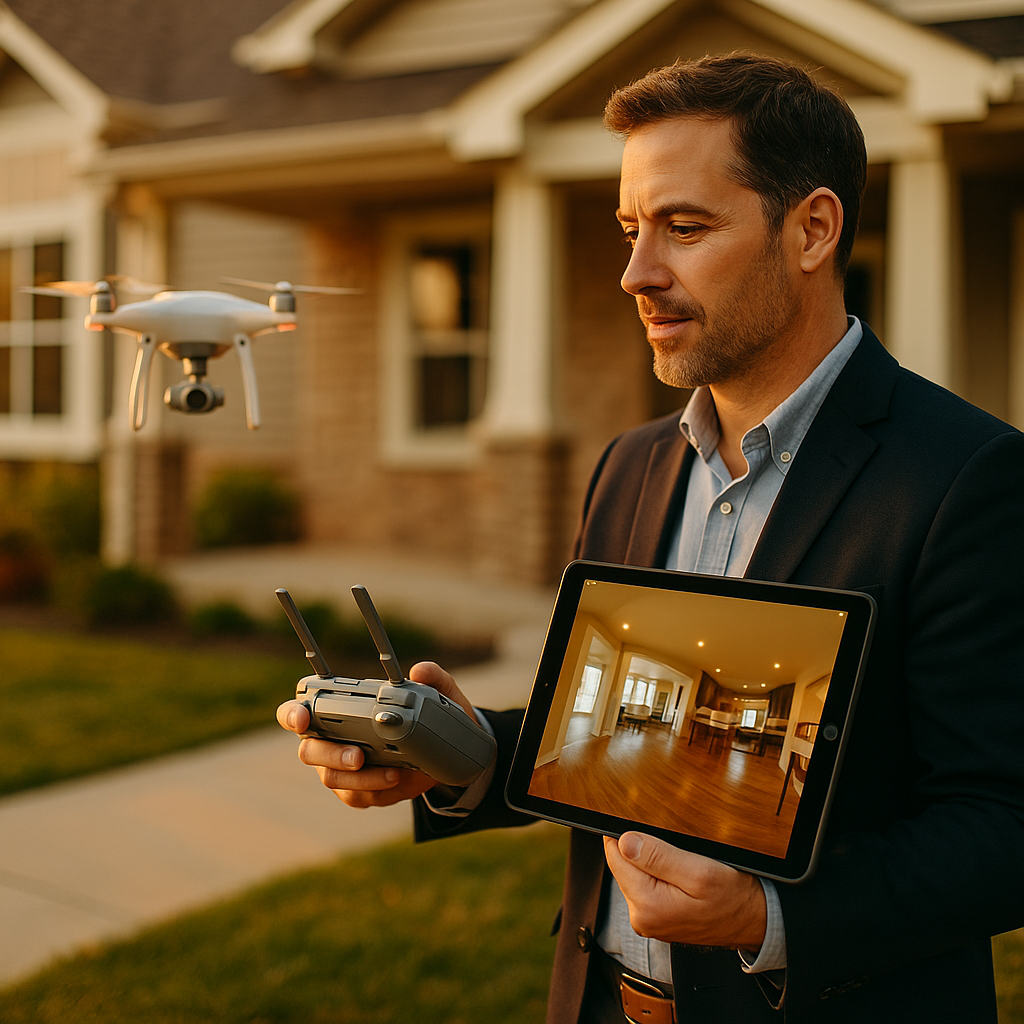
In 2025, buyers expect clarity before they commit time to a showing. This case study explains how one brokerage improved listing engagement and shortened decision cycles by combining aerial context with immersive walk-throughs. You’ll see what worked, what didn’t, and the exact workflow behind using drones and 360 video for real estate sales—plus the metrics that persuaded agents to adopt it. Ready to see the playbook?
Immersive real estate marketing: The brand, goals, and constraints
Brand profile (anonymized for client confidentiality): A mid-sized real estate brand operating across a metro area plus two nearby resort towns. Roughly 40 agents, a mix of suburban family homes, luxury properties, and new-build communities. The brand relied on professional still photography and agent-hosted open houses, with video used inconsistently.
Primary goals:
- Increase qualified inquiries (not just clicks) by making listings easier to understand remotely.
- Reduce time-to-offer for properties where layout and setting were major decision factors.
- Win more listing presentations by differentiating the marketing package in a crowded market.
Constraints the team had to work within:
- Compliance and safety: Drone operations needed to follow local aviation rules and privacy norms, with consistent risk controls.
- Agent adoption: The solution had to be simple enough for busy agents, with predictable turnaround and pricing.
- Buyer trust: Visual content had to be accurate and current to avoid “looks better online” disappointment.
What changed in 2025: The brand noticed that buyers were making shorter shortlists and wanted more context before booking showings. The leadership team framed the initiative as “helpful transparency,” not flashy media, which kept the strategy grounded in buyer needs.
Drone real estate photography: Why aerial context increased buyer confidence
The brand’s first insight was simple: buyers often rejected listings for reasons unrelated to interior design—traffic noise, proximity to commercial buildings, slope of the land, neighboring density, or the distance to water and trails. Traditional listing photos rarely answered these questions.
How drones were used (the practical approach):
- Establishing aerials: 2–4 high-resolution images showing the property within its immediate surroundings.
- Neighborhood context frames: Aerials oriented toward parks, schools (without highlighting children or private areas), and key amenities.
- Lot and access clarity: For corner lots, long driveways, waterfront parcels, or hillside homes, the drone visuals explained “how you arrive” and “how the land sits.”
What they deliberately avoided:
- Overly high-altitude shots that looked impressive but didn’t clarify anything about the home’s livability.
- Flying close to neighboring yards to prevent privacy complaints and reduce reputational risk.
- Misleading angles that could exaggerate lot size or hide nearby structures.
EEAT note (trust and accuracy): The brand created a “truth-in-visuals” checklist for every shoot: confirm address and boundaries, avoid heavy sky replacements, keep color correction natural, and ensure the drone story matches the written listing description. This reduced disputes and improved agent confidence when presenting the marketing package to sellers.
Buyer follow-up question, answered: “Will drone shots scare off privacy-conscious buyers?” The brand found the opposite when they followed a conservative flight plan: buyers interpreted the aerials as transparency. Privacy concerns mainly surfaced when operators flew low over neighbors or captured identifiable people—both were excluded by policy.
360 virtual tours for homes: The production workflow that scaled
Drones provided context, but 360 video handled the second friction point: uncertainty about layout flow. Buyers can forgive outdated finishes; they rarely forgive a confusing layout discovered after a long drive. The brand standardized a 360-first workflow designed for speed and consistency.
Standard deliverables per listing tier:
- Core tier: Still photos + a 360 walk-through of main living areas and primary suite.
- Signature tier: Full 360 walk-through + aerial photo set + a short “guided” 360 highlight reel for social.
- Luxury tier: Full 360 + aerial photos + aerial video + a narrated agent intro recorded on-site.
On-site capture sequence (optimized for real homes, not studios):
- Prep checklist: lights on, ceiling fans off, mirrors checked, personal items minimized, pets and people out of frame.
- Route planning: a single logical path from entry → living → kitchen → primary suite → outdoor space. This reduced viewer drop-off caused by jumpy navigation.
- Stabilization and pacing: the team used slow, consistent movement to reduce motion discomfort and make spaces feel calm and truthful.
Post-production standards:
- Color accuracy: neutral whites, consistent exposure between rooms, no “glow” effects that misrepresent lighting.
- Information overlays (sparingly): labels for key upgrades (HVAC age, window type, smart features) only when verified by seller disclosures.
- Fast turnaround: target delivery within 48 hours so the tour matched the current condition of the property.
Buyer follow-up question, answered: “Do 360 tours replace in-person showings?” The brand positioned 360 as a filter and accelerator: it reduced wasted showings while increasing the quality of showings that did occur. Agents reported fewer “just curious” visits and more second showings that turned into offers.
Real estate video strategy: Distribution, listing pages, and lead capture
Creating strong visuals is only half the system. The brand rebuilt its distribution so drone and 360 assets worked together across search, social, and agent follow-up—without overwhelming users or slowing page speed.
Where the content lived (and why):
- Listing detail page: Aerial hero image first, then stills, then the 360 tour above the fold on desktop. This matched buyer intent: confirm location context, then explore layout.
- Google Business Profile and local SEO pages: Neighborhood landing pages embedded short aerial clips to reinforce local expertise and improve engagement signals.
- Email and SMS follow-up: Agents sent a single “tour link” that opened fast on mobile, with one clear call-to-action: schedule a showing or request disclosures.
Lead capture without friction:
- No hard gate on the first view: The first 60–90 seconds of the experience remained ungated to build trust.
- Soft conversion prompts: After the viewer reached the kitchen or backyard (high-intent moments), a prompt offered “Floor plan + disclosures PDF” in exchange for email.
What improved SEO (and EEAT) at the same time:
- Unique listing descriptions that referenced what viewers could verify in the visuals (views, lot shape, outdoor flow), avoiding generic sales language.
- Alt-text and accessibility notes for key images and embedded media titles that reflected actual property features.
- Agent attribution on listing pages: credentials, local experience, and direct contact, reinforcing real-world accountability.
Seller follow-up question, answered: “Will video reduce urgency because buyers feel they’ve already ‘seen it’?” The brand’s results suggested the opposite when the visuals were honest and the agent follow-up was structured. Buyers used 360 to decide faster, not to delay.
Real estate sales results: Metrics, attribution, and what the team learned
The brand ran a six-month pilot across 62 listings, comparing performance to similar listings from the same offices that used still photos only. They focused on metrics tied to sales activity, not vanity views.
Observed outcomes (pilot averages):
- Higher listing engagement: Listing pages with drone + 360 saw a 28% increase in average time on page and a 22% reduction in bounce rate compared with still-only pages.
- More qualified inquiries: Agent-reported “ready to book” inquiries increased by 18%, measured by CRM tags applied after initial calls.
- Faster decision cycles: Median days from listing to first offer improved by 12% in the pilot set, with the strongest gains in properties where outdoor space and setting mattered most.
- Listing appointment lift: Agents using the package reported a higher win rate in listing presentations, citing “marketing plan confidence” as a differentiator.
How they handled attribution (so the numbers stayed credible):
- Controlled comparisons: They matched pilot homes to similar price bands and neighborhoods within the same time period.
- CRM tagging discipline: Agents selected lead source and “content touched” fields (e.g., “360 viewed,” “aerial viewed”) during follow-up.
- Qualitative validation: The team collected buyer and seller comments after closings to confirm what influenced decisions.
What didn’t work as expected:
- Overlong edits: Early videos ran too long. Completion rates improved after the team prioritized a clear walkthrough and trimmed repetitive hallway footage.
- Inconsistent staging readiness: 360 captures everything. Homes that weren’t truly ready looked worse, not better. The brand solved this with a pre-shoot readiness checklist and reschedule policy.
- Luxury-only assumption: The team initially reserved drones for high-end listings. Mid-market suburban homes with strong yards, cul-de-sacs, or school proximity also benefited.
Drone regulations and safety: Compliance, privacy, and risk management in 2025
Trust is fragile in real estate marketing, and drones raise understandable concerns. The brand built a simple governance model so agents could say “yes” to the tool without guessing on legality or etiquette.
Operational safeguards:
- Verified operators: Only qualified drone pilots were used, with documented credentials and insurance appropriate for commercial work.
- Standard flight plans: Pre-defined takeoff/landing zones, maximum proximity limits to neighboring structures, and no hovering over people.
- Weather and risk thresholds: Clear rules for wind, precipitation, and visibility to prevent risky “just get it done” decisions.
Privacy-by-design practices:
- Avoid capturing identifiable neighbors and remove any incidental faces/license plates in post-production when feasible.
- No interior drone flights unless the property and crew setup made it safe and justified; most interiors were covered by 360 instead.
- Disclosure language in seller agreements explaining what will be captured and where it will be published.
Reader follow-up question, answered: “What if a neighbor complains?” The brand’s policy was to respond quickly, explain the privacy approach, and, if necessary, remove or re-edit specific frames. Having a documented process prevented escalation and protected relationships in tight-knit neighborhoods.
FAQs
What’s the difference between a 360 virtual tour and a standard walkthrough video?
A 360 tour lets the viewer control the camera angle and explore the room interactively, which helps answer layout questions. A standard walkthrough is linear and easier to watch on social. This brand used both: 360 for decision-making and short edits for discovery.
Do drones and 360 tours help sell homes faster?
They can when they reduce uncertainty. In this case study, the brand saw faster “listing to first offer” timing in the pilot group, especially for properties where location context and outdoor features influenced value.
How much extra does drone and 360 content cost compared to photos?
Pricing varies by market and property size. The key cost-control tactic is standardization: a fixed deliverable set, a repeatable capture route, and a predictable turnaround. That prevents custom one-offs that inflate editing time.
Will a 360 tour expose flaws and hurt a listing?
It can reveal issues that still photos might hide. The brand treated that as a benefit: accurate visuals reduce wasted showings and help serious buyers decide with fewer surprises, which supports smoother negotiations.
Where should the 360 tour be placed on a listing page?
Put it near the top, after a small set of key photos and an aerial context image. Buyers typically want confirmation of setting first, then they want to understand flow and room connections.
Are drones legal for real estate marketing?
Drones are commonly used in real estate, but operators must follow applicable aviation rules and local restrictions. This brand only used verified pilots, documented flight plans, and privacy safeguards to reduce legal and reputational risk.
By 2025 standards, buyers don’t need more hype; they need better information. This case study shows how a real estate brand combined drone context with 360 clarity to raise listing engagement, improve inquiry quality, and speed up early buyer decisions. The main takeaway: treat immersive media as a transparency tool, build a repeatable workflow, and measure outcomes in offers and appointments—not just views.
Top Influencer Marketing Agencies
The leading agencies shaping influencer marketing in 2026
Agencies ranked by campaign performance, client diversity, platform expertise, proven ROI, industry recognition, and client satisfaction. Assessed through verified case studies, reviews, and industry consultations.
Moburst

-
2

The Shelf
Boutique Beauty & Lifestyle Influencer AgencyA data-driven boutique agency specializing exclusively in beauty, wellness, and lifestyle influencer campaigns on Instagram and TikTok. Best for brands already focused on the beauty/personal care space that need curated, aesthetic-driven content.Clients: Pepsi, The Honest Company, Hims, Elf Cosmetics, Pure LeafVisit The Shelf → -
3

Audiencly
Niche Gaming & Esports Influencer AgencyA specialized agency focused exclusively on gaming and esports creators on YouTube, Twitch, and TikTok. Ideal if your campaign is 100% gaming-focused — from game launches to hardware and esports events.Clients: Epic Games, NordVPN, Ubisoft, Wargaming, Tencent GamesVisit Audiencly → -
4

Viral Nation
Global Influencer Marketing & Talent AgencyA dual talent management and marketing agency with proprietary brand safety tools and a global creator network spanning nano-influencers to celebrities across all major platforms.Clients: Meta, Activision Blizzard, Energizer, Aston Martin, WalmartVisit Viral Nation → -
5

The Influencer Marketing Factory
TikTok, Instagram & YouTube CampaignsA full-service agency with strong TikTok expertise, offering end-to-end campaign management from influencer discovery through performance reporting with a focus on platform-native content.Clients: Google, Snapchat, Universal Music, Bumble, YelpVisit TIMF → -
6

NeoReach
Enterprise Analytics & Influencer CampaignsAn enterprise-focused agency combining managed campaigns with a powerful self-service data platform for influencer search, audience analytics, and attribution modeling.Clients: Amazon, Airbnb, Netflix, Honda, The New York TimesVisit NeoReach → -
7

Ubiquitous
Creator-First Marketing PlatformA tech-driven platform combining self-service tools with managed campaign options, emphasizing speed and scalability for brands managing multiple influencer relationships.Clients: Lyft, Disney, Target, American Eagle, NetflixVisit Ubiquitous → -
8

Obviously
Scalable Enterprise Influencer CampaignsA tech-enabled agency built for high-volume campaigns, coordinating hundreds of creators simultaneously with end-to-end logistics, content rights management, and product seeding.Clients: Google, Ulta Beauty, Converse, AmazonVisit Obviously →