


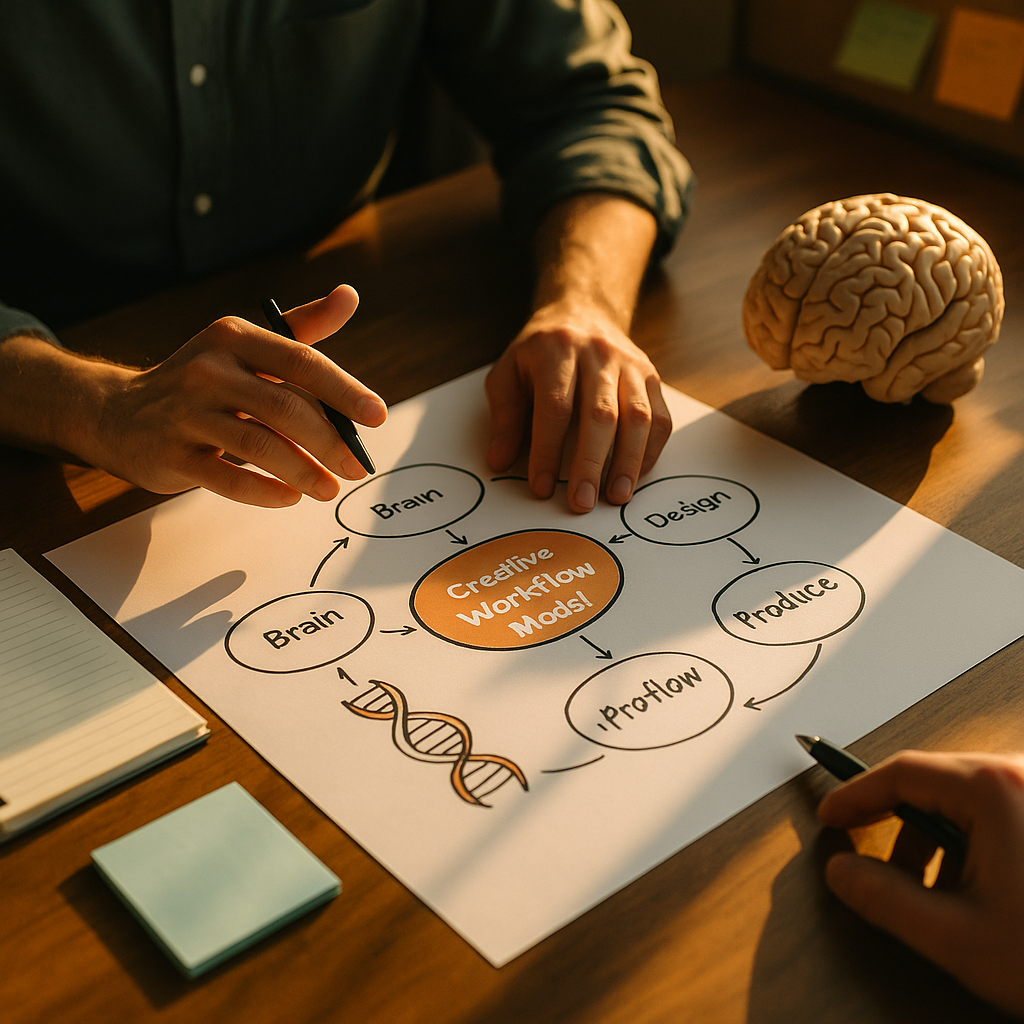
Strategic Planning for the Ten Percent Human Creative Workflow Model is a practical response to 2025’s reality: teams move fast, tools generate instantly, and attention is scarce. The model protects what humans do best while letting automation handle repetitive steps. With the right plan, it improves quality, accountability, and speed without diluting brand voice. Want a framework your team can actually run?
Ten Percent Human Creative Workflow Model definition
The Ten Percent Human Creative Workflow Model is a production approach where roughly 10% of the workflow is reserved for high-leverage human creativity and decision-making, while the remaining work is streamlined through templates, systems, automation, and assistive tools. The “ten percent” is not a rigid quota; it is a strategic constraint that forces teams to prioritize human judgment where it changes outcomes.
In strategic planning terms, the model answers three questions:
- Where does human originality materially improve results? (concept, narrative, positioning, taste, ethical judgment)
- Where does consistency and speed matter more than novelty? (formatting, variations, QA checklists, distribution)
- How do we prove quality and protect accountability? (review gates, audit trails, measurement)
To apply it across marketing, product content, design, or internal communications, treat the model as a workflow architecture, not an ideology. Your plan should clearly define the human “ten percent,” set guardrails for the automated “ninety percent,” and establish measurable outcomes.
Creative strategy alignment and positioning
Strategic planning starts with alignment. If your team can’t articulate what “good” looks like, automation will produce more output, not better outcomes. Lock in creative strategy before you optimize production.
Build a one-page “creative north star” that includes:
- Audience and intent: who this is for, what they need, and what action matters.
- Promise and proof: the core claim and the evidence you can support.
- Point of view: what you believe that competitors don’t say as clearly.
- Brand voice rules: vocabulary, tone boundaries, and examples of “on-brand” and “off-brand.”
- Compliance constraints: regulated terms, disclaimers, and review requirements.
Then define what belongs in the human ten percent. In most teams, the highest-return human activities are:
- Idea selection: choosing the angle that will earn attention, not just fill a calendar.
- Structural thinking: deciding the narrative arc, argument order, and emphasis.
- Editorial taste: determining what is clear, credible, and worth publishing.
- Final accountability: approving claims, sources, and sensitive messaging.
This alignment work prevents a common failure mode: teams over-automate ideation and under-invest in judgment. If you do the opposite, the model becomes a quality amplifier rather than a content factory.
Workflow design and automation boundaries
Next, translate strategy into a workflow that people can follow under deadline. A useful planning tool is a stage-gate process with explicit ownership and “definition of done” criteria at each step.
A typical Ten Percent workflow can look like this:
- Briefing (human-led): finalize audience, objective, claim, proof points, and constraints.
- Draft generation (system-assisted): use templates, outline frameworks, and tool-assisted first drafts.
- Substance edit (human ten percent): validate argument, accuracy, and differentiation; remove filler.
- Production pass (system-led): formatting, SEO basics, accessibility checks, variants for channels.
- Risk and compliance review (human-led when needed): verify regulated language, permissions, and citations.
- Publish and distribute (system-led): scheduling, UTM tagging, repurposing, and reporting.
Strategic planning is not only about steps; it’s about boundaries. Define what automation may do and what it must not do. Strong boundaries protect quality and reduce review friction.
- Allow: summarizing internal notes, formatting to templates, generating variations, drafting outlines, suggesting headlines, creating metadata.
- Restrict: inventing facts, creating quotes, attributing statistics without sources, making medical/legal/financial claims, using unlicensed brand assets.
- Require human sign-off: final claims, comparative statements, sensitive topics, and anything customer-facing that could create risk.
Make these boundaries visible where work happens: inside briefs, checklists, and approval forms. If they live only in a policy document, they won’t survive real production pressure.
Human review gates and quality control
The “ten percent” works only if human involvement happens at the moments that shape outcomes. Strategic planning should therefore specify review gates, not vague “someone checks it” expectations.
Implement three practical gates:
- Gate 1: Intent check (pre-draft) to confirm the brief is strong enough to produce a focused piece.
- Gate 2: Substance check (post-draft) to validate accuracy, logic, and differentiation before polishing.
- Gate 3: Reputation check (pre-publish) to confirm tone, ethics, brand fit, and risk controls.
Define quality with a scorecard so feedback stays consistent across editors and teams. A useful scorecard includes:
- Accuracy: claims supported with internal evidence or reputable sources.
- Clarity: can a busy reader understand the point in one pass?
- Originality: includes insight, examples, or a point of view beyond generic summaries.
- Usefulness: answers likely follow-up questions and offers actionable steps.
- Brand voice: meets tone rules and avoids prohibited language.
To reinforce Google’s EEAT expectations in 2025, build credibility into the workflow rather than adding it at the end. Use these practices:
- Author and reviewer accountability: record who approved key claims and why.
- Source hygiene: require a source line for statistics, definitions, and comparisons.
- Experience signals: include concrete examples from your projects, constraints you faced, and what you learned.
- Transparent limitations: state assumptions and where advice may not apply (industry, compliance, audience maturity).
This approach reduces rework. Editors stop debating preferences and start evaluating against shared criteria, which is exactly what makes a lean human layer effective.
Resource planning, roles, and governance
Strategic planning must account for people, not just process. The Ten Percent model succeeds when roles are crisp and governance prevents last-minute chaos.
Define a core set of roles (one person can hold multiple roles on small teams):
- Creative lead: owns positioning, creative north star, and final editorial standards.
- Content engineer or workflow owner: maintains templates, checklists, prompt libraries, and tool configuration.
- Subject matter expert (SME): validates technical truth and supplies real examples and constraints.
- Editor: runs substance checks, enforces clarity, and protects brand voice.
- Compliance or legal reviewer (as needed): approves high-risk categories and mandated language.
Then set governance rules that reduce decision debt:
- Approval thresholds: specify what requires SME review and what can ship with editor approval.
- Change control: define when a new request triggers a new brief (scope changes are a common hidden cost).
- Asset permissions: maintain a single source of truth for licensed images, brand marks, and reusable components.
- Security and privacy: classify data and prevent sensitive inputs from entering tools or shared workspaces.
Capacity planning is also part of strategy. Reserve human time for the highest-impact moments: briefing, substance edit, and final sign-off. If your schedule forces humans to spend time on formatting and variations, you have designed the workflow backwards.
Measurement, iteration, and SEO performance
Finally, treat the Ten Percent model as an operating system you improve monthly. Strategic planning should specify what you measure, how you learn, and what changes you are willing to make.
Track three categories of metrics:
- Outcome metrics: organic traffic quality, conversions, qualified leads, retention signals, or support ticket reduction (choose what matches your goal).
- Quality metrics: editorial scorecard averages, correction rates, compliance findings, and customer feedback.
- Efficiency metrics: cycle time, rework loops, cost per asset, and reviewer load.
To keep SEO performance aligned with helpful content, plan for:
- Search intent mapping: ensure each asset targets a distinct intent and avoids internal competition.
- Content depth decisions: choose when a topic needs a comprehensive guide versus a focused answer page.
- Internal linking strategy: connect related assets so readers can self-navigate and search engines understand topical authority.
- Refresh cadence: schedule updates for pages that drive revenue or represent your expertise.
Run a monthly retrospective with a short agenda:
- What shipped that performed well, and why? Identify reusable patterns.
- Where did rework happen? Fix briefs, templates, or gates rather than blaming individuals.
- What risks appeared? Update boundaries, checklists, and reviewer thresholds.
This closes the loop: measurement informs workflow changes, and workflow changes protect the human ten percent for higher-value creative decisions.
FAQs: Strategic Planning for the Ten Percent Human Creative Workflow Model
Is the “ten percent” literal or flexible?
It is flexible. Use it as a constraint to protect high-leverage human work, not as a timekeeping rule. Some high-risk or high-stakes assets may require more human involvement, especially in regulated industries.
What should humans do in the Ten Percent model?
Humans should handle positioning, idea selection, narrative structure, ethical judgment, fact validation, and final approval. These tasks benefit most from experience, context, and taste.
How do we prevent inaccurate claims and hallucinated details?
Use strict source requirements, require a citation line for any statistic or comparison, and add a substance review gate where an editor or SME verifies claims against approved sources before polishing and publishing.
How does this model support Google’s EEAT expectations?
It builds expertise and trust into the workflow through SME validation, transparent sourcing, consistent editorial standards, and accountable sign-offs. It also encourages original experience-based insights rather than generic summaries.
What tools do we need to implement it?
You need a documented brief template, a content checklist, a place to store approved sources and brand rules, and a workflow system for approvals. Specific tools vary; the strategy works as long as boundaries and gates are enforced.
How do we roll this out without disrupting current production?
Pilot it on one content type (for example, blog posts or product pages), measure cycle time and quality, then expand. Keep the first version simple: one brief template, three review gates, and a scorecard.
Strategic planning for the Ten Percent Human Creative Workflow Model works when you define what only humans can do, automate the rest with clear boundaries, and enforce review gates that protect quality. In 2025, the advantage is not volume; it is trustworthy differentiation at speed. Build alignment, design the workflow, assign accountable roles, and measure outcomes. Then iterate until quality becomes predictable.
Top Influencer Marketing Agencies
The leading agencies shaping influencer marketing in 2026
Agencies ranked by campaign performance, client diversity, platform expertise, proven ROI, industry recognition, and client satisfaction. Assessed through verified case studies, reviews, and industry consultations.
Moburst

-
2

The Shelf
Boutique Beauty & Lifestyle Influencer AgencyA data-driven boutique agency specializing exclusively in beauty, wellness, and lifestyle influencer campaigns on Instagram and TikTok. Best for brands already focused on the beauty/personal care space that need curated, aesthetic-driven content.Clients: Pepsi, The Honest Company, Hims, Elf Cosmetics, Pure LeafVisit The Shelf → -
3

Audiencly
Niche Gaming & Esports Influencer AgencyA specialized agency focused exclusively on gaming and esports creators on YouTube, Twitch, and TikTok. Ideal if your campaign is 100% gaming-focused — from game launches to hardware and esports events.Clients: Epic Games, NordVPN, Ubisoft, Wargaming, Tencent GamesVisit Audiencly → -
4

Viral Nation
Global Influencer Marketing & Talent AgencyA dual talent management and marketing agency with proprietary brand safety tools and a global creator network spanning nano-influencers to celebrities across all major platforms.Clients: Meta, Activision Blizzard, Energizer, Aston Martin, WalmartVisit Viral Nation → -
5

The Influencer Marketing Factory
TikTok, Instagram & YouTube CampaignsA full-service agency with strong TikTok expertise, offering end-to-end campaign management from influencer discovery through performance reporting with a focus on platform-native content.Clients: Google, Snapchat, Universal Music, Bumble, YelpVisit TIMF → -
6

NeoReach
Enterprise Analytics & Influencer CampaignsAn enterprise-focused agency combining managed campaigns with a powerful self-service data platform for influencer search, audience analytics, and attribution modeling.Clients: Amazon, Airbnb, Netflix, Honda, The New York TimesVisit NeoReach → -
7

Ubiquitous
Creator-First Marketing PlatformA tech-driven platform combining self-service tools with managed campaign options, emphasizing speed and scalability for brands managing multiple influencer relationships.Clients: Lyft, Disney, Target, American Eagle, NetflixVisit Ubiquitous → -
8

Obviously
Scalable Enterprise Influencer CampaignsA tech-enabled agency built for high-volume campaigns, coordinating hundreds of creators simultaneously with end-to-end logistics, content rights management, and product seeding.Clients: Google, Ulta Beauty, Converse, AmazonVisit Obviously →