


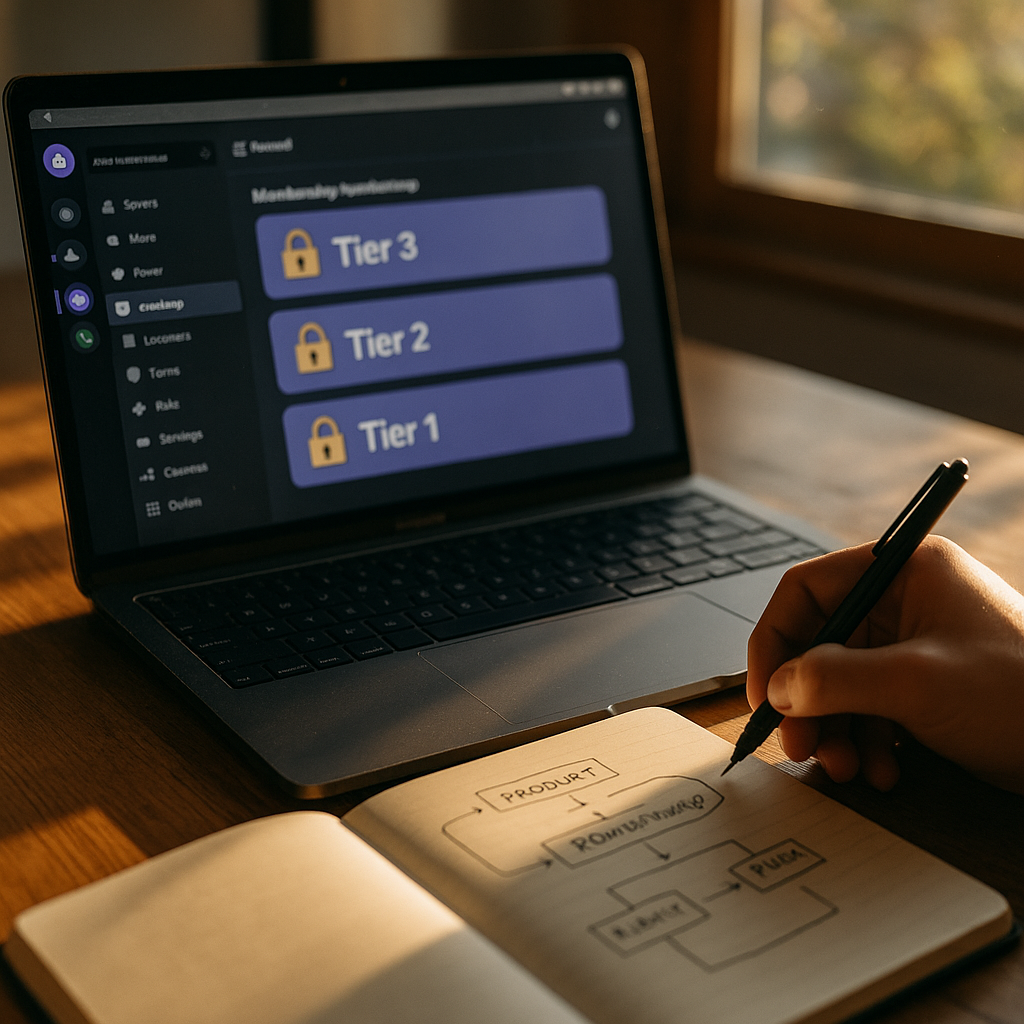
Building a product roadmap with your community sounds simple until votes get brigaded, leaks spread, and loud voices drown out real user needs. In 2025, teams need a system that is transparent, secure, and repeatable. This playbook for community driven product roadmaps on Discord tiers shows how to segment access, validate feedback, and turn discussion into shippable priorities—without sacrificing trust. Ready to operationalize it?
Secure Discord tiers for roadmap governance
A roadmap is a decision system, not a suggestion box. Discord tiers work when they create clear boundaries around who can see what, who can influence what, and how feedback becomes commitments. Start by mapping tiers to governance responsibilities rather than vanity access.
- Public (read-mostly): Announcements, changelogs, public FAQs, and a single “ideas intake” channel. Keep it simple to reduce moderation load and prevent rumor loops.
- Verified users: Access granted after lightweight verification (email, purchase link, or account linking) to reduce spam and duplicate voting. Use this tier for structured surveys, reproducible bug reports, and feature clarification threads.
- Customers / Subscribers: Priority channels for support triage, feedback on paid features, and controlled previews. This tier should be the main input to near-term roadmap items that affect retention and revenue.
- Beta / Design partners: NDA or explicit confidentiality rules, early builds, detailed research sessions, and high-signal feedback templates. Treat this tier like an extension of your product discovery team.
- Internal / Moderators: A private workspace for triage, tagging, summarization, and escalation. This is where you protect users from chaos by standardizing how feedback gets processed.
Security posture: Apply least-privilege access, minimize “@everyone” permissions, and separate view from post rights. For sensitive channels, disable invite links, restrict file uploads, and require verified accounts. Publish a short “Roadmap Governance” post that explains how input is used, what is not promised, and expected conduct. That transparency is part of security: it reduces social engineering and entitlement conflicts.
Community driven product roadmaps with structured intake
The fastest way to lose trust is to ask for ideas and then ignore them without explanation. The fastest way to lose focus is to accept unstructured feedback at scale. Solve both with a single intake funnel that captures enough context to be useful while staying easy to complete.
Create one canonical intake format and route everything into it. Discord is where people talk; your product system is where decisions live. Use a simple template users can paste into an ideas channel:
- Problem: What are you trying to accomplish?
- Who it affects: Role, plan/tier, workflow, device.
- Current workaround: What do you do today?
- Impact: Time saved, risk reduced, revenue protected, satisfaction improved.
- Evidence: Screenshots/logs (if safe), steps to reproduce, or a short Loom-style description.
Tagging is non-negotiable. Assign moderators or community ops to tag each submission with product area, user segment, urgency, and type (bug, enhancement, new feature, integration, UX debt). Then mirror each qualified item into a backlog tool (Jira/Linear/Notion) with a link back to the Discord thread for context.
Answer the follow-up question early: “How do we know you heard us?” Set an SLA for first response on qualified posts (for example, within 48 hours for verified users). The response does not need to be “yes.” It should clarify what information is missing, how it will be evaluated, and when the next checkpoint is (monthly review, quarterly planning, next beta cycle).
Discord role-based access control and privacy safeguards
When roadmap work moves into Discord, you inherit the security risks of any always-on community space: impersonation, doxxing, leaked previews, and manipulation of feedback signals. Role-based access control (RBAC) must be paired with privacy safeguards that protect users and your product.
RBAC checklist for roadmap channels:
- Separate “suggest” from “decide” spaces: Allow broad input but restrict decision threads (trade-offs, timelines, dependencies) to trusted tiers.
- Use time-boxed access: Grant beta roles for a fixed period and renew only for active, constructive participants.
- Require verification for voting: Votes should reflect real users. Use verified roles to reduce sockpuppets.
- Lock down attachments: In sensitive tiers, limit file uploads and link posting. Use approved domains where possible.
- Use private threads for account-specific info: Never collect personal data in public channels. Route to ticketing or private support channels.
Privacy-by-design in community research: When you run feedback sessions, state what you will record, how long you keep it, and how you anonymize quotes. If users share logs, instruct them to redact tokens, emails, and IDs. Make it easy: provide a short redaction guide and a “safe logging” snippet if your product supports it.
Moderation as product quality control: Moderators should remove harassment quickly, but they should also enforce relevance. A secure roadmap process is one where participants feel safe to share messy truths without fear of pile-ons. Publish clear escalation paths and consistently apply them across tiers.
Member verification and anti-abuse signals for trustworthy voting
Community voting can inform prioritization, but it cannot be the prioritization model. The goal is to measure demand without letting coordinated groups hijack direction. Treat votes as one input in a broader evidence set.
Verification options by friction level:
- Low friction: Email verification + Discord account age thresholds + phone verification (where appropriate).
- Medium friction: Product account linking (OAuth) to assign roles based on plan, usage tier, or tenure.
- High trust: Paid receipt validation or license key association for customer-only roadmap influence channels.
Anti-abuse signals to monitor:
- Vote velocity: Sudden spikes can indicate brigading.
- Account freshness: New accounts voting in clusters should be weighted down or flagged.
- Segment imbalance: If one segment dominates, you may be optimizing for the wrong user base.
- Comment quality: High-signal feedback often includes context, constraints, and workarounds; low-signal feedback repeats slogans.
Weighted input beats raw counts. Consider a scoring model that combines votes with user segment value, retention impact, support volume, revenue exposure, and strategic fit. Explain this publicly at a high level. You do not need to reveal every coefficient, but you should clarify that “most upvoted” is not the same as “next shipped.” That honesty prevents backlash and improves feedback quality.
Close the loop on “why not.” Create a “Decisions & Rationale” channel that posts monthly: what moved up, what moved down, what got rejected, and what evidence drove the call. People accept “no” when they respect the process.
Product feedback loops and decision rituals that ship outcomes
Discord excels at real-time conversation; roadmaps require disciplined cadence. The bridge between them is a set of rituals that turn talk into validated direction and, ultimately, releases.
Adopt three recurring loops:
- Weekly triage (ops-led): Consolidate duplicates, request missing details, tag items, and escalate severe issues. Output: a clean shortlist for product review.
- Monthly roadmap review (PM-led): Evaluate top themes against strategy, capacity, and evidence. Output: updated roadmap states (Now/Next/Later) and a decision log post.
- Quarterly betas (cross-functional): Invite design partners and verified users to test. Output: measurable success criteria, bug counts, adoption indicators, and a go/no-go decision.
Use states that match uncertainty. A secure, community-facing roadmap should avoid date promises in early stages. Prefer:
- Exploring: Collecting evidence; no commitment.
- Validating: Prototypes, research, feasibility checks.
- Committed: Scheduled in a sprint or release train.
- Shipped: Released with notes and follow-up questions.
Instrument outcomes, not applause. When you ship a community-influenced feature, ask for targeted validation: “Did this reduce time-to-complete by 20%?” “Did it eliminate the workaround?” Provide a short survey link and a dedicated thread. Tie those results back to the original request so contributors can see the chain from idea to impact.
Document expertise visibly. To align with EEAT, identify who owns the process: the product lead, security lead, and community manager. In decision posts, cite internal evidence (support ticket volume, churn drivers, performance constraints) and clearly distinguish facts from assumptions. This shows competence and helps the community participate at a higher level.
Roadmap transparency and EEAT-aligned communication in Discord
Transparency is not “share everything.” It is “share the right level of detail so people can trust what they see.” In Discord tiers, you can tailor transparency to sensitivity while maintaining consistency in how you communicate.
Publish these artifacts in the appropriate tier:
- Public: High-level Now/Next/Later, changelog, known issues, and a roadmap FAQ.
- Verified: Top themes under exploration, research calls, and summaries of what you learned.
- Customers: Migration notes, deprecations, integration timelines, and support playbooks.
- Beta/Design partners: Spec drafts, prototype walkthroughs, and explicit risk areas.
Write decisions like an operator. Each decision post should answer:
- What: The change in status (moved to Validating, Committed, etc.).
- Why: The evidence and trade-offs.
- Who: The impacted segments.
- When: The next checkpoint, not an early date promise.
- How to help: The exact feedback needed (logs, steps, edge cases, beta participation).
Prevent trust erosion during incidents. If a leak happens or a beta goes wrong, address it quickly in the tier affected. State what was exposed, what changed, and what protections you added. Security communication is part of roadmap management because it preserves the integrity of future collaboration.
FAQs
How many Discord tiers should we use for roadmap input?
Use the minimum that matches real governance needs. Most teams succeed with four: Public, Verified, Customer, and Beta/Design Partners. Add an internal moderator tier for processing. More tiers increase overhead and confusion unless each tier has a distinct purpose and permissions.
How do we stop “vote brigading” from hijacking our priorities?
Require verification for voting, monitor vote velocity, and treat votes as a signal rather than a decision. Use weighted scoring that includes segment value, support volume, retention risk, and strategic fit. Publish a plain-language explanation so users know what votes mean.
What should be public versus private in a secure roadmap?
Keep high-level themes and statuses public, and keep sensitive details private: security fixes, partner negotiations, competitive differentiators, and unreleased screenshots/build links. Share decision rationales broadly, but limit implementation specifics to trusted tiers.
How do we connect Discord feedback to our backlog without losing context?
Use one intake template, tag posts consistently, and create a linked backlog item that references the Discord thread. Summarize key constraints and reproduce steps inside the backlog tool, and keep Discord as the discussion layer for follow-ups.
How often should we update the community-facing roadmap?
Post lightweight updates continuously (changelog and “state changes”) and publish a structured roadmap review monthly. Pair this with quarterly beta cycles for major bets. Consistent cadence matters more than frequent promises.
How do we prove we’re listening if we can’t build everything?
Close the loop with a decision log: accepted, deferred, and rejected items with clear reasons. Ask for targeted evidence when something is blocked, and show what you prioritized instead. Respectful “no” responses build more trust than vague “soon” replies.
Community roadmaps succeed when you treat Discord as a governed system: clear tiers, verified participation, disciplined intake, and security-first permissions. Use votes as evidence, not authority, and publish decision rationales on a predictable cadence. When you connect feedback to measurable outcomes and close the loop transparently, your community becomes a durable product advantage. Build the process once, then let it scale.
Top Influencer Marketing Agencies
The leading agencies shaping influencer marketing in 2026
Agencies ranked by campaign performance, client diversity, platform expertise, proven ROI, industry recognition, and client satisfaction. Assessed through verified case studies, reviews, and industry consultations.
Moburst

-
2

The Shelf
Boutique Beauty & Lifestyle Influencer AgencyA data-driven boutique agency specializing exclusively in beauty, wellness, and lifestyle influencer campaigns on Instagram and TikTok. Best for brands already focused on the beauty/personal care space that need curated, aesthetic-driven content.Clients: Pepsi, The Honest Company, Hims, Elf Cosmetics, Pure LeafVisit The Shelf → -
3

Audiencly
Niche Gaming & Esports Influencer AgencyA specialized agency focused exclusively on gaming and esports creators on YouTube, Twitch, and TikTok. Ideal if your campaign is 100% gaming-focused — from game launches to hardware and esports events.Clients: Epic Games, NordVPN, Ubisoft, Wargaming, Tencent GamesVisit Audiencly → -
4

Viral Nation
Global Influencer Marketing & Talent AgencyA dual talent management and marketing agency with proprietary brand safety tools and a global creator network spanning nano-influencers to celebrities across all major platforms.Clients: Meta, Activision Blizzard, Energizer, Aston Martin, WalmartVisit Viral Nation → -
5

The Influencer Marketing Factory
TikTok, Instagram & YouTube CampaignsA full-service agency with strong TikTok expertise, offering end-to-end campaign management from influencer discovery through performance reporting with a focus on platform-native content.Clients: Google, Snapchat, Universal Music, Bumble, YelpVisit TIMF → -
6

NeoReach
Enterprise Analytics & Influencer CampaignsAn enterprise-focused agency combining managed campaigns with a powerful self-service data platform for influencer search, audience analytics, and attribution modeling.Clients: Amazon, Airbnb, Netflix, Honda, The New York TimesVisit NeoReach → -
7

Ubiquitous
Creator-First Marketing PlatformA tech-driven platform combining self-service tools with managed campaign options, emphasizing speed and scalability for brands managing multiple influencer relationships.Clients: Lyft, Disney, Target, American Eagle, NetflixVisit Ubiquitous → -
8

Obviously
Scalable Enterprise Influencer CampaignsA tech-enabled agency built for high-volume campaigns, coordinating hundreds of creators simultaneously with end-to-end logistics, content rights management, and product seeding.Clients: Google, Ulta Beauty, Converse, AmazonVisit Obviously →