


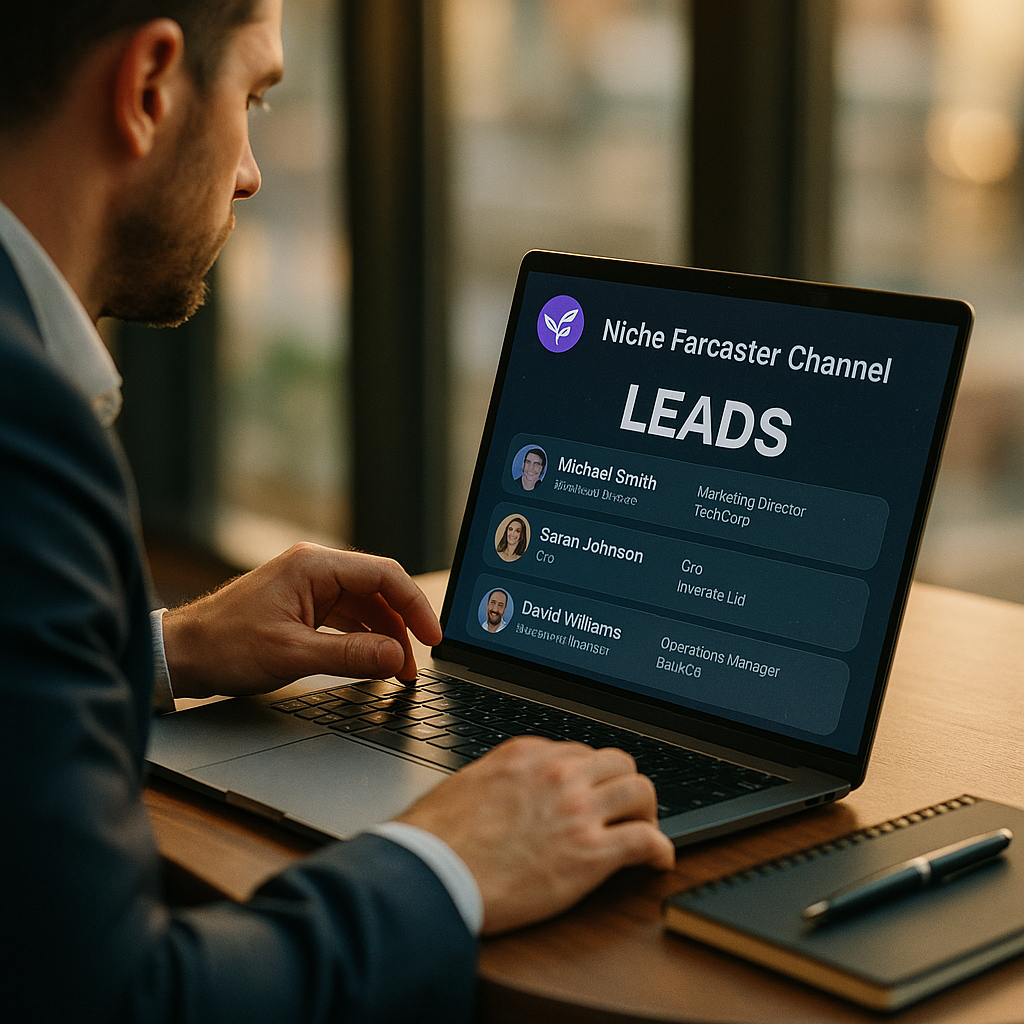
In 2025, attention is fragmented, ad costs keep climbing, and buyers trust peers more than brands. A playbook for reaching high value leads via niche Farcaster channels gives you a repeatable way to meet decision-makers where they already talk, learn, and buy. This article shows how to choose the right channels, earn credibility, and convert interest into meetings—without spamming. Ready to turn conversations into pipeline?
Understanding niche Farcaster channels for B2B growth
Farcaster is a decentralized social protocol where communities form around specific interests and identities. “Channels” act like focused rooms: some revolve around developer tooling, onchain data, AI agents, security, product design, fintech, or local ecosystems. For B2B teams, the advantage is precision—channels concentrate people who share a context, vocabulary, and set of problems.
The goal is not to “go viral.” The goal is to get into the tight loop where buyers, builders, and budget holders trade recommendations. Niche channels often include founders, operators, and technically literate evaluators—exactly the people who influence purchases for infrastructure, SaaS, services, and platforms.
Before you post anything, verify two realities:
- Intent signals exist. Members ask for tools, vendors, integrations, audits, or “what are you using for X?”
- Decision influence exists. The people answering questions ship products, run teams, or control spend—even if they are not the final signer.
If a channel is only memes or generic market talk, it may be great for awareness but weak for qualified lead generation. Your job is to find the intersection of relevance, intent, and authority.
Secondary keyword: High value lead targeting—who to reach and why
High value leads are not defined by job title alone. In Farcaster, influence is often earned through shipping, insight, and helpfulness. Build your target profile around buying context and problem severity, then map it to recognizable onchain and social behaviors.
Create a simple targeting matrix:
- Primary buyer: the person who owns budget and outcomes (e.g., Head of Engineering, CTO, Growth Lead, Security Lead).
- Champion: the hands-on evaluator who will trial your solution and defend it internally (senior engineers, product managers, analysts).
- Influencer: trusted peers who recommend vendors and shape opinions (builders with strong reputations, community operators, researchers).
Then define “high value” using criteria your sales team can act on:
- Urgency: an active project, migration, incident, or launch window.
- Complexity: needs that require a capable vendor (compliance, scale, reliability, security).
- Fit: stack compatibility, use case alignment, and willingness to pay.
Answer the follow-up question your team will ask: “How do we spot them quickly?” Use observable signals:
- They ask for recommendations and specify constraints (“must support X,” “needs SOC2,” “onchain indexer for Y”).
- They share build logs, architecture diagrams, postmortems, or performance benchmarks.
- They respond to technical threads with specifics, not opinions.
Document 10–20 “trigger phrases” that indicate intent. Examples: “looking for,” “anyone using,” “recommend,” “vendor,” “audit,” “alternatives to,” “best practice for,” “need help with,” “migration,” “incident,” “latency,” “costs.”
Secondary keyword: Farcaster channel research—how to find the right communities
Effective channel research is less about tools and more about disciplined observation. Start with a shortlist of topics tied to your strongest outcomes (not your product category). For example, “reduce fraud,” “ship faster,” “improve uptime,” “secure smart contracts,” “cut cloud spend,” “increase activation,” or “index onchain data reliably.”
Use a three-pass approach:
- Pass 1: Discovery. Identify 15–30 channels that mention your problem space or adjacent workflows.
- Pass 2: Qualification. Spend several days reading threads. Track: question quality, member expertise, and whether vendors are discussed constructively.
- Pass 3: Prioritization. Select 5–8 channels to engage consistently for 30 days.
To keep this objective, score each channel (1–5) on:
- Relevance: do discussions match your use cases?
- Density of experts: do credible people answer with details?
- Intent frequency: are there regular “help me choose” threads?
- Noise level: can you follow the thread without wading through unrelated posts?
- Openness to newcomers: do members welcome questions and resources?
Also evaluate cultural fit. Some channels value rigorous citations and benchmarks; others prefer quick summaries and practical templates. Align your content format to the channel’s norms to avoid looking like an outsider running a play.
EEAT note: keep a lightweight internal log of what you observe—screenshots, thread links, and recurring pain points. This becomes a source-of-truth for your messaging, content, and sales enablement.
Secondary keyword: Farcaster lead generation—credibility-first engagement that converts
Most teams fail on Farcaster for one reason: they treat it like a distribution channel instead of a trust channel. In niche communities, members can spot “drive-by promotion” instantly. Your approach should mirror how respected builders behave: show your work, be specific, and help without demanding anything.
Follow a 4-layer engagement model:
1) Listen and summarize. When a thread is active, post a short synthesis that clarifies trade-offs. Example structure: “If you care about X, choose A; if you care about Y, choose B; here’s a gotcha to watch.” This establishes competence without selling.
2) Share proof, not claims. Replace “we’re best-in-class” with verifiable artifacts:
- Benchmarks (with methodology).
- Architecture diagrams or implementation notes.
- Security practices and audit posture (only if true and current).
- Case studies focused on outcomes and constraints.
3) Offer a low-friction next step. Instead of “book a demo,” offer something useful: a teardown, a checklist, or a quick assessment. Example: “If you share your constraints (traffic, chain, latency target), I’ll suggest an approach and pitfalls.”
4) Move to private only when invited by intent. When a member asks a follow-up that involves sensitive details, respond publicly with guidance and propose: “If you want, DM me your constraints and I’ll share a tailored recommendation.”
Handle the likely follow-up: “How often should we post?” Optimize for consistency over volume. A reliable cadence (several helpful replies per week plus one deeper post) typically outperforms sporadic bursts. Your aim is to become a familiar, trusted problem-solver.
What to avoid:
- Generic announcements with no user impact.
- Thread hijacking where your product is not the best answer.
- Link dumping without context, summary, or relevance.
Secondary keyword: Onchain community marketing—content and offers built for trust
In onchain-native communities, trust is earned through transparency and practical utility. Your content should be designed as decision support for technical and operator audiences. The best-performing assets usually answer “How do I do this safely, quickly, and with fewer regrets?”
Build a small content library tailored to channel conversations:
- Implementation guides: “How to migrate without downtime,” “How to set up monitoring for X.”
- Comparisons with clear criteria: “When to use A vs B,” including limitations of your own approach.
- Checklists: security review checklist, evaluation rubric, procurement readiness list.
- Templates: RFP question set, incident runbook, KPI framework.
Package offers that feel like help, not a pitch:
- 15-minute architecture triage: you review constraints and outline options.
- Proof-of-concept plan: a one-page plan with success metrics and risks.
- Risk review: “Top 10 failure modes” relevant to the channel’s topic.
To follow EEAT best practices, make your expertise legible:
- State your role and scope when relevant (“I lead security reviews for…”).
- Explain assumptions and limitations (“This applies when traffic is…”).
- Disclose conflicts when you mention your product (“Full disclosure: I work on…”).
Answer the follow-up: “Should we use incentives?” Use them carefully. In high-signal channels, monetary incentives can reduce trust. If you run a program, tie it to learning and effort (e.g., structured beta with clear feedback requirements) rather than casual referrals.
Secondary keyword: Sales pipeline from Farcaster—qualification, tracking, and handoff
Conversation does not equal pipeline unless you capture intent, qualify quickly, and follow up professionally. Treat Farcaster as a top-of-funnel and mid-funnel environment where qualification happens in public and in DMs—with respect for privacy and community norms.
Set up a simple operating system:
- Intake: tag promising threads and users; record the problem, constraints, and urgency.
- Qualification: ask 3–5 clarifying questions that reveal fit without interrogation: current approach, success metric, timeline, must-have requirements, and blockers.
- Next step: propose a specific action with a clear output (e.g., “I’ll send a 1-page plan,” “Let’s review your constraints in 15 minutes”).
- Handoff: if sales takes over, include thread context, exact pain points, and what the prospect already values.
Use consistent qualification signals to avoid chasing low-quality interest:
- Strong: named project, budget owner involved, clear timeline, stated requirements, willingness to share constraints.
- Medium: exploring options, needs education, unclear timeline, evaluator present.
- Weak: curiosity only, no constraints, asks for “best tool” with no context, unwilling to engage beyond links.
Track what matters:
- Leading indicators: meaningful replies, DMs initiated by prospects, requests for recommendations, repeat interactions with the same accounts.
- Conversion indicators: scheduled calls, POCs started, security reviews requested, procurement steps.
- Quality indicators: deal size range, cycle length, retention likelihood based on fit.
Answer the follow-up: “Can we automate this?” Automate logging and reminders, not relationship-building. Over-automation risks sounding generic, which performs poorly in niche channels. Keep messages human, specific, and tied to the exact thread context.
FAQs
How many niche Farcaster channels should a team focus on at once?
Start with 5–8 channels for 30 days. That’s enough to learn norms, build recognition, and test messages without spreading attention thin. After you identify 2–3 high-intent channels, double down there and keep the rest on a lighter monitoring cadence.
What should I say when disclosing I’m affiliated with a product?
Be direct and brief: “Disclosure: I work on [product].” Then lead with helpful guidance that stands on its own, including when your product is not the best fit. This transparency builds trust and reduces pushback.
How do I avoid being seen as spammy while still generating leads?
Prioritize replies that answer a real question with specifics, and only offer a DM when the discussion requires sensitive details. Share resources with a short summary and why it matters. If you can’t add context, don’t post the link.
What types of posts attract high value leads most reliably?
Technical teardowns, evaluation rubrics, migration playbooks, and “lessons learned” posts from real implementations. These attract serious operators because they reduce risk and save time, which is what high value buyers care about.
How do I measure ROI from Farcaster without perfect attribution?
Use a mix: track thread-to-DM conversions, meetings sourced, POCs initiated, and sales-qualified opportunities influenced. In your CRM, record the originating channel/thread as the source note. Over time, compare cycle length and win rate of Farcaster-sourced deals versus other channels.
Is Farcaster better for technical products than non-technical services?
It’s strongest when your offer can be demonstrated with clear artifacts—benchmarks, frameworks, checklists, or results. Non-technical services can still perform well if you publish concrete deliverables (audit templates, operating cadences, before/after outcomes) and show credible expertise.
Winning in niche channels is not about volume; it is about relevance, proof, and consistent helpfulness. Use focused Farcaster research to pick communities with real intent, engage with credibility-first replies, and offer low-friction next steps that solve immediate problems. When you log context, qualify efficiently, and hand off cleanly, conversations become meetings and meetings become revenue—repeatably.
Top Influencer Marketing Agencies
The leading agencies shaping influencer marketing in 2026
Agencies ranked by campaign performance, client diversity, platform expertise, proven ROI, industry recognition, and client satisfaction. Assessed through verified case studies, reviews, and industry consultations.
Moburst

-
2

The Shelf
Boutique Beauty & Lifestyle Influencer AgencyA data-driven boutique agency specializing exclusively in beauty, wellness, and lifestyle influencer campaigns on Instagram and TikTok. Best for brands already focused on the beauty/personal care space that need curated, aesthetic-driven content.Clients: Pepsi, The Honest Company, Hims, Elf Cosmetics, Pure LeafVisit The Shelf → -
3

Audiencly
Niche Gaming & Esports Influencer AgencyA specialized agency focused exclusively on gaming and esports creators on YouTube, Twitch, and TikTok. Ideal if your campaign is 100% gaming-focused — from game launches to hardware and esports events.Clients: Epic Games, NordVPN, Ubisoft, Wargaming, Tencent GamesVisit Audiencly → -
4

Viral Nation
Global Influencer Marketing & Talent AgencyA dual talent management and marketing agency with proprietary brand safety tools and a global creator network spanning nano-influencers to celebrities across all major platforms.Clients: Meta, Activision Blizzard, Energizer, Aston Martin, WalmartVisit Viral Nation → -
5

The Influencer Marketing Factory
TikTok, Instagram & YouTube CampaignsA full-service agency with strong TikTok expertise, offering end-to-end campaign management from influencer discovery through performance reporting with a focus on platform-native content.Clients: Google, Snapchat, Universal Music, Bumble, YelpVisit TIMF → -
6

NeoReach
Enterprise Analytics & Influencer CampaignsAn enterprise-focused agency combining managed campaigns with a powerful self-service data platform for influencer search, audience analytics, and attribution modeling.Clients: Amazon, Airbnb, Netflix, Honda, The New York TimesVisit NeoReach → -
7

Ubiquitous
Creator-First Marketing PlatformA tech-driven platform combining self-service tools with managed campaign options, emphasizing speed and scalability for brands managing multiple influencer relationships.Clients: Lyft, Disney, Target, American Eagle, NetflixVisit Ubiquitous → -
8

Obviously
Scalable Enterprise Influencer CampaignsA tech-enabled agency built for high-volume campaigns, coordinating hundreds of creators simultaneously with end-to-end logistics, content rights management, and product seeding.Clients: Google, Ulta Beauty, Converse, AmazonVisit Obviously →