


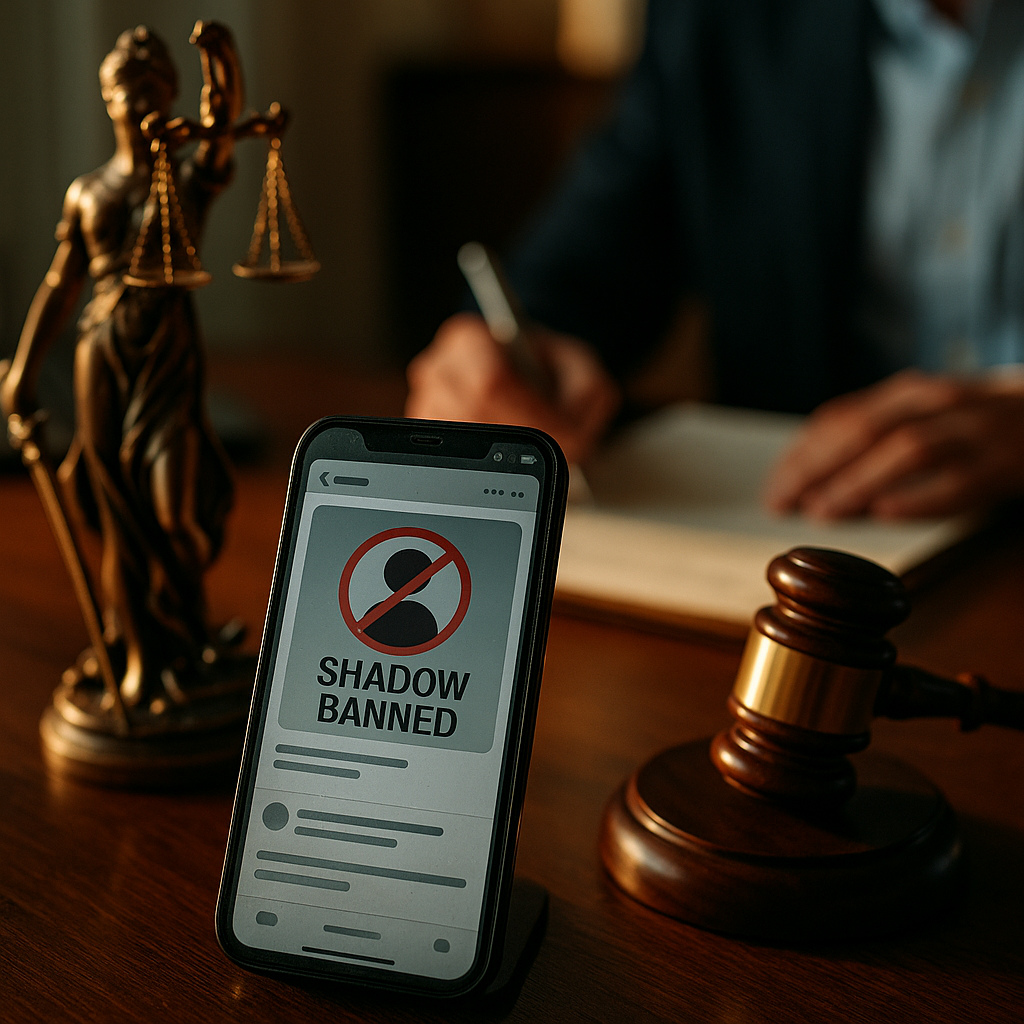
For brands that depend on reach, legal risks of platform shadow banning for brands now demand serious attention. Reduced visibility can damage revenue, partnerships, and customer trust without any clear explanation from the platform. In 2026, the legal questions are no longer theoretical: contracts, consumer protection, and platform accountability all matter. So when does hidden suppression become a real legal problem?
What Shadow Banning Means: platform visibility suppression
Shadow banning usually refers to a platform limiting the visibility of an account, post, ad, or creator without issuing a clear public suspension notice. A brand may still publish content, but reach drops sharply in feeds, search, recommendations, hashtags, or discovery surfaces. The difficult part is that platforms rarely label the action as “shadow banning.” Instead, they may describe it as ranking changes, integrity enforcement, spam prevention, trust-and-safety moderation, or policy-based distribution limits.
For brands, that distinction matters. A drop in impressions alone does not prove hidden suppression. Algorithms change constantly, audience behavior shifts, and competitors increase spend. But when a pattern appears suddenly across multiple content types, geographies, or campaign objectives, legal and operational review becomes necessary.
Typical signs include:
- Sudden reach collapse despite normal posting frequency and stable audience quality
- Search invisibility for branded keywords, hashtags, or creator handles
- Ad account or page limitations without a detailed explanation
- Loss of recommendation eligibility on short-form video, marketplace, or discovery tabs
- Uneven enforcement where similar competitors remain fully visible
Not every suppression event creates a legal claim. Platforms usually reserve broad rights in their terms of service to rank, restrict, label, or remove content. Still, hidden visibility limitations can create legal exposure when they conflict with contractual commitments, mislead business users, trigger unfair treatment, or interfere with commercial relationships in ways the law recognizes.
Why Brands Face Legal Exposure: content moderation liability
Most legal risk discussions focus on whether brands can sue platforms. That is only part of the picture. Brands themselves face exposure when shadow banning affects customers, advertisers, creators, and investors. If a company knows its reach is being restricted but continues making aggressive claims about campaign delivery, audience growth, or guaranteed distribution, that can create downstream problems.
Here are the main legal pressure points brands should evaluate:
- Advertising and sponsorship commitments. If a brand promises certain reach, visibility, or creator amplification and hidden suppression undermines performance, counterparties may allege breach of contract or misrepresentation.
- Consumer protection issues. If a platform’s restrictions cause customer service content, recall notices, or key disclosures to become less visible, regulators may question whether the brand took reasonable steps to communicate material information.
- Investor and partner communications. Public or private companies that describe platform performance inaccurately may create securities, diligence, or disclosure concerns.
- Agency and vendor disputes. Performance drops can trigger conflicts over scope, payment, KPIs, and accountability, especially if contracts did not address platform-side distribution limits.
From an EEAT perspective, brands should treat shadow banning as a governance issue, not just a social media mystery. Helpful internal documentation includes baseline metrics, chronology of account events, platform notices, policy changes, creative samples, and records of business impact. This kind of evidence helps legal teams separate algorithmic volatility from actionable suppression.
Experience also matters. In practice, brands often discover that hidden distribution limits are linked to repeated policy flags, affiliate disclosure failures, metadata issues, sensitive-category targeting, user complaints, or coordinated engagement tactics. A legal review should therefore work closely with marketing, compliance, and platform operations teams rather than assuming the platform acted arbitrarily.
Contract Issues and Brand Rights: terms of service disputes
The first legal document to examine is the platform contract. In 2026, most major platforms structure business relationships through layered terms: general terms of service, advertising terms, commerce terms, developer policies, monetization policies, branded content rules, and community guidelines. These documents often give platforms broad discretion, but they do not eliminate all legal arguments.
Key contract questions include:
- Did the platform promise any minimum access, distribution, review process, or appeal rights?
- Does the contract limit arbitrary enforcement or require good-faith performance?
- Were policy updates communicated clearly before enforcement?
- Is there a dispute resolution clause, arbitration mandate, forum selection rule, or class action waiver?
- Are there separate enterprise or managed-service agreements with stronger obligations than the public terms?
Brands with strategic platform partnerships sometimes have better leverage than ordinary users because negotiated insertion orders, reseller arrangements, managed account terms, or creator marketplace agreements may include service commitments. Even then, platforms generally avoid guaranteeing organic reach. The strongest claims usually arise when a platform made specific business representations, then took action inconsistent with those statements.
Brands should also review their own contracts. If a company sells influencer packages, paid social campaigns, marketplace placements, or affiliate programs, the agreement should address what happens when a platform restricts visibility. Strong clauses can:
- Define platform actions as a performance exception or force-majeure-like operational event
- Limit liability for algorithmic or moderation-driven reach losses outside the brand’s control
- Require prompt notice and cooperation if an account is restricted
- Set revised KPIs, make-goods, or alternate distribution channels
- Preserve audit trails and data access for dispute resolution
Without these protections, a brand may absorb losses even when the immediate cause lies with the platform.
Regulatory Scrutiny and Fairness: unfair platform practices
Regulators worldwide continue to examine the power platforms hold over business users. A central concern is transparency: if a platform can suppress commercial speech or reduce visibility without clear notice, consistent standards, or meaningful appeal, authorities may ask whether that conduct is unfair, deceptive, discriminatory, or anti-competitive under applicable law.
For brands, the legal relevance depends on jurisdiction, sector, and platform type. Common regulatory themes include:
- Transparency obligations. Platforms may face duties to explain ranking parameters, moderation systems, or major enforcement reasons, especially for business users.
- Consumer protection. Hidden limitations can become problematic if they distort marketplace fairness or mislead merchants about expected visibility.
- Competition concerns. If a platform favors its own products, preferred sellers, or specific content formats while suppressing others without neutral criteria, competition law questions may arise.
- Due process and appeals. Increasingly, regulators look at whether businesses receive practical mechanisms to challenge restrictions.
This does not mean every brand should rush to frame shadow banning as a regulatory violation. Agencies and courts usually expect evidence: comparative treatment, internal platform messages, policy inconsistency, measurable commercial harm, and efforts to seek clarification. Still, the compliance environment in 2026 makes platform opacity a more serious legal issue than it was treated in the past.
Brands in regulated sectors such as health, finance, alcohol, gaming, and politics face added complexity. Sometimes visibility suppression occurs because the platform applies stricter rules to sensitive categories. If a brand fails to understand those rules, it may blame “shadow banning” when the real issue is lawful enforcement. That is why a legal assessment should start with the category-specific policies and any applicable statutory restrictions on the advertising itself.
How to Prove Harm: evidence for shadow banning claims
A legal complaint rises or falls on evidence. The biggest challenge in shadow banning disputes is proving both the hidden restriction and the business damage it caused. Because platforms control most of the relevant data, brands need disciplined internal records from the first sign of abnormal suppression.
Useful evidence includes:
- Before-and-after analytics covering reach, engagement, click-through rates, conversions, follower growth, and search visibility
- Content-level comparisons showing similar creative before suppression and after suppression
- Platform communications such as warnings, support tickets, review decisions, policy notices, or account health dashboards
- Competitive benchmarks demonstrating unusual divergence from peer accounts in the same category
- Revenue impact records including lost sales, canceled campaigns, make-goods, refunds, and creator disputes
- Technical evidence such as screenshot archives, API logs where available, and discovery tests from neutral accounts
Brands should avoid overclaiming. A single viral miss or a temporary recommendation drop rarely proves hidden suppression. Stronger patterns involve multiple indicators over time, especially after a specific moderation event, keyword change, policy label, or account status shift.
Expert analysis can also help. Data scientists, digital forensics professionals, and experienced platform counsel may identify whether the issue reflects ranking changes, user-quality problems, ad-delivery constraints, or direct visibility restrictions. That kind of analysis supports both litigation readiness and practical recovery efforts.
If the harm is substantial, legal counsel may consider preservation notices, arbitration strategy, pre-suit demands, insurance review, and partner communications. But in many cases, the immediate priority is less about filing a claim and more about building a credible record that prompts escalation within the platform’s business support channels.
Risk Management for 2026: social media compliance strategy
The smartest response to shadow banning risk is prevention plus rapid escalation. Brands should assume that platform visibility is conditional, data access is imperfect, and enforcement systems are partly automated. A modern compliance strategy reduces both legal exposure and operational disruption.
A strong 2026 playbook includes:
- Audit platform dependencies. Identify which products, creators, regions, and revenue lines rely too heavily on a single platform.
- Map policy triggers. Review ad policies, community guidelines, branded content rules, restricted-category standards, and disclosure requirements for every active channel.
- Create escalation protocols. Decide who owns legal review, platform support outreach, PR messaging, and partner notice if suppression is suspected.
- Strengthen contract language. Update creator, agency, and advertiser agreements to address hidden platform restrictions and alternative performance remedies.
- Document everything. Maintain consistent analytics snapshots, account health records, and evidence archives.
- Diversify distribution. Build owned channels like email, SMS, apps, communities, and web content so one platform cannot quietly cut off customer access.
- Train teams. Marketers, community managers, legal, and customer support should all know how policy enforcement affects commercial obligations.
Brands also need realistic expectations. Platforms have broad rights to protect user experience and brand safety. Not every opaque decision is unlawful. But when commercial visibility is restricted without transparency, and that restriction causes measurable harm, legal risk becomes real for everyone involved. The brands that respond best are the ones with evidence, process, and diversified channels before a crisis starts.
FAQs: brand account restrictions
What is the difference between shadow banning and a normal algorithm change?
A normal algorithm change affects distribution rules broadly and often unevenly across content types. Shadow banning usually implies account-specific or content-specific visibility suppression with limited notice. The distinction is not always clear, which is why evidence and trend analysis matter.
Can a brand sue a platform for shadow banning?
Sometimes, but success depends on the contract, the jurisdiction, the evidence, and the actual conduct involved. Broad platform discretion often limits claims. Stronger cases usually involve specific promises, inconsistent enforcement, unfair commercial practices, or measurable business harm tied to documented restrictions.
Is shadow banning illegal in 2026?
Not automatically. Platforms can often rank or restrict content under their terms and policies. It may become legally problematic if the conduct is deceptive, discriminatory, anti-competitive, inconsistent with contractual duties, or part of unfair treatment of business users under applicable law.
What should a brand do first if it suspects shadow banning?
Start preserving evidence. Capture analytics, screenshots, account status information, support messages, and content samples. Then review platform policies, identify any recent flags or changes, and escalate through business support channels. If commercial harm is significant, involve legal counsel early.
Can hidden suppression create problems with influencers or advertisers?
Yes. If a brand promised campaign reach, placements, or discoverability, shadow banning can trigger disputes over underperformance, payment, or disclosure. Contracts should explain how platform restrictions affect KPIs, timelines, make-goods, and liability.
How can brands reduce the legal risk of future platform suppression?
Diversify channels, strengthen compliance reviews, monitor account health, improve disclosure practices, and add protective contract terms. Build internal escalation procedures so legal, marketing, and platform teams can respond quickly and consistently.
Platform visibility is now a legal and commercial asset, not just a marketing metric. Brands that understand the legal risks of platform shadow banning can respond faster, preserve better evidence, and protect contracts, customers, and reputation. The clearest takeaway for 2026 is simple: do not rely on platform trust alone. Build documentation, tighten agreements, and diversify distribution before hidden suppression turns into measurable loss.
Top Influencer Marketing Agencies
The leading agencies shaping influencer marketing in 2026
Agencies ranked by campaign performance, client diversity, platform expertise, proven ROI, industry recognition, and client satisfaction. Assessed through verified case studies, reviews, and industry consultations.
Moburst

-
2

The Shelf
Boutique Beauty & Lifestyle Influencer AgencyA data-driven boutique agency specializing exclusively in beauty, wellness, and lifestyle influencer campaigns on Instagram and TikTok. Best for brands already focused on the beauty/personal care space that need curated, aesthetic-driven content.Clients: Pepsi, The Honest Company, Hims, Elf Cosmetics, Pure LeafVisit The Shelf → -
3

Audiencly
Niche Gaming & Esports Influencer AgencyA specialized agency focused exclusively on gaming and esports creators on YouTube, Twitch, and TikTok. Ideal if your campaign is 100% gaming-focused — from game launches to hardware and esports events.Clients: Epic Games, NordVPN, Ubisoft, Wargaming, Tencent GamesVisit Audiencly → -
4

Viral Nation
Global Influencer Marketing & Talent AgencyA dual talent management and marketing agency with proprietary brand safety tools and a global creator network spanning nano-influencers to celebrities across all major platforms.Clients: Meta, Activision Blizzard, Energizer, Aston Martin, WalmartVisit Viral Nation → -
5

The Influencer Marketing Factory
TikTok, Instagram & YouTube CampaignsA full-service agency with strong TikTok expertise, offering end-to-end campaign management from influencer discovery through performance reporting with a focus on platform-native content.Clients: Google, Snapchat, Universal Music, Bumble, YelpVisit TIMF → -
6

NeoReach
Enterprise Analytics & Influencer CampaignsAn enterprise-focused agency combining managed campaigns with a powerful self-service data platform for influencer search, audience analytics, and attribution modeling.Clients: Amazon, Airbnb, Netflix, Honda, The New York TimesVisit NeoReach → -
7

Ubiquitous
Creator-First Marketing PlatformA tech-driven platform combining self-service tools with managed campaign options, emphasizing speed and scalability for brands managing multiple influencer relationships.Clients: Lyft, Disney, Target, American Eagle, NetflixVisit Ubiquitous → -
8

Obviously
Scalable Enterprise Influencer CampaignsA tech-enabled agency built for high-volume campaigns, coordinating hundreds of creators simultaneously with end-to-end logistics, content rights management, and product seeding.Clients: Google, Ulta Beauty, Converse, AmazonVisit Obviously →