


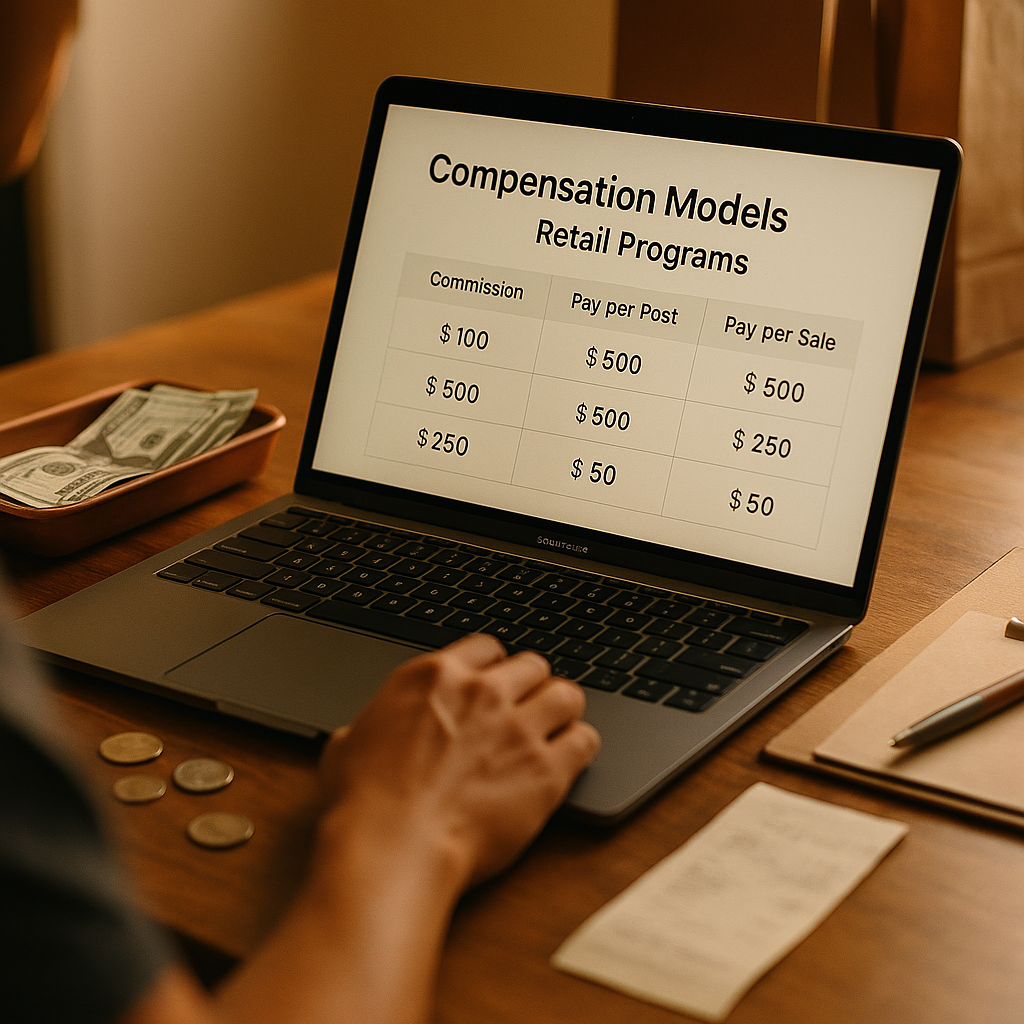
Retail Creator Program Design: Commission-Only, Challenge-Based, and Hybrid Compensation Compared
Seventy-one percent of retail brands now run a formal creator program — yet fewer than a quarter say their compensation model actually aligns with business outcomes. That disconnect is expensive. As retail creator program design matures, the gap between brands that pick the right pay structure and brands that bleed margin on misaligned incentives keeps widening. Three dominant models have emerged: commission-only, challenge-based, and hybrid compensation. Each carries distinct implications for DTC and mass-market operators.
Why Compensation Architecture Matters More Than Headcount
Most program managers obsess over recruiting more creators. That’s the wrong lever. The compensation model you choose determines which creators apply, how they behave once activated, and whether the content they produce serves upper-funnel brand building or lower-funnel conversion — or neither.
Think of it this way: a commission-only structure self-selects for deal-closers. A challenge-based model attracts storytellers. A hybrid tries to get both, but adds operational complexity. None is universally superior. The right answer depends on your margin profile, attribution infrastructure, and how much creative control you’re willing to surrender.
The compensation model is the program. Everything else — onboarding, creative briefs, reporting cadence — follows from how you pay.
Before diving into each model, a quick framing note: DTC brands and mass-market retailers face structurally different challenges. DTC brands typically own the checkout flow, have first-party attribution, and can afford to pay higher commissions because they keep the full margin. Mass-market brands often sell through third-party retailers, deal with broken attribution chains, and need to justify spend against trade-marketing budgets. Keep that tension in mind throughout.
Commission-Only: The Pure Performance Play
Commission-only programs pay creators a percentage of each sale they drive, typically tracked via affiliate links or unique discount codes. Platforms like Shopify Collabs and impact.com have made this operationally trivial to set up.
Where it works: DTC brands with average order values above $50, strong product-market fit, and a conversion-optimized site. Commission-only is also effective when you’re scaling a long-tail army of micro-creators who each drive modest but measurable revenue.
Where it breaks: Mass-market brands selling $8 shampoo through Target. The math doesn’t work. A 15% commission on an $8 product nets the creator $1.20 per sale. Even a creator driving 50 units a month earns $60. That’s not compensation — it’s an insult.
Commission-only also introduces a subtler risk: content quality erosion. When creators are paid only on conversion, they optimize for hard-sell tactics — countdown timers, fake urgency, aggressive CTAs. That might juice short-term ROAS, but it can erode brand equity over time. Brands serious about brand equity and valuation need to weigh this carefully.
One more wrinkle: attribution windows. Most affiliate platforms default to a 30-day last-click window. But if your customer journey involves three TikTok videos, a Google search, and a retargeting ad before checkout, the creator who sparked initial interest gets nothing. Commission-only programs systematically under-reward top-of-funnel creators and over-reward bottom-of-funnel ones.
Challenge-Based Compensation: Paying for Actions, Not Outcomes
Challenge-based models pay creators for completing specific tasks — posting a Reel, hitting a view threshold, participating in a branded hashtag campaign, or submitting UGC that meets creative specs. Payment is fixed and predictable.
This model has gained traction because of platforms like TikTok’s creator marketplace and emerging tools that let brands set up gamified missions. If you’re curious about the mechanics, our deep dive on gamified creator compensation covers how leading programs structure these incentives.
Where it works: Product launches, awareness campaigns, and mass-market brands where direct attribution to a sale is impractical. Challenge-based pay also excels when you need volume — say, 500 pieces of UGC for a seasonal push — and care more about content production than trackable conversions.
Where it breaks: Sustained, always-on programs. Challenge-based models are inherently campaign-shaped. They spike engagement, then flatline. You also risk paying for vanity outputs: a creator posts the Reel, collects $200, and the content gets 300 views. You’ve paid for activity, not impact.
The FTC’s updated endorsement guidelines add another consideration. Challenge-based payments are clearly “material connections,” requiring disclosure. That’s fine — but brands need robust compliance workflows when running challenges at scale. The FTC’s endorsement guidance leaves little room for ambiguity here.
The Hybrid Model: Harder to Build, Harder to Beat
Hybrid compensation blends a base payment (fixed fee or challenge reward) with a performance kicker (commission, bonus tier, or revenue share). It’s the most operationally complex model — and, when executed well, the most effective.
Here’s what a well-designed hybrid looks like in practice:
- Base layer: $150–$500 per content deliverable, depending on creator tier and production quality expectations.
- Performance layer: 8–15% commission on attributed sales, with a 14-day multi-touch attribution window.
- Bonus layer: Quarterly bonuses for creators who exceed a GMV threshold or maintain content consistency (e.g., 4+ posts per month for 3 consecutive months).
The base layer solves recruitment. Talented creators — the ones who actually move product — won’t work for free on the promise of commissions alone. The performance layer aligns incentives. The bonus layer drives retention and reduces churn, which is critical when you consider that replacing a top-performing creator costs 3–5x their monthly payout in recruitment, onboarding, and ramp-up time.
According to CreatorIQ’s benchmarking data, hybrid programs retain creators 2.4x longer than commission-only programs and generate 37% higher content volume per creator per quarter.
The downside? You need infrastructure. Hybrid programs require clean attribution, a CRM or creator management platform (like CreatorIQ, Grin, or AspireIQ), and a finance team willing to manage variable payouts. Brands building always-on creator activation teams should consider hybrid as the default model from day one.
DTC vs. Mass-Market: Same Models, Different Math
A DTC skincare brand selling a $65 serum directly through its site can afford a generous hybrid — $200 base plus 12% commission — because its gross margins sit around 75%. A mass-market CPG brand selling a $12 body wash through Walmart.com faces an entirely different equation. The brand doesn’t own checkout. Attribution is spotty. Margins after retail take-rate hover around 35%.
For mass-market brands, challenge-based models often make more sense as the primary structure, with a lightweight affiliate layer bolted on for creators who can drive measurable e-commerce traffic. Some brands are experimenting with retailer-specific affiliate links (Amazon Attribution, Walmart Creator) to close the attribution gap, but these tools remain inconsistent.
DTC brands, conversely, should lean into hybrid or commission-heavy structures that reward their best performers disproportionately. The top 5% of creators in most DTC programs drive 40–60% of total attributed revenue. Identifying and nurturing these high-performance creators is where the real ROI lives.
A Decision Framework, Not a Formula
Rather than prescribing a single model, use these questions to guide your choice:
- Can you attribute sales to individual creators? If yes, commission or hybrid. If no, challenge-based.
- Is your AOV above $30? If yes, commission rates can be meaningful. If no, base pay is essential for recruitment.
- Are you running campaigns or an always-on program? Campaigns suit challenge-based. Always-on demands hybrid.
- How important is content quality vs. volume? High-quality expectations require base pay. Volume plays can rely more on commission.
- What does your finance team support? Variable payouts need CFO buy-in. Fixed challenge fees are simpler to budget. Explore how shifting away from seasonal budgeting opens up flexibility for hybrid structures.
The brands winning in retail creator program design aren’t picking a model from a menu. They’re stress-testing compensation structures against their specific margin economics, attribution capabilities, and brand-building goals — then iterating quarterly.
Your next step: Audit your current creator program’s payout data. Calculate the per-creator revenue contribution distribution. If fewer than 10% of creators drive more than 50% of results, you likely need a hybrid model that rewards the top tier differently — and you need it before next quarter’s planning cycle.
FAQs
What is the best compensation model for a DTC retail creator program?
For most DTC brands, a hybrid compensation model works best because it combines a base payment to attract quality creators with performance-based commissions that align incentives around revenue. DTC brands with strong first-party attribution and gross margins above 60% are ideally positioned for hybrid structures that reward top-performing creators disproportionately.
How do mass-market brands compensate creators when direct attribution is difficult?
Mass-market brands typically rely on challenge-based compensation as their primary model, paying creators fixed fees for completing specific content deliverables. They can supplement this with lightweight affiliate layers using retailer-specific attribution tools like Amazon Attribution or Walmart Creator, though these tools remain inconsistent in tracking accuracy.
What commission rates are standard for retail creator programs?
Commission rates for retail creator programs typically range from 8% to 20%, depending on product category, average order value, and margin profile. DTC brands with higher margins often offer 10–15% base commissions with bonus tiers for top performers, while mass-market brands with tighter margins usually stay in the 5–10% range when commissions are offered at all.
How do you prevent content quality from declining in commission-only programs?
Commission-only programs tend to incentivize hard-sell content that prioritizes short-term conversion over brand building. To mitigate this, brands can add content quality requirements as eligibility criteria for higher commission tiers, implement creative review processes, or shift to a hybrid model that includes a base payment contingent on meeting brand guidelines and production standards.
What tools are needed to run a hybrid creator compensation program?
Running a hybrid program requires a creator management platform such as CreatorIQ, Grin, or AspireIQ for tracking deliverables and managing relationships; a multi-touch attribution system to credit sales accurately; and a flexible finance or payments infrastructure that can handle both fixed and variable creator payouts at scale on a regular cadence.
Top Influencer Marketing Agencies
The leading agencies shaping influencer marketing in 2026
Agencies ranked by campaign performance, client diversity, platform expertise, proven ROI, industry recognition, and client satisfaction. Assessed through verified case studies, reviews, and industry consultations.
Moburst

-
2

The Shelf
Boutique Beauty & Lifestyle Influencer AgencyA data-driven boutique agency specializing exclusively in beauty, wellness, and lifestyle influencer campaigns on Instagram and TikTok. Best for brands already focused on the beauty/personal care space that need curated, aesthetic-driven content.Clients: Pepsi, The Honest Company, Hims, Elf Cosmetics, Pure LeafVisit The Shelf → -
3

Audiencly
Niche Gaming & Esports Influencer AgencyA specialized agency focused exclusively on gaming and esports creators on YouTube, Twitch, and TikTok. Ideal if your campaign is 100% gaming-focused — from game launches to hardware and esports events.Clients: Epic Games, NordVPN, Ubisoft, Wargaming, Tencent GamesVisit Audiencly → -
4

Viral Nation
Global Influencer Marketing & Talent AgencyA dual talent management and marketing agency with proprietary brand safety tools and a global creator network spanning nano-influencers to celebrities across all major platforms.Clients: Meta, Activision Blizzard, Energizer, Aston Martin, WalmartVisit Viral Nation → -
5

The Influencer Marketing Factory
TikTok, Instagram & YouTube CampaignsA full-service agency with strong TikTok expertise, offering end-to-end campaign management from influencer discovery through performance reporting with a focus on platform-native content.Clients: Google, Snapchat, Universal Music, Bumble, YelpVisit TIMF → -
6

NeoReach
Enterprise Analytics & Influencer CampaignsAn enterprise-focused agency combining managed campaigns with a powerful self-service data platform for influencer search, audience analytics, and attribution modeling.Clients: Amazon, Airbnb, Netflix, Honda, The New York TimesVisit NeoReach → -
7

Ubiquitous
Creator-First Marketing PlatformA tech-driven platform combining self-service tools with managed campaign options, emphasizing speed and scalability for brands managing multiple influencer relationships.Clients: Lyft, Disney, Target, American Eagle, NetflixVisit Ubiquitous → -
8

Obviously
Scalable Enterprise Influencer CampaignsA tech-enabled agency built for high-volume campaigns, coordinating hundreds of creators simultaneously with end-to-end logistics, content rights management, and product seeding.Clients: Google, Ulta Beauty, Converse, AmazonVisit Obviously →