


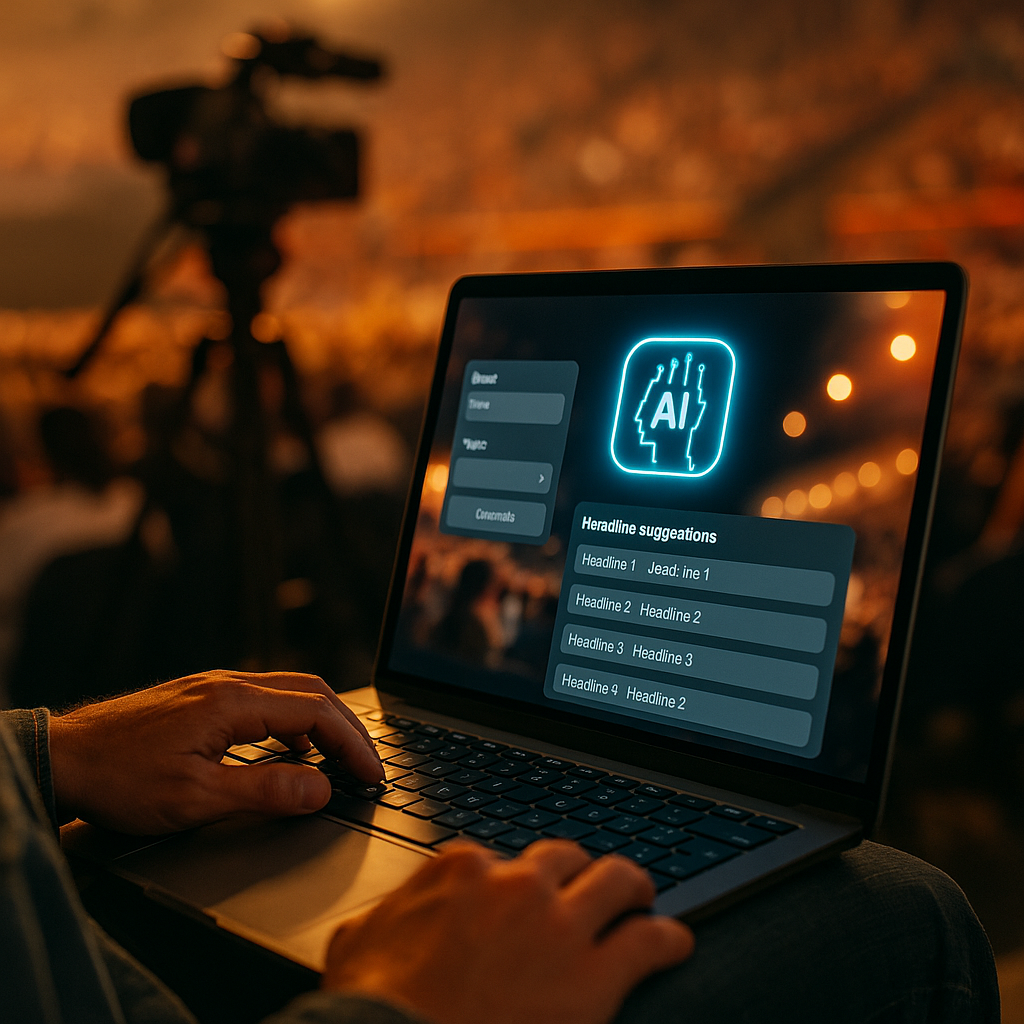
The 90-Second Window That Separates Winners From Watchers
Brands that activate real-time creative during cultural moments see engagement rates 3–4x higher than those running pre-produced assets, according to eMarketer research. Yet most brand teams still can’t move fast enough. The bottleneck isn’t creative talent—it’s operational readiness. AI headline generation for live-event advertising has matured past novelty status. The question now: does your team have the playbook to actually use it under pressure?
Why Pre-Produced Creative Keeps Losing the Moment
Think about the last Super Bowl, awards show, or product-launch livestream your brand tried to capitalize on. Odds are your “real-time” social post went live 45 minutes after the moment peaked—an eternity in algorithmic timelines. Pre-produced assets are safe. They’re also stale the instant context shifts.
The math is brutal. A headline written and approved within 90 seconds of a cultural flashpoint captures peak search and social velocity. The same headline deployed 20 minutes later competes with thousands of other brands who also noticed the moment. AI-generated headlines don’t guarantee speed, but they collapse the creative generation step from minutes to seconds—shifting the constraint entirely to your approval pipeline.
The real competitive advantage isn’t having AI that writes headlines. It’s having an approval workflow fast enough to let those headlines reach the audience while the moment still matters.
This is an operational problem, not a technology problem. And operational problems demand playbooks.
Building the Approval Workflow: Three Tiers, Not One Committee
Most brand approval chains were designed for campaign creative with two-week lead times. They collapse under real-time pressure. The fix isn’t removing approvals—it’s restructuring them into parallel tiers with pre-defined authority.
Tier 1: Auto-Approved (0–15 seconds). Headlines that swap only pre-approved dynamic variables into pre-approved templates. Example: “[Event Name] just got interesting. [Brand tagline].” The AI fills slots. No human review needed because the template was reviewed weeks earlier. This tier handles 40–60% of real-time output.
Tier 2: Single-Approver (15–90 seconds). Headlines with novel phrasing but no risk flags. One designated approver—not a committee—has authority to greenlight. This person sits in the war room during the event, phone in hand. Their job is binary: approve or kill. No rewrites.
Tier 3: Escalated Review (90 seconds–5 minutes). Headlines that trigger brand-safety flags—political references, competitor mentions, tragedy-adjacent language. Two approvers required. If they can’t align within five minutes, the headline dies. Period.
The key insight: tier assignments happen before the event, not during it. Your AI system must classify every generated headline into a tier automatically based on rules your legal and brand teams define in advance. If you’re evaluating AI ad creative governance frameworks, the tier-classification logic is where most teams underinvest.
Brand Safety Gates That Don’t Kill Speed
Brand safety in real-time AI creative is non-negotiable. It’s also where most playbooks stall. The instinct is to add more checkpoints. The correct instinct is to front-load safety into the AI’s generation constraints.
Here’s what works:
- Negative keyword libraries updated per-event. Before the Grammys, you block references to specific controversies. Before a sporting final, you block opponent-disparaging language. These libraries feed directly into the AI’s prompt constraints, not into a post-generation filter.
- Sentiment scoring at generation time. Tools like Brandwatch and Sprinklr now offer API-level sentiment checks that can evaluate a headline in under 200 milliseconds. Wire them into the pipeline between generation and tier classification.
- Hard kills on specific entity mentions. Politicians, minors, tragedies—build an immutable block list that the AI cannot override regardless of prompt. This is table stakes, yet a surprising number of brand teams still rely on human reviewers to catch these.
For teams building more sophisticated guardrails, the frameworks emerging around securing customer-facing AI agents translate directly to real-time ad creative pipelines. The principles are identical: constrain at the model level, validate at the output level, and log everything.
One more thing: every headline your AI generates during a live event should be logged with a timestamp, the prompt that triggered it, the tier classification, and the approval decision. If regulators or your CMO ask questions six months later, you need the receipts.
Disclosure Requirements: What the FTC Expects Right Now
The FTC’s updated guidance on AI-generated advertising content requires clear disclosure when AI materially contributes to consumer-facing creative. “Materially” is doing a lot of work in that sentence, and the enforcement landscape is still evolving. But the safe-money position is straightforward: disclose.
For live-event AI headlines deployed as paid social ads, this means:
- Platform-level disclosure tags. Meta, TikTok, and Google all now support AI-generated content labels within their ad managers. Use them. They’re not optional if the creative is substantially AI-produced.
- Influencer amplification adds layers. If a creator reposts or riffs on your AI-generated headline, their disclosure obligations stack on top of yours. Brief creators before the event—not after. Teams already managing narrative drift in influencer contracts will recognize this pattern: the further content travels from the original source, the higher the compliance risk.
- Ephemeral formats are not exempt. Stories, live overlays, and disappearing posts still require disclosure. The FTC has been explicit: the format doesn’t change the obligation.
Build disclosure into your templates at Tier 1. For Tier 2 and Tier 3 headlines, make disclosure a mandatory field the approver must confirm before the headline ships. Automate what you can; verify what you can’t.
Performance Benchmarking: AI Real-Time vs. Pre-Produced Assets
Here’s where the business case gets concrete. Brand teams piloting real-time AI headlines during live events are reporting meaningful performance deltas against pre-produced assets—but the picture is nuanced.
Early benchmarks from Q1 show AI-generated real-time headlines outperforming pre-produced equivalents by 2.1–3.8x on click-through rate, while conversion rate differences are statistically insignificant for most categories. Speed wins attention; pre-produced creative still wins on message depth.
What to measure:
- Time-to-publish. The gap between cultural moment and first ad impression. AI pipelines with Tier 1 auto-approval consistently achieve sub-60-second deployment. Pre-produced assets average 15–30 minutes even with dedicated social teams.
- Engagement velocity. Likes, shares, and comments within the first five minutes of publication. This is where AI-generated headlines dominate because they ride the algorithmic wave of the event itself.
- Downstream attribution. This is harder and where most teams fumble the measurement. If you’re struggling with AI-powered attribution models, the same challenges apply here—real-time creative often seeds awareness that converts through entirely different channels days later.
- Brand lift. Run post-event brand-lift studies that isolate audiences exposed to real-time AI creative vs. pre-produced assets. Meta’s brand lift tools and TikTok’s measurement suite both support this segmentation natively.
The honest takeaway from current data: AI real-time headlines are a top-of-funnel accelerant, not a full-funnel replacement. The smartest brand teams run both—using AI-generated real-time creative for moment capture and pre-produced assets for sustained conversion messaging in the hours and days after.
The War Room Checklist: What to Have Ready Before the Event
Playbooks mean nothing if the pieces aren’t staged. Before your next live-event activation, confirm these are in place:
- AI headline generation tool connected to your ad platforms via API (not manual copy-paste)
- Tier classification rules reviewed and signed off by legal, brand, and the single-approver designee
- Negative keyword library updated for the specific event
- Sentiment scoring API tested and latency-verified under load
- Disclosure templates embedded in every ad format you plan to use
- Creator briefing documents distributed with explicit AI-content disclosure language
- Performance dashboards configured to segment AI real-time vs. pre-produced assets in real time
- Post-event audit log export tested and working
If your broader generative AI creative stack doesn’t support API-level ad platform integration yet, fix that before you attempt live-event activation. Manual workflows cannot sustain the speed this strategy demands.
Your next step: Pick one upcoming cultural moment—not the biggest one, a mid-tier event—and run a controlled pilot with AI-generated headlines against your pre-produced assets. Measure the five metrics above. The data from that single test will tell you exactly where your approval pipeline breaks and what to fix before the stakes get real.
FAQs
What tools are best for AI headline generation during live events?
Platforms like Jasper, Copy.ai, and Persado offer API-level headline generation with customizable brand voice settings. The critical factor is not the generation tool itself but its ability to integrate with your ad platform APIs and brand-safety middleware for sub-60-second deployment pipelines.
How do you handle FTC disclosure for AI-generated ad headlines?
Use platform-native AI content labels available on Meta, TikTok, and Google ad managers. Embed disclosure language into your Tier 1 templates and require approvers to confirm disclosure compliance before publishing Tier 2 and Tier 3 headlines. Brief influencers on their stacking disclosure obligations before the event.
Do AI-generated real-time headlines outperform pre-produced ad creative?
Early benchmarks show AI real-time headlines outperform pre-produced assets by 2.1–3.8x on click-through rate due to algorithmic timing advantages. However, conversion rates remain comparable. The most effective strategy combines AI-generated headlines for immediate moment capture with pre-produced assets for sustained conversion messaging.
What approval workflow structure works for real-time AI ad creative?
A three-tier system works best. Tier 1 uses pre-approved templates with dynamic variables for auto-approval in under 15 seconds. Tier 2 assigns a single approver for novel-but-safe headlines within 90 seconds. Tier 3 escalates risk-flagged headlines to two reviewers with a five-minute hard deadline before the headline is killed.
How do you ensure brand safety with AI-generated headlines during live events?
Front-load safety into the AI’s generation constraints using event-specific negative keyword libraries, sub-200-millisecond sentiment scoring APIs from tools like Brandwatch or Sprinklr, and immutable block lists for sensitive entity mentions. Log every generated headline with its prompt, tier classification, and approval decision for post-event auditing.
Top Influencer Marketing Agencies
The leading agencies shaping influencer marketing in 2026
Agencies ranked by campaign performance, client diversity, platform expertise, proven ROI, industry recognition, and client satisfaction. Assessed through verified case studies, reviews, and industry consultations.
Moburst

-
2

The Shelf
Boutique Beauty & Lifestyle Influencer AgencyA data-driven boutique agency specializing exclusively in beauty, wellness, and lifestyle influencer campaigns on Instagram and TikTok. Best for brands already focused on the beauty/personal care space that need curated, aesthetic-driven content.Clients: Pepsi, The Honest Company, Hims, Elf Cosmetics, Pure LeafVisit The Shelf → -
3

Audiencly
Niche Gaming & Esports Influencer AgencyA specialized agency focused exclusively on gaming and esports creators on YouTube, Twitch, and TikTok. Ideal if your campaign is 100% gaming-focused — from game launches to hardware and esports events.Clients: Epic Games, NordVPN, Ubisoft, Wargaming, Tencent GamesVisit Audiencly → -
4

Viral Nation
Global Influencer Marketing & Talent AgencyA dual talent management and marketing agency with proprietary brand safety tools and a global creator network spanning nano-influencers to celebrities across all major platforms.Clients: Meta, Activision Blizzard, Energizer, Aston Martin, WalmartVisit Viral Nation → -
5

The Influencer Marketing Factory
TikTok, Instagram & YouTube CampaignsA full-service agency with strong TikTok expertise, offering end-to-end campaign management from influencer discovery through performance reporting with a focus on platform-native content.Clients: Google, Snapchat, Universal Music, Bumble, YelpVisit TIMF → -
6

NeoReach
Enterprise Analytics & Influencer CampaignsAn enterprise-focused agency combining managed campaigns with a powerful self-service data platform for influencer search, audience analytics, and attribution modeling.Clients: Amazon, Airbnb, Netflix, Honda, The New York TimesVisit NeoReach → -
7

Ubiquitous
Creator-First Marketing PlatformA tech-driven platform combining self-service tools with managed campaign options, emphasizing speed and scalability for brands managing multiple influencer relationships.Clients: Lyft, Disney, Target, American Eagle, NetflixVisit Ubiquitous → -
8

Obviously
Scalable Enterprise Influencer CampaignsA tech-enabled agency built for high-volume campaigns, coordinating hundreds of creators simultaneously with end-to-end logistics, content rights management, and product seeding.Clients: Google, Ulta Beauty, Converse, AmazonVisit Obviously →