


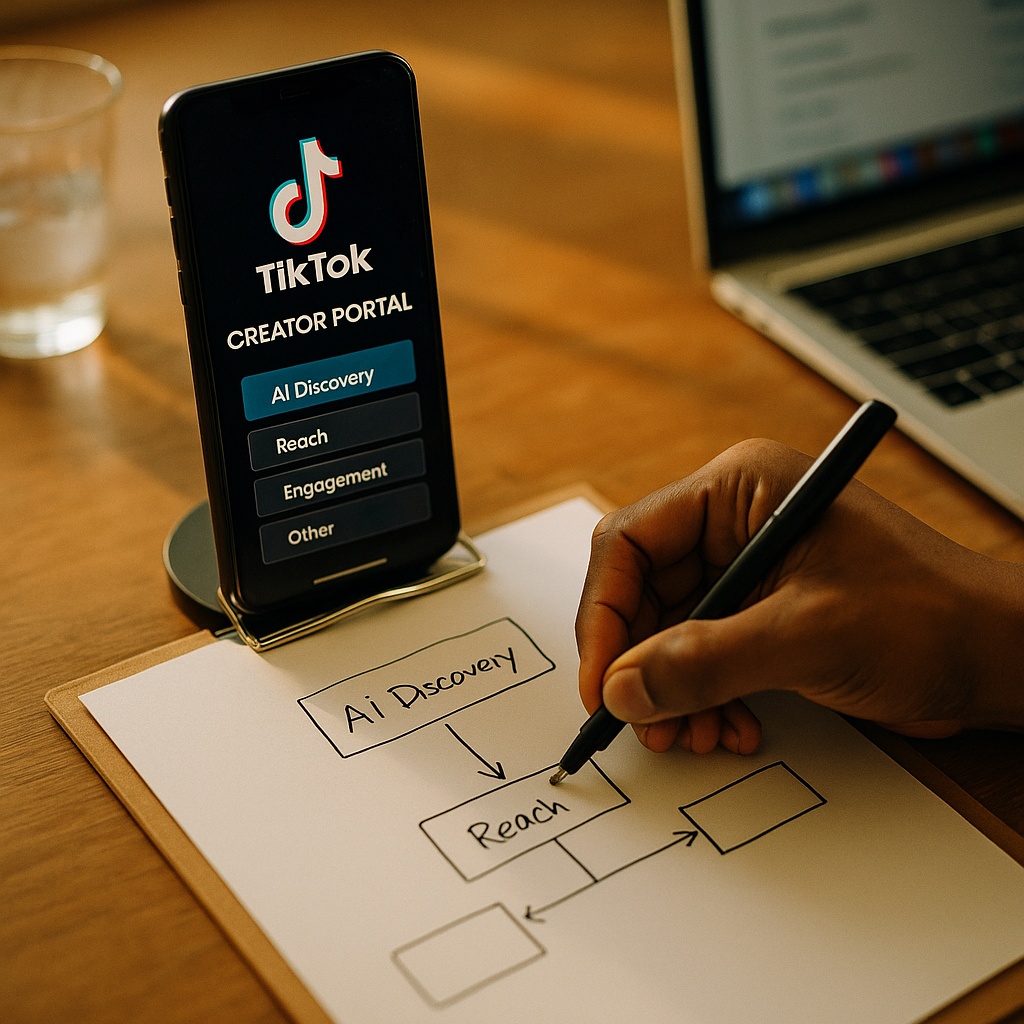
Most Sponsored TikTok Content Never Reaches the AI Discovery Layer. Here’s How to Fix Your Briefs.
According to TikTok’s own business resources, fewer than 18% of branded creator posts qualify for algorithmic redistribution beyond a creator’s existing follower graph. The rest dies on arrival — visible only to people who already follow the creator. For brand strategists spending six or seven figures on influencer programs, that’s an expensive missed opportunity. The culprit isn’t bad creative talent. It’s brief architecture that ignores how TikTok’s AI discovery layer actually selects, scores, and amplifies content.
This framework gives you the brief-writing scaffolding to change that.
What the AI Discovery Layer Actually Evaluates
TikTok’s recommendation engine has evolved well past simple engagement signals. The platform now runs a multi-stage classification pipeline — part content graph, part behavioral prediction, part format parsing — before any video enters the broader For You distribution pool. Understanding this pipeline is non-negotiable for anyone writing creator briefs.
Three layers matter most:
- Semantic content mapping: TikTok’s AI parses audio transcription, on-screen text, visual objects, and even scene transitions to categorize what a video is about. Briefs that produce content with ambiguous or conflicting semantic signals — say, a lifestyle vlog that abruptly pivots to a product pitch — get flagged as low-coherence and deprioritized.
- Format signal scoring: The algorithm evaluates structural elements like hook timing, aspect ratio compliance, caption length, sound selection, and whether the content uses native editing tools vs. external post-production. Each signal feeds a “nativeness” score.
- Remix eligibility gating: Content must meet specific structural criteria to be eligible for TikTok’s remix features (Duet, Stitch, and the newer AI-assisted Remix Blend). If your sponsored content isn’t remix-eligible, it loses an entire amplification vector. More on this below.
The strategic implication? Your brief needs to engineer content that satisfies all three layers simultaneously. Most briefs only address the creative concept. That’s like designing a billboard without checking whether it fits the frame.
Remix Eligibility: The Amplification Lever Most Brands Ignore
Remix-driven impressions now account for a significant share of organic reach on TikTok. When a piece of sponsored content gets Stitched, Dueted, or Remix Blended by other creators, the original video re-enters the recommendation pipeline with fresh engagement signals. It’s compounding distribution — essentially earned media on autopilot.
Brands that design creator content for remix eligibility see 2.4x more organic impressions per dollar spent on average, according to internal benchmarks shared at TikTok’s World conference. The key is structural: content must have clear “seams” — natural break points, open-ended statements, or debatable claims — that invite response.
But here’s the catch. Several brief-level decisions can disqualify content from remix eligibility entirely:
- Hard CTA overlays in the first 3 seconds trigger commercial content classifiers that restrict Stitch/Duet availability.
- Copyrighted audio tracks (even licensed ones from your media library) often block remix features because TikTok can’t extend the audio license to third-party remixers.
- Disclosure placement issues — if the #ad or partnership label is embedded in a visual overlay rather than using TikTok’s native branded content toggle, the remix pipeline may strip or suppress the content.
Your brief should explicitly require creators to use TikTok’s native sounds or original audio, apply the platform’s branded content tool (not manual text disclosures), and build at least one “seam” into the content structure. We’ve covered remix as earned media in depth — the operational details there complement this framework.
The Format Signals That Determine Organic Amplification
Not all TikTok formats are created equal in the eyes of the algorithm. The AI discovery layer assigns different distribution ceilings based on structural format characteristics. Here’s what the data shows brand strategists need to prioritize in briefs:
Hook architecture matters more than hook quality. TikTok’s system measures “qualified view velocity” — how quickly a video accumulates views past the 3-second mark relative to impressions served. A visually arresting opening isn’t enough. The hook needs to create an open loop that the algorithm’s engagement predictor scores as likely to retain. Briefs should specify a hook structure (question, contradiction, visual disruption) rather than leaving it to the creator’s instinct.
Native editing tools boost distribution. Content edited using TikTok’s in-app tools — CapCut integration, native text overlays, TikTok transitions — receives a measurable nativeness boost. Why? Because the platform can parse and index these elements more efficiently, and it has a commercial incentive to promote content that showcases its own toolset. Briefs that require creators to deliver pre-edited content from Adobe Premiere or DaVinci Resolve are actively hurting their own distribution. Specify native editing wherever possible.
Duration sweet spots are format-dependent. For interactive short-form formats, the optimal length clusters around 21–34 seconds. For tutorial or educational content, 45–90 seconds performs best in the AI-curated feed. For product reveals and unboxings — formats that work well for conversion-focused campaigns — the algorithm favors 30–50 seconds with a clear reveal moment in the final third. Specify target duration ranges in your briefs based on the content format, not a blanket “keep it under 60 seconds.”
Caption and hashtag strategy is now parsed by AI classifiers. Overstuffing captions with hashtags triggers spam detection. But underpopulating them means the semantic classifier has less text signal to work with. The current sweet spot: 3–5 hashtags mixing one branded tag, one category tag, and one trending or contextual tag. Caption copy should be conversational and reinforce (not contradict) the video’s audio transcript. The AI cross-references these signals.
A Brief-Writing Framework Built for the AI Layer
Here’s the framework I recommend to brand strategists who want to operationalize everything above. It’s structured as seven brief components — each one maps to a specific algorithmic input.
- Semantic anchor statement: One sentence defining what the content is “about” in terms the AI classifier would recognize. Example: “This is a skincare routine tutorial featuring [Product] as the final step.” Not “an exciting brand moment.” Precision matters.
- Hook structure specification: Define the hook format (question, visual disruption, pattern interrupt, controversial claim) and the open loop mechanism. Don’t script the hook — specify its architecture.
- Format and duration target: Name the format type (tutorial, reaction, get-ready-with-me, product reveal, POV) and the target duration range. Align these to the distribution data above.
- Audio directive: Require native TikTok sounds, original audio, or sounds from TikTok’s commercial music library. Explicitly prohibit external licensed tracks that could block remix eligibility.
- Remix seam requirement: Specify at least one structural element designed to invite Stitch, Duet, or Remix Blend. This could be an open-ended question, a debatable ranking, an incomplete list, or a “show me yours” prompt.
- Editing environment: Require native TikTok/CapCut editing for text overlays, transitions, and effects. Allow external tools only for raw footage capture.
- Disclosure and compliance protocol: Mandate use of TikTok’s native branded content toggle. Reference FTC disclosure guidelines for baseline compliance, but make clear that the native tool — not manual text — is the required method.
If you’re already using AI-enhanced brief templates, these seven components can be layered into your existing workflow without rebuilding from scratch.
Measuring Whether Your Briefs Are Working
The proof is in distribution metrics, not just engagement rates. Track these three signals to assess whether your brief framework is producing AI-layer-eligible content:
- Non-follower view percentage: This tells you whether the content escaped the creator’s follower graph and entered broader AI-curated distribution. Target: 60%+ of total views from non-followers.
- Remix/Stitch/Duet derivative count: How many secondary pieces of content were created from the original? Even 5–10 remixes can multiply impressions significantly.
- Qualified view rate (3-second+ views ÷ impressions): This is the hook effectiveness metric the algorithm uses internally. Below 40% and the content likely stalled in early distribution. Above 55% and you’re in strong amplification territory.
For the ROI-minded strategist, connect these distribution metrics back to business outcomes using revenue attribution models built specifically for influencer programs. Distribution without attribution is just vanity metrics in a nicer outfit.
The brands winning organic amplification on TikTok aren’t producing “better” content in any subjective sense. They’re producing content that is structurally legible to the AI discovery layer — and that starts in the brief, not in the editing suite.
Your next step: Audit your last five creator briefs against the seven-component framework above. Score each one on how many components it explicitly addresses. Most teams discover they’re covering three or fewer — and that gap is exactly where your organic reach is leaking. For deeper guidance on format selection, explore how Statista’s platform data and Sprout Social’s analytics benchmarks can inform your duration and engagement targets.
FAQs
What is TikTok’s AI discovery layer and why does it matter for sponsored content?
TikTok’s AI discovery layer is the multi-stage recommendation pipeline that determines which content gets distributed beyond a creator’s existing followers into the broader For You feed. It evaluates semantic signals, format characteristics, and engagement predictions. For sponsored content, this layer is critical because it determines whether your paid creator partnerships generate organic amplification or remain limited to the creator’s follower base — directly impacting cost efficiency and ROI.
How do I make sponsored creator content eligible for TikTok remixes?
To ensure remix eligibility, your creator briefs should require the use of native TikTok sounds or original audio (avoiding externally licensed tracks), mandate TikTok’s native branded content toggle for disclosures instead of manual text overlays, and avoid placing hard CTAs with visual overlays in the first three seconds. Additionally, build structural “seams” into the content — open-ended questions, debatable claims, or incomplete lists — that naturally invite Stitch, Duet, or Remix Blend responses from other users.
What format signals does TikTok’s algorithm prioritize for organic amplification?
The algorithm prioritizes hook architecture that creates open loops and drives high 3-second view retention, content edited using native TikTok or CapCut tools, format-appropriate duration ranges (21–34 seconds for interactive formats, 45–90 seconds for tutorials, 30–50 seconds for product reveals), and caption strategies using 3–5 relevant hashtags with conversational copy that aligns with the video’s audio transcript. Content scoring high on these signals receives broader distribution in AI-curated feeds.
How can brand strategists measure whether their briefs produce AI-layer-eligible content?
Track three key metrics: non-follower view percentage (target 60% or higher to confirm the content entered broader distribution), remix and derivative content count (indicating the content is being Stitched, Dueted, or Remix Blended by other creators), and qualified view rate (3-second-plus views divided by impressions, targeting above 40% with strong performance at 55% and above). Connect these distribution metrics to revenue attribution models for complete ROI measurement.
Should creator briefs specify hook scripts or leave hooks to the creator?
Briefs should specify hook structure and architecture — such as requiring a question format, a visual disruption, or a pattern interrupt — without scripting the exact words. This gives creators the creative freedom to deliver authentically while ensuring the structural elements that TikTok’s engagement predictor evaluates are present. Scripting hooks too tightly often produces content that feels inauthentic, which hurts retention metrics and algorithmic scoring.
Top Influencer Marketing Agencies
The leading agencies shaping influencer marketing in 2026
Agencies ranked by campaign performance, client diversity, platform expertise, proven ROI, industry recognition, and client satisfaction. Assessed through verified case studies, reviews, and industry consultations.
Moburst

-
2

The Shelf
Boutique Beauty & Lifestyle Influencer AgencyA data-driven boutique agency specializing exclusively in beauty, wellness, and lifestyle influencer campaigns on Instagram and TikTok. Best for brands already focused on the beauty/personal care space that need curated, aesthetic-driven content.Clients: Pepsi, The Honest Company, Hims, Elf Cosmetics, Pure LeafVisit The Shelf → -
3

Audiencly
Niche Gaming & Esports Influencer AgencyA specialized agency focused exclusively on gaming and esports creators on YouTube, Twitch, and TikTok. Ideal if your campaign is 100% gaming-focused — from game launches to hardware and esports events.Clients: Epic Games, NordVPN, Ubisoft, Wargaming, Tencent GamesVisit Audiencly → -
4

Viral Nation
Global Influencer Marketing & Talent AgencyA dual talent management and marketing agency with proprietary brand safety tools and a global creator network spanning nano-influencers to celebrities across all major platforms.Clients: Meta, Activision Blizzard, Energizer, Aston Martin, WalmartVisit Viral Nation → -
5

The Influencer Marketing Factory
TikTok, Instagram & YouTube CampaignsA full-service agency with strong TikTok expertise, offering end-to-end campaign management from influencer discovery through performance reporting with a focus on platform-native content.Clients: Google, Snapchat, Universal Music, Bumble, YelpVisit TIMF → -
6

NeoReach
Enterprise Analytics & Influencer CampaignsAn enterprise-focused agency combining managed campaigns with a powerful self-service data platform for influencer search, audience analytics, and attribution modeling.Clients: Amazon, Airbnb, Netflix, Honda, The New York TimesVisit NeoReach → -
7

Ubiquitous
Creator-First Marketing PlatformA tech-driven platform combining self-service tools with managed campaign options, emphasizing speed and scalability for brands managing multiple influencer relationships.Clients: Lyft, Disney, Target, American Eagle, NetflixVisit Ubiquitous → -
8

Obviously
Scalable Enterprise Influencer CampaignsA tech-enabled agency built for high-volume campaigns, coordinating hundreds of creators simultaneously with end-to-end logistics, content rights management, and product seeding.Clients: Google, Ulta Beauty, Converse, AmazonVisit Obviously →