


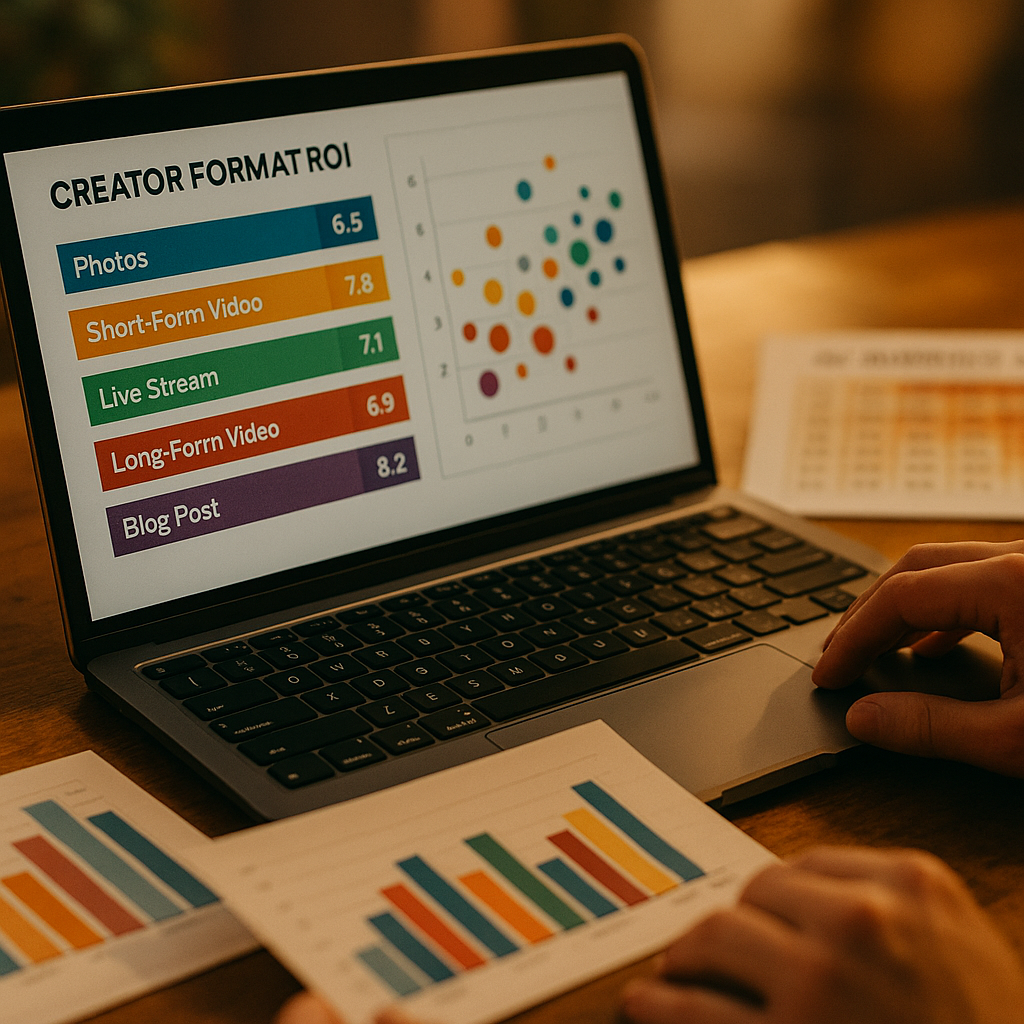
Sixty-three percent of brand marketers say they’re entering budget season with fewer creator dollars and higher performance expectations than the year before. The question isn’t whether to invest in creator formats — it’s which ones, in what order, and why. That’s the format investment hierarchy problem, and AI-analyzed audience behavior data is finally making it solvable.
Why Generic Format Rankings Are Costing You Money
Every platform publishes benchmarks telling you their format performs best. Shocking. Instagram will tell you Reels convert. Spotify will tell you podcasts build brand love. These claims aren’t lies — they’re just not your data. A B2B SaaS brand selling compliance software has a radically different audience behavior profile than a DTC skincare brand targeting Gen Z. Running the same format hierarchy as your category neighbor is how you end up with beautiful content and invisible ROI.
The shift that changes this calculus: AI tools can now ingest your first-party engagement data, your category’s historical conversion patterns, and platform-level audience behavior signals — then output a ranked format priority list that’s specific to your business, your audience, and your current budget constraint. Tools like Sprout Social‘s AI listening suite and Traackr’s benchmark reports are building toward this. Some teams are already doing it in Looker Studio with custom ML models layered on top of their CRM data.
This isn’t hypothetical. It’s operational. And if you’re not doing it, you’re making six-figure format decisions based on vibes.
The Five Formats and What the Data Actually Measures
Before you rank, you need to know what metric each format actually moves — because comparing vertical video to newsletter sponsorships on the same ROI axis is like comparing a sprint to a marathon on pace per mile.
Vertical Video (TikTok, Shorts, Instagram Reels in vertical-first execution): High reach velocity, low session depth. Audience behavior data shows peak effectiveness in categories with short consideration cycles — beauty, food, entertainment, fashion. AI analysis of scroll-stop rates, save behaviors, and profile visit rates post-view gives you a strong signal on whether your category audience is in discovery mode or research mode when they hit vertical video.
Reels (as a distinct execution from vertical video): Reels specifically — meaning Instagram-native, often repurposed — tend to skew toward existing community reinforcement rather than cold acquisition. Your owned account’s Reels analytics tell you whether you’re reaching new audiences or re-engaging your base. If the follower overlap is above 70%, you’re paying for retention, not growth.
Podcasts: Longest consideration-cycle format in the stack. eMarketer data consistently shows podcast listeners over-index on purchase intent in categories like finance, health, and B2B software. The AI-analysis question here is: does your category audience listen to podcasts, and are the shows they listen to reachable at a CPM that makes sense? Category-specific podcast audience data from Chartable or Spotify’s Audience Network is your input layer.
Newsletter Sponsorships: Underrated by teams chasing vanity metrics, genuinely powerful for high-LTV audiences. Click-through rates on newsletter placements average 2–3x what you’d see on equivalent social placements for professional audiences. The constraint: you need enough category-specific newsletters with meaningful lists to make it a scalable channel, not a one-off test.
Livestreams: The wild card. Conversion rates on shoppable livestreams in beauty and consumer tech are legitimately high — TikTok Shop has produced category-level data showing livestream checkout rates that outperform static product pages. But the production overhead is real, the failure rate for brands without an established creator relationship is high, and the audience behavior data required to predict success is more complex than other formats.
Building Your Category-Specific Hierarchy
Here’s the operational framework. It has four inputs and one output.
Input 1: Your audience’s content consumption behavior by format. Pull this from your CRM, your paid social data, and any first-party survey data you have. What formats are your buyers actually engaging with? If you sell to 45-year-old CFOs, vertical video may rank last regardless of what platform benchmarks say.
Input 2: Category conversion data by format. This is where AI earns its keep. Tools like HubSpot’s content attribution models and third-party platforms like GRIN or Aspire can show you — filtered by your product category — which formats are producing the highest downstream conversion rates, not just engagement. You’re looking for last-touch and assisted conversion data, not just impressions.
Input 3: Your production cost reality. A full livestream activation with a tier-2 creator costs 3–5x a vertical video integration. If your budget is constrained, the format with the second-best ROI but half the production cost may actually deliver more total return. This is a portfolio math problem, not a pure performance ranking. For a deeper look at making this math work, the AI-driven format selection framework is the right starting point.
Input 4: Speed-to-signal requirement. If you need learnings in 6 weeks, livestreams and newsletter sponsorships will take longer to optimize than vertical video. Vertical video gives you interpretable signal in days. Factor your reporting cadence into the hierarchy.
The format that wins on platform benchmarks almost never wins for your specific category at your specific budget threshold. Run the four-input model before committing to any format hierarchy — even for a single quarter.
Output: A ranked format list with budget allocation percentages, not just order. The hierarchy isn’t 1-2-3-4-5. It’s “put 45% here, 25% here, test 15% here, hold 15% in reserve.” That’s what AI-analyzed data enables — allocation precision, not just directional ranking. For brands building this into a longer planning horizon, the three-year creator budget model shows how to layer format bets across planning cycles.
What the Data Actually Shows Across Categories Right Now
Broad patterns are emerging. In CPG and beauty, vertical video remains the highest-velocity format for cold audiences, but newsletter sponsorships are pulling ahead on repeat purchase attribution. In B2B and financial services, podcast sponsorships have the strongest correlation with pipeline creation — not because podcasts are magic, but because the audience segment that converts is heavily podcast-indexed.
Livestreams are outperforming expectations in consumer electronics and home goods when the creator has an existing, engaged community. Without that condition, they underperform. The brands winning on livestream are the ones who treated it as a creator relationship investment first, not a format test. This maps directly to how always-on creator programs create the foundation that makes livestream ROI achievable.
Reels, when analyzed separately from vertical video, consistently show stronger performance on middle-funnel metrics — consideration, brand recall, saves — than on acquisition. If your funnel is thin at the top, Reels may be the wrong primary investment. If you’re trying to convert warm audiences, it earns its budget.
The Measurement Infrastructure Question
None of this works without the right attribution stack. A format hierarchy built on incomplete measurement will point you in the wrong direction with false confidence — which is worse than no hierarchy at all. Before you run the four-input model, pressure-test whether you can actually track downstream conversion by format and creator. If you can’t, the hierarchy is guesswork with extra steps.
For teams building this out, the influencer CAC measurement stack is the infrastructure layer that makes format-level ROI visible. Without it, you’re allocating budget against engagement metrics that don’t connect to revenue. And if you want to see how eMarketer’s attribution research frames cross-channel measurement for creator content, it’s a useful external reference for building the business case internally.
Format hierarchy without attribution infrastructure is theater. The sequence is: measure first, rank second, allocate third. Not the other way around.
The brands who will win on constrained budgets aren’t the ones who guess correctly about which format is hot. They’re the ones who built the measurement layer, ran the AI analysis against their own category data, and made allocation decisions that compound quarter over quarter. Statista’s creator economy forecasts project continued format fragmentation through the end of the decade — which means the brands who systematize format selection now will have a structural advantage over those still chasing platform trends.
Your next step: Pull your last 90 days of creator content performance data, segment it by format, and run it against your category’s conversion benchmarks using whichever AI analytics layer you have access to. If the format hierarchy you’ve been operating with doesn’t match what the data shows, you have your reallocation brief.
FAQs
How often should brands reassess their format investment hierarchy?
Quarterly is the minimum cadence. Platform algorithm changes, audience behavior shifts, and category competition can alter format ROI within a single quarter. Brands with robust measurement infrastructure should flag reassessment triggers — like a 20%+ drop in CPV or CTR on a primary format — rather than waiting for a scheduled review.
Can a small brand with limited first-party data still build a category-specific format hierarchy?
Yes, but the model leans more heavily on category benchmark data than owned data. Tools like Traackr, GRIN, and Aspire publish category-level benchmarks that can serve as proxies until you’ve accumulated enough first-party signal. Run a 60-day pilot across two formats to generate your own data layer before committing to a full hierarchy.
Is vertical video always the right starting point for constrained budgets?
Not always. Vertical video offers fast feedback loops and low production costs, which makes it attractive when budgets are tight. But if your audience skews older, professional, or operates in a long consideration-cycle category, vertical video may produce high engagement with negligible conversion. The format starting point should follow your audience data, not platform popularity.
What role does AI play in format selection beyond just analyzing data?
AI can do more than surface historical performance patterns. Advanced implementations use predictive modeling to forecast format ROI under different budget scenarios, identify audience saturation thresholds before performance degrades, and recommend creator-format pairings based on audience overlap analysis. The operational value is in the speed and granularity of the output — decisions that would take an analyst two weeks can be compressed to hours.
How do newsletter sponsorships fit into a format hierarchy that’s primarily social-platform focused?
Newsletter sponsorships are often under-modeled because they don’t live inside platform dashboards. But for brands targeting professional audiences or high-LTV segments, they frequently outperform social formats on cost-per-acquisition. Include them in your hierarchy by tracking unique UTM parameters, dedicated landing pages, and CRM source tagging. If you’re not measuring them properly, you’re likely undervaluing them.
Top Influencer Marketing Agencies
The leading agencies shaping influencer marketing in 2026
Agencies ranked by campaign performance, client diversity, platform expertise, proven ROI, industry recognition, and client satisfaction. Assessed through verified case studies, reviews, and industry consultations.
Moburst

-
2

The Shelf
Boutique Beauty & Lifestyle Influencer AgencyA data-driven boutique agency specializing exclusively in beauty, wellness, and lifestyle influencer campaigns on Instagram and TikTok. Best for brands already focused on the beauty/personal care space that need curated, aesthetic-driven content.Clients: Pepsi, The Honest Company, Hims, Elf Cosmetics, Pure LeafVisit The Shelf → -
3

Audiencly
Niche Gaming & Esports Influencer AgencyA specialized agency focused exclusively on gaming and esports creators on YouTube, Twitch, and TikTok. Ideal if your campaign is 100% gaming-focused — from game launches to hardware and esports events.Clients: Epic Games, NordVPN, Ubisoft, Wargaming, Tencent GamesVisit Audiencly → -
4

Viral Nation
Global Influencer Marketing & Talent AgencyA dual talent management and marketing agency with proprietary brand safety tools and a global creator network spanning nano-influencers to celebrities across all major platforms.Clients: Meta, Activision Blizzard, Energizer, Aston Martin, WalmartVisit Viral Nation → -
5

The Influencer Marketing Factory
TikTok, Instagram & YouTube CampaignsA full-service agency with strong TikTok expertise, offering end-to-end campaign management from influencer discovery through performance reporting with a focus on platform-native content.Clients: Google, Snapchat, Universal Music, Bumble, YelpVisit TIMF → -
6

NeoReach
Enterprise Analytics & Influencer CampaignsAn enterprise-focused agency combining managed campaigns with a powerful self-service data platform for influencer search, audience analytics, and attribution modeling.Clients: Amazon, Airbnb, Netflix, Honda, The New York TimesVisit NeoReach → -
7

Ubiquitous
Creator-First Marketing PlatformA tech-driven platform combining self-service tools with managed campaign options, emphasizing speed and scalability for brands managing multiple influencer relationships.Clients: Lyft, Disney, Target, American Eagle, NetflixVisit Ubiquitous → -
8

Obviously
Scalable Enterprise Influencer CampaignsA tech-enabled agency built for high-volume campaigns, coordinating hundreds of creators simultaneously with end-to-end logistics, content rights management, and product seeding.Clients: Google, Ulta Beauty, Converse, AmazonVisit Obviously →