


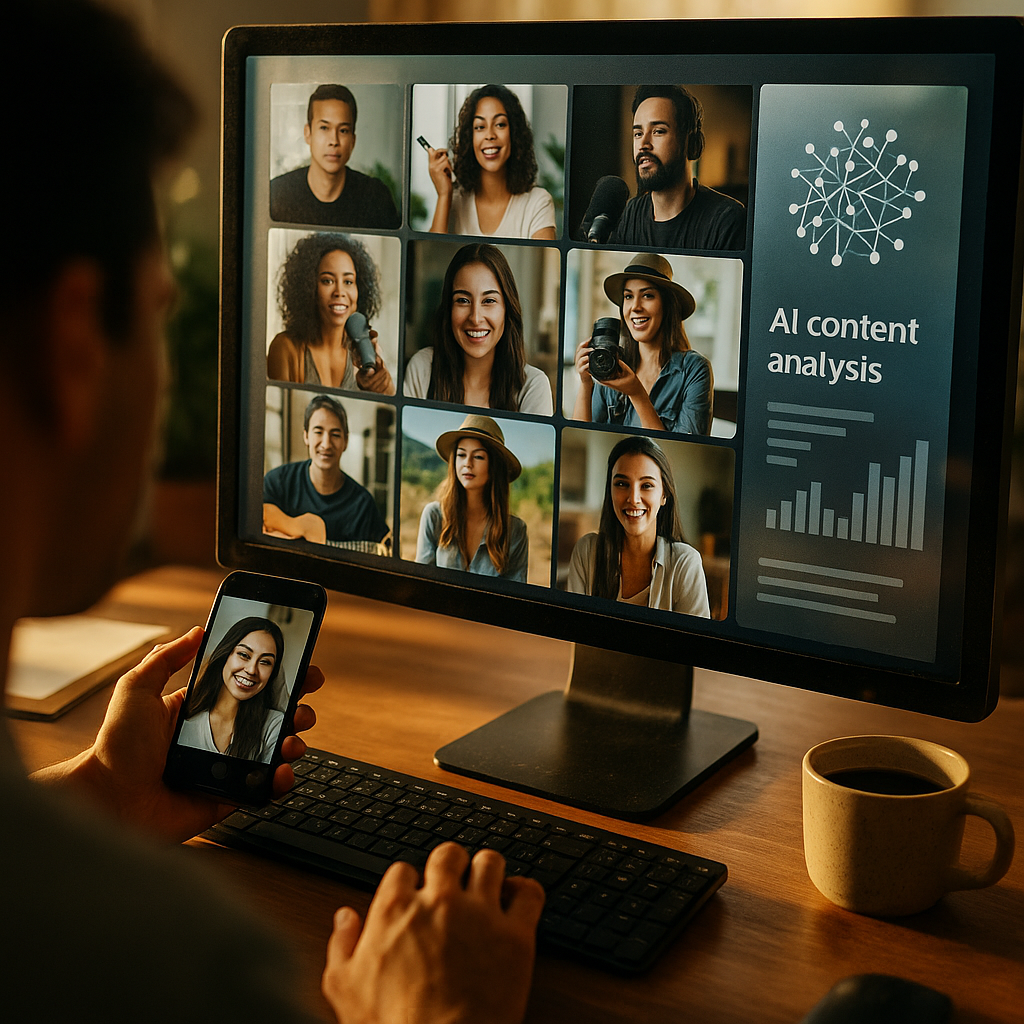
There are now over 200 million creators active across major platforms. In niche verticals alone — functional fitness, regenerative skincare, neurodiverse parenting, B2B SaaS — creator volume has tripled in three years. Manual discovery isn’t just slow. It’s a liability. This is the niche-first creator discovery playbook brands need to run AI-driven content analysis at the scale the market now demands.
The Signal-to-Noise Problem Is Getting Worse, Not Better
Every category that matters to a brand right now is flooded. Supplement brands trying to find credible micro-creators in longevity and metabolic health are wading through thousands of accounts that look legitimate on the surface — decent follower counts, clean aesthetics, regular posting cadence. But surface metrics are a trap. Follower counts are manipulable. Post frequency tells you nothing about content depth. And engagement rates, in isolation, have become nearly meaningless as a proxy for genuine audience connection.
The real problem: the ratio of high-quality, brand-relevant niche creators to total creator volume in a given category is shrinking as a percentage, even as the absolute number of good creators grows. Your team can’t find them manually. Not at pace. Not at scale.
In high-growth niche verticals, the signal-to-noise ratio in creator discovery has degraded to the point where manual screening is operationally equivalent to random selection — you’re spending analyst hours to achieve coin-flip accuracy.
This is the foundational reason why AI content analysis for niche discovery has moved from experimental feature to operational necessity for any brand running a serious influencer program.
What “Content Analysis” Actually Means in This Context
Let’s be precise about the terminology, because vendors abuse it constantly.
AI-driven content analysis — as it applies to creator discovery — means systems that go beyond profile-level metadata to analyze the actual content a creator produces: the topics they cluster around, the depth of their engagement with those topics, the semantic consistency of their audience conversations, the sentiment arc across comment threads, and the behavioral patterns that indicate authentic community rather than passive consumption.
This is distinct from keyword-based search or hashtag filtering, which is what most brands are still relying on. Hashtag filtering finds creators who tag correctly. Content analysis finds creators who think correctly about the topics your brand needs them to own.
Platforms like Traackr, Sprinklr, and Influential have built varying degrees of this into their discovery layers. Tools like CreatorIQ have moved toward semantic topic modeling that can surface thematic consistency even when a creator doesn’t use category-standard hashtags. The more sophisticated implementations use multimodal analysis — processing video transcripts, visual elements, comment language, and posting behavior simultaneously — to generate a content fingerprint for each creator.
That fingerprint is what you’re actually buying when you invest in AI-powered discovery infrastructure.
Building the Niche-First Discovery Framework
The methodology matters as much as the tools. Here’s how brands running best-in-class programs structure their niche discovery process:
1. Define the category at the content layer, not the demographic layer. Most briefs start with audience targeting: “female, 28-40, interested in wellness.” That’s backward for niche discovery. Start with the content territory — the specific conversation your brand needs to be part of — and let the audience emerge from there. Brands that flip this logic consistently find creators whose audiences over-index on purchase intent rather than just demographic fit.
2. Set content depth thresholds, not just engagement rate floors. Your AI filters should score for topical depth — how consistently and substantively does a creator engage with the specific niche topic, not just the parent category? A creator posting about “fitness” is not the same as a creator who has built a documented, longitudinal body of content about kettlebell training for perimenopausal women. The latter has a community. The former has an audience.
3. Analyze comment sentiment at the thread level, not the post level. Aggregate sentiment scores flatten the data. What you want is thread-level analysis that reveals whether audience members are asking substantive questions, sharing personal experiences, and returning to the creator’s content repeatedly. These behavioral signals are the strongest available proxy for genuine community influence.
4. Weight recency and velocity appropriately. In fast-moving niche categories, a creator’s content from 18 months ago may be from a completely different era of the conversation. Your discovery model needs to weight recent content heavily and flag creators whose niche consistency has shifted — either deepening (positive signal) or drifting (risk signal).
5. Cross-reference against brand safety parameters automatically. Discovery and vetting should not be separate workflows. AI brand safety scoring should be embedded in the discovery pipeline, not bolted on after you’ve already generated a shortlist. Running vetting after discovery wastes cycles and creates false attachment to creators your team has already invested time in evaluating.
Why Niche Categories Specifically Require This Approach
Mainstream creator discovery — finding a fitness macro-influencer with 2M followers — is a solved problem. Agencies have done it a thousand times. The creator economy’s real value for brands in the next phase isn’t at the top of the funnel. It’s in niche depth.
Consider what’s happened in categories like functional mushrooms, adaptive athletics, clean architecture, and halal beauty. Each of these has gone from a handful of recognizable creators to hundreds of accounts within 24 months. The creators who matter in those spaces — who actually move product, who have genuine authority — are not necessarily the ones with the largest followings. They’re often mid-tier or micro accounts with comment sections that read like industry forums.
Manual discovery in these categories creates a specific operational failure mode: teams default to the creators they already know, or the ones who happen to show up in the first page of platform search results. Both pathways produce mediocre results and systematically miss the creators who are actually driving category conversation.
For brands thinking about how this integrates with their broader measurement architecture, the creator performance scoring model framework is worth reviewing — because the same signals that make a niche creator discoverable also tend to predict sales conversion.
The Operational Architecture: What You Need to Build or Buy
Be honest about what your current stack can actually do. Most brands are running influencer discovery through platforms that were built for mid-tier and macro creator management. Their niche discovery capabilities are either underdeveloped or require significant manual configuration to be useful at the category specificity you need.
The components of a functional niche discovery operation in the current environment:
- Semantic topic modeling layer: Capable of mapping content to specific sub-topics, not just parent categories. Should handle multi-platform content simultaneously.
- Multimodal content processing: Video transcript analysis, visual content classification, and text-based engagement analysis working in combination — not sequentially.
- Dynamic creator scoring: Scores that update in near-real-time as creator content evolves, not static snapshots from a quarterly database refresh.
- Audience authenticity verification: Integrated, not add-on. AI creator vetting that scores authenticity at the audience behavior level, not just follower count analysis.
- Workflow integration: Discovery outputs that feed directly into CRM or campaign management platforms, eliminating the export-and-reformat cycle that kills analyst productivity.
If you’re evaluating vendors against these criteria, the AI vendor matchmaking approach is replacing traditional RFP processes for good reason — static vendor scorecards don’t capture capability drift in a fast-moving space.
The brands that will own niche creator relationships in the next 18 months are the ones investing in discovery infrastructure now — not the ones waiting for their existing platform to release a feature update.
The Competitive Advantage Window Is Narrow
Here’s the uncomfortable truth about niche creator discovery: the window for establishing authentic, exclusive partnerships with the best voices in emerging categories is short. Once a creator in functional skincare or decentralized finance education crosses a certain engagement threshold, their inbox fills up and their rates increase. The brands that found them at 15K followers — because their AI systems surfaced them based on content depth, not vanity metrics — have a cost and relationship advantage that is genuinely difficult to replicate.
This is not theoretical. Brands running sophisticated discovery programs consistently report finding category-defining creators 6-9 months before their competitors, at a fraction of the partnership cost. The data bears this out: according to research cited by Sprout Social, micro-influencers in niche categories generate engagement rates 3-5x higher than macro-influencers in the same space — but only if you can find the right ones before the market does.
The broader landscape data from eMarketer confirms that influencer marketing spend continues to shift toward niche and micro tiers, with brands reporting higher ROI from targeted niche programs than broad-reach campaigns. The infrastructure investment to find those creators at scale is the unlock.
For teams thinking about how discovery connects to downstream attribution and the AI attribution layer for creator revenue, the connection is direct: better discovery means better creator-audience fit, which means cleaner attribution signals and more defensible ROI reporting to leadership.
Platform-native tools from TikTok for Business and Meta Business Suite offer baseline discovery capabilities, but neither is built for the kind of semantic depth analysis that serious niche discovery requires. They’re entry points, not infrastructure.
For compliance-conscious teams, it’s also worth flagging that AI-driven content analysis must be implemented within FTC disclosure frameworks — ensure any automated outreach or partnership workflows include appropriate disclosure prompting. The FTC’s guidance on endorsements applies regardless of how sophisticated your discovery methodology is.
Finally, for teams already running creator programs at scale, integrating niche discovery outputs with UGC-to-paid media routing creates a compounding efficiency: the same content analysis infrastructure that surfaces the best niche creators can also score which of their content is most promotable as paid media — closing the loop between discovery and performance.
Start by auditing one high-priority niche category this quarter: map the creator universe, run content depth analysis against your current shortlist, and measure how many creators your team would have missed using manual methods. That gap — and it will be significant — is your business case for building this capability at scale.
Frequently Asked Questions
What is AI-driven content analysis in creator discovery?
AI-driven content analysis in creator discovery refers to systems that analyze the actual content a creator produces — including video transcripts, comment sentiment, topic consistency, and audience behavior patterns — rather than relying solely on surface metrics like follower count or engagement rate. These systems generate a content fingerprint for each creator that reflects genuine topical authority and community influence within a specific niche.
Why is manual creator discovery no longer viable in niche categories?
Creator volume in most niche verticals has grown dramatically, while the proportion of high-quality, brand-relevant creators has remained relatively small. Manual screening cannot process enough accounts at sufficient depth to reliably surface the best creators before market rates increase. AI systems can analyze thousands of accounts simultaneously across multiple content dimensions, making them the only operationally sustainable discovery method at the scale brands now require.
How do you measure content depth in creator discovery?
Content depth is measured by evaluating how consistently and substantively a creator engages with a specific sub-topic over time, the sophistication of their audience conversations (comment quality, question depth, return engagement), and the longitudinal consistency of their thematic focus. AI tools that use semantic topic modeling can distinguish between creators who mention a topic occasionally and creators who have built genuine authority within it.
What platforms support AI-powered niche creator discovery?
Platforms including Traackr, CreatorIQ, Sprinklr, and Influential have varying degrees of AI-powered content analysis built into their discovery layers. TikTok for Business and Meta Business Suite offer baseline discovery tools but are not built for deep semantic niche analysis. For serious niche discovery programs, brands typically combine a specialist platform with additional content analysis tooling configured to their specific category requirements.
How does creator discovery connect to campaign attribution?
The quality of creator discovery directly impacts attribution accuracy. Creators sourced through content depth analysis tend to have higher audience-topic alignment, which produces cleaner purchase intent signals and more attributable conversion paths. Integrating discovery outputs with an AI attribution layer for creator revenue allows brands to connect discovery quality to downstream ROI, making the business case for discovery infrastructure investment concrete and reportable to leadership.
Top Influencer Marketing Agencies
The leading agencies shaping influencer marketing in 2026
Agencies ranked by campaign performance, client diversity, platform expertise, proven ROI, industry recognition, and client satisfaction. Assessed through verified case studies, reviews, and industry consultations.
Moburst

-
2

The Shelf
Boutique Beauty & Lifestyle Influencer AgencyA data-driven boutique agency specializing exclusively in beauty, wellness, and lifestyle influencer campaigns on Instagram and TikTok. Best for brands already focused on the beauty/personal care space that need curated, aesthetic-driven content.Clients: Pepsi, The Honest Company, Hims, Elf Cosmetics, Pure LeafVisit The Shelf → -
3

Audiencly
Niche Gaming & Esports Influencer AgencyA specialized agency focused exclusively on gaming and esports creators on YouTube, Twitch, and TikTok. Ideal if your campaign is 100% gaming-focused — from game launches to hardware and esports events.Clients: Epic Games, NordVPN, Ubisoft, Wargaming, Tencent GamesVisit Audiencly → -
4

Viral Nation
Global Influencer Marketing & Talent AgencyA dual talent management and marketing agency with proprietary brand safety tools and a global creator network spanning nano-influencers to celebrities across all major platforms.Clients: Meta, Activision Blizzard, Energizer, Aston Martin, WalmartVisit Viral Nation → -
5

The Influencer Marketing Factory
TikTok, Instagram & YouTube CampaignsA full-service agency with strong TikTok expertise, offering end-to-end campaign management from influencer discovery through performance reporting with a focus on platform-native content.Clients: Google, Snapchat, Universal Music, Bumble, YelpVisit TIMF → -
6

NeoReach
Enterprise Analytics & Influencer CampaignsAn enterprise-focused agency combining managed campaigns with a powerful self-service data platform for influencer search, audience analytics, and attribution modeling.Clients: Amazon, Airbnb, Netflix, Honda, The New York TimesVisit NeoReach → -
7

Ubiquitous
Creator-First Marketing PlatformA tech-driven platform combining self-service tools with managed campaign options, emphasizing speed and scalability for brands managing multiple influencer relationships.Clients: Lyft, Disney, Target, American Eagle, NetflixVisit Ubiquitous → -
8

Obviously
Scalable Enterprise Influencer CampaignsA tech-enabled agency built for high-volume campaigns, coordinating hundreds of creators simultaneously with end-to-end logistics, content rights management, and product seeding.Clients: Google, Ulta Beauty, Converse, AmazonVisit Obviously →