


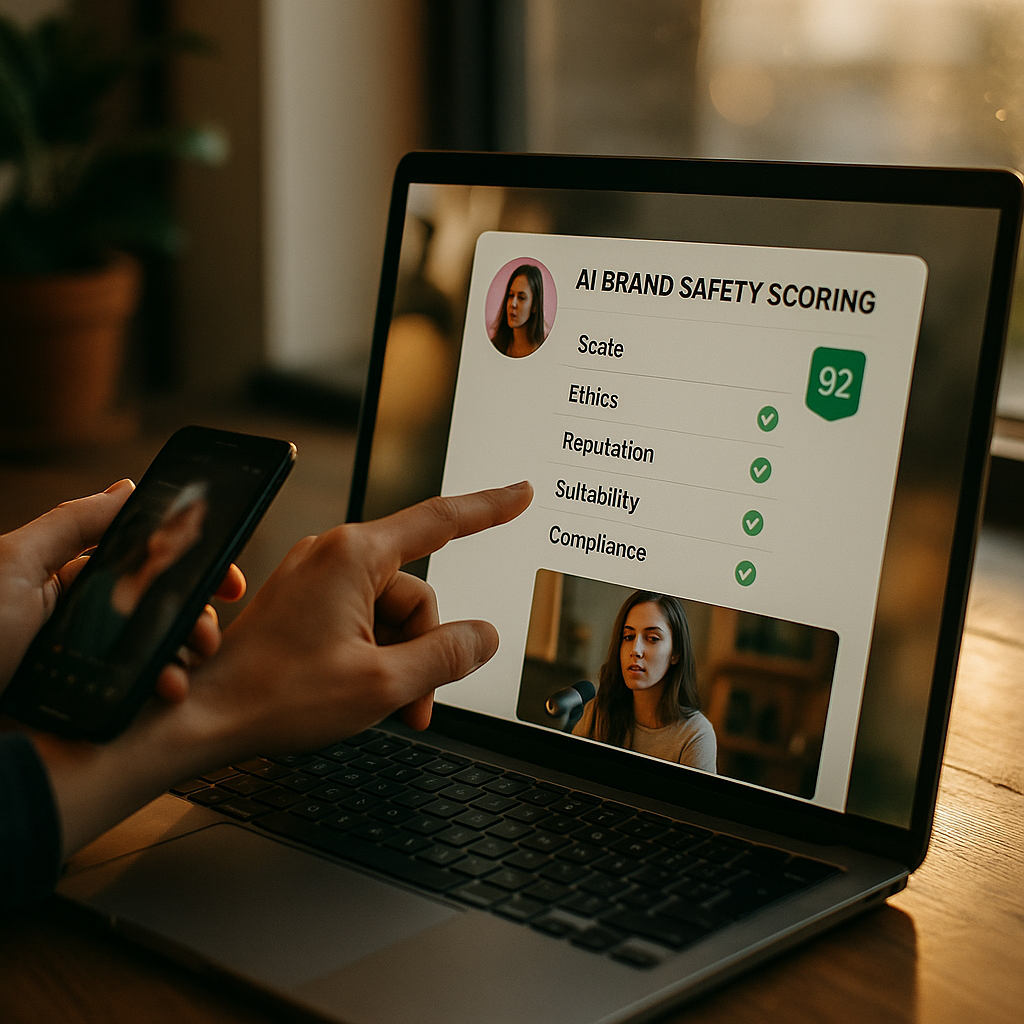
Most Brands Are Flying Blind When They Boost Creator Posts
Roughly 68% of brand safety incidents in paid social occur not from the creator’s core content — but from adjacent elements: comment sections, visual backgrounds, tagged accounts, and contextual framing that human reviewers miss entirely. If you’re committing paid budget to amplify organic creator posts without contextual brand safety scoring, you’re not running influencer marketing. You’re running a lottery.
AI-powered contextual brand safety for creator amplification isn’t a nice-to-have anymore. For brands managing mid-to-large influencer programs across TikTok, Instagram, and YouTube, it’s table stakes — and the platforms selling it vary wildly in what they actually deliver.
What “Contextual” Actually Means (And Why It’s Not What Platforms Claim)
Most brand safety tools still operate on keyword blocklists and IAB category flags. That’s not contextual analysis — that’s a 2018 solution applied to a 2026 problem. True contextual brand safety requires three simultaneous inputs: what is visually in the frame, what language signals are present in captions and comments, and what the surrounding content ecosystem looks like for that creator at that moment in time.
Computer vision models can now identify background objects, visible logos, hand gestures, clothing with social signaling, and crowd compositions — information that fundamentally changes whether your brand should be adjacent to a piece of content. NLP layers then process caption sentiment, hashtag clusters, and comment thread dynamics. The combination produces what the better platforms call a brand adjacency risk score: a composite signal that tells you how dangerous it is to pour paid fuel on this particular piece of organic fire.
A creator’s core video might be perfectly aligned with your brand values — but if the comment section has been colonized by a political debate, amplifying that post puts your ads in a contextual neighborhood you never approved.
This is the gap between surface-level creator vetting (which most brands do) and post-level contextual scoring (which very few do before committing to amplification). For a deeper look at how AI is handling brand safety scoring for amplification, the operational mechanics are worth reviewing before you evaluate vendors.
The Walled-Garden Intelligence Problem
Here’s the structural challenge most platforms won’t tell you directly: TikTok, Meta, and YouTube each operate closed data environments. No third-party tool has unfettered access to raw signal data. What they have is API access — which is curated, rate-limited, and governed by platform policy. When a vendor claims their computer vision model “analyzes every frame of every creator video before you boost it,” the honest question is: where exactly is that analysis happening, and on what data?
The legitimate platforms — brand adjacency mapping tools like Zefr, Verity, and Samba TV’s content intelligence layer — work within platform partnerships. Zefr, for example, operates as an official YouTube measurement partner, which gives it access to content classification at scale that genuinely differs from scraped approximations. Integral Ad Science (IAS) and DoubleVerify have equivalent partnerships across Meta and TikTok’s ecosystems.
That distinction matters enormously in your vendor evaluation. A platform with an official API partnership and co-certified measurement methodology is not the same thing as a startup running computer vision models on publicly accessible thumbnails and calling it contextual scoring. One is walled-garden intelligence. The other is a workaround dressed up in AI language.
Evaluating Platforms: The Five Questions That Cut Through the Noise
When you’re in vendor conversations for a contextual brand safety platform to gate your creator amplification decisions, the evaluation framework should be rigorous. Here’s where most brand teams leave value on the table.
1. What is the model’s training data provenance?
Any vendor using computer vision to score visual content should be able to tell you what their model was trained on, how frequently it’s retrained, and whether it’s been validated against human review at scale. Generic image classification models fine-tuned on stock photography will not catch the nuanced visual signals that create brand safety risk in creator content specifically.
2. How is the platform integrated with the amplification workflow?
Safety scoring that lives in a separate dashboard you have to check manually is not a solution — it’s a speed bump. What you need is a system where brand adjacency risk scores are surfaced inside your paid media buying workflow, or at minimum trigger automatic holds before budget deployment. Tools that integrate with Meta’s Ads Manager or TikTok’s creative center API at the point of boost authorization are operationally superior.
3. What is the false positive rate, and how is it audited?
Over-blocking kills reach and frustrates creator partners. If your safety tool flags 40% of eligible content, you’re not protected — you’re paralyzed. Ask vendors for documented false positive rates broken down by content category, and ask how brands can appeal or override flags with audit trails intact. Responsible platforms have this data. Platforms that don’t are telling you something.
4. Can the model be tuned to your brand’s specific risk thresholds?
A financial services brand and an energy drink brand do not have the same adjacency risk profile. Platforms that offer only binary safe/unsafe outputs are selling you a blunt instrument. Look for scoring systems that let you define acceptable risk bands by content category, creator tier, campaign objective, and even regional market — because what’s appropriate for a German market may differ from what’s acceptable in the US or Southeast Asia.
5. How does the platform handle dynamic content — live streams, Stories, Reels?
Static post analysis is the easier problem. Ephemeral and live content is where most tools fail quietly. If you’re amplifying Stories or boosting Reels that disappear or update, your safety scoring needs to operate in near-real-time. Ask for specifics about latency between content publication and score availability. Anything over 90 minutes is operationally useless for time-sensitive amplification decisions.
Brand safety scoring that runs after you’ve already committed budget isn’t prevention — it’s forensics. The platform architecture you choose must score before the boost fires, not after the impression is served.
NLP Scoring for Comment Section Risk Is Underrated
The visual content in a creator post is only part of the risk surface. Comment sections represent a dynamic, user-generated risk layer that changes by the hour. NLP models that monitor sentiment trajectory, detect coordinated negative pile-ons, or flag emerging controversy in thread discussions can give your team early warning before a boost turns a manageable situation into a brand crisis.
This is especially relevant for real-time monitoring at scale — where the volume of creator posts across a campaign makes human review impossible. Platforms like Sprinklr and Talkwalker have built comment-level NLP pipelines specifically for this use case, though their integration with paid amplification workflows varies. If you’re evaluating vendors, ask whether their NLP scoring covers comment threads at the time of boost authorization — and whether it continues monitoring post-amplification for risk escalation.
Understanding how AI content analysis differs between discovery and amplification use cases is worth the time. The models optimized for finding new creators are not necessarily the same ones you want governing your paid spend decisions.
Compliance Is the Hidden Layer Nobody Budgets For
When you use an AI-powered system to make automated or semi-automated decisions about which creator content gets amplified, you’re operating in territory that FTC guidelines and emerging EU AI Act frameworks are beginning to address. Specifically: if your brand safety tool systematically suppresses content from creators based on demographic signals embedded in visual or linguistic patterns, you may have discriminatory impact exposure that your legal team hasn’t stress-tested yet.
Ask vendors whether their models have been audited for demographic bias. Ask whether their scoring outputs are explainable — meaning a human reviewer can understand why a particular score was assigned, not just that it was. The ICO’s guidance on automated decision-making applies to any brand operating in or targeting UK markets, and it sets a precedent that’s worth taking seriously globally.
This is also why the AI agents in media buying risk framework matters beyond just operational efficiency — it’s a compliance architecture question as much as a performance one.
The Operational Reality of Scaling This Across a Creator Program
For brands running programs with 50+ active creators, manual pre-boost review is simply not viable. The case for AI-powered contextual scoring rests partly on speed and partly on consistency — human reviewers apply different standards on different days. Algorithmic scoring, when properly calibrated, gives you defensible, consistent thresholds across every post, every creator, every market.
Build your vendor evaluation around a pilot: take 30 days of historical creator posts that were boosted, run them through the platform’s scoring engine retroactively, and compare the flags against actual performance outcomes and any brand safety incidents that occurred. That gap analysis will tell you more than any vendor demo. For brands already operating UGC-to-paid routing systems, contextual safety scoring is the logical gate that sits upstream of the routing decision.
Check Sprout Social and EMARKETER benchmarks for creator program safety incident rates in your category — they’ll sharpen your internal business case for the investment.
Your Next Step
Before your next creator amplification cycle, run a retroactive audit: take your last 60 days of boosted posts, manually score a random sample of 20 against the contextual risk dimensions covered here — visual content, comment sentiment, creator ecosystem — and calculate how many would have triggered a hold. That number is your baseline risk exposure, and it’s the number you bring to the budget conversation for contextual brand safety tooling.
Frequently Asked Questions
What is AI-powered contextual brand safety for creator amplification?
It’s a category of technology that uses computer vision and natural language processing (NLP) to analyze creator posts — including visual elements, captions, hashtags, and comment threads — and assign a brand adjacency risk score before a brand commits paid budget to boost that content. The goal is to prevent brand ads from appearing alongside content that could create reputational, legal, or commercial risk, even when the creator’s core output appears brand-safe on the surface.
How is contextual brand safety scoring different from standard keyword blocklists?
Keyword blocklists flag content based on the presence of specific words or phrases. Contextual scoring analyzes the full content environment: what’s visually in frame, the sentiment trajectory of comment sections, the creator’s surrounding content ecosystem, and cross-signal risk patterns. Contextual analysis catches risk that keyword tools miss — such as a politically charged comment thread under an otherwise neutral video, or a background element in a creator’s video that carries brand adjacency risk.
Which platforms or tools offer legitimate walled-garden brand safety intelligence?
Zefr (official YouTube measurement partner), Integral Ad Science (IAS), and DoubleVerify are among the most established platforms with verified API partnerships across TikTok, Meta, and YouTube. These partnerships matter because they provide access to content classification data that third-party scrapers cannot replicate. When evaluating vendors, always ask for documentation of their platform partnership status before accepting claims about the depth of their content analysis.
What should brands include in a vendor evaluation RFP for contextual brand safety tools?
Key evaluation criteria should include: model training data provenance and retraining frequency, integration with your paid amplification workflow (not just a standalone dashboard), documented false positive rates by content category, the ability to customize risk thresholds by brand, market, and campaign type, and real-time or near-real-time scoring capability for ephemeral content like Stories and Reels. Requiring a retroactive pilot audit against historical boosted posts is also strongly recommended before signing any contract.
Are there compliance risks associated with using AI for brand safety scoring?
Yes. If an AI-powered brand safety system systematically suppresses creator content based on demographic signals embedded in visual or linguistic patterns, brands may face discriminatory impact exposure under FTC guidelines and emerging EU AI Act provisions. Brands operating in or targeting UK markets should also review ICO guidance on automated decision-making. Prioritize vendors whose models include bias auditing and explainability features — meaning a human reviewer can understand why a specific risk score was assigned.
Top Influencer Marketing Agencies
The leading agencies shaping influencer marketing in 2026
Agencies ranked by campaign performance, client diversity, platform expertise, proven ROI, industry recognition, and client satisfaction. Assessed through verified case studies, reviews, and industry consultations.
Moburst

-
2

The Shelf
Boutique Beauty & Lifestyle Influencer AgencyA data-driven boutique agency specializing exclusively in beauty, wellness, and lifestyle influencer campaigns on Instagram and TikTok. Best for brands already focused on the beauty/personal care space that need curated, aesthetic-driven content.Clients: Pepsi, The Honest Company, Hims, Elf Cosmetics, Pure LeafVisit The Shelf → -
3

Audiencly
Niche Gaming & Esports Influencer AgencyA specialized agency focused exclusively on gaming and esports creators on YouTube, Twitch, and TikTok. Ideal if your campaign is 100% gaming-focused — from game launches to hardware and esports events.Clients: Epic Games, NordVPN, Ubisoft, Wargaming, Tencent GamesVisit Audiencly → -
4

Viral Nation
Global Influencer Marketing & Talent AgencyA dual talent management and marketing agency with proprietary brand safety tools and a global creator network spanning nano-influencers to celebrities across all major platforms.Clients: Meta, Activision Blizzard, Energizer, Aston Martin, WalmartVisit Viral Nation → -
5

The Influencer Marketing Factory
TikTok, Instagram & YouTube CampaignsA full-service agency with strong TikTok expertise, offering end-to-end campaign management from influencer discovery through performance reporting with a focus on platform-native content.Clients: Google, Snapchat, Universal Music, Bumble, YelpVisit TIMF → -
6

NeoReach
Enterprise Analytics & Influencer CampaignsAn enterprise-focused agency combining managed campaigns with a powerful self-service data platform for influencer search, audience analytics, and attribution modeling.Clients: Amazon, Airbnb, Netflix, Honda, The New York TimesVisit NeoReach → -
7

Ubiquitous
Creator-First Marketing PlatformA tech-driven platform combining self-service tools with managed campaign options, emphasizing speed and scalability for brands managing multiple influencer relationships.Clients: Lyft, Disney, Target, American Eagle, NetflixVisit Ubiquitous → -
8

Obviously
Scalable Enterprise Influencer CampaignsA tech-enabled agency built for high-volume campaigns, coordinating hundreds of creators simultaneously with end-to-end logistics, content rights management, and product seeding.Clients: Google, Ulta Beauty, Converse, AmazonVisit Obviously →