


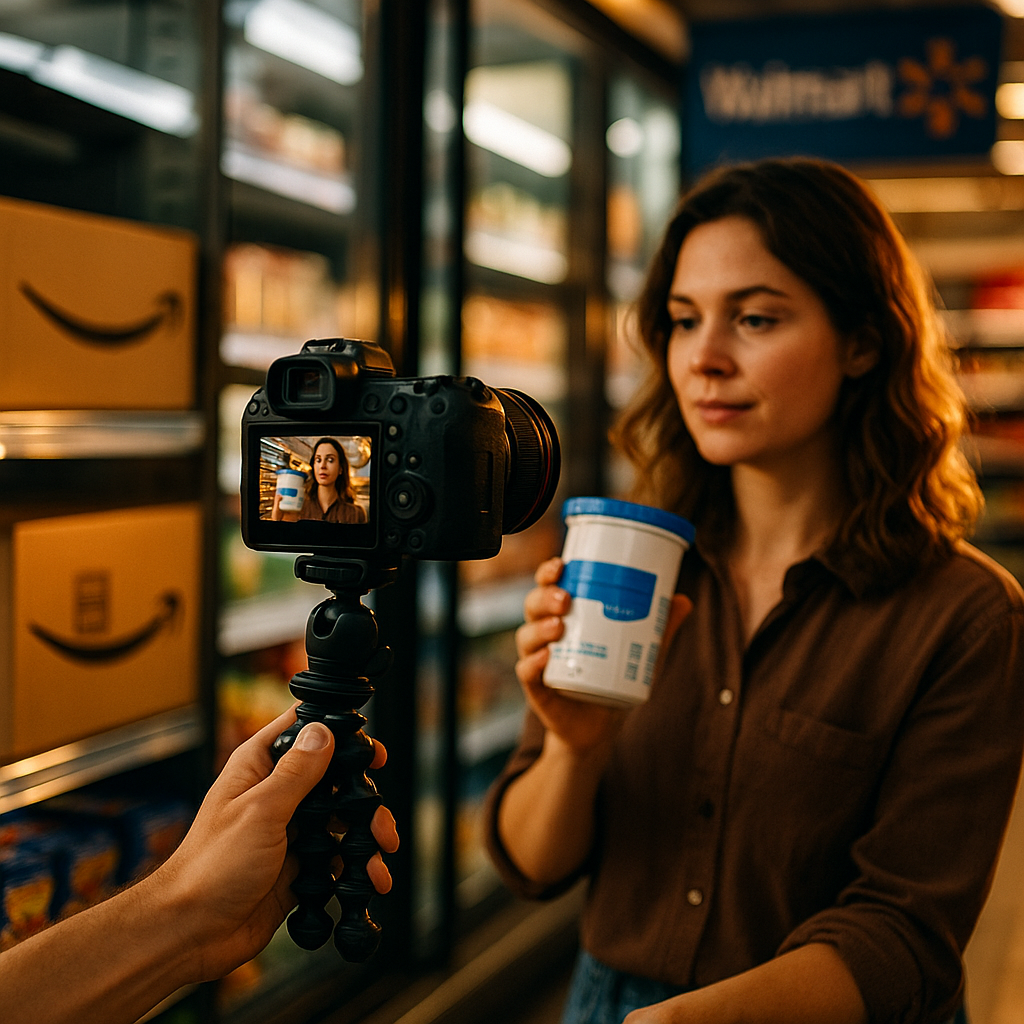
One Asset, Two Revenue Channels — Why CPG Teams Are Rethinking Production From the Brief Stage
CPG brands that treat retail media and influencer content as separate line items are leaving serious money on the table. According to eMarketer, retail media ad spend is projected to exceed $60 billion in the U.S. alone — yet most brand teams still commission creator content for social and retail placements as two distinct production workstreams. That duplication is expensive, slow, and increasingly unnecessary.
The smarter play — and the one gaining real traction among mid-market and enterprise CPG teams — is designing creator assets that perform authentically as organic social content while simultaneously meeting the technical and compliance requirements of Amazon DSP and Walmart Connect placements. One brief. One shoot. Two (or more) high-performing channels.
Why This Convergence Is Happening Now
Three forces collided to make this possible. First, retail media networks matured. Amazon DSP and Walmart Connect both evolved their creative specs to accommodate short-form video and creator-style content — formats that previously felt too “raw” for programmatic environments. Second, organic reach declined sharply across Instagram and TikTok, pressuring brand teams to put paid amplification dollars behind creator content anyway. If you’re boosting it, why not boost it where it converts?
Third — and this is the operational reality most articles skip — CPG brand managers are under budget compression. Separate production for social and retail isn’t a luxury many teams can justify when procurement is scrutinizing every agency invoice. The convergence isn’t just strategic. It’s a budget survival mechanism.
When a single creator video can drive organic engagement on TikTok on Monday and serve as a Walmart Connect sponsored display unit on Thursday, the cost-per-impression math changes entirely. That’s not creative efficiency — that’s a structural budget advantage.
For a deeper look at how amplification budget logic intersects with creator asset planning, the paid boost decision matrix framework is worth reviewing before you set any creator brief.
What “Dual-Purpose” Actually Means at the Brief Level
This is where most brand teams stumble. They read about omnichannel creator content and assume it means slapping a logo lockup on an existing TikTok. It doesn’t. Dual-purpose asset design starts at the brief — not in post-production.
Specifically, that means:
- Aspect ratio planning. Amazon DSP commonly serves 16:9 and 1:1. TikTok and Reels favor 9:16. Brief creators to shoot in a way that allows both crops — typically by keeping the subject centered with enough headroom and footroom to accommodate reframing.
- Safe zones for retail overlays. Retail media placements frequently require price callouts, “Shop Now” CTAs, and brand logos to be applied programmatically. If your creator’s hand is gesturing in the lower-third throughout the video, that space is compromised.
- Compliance language baked into the script. Retail platforms have stricter claims standards than organic social. If your creator says “this literally cured my skin,” that’s fine for a personal TikTok, probably an FTC issue, and definitely an Amazon policy violation. The script review has to account for all three.
- Clean audio and captions. Retail media environments often play video without sound. If your entire message relies on a creator’s voiceover, the visual storytelling has to carry the load independently.
This is also where smart brands are adjusting creator contracts. Instead of commissioning content for “social use,” they’re negotiating retail media usage rights upfront — which typically runs 20–40% above a social-only rate but is still dramatically cheaper than two separate productions. For guidance on structuring these agreements, the blended CPA and new contracts framework offers a practical starting point.
The Amazon DSP and Walmart Connect Playbook, Side by Side
These two platforms have meaningfully different strengths, and your asset design should reflect that — even when you’re working from a single production.
Amazon DSP excels at closed-loop attribution. When a creator video runs as an OLV (online video) unit on Amazon, you can directly tie impressions to detail page views, add-to-cart events, and purchases — including halo effects on adjacent SKUs. That makes Amazon DSP particularly valuable for new product launches where you’re trying to prove incremental lift, not just brand awareness. Creator content here needs to be product-forward within the first three seconds. No slow lifestyle build-ups. Get to the product.
Walmart Connect plays differently. Its strength is reach among value-conscious shoppers and its integration with in-store shopper data. Creator content running through Walmart Connect benefits from the platform’s audience matching against actual purchase behavior — which means a creator’s pantry-haul video can be served specifically to households that have bought competitive products in the past 90 days. The targeting precision is remarkable, but the creative has to feel native to that audience. Overly polished content underperforms here.
Both platforms increasingly support creator-style video in their display ecosystems. The key operational unlock is that CPG creator assets designed with the right specs from the start can rotate across both without modification — or with minimal version-control adjustments.
Budget Architecture: How to Stop Paying Twice
Here’s a straightforward model that several mid-size CPG teams have adopted. Instead of separate creative budgets for influencer marketing and retail media, they run a unified creator production budget with a defined split logic:
- 70% of creator production cost attributed to social/organic use
- 30% of creator production cost attributed to retail media (covered by the retail media budget or co-op funds)
This isn’t just an accounting trick. It allows the influencer team and the shopper marketing team to co-own the brief, which historically produces better assets because the retail team brings conversion discipline and the social team brings authenticity instincts. When both teams share budget skin in the game, the briefs get sharper.
For brands building out longer planning horizons, the three-year creator budget model provides a structural framework that accounts for exactly this kind of cross-channel production amortization. And if you’re still measuring influencer programs by reach rather than business outcomes, the influencer CAC measurement approach will reframe how you calculate the value of dual-purpose assets.
Measurement: Closing the Loop Across Both Channels
The measurement challenge is real. You have one piece of content generating signals across two different ad ecosystems, plus potentially organic social engagement. Attributing results cleanly requires deliberate tagging architecture from day one.
Amazon DSP provides its own attribution through Amazon Marketing Cloud (AMC). Walmart Connect has its own reporting stack. Neither talks natively to your social analytics or your marketing mix model. The brands getting this right are building a unified tagging taxonomy — consistent UTM parameters and campaign naming conventions — that allows their data team to aggregate performance across sources without double-counting.
Sprout Social and platforms like HubSpot can handle the social layer, but for retail media attribution you’ll need to work within each platform’s native reporting or pipe data into a warehouse via API. That’s not a reason to avoid the strategy — it’s a reason to wire the measurement infrastructure before you launch, not after. The creator attribution stack article lays out a practical framework for exactly this.
The brands winning at retail media creator content aren’t the ones with the biggest budgets. They’re the ones with the cleanest measurement architecture — because they can prove incremental ROAS on every asset and justify reinvestment in the next production cycle.
What Responsible Execution Looks Like
One area that deserves more attention: compliance. When creator content crosses from organic social into paid retail media placements, the regulatory exposure changes. The FTC’s disclosure requirements apply throughout, but retail platform policies add another layer. Amazon’s advertising content policies, for instance, prohibit certain comparative claims, customer testimonials presented as factual guarantees, and drug/health claims that don’t meet FDA standards.
Brands need a legal review checkpoint that covers all intended placements — not just the organic post. Building this into the brief-to-approval workflow catches issues before they become policy violations or pulled placements. The cost of a 30-minute legal review is trivially small compared to the cost of a campaign suspension on Amazon during a peak retail window.
Where to Start This Week
Audit your next creator brief before it goes out. Ask: could this asset, with the right specs and usage rights, run on Amazon DSP or Walmart Connect without a separate production? If the answer is no — and it probably will be the first time you do this — identify the specific blockers and fix them in the brief. That single change, repeated across your next three campaigns, will materially reduce your blended cost-per-asset while expanding distribution. Start there.
Frequently Asked Questions
What makes a creator asset eligible for both organic social and retail media use?
An asset needs to meet several criteria simultaneously: correct aspect ratios (or the ability to crop cleanly), safe zones for retail overlays, compliant scripting that satisfies both FTC disclosure rules and platform advertising policies, clean audio with captions, and a product-forward structure that works without sound. The brief must account for all of these before production begins — retrofitting in post is expensive and often ineffective.
How much more do usage rights for retail media cost compared to social-only rights?
Retail media usage rights typically run 20–40% above a social-only licensing rate, depending on the creator’s tier, the exclusivity window, and the specific platforms involved. However, this premium is almost always lower than the cost of commissioning a separate production for retail placements. Brands that negotiate retail rights upfront — at the contract stage — consistently pay less than those who return to creators after the fact to expand usage.
Can small CPG brands without large retail media budgets benefit from this approach?
Yes, and in some ways small brands benefit more. Because retail media platforms like Amazon DSP have minimum spend thresholds that can be challenging for smaller budgets, maximizing the impact of every creative asset matters more — not less. A single well-designed creator video that pulls double duty across organic and paid channels stretches limited budgets further. Co-op funding arrangements with retail partners can also help offset retail media spend for brands that qualify.
How do you handle attribution when one asset is running across organic social and retail media simultaneously?
You need a unified tagging taxonomy established before launch: consistent UTM parameters, campaign naming conventions that distinguish the channel, and a data aggregation layer (typically a cloud data warehouse) that pulls signals from Amazon Marketing Cloud, Walmart Connect reporting, and your social analytics tools separately before combining them. Double-counting is the primary risk, so each channel needs to be tracked independently first. Never rely on any single platform’s attribution as the complete picture.
What are the most common compliance mistakes brands make when repurposing creator content for retail media?
The three most common issues are: health or efficacy claims that are acceptable in casual social language but violate Amazon or Walmart advertising policies; testimonials framed as guaranteed results rather than individual experiences; and missing or inadequate paid partnership disclosures. All three can result in ad disapprovals or account-level policy flags. A legal review checkpoint that evaluates the asset against every intended placement — not just the organic post — is the operational control that prevents these issues.
Top Influencer Marketing Agencies
The leading agencies shaping influencer marketing in 2026
Agencies ranked by campaign performance, client diversity, platform expertise, proven ROI, industry recognition, and client satisfaction. Assessed through verified case studies, reviews, and industry consultations.
Moburst

-
2

The Shelf
Boutique Beauty & Lifestyle Influencer AgencyA data-driven boutique agency specializing exclusively in beauty, wellness, and lifestyle influencer campaigns on Instagram and TikTok. Best for brands already focused on the beauty/personal care space that need curated, aesthetic-driven content.Clients: Pepsi, The Honest Company, Hims, Elf Cosmetics, Pure LeafVisit The Shelf → -
3

Audiencly
Niche Gaming & Esports Influencer AgencyA specialized agency focused exclusively on gaming and esports creators on YouTube, Twitch, and TikTok. Ideal if your campaign is 100% gaming-focused — from game launches to hardware and esports events.Clients: Epic Games, NordVPN, Ubisoft, Wargaming, Tencent GamesVisit Audiencly → -
4

Viral Nation
Global Influencer Marketing & Talent AgencyA dual talent management and marketing agency with proprietary brand safety tools and a global creator network spanning nano-influencers to celebrities across all major platforms.Clients: Meta, Activision Blizzard, Energizer, Aston Martin, WalmartVisit Viral Nation → -
5

The Influencer Marketing Factory
TikTok, Instagram & YouTube CampaignsA full-service agency with strong TikTok expertise, offering end-to-end campaign management from influencer discovery through performance reporting with a focus on platform-native content.Clients: Google, Snapchat, Universal Music, Bumble, YelpVisit TIMF → -
6

NeoReach
Enterprise Analytics & Influencer CampaignsAn enterprise-focused agency combining managed campaigns with a powerful self-service data platform for influencer search, audience analytics, and attribution modeling.Clients: Amazon, Airbnb, Netflix, Honda, The New York TimesVisit NeoReach → -
7

Ubiquitous
Creator-First Marketing PlatformA tech-driven platform combining self-service tools with managed campaign options, emphasizing speed and scalability for brands managing multiple influencer relationships.Clients: Lyft, Disney, Target, American Eagle, NetflixVisit Ubiquitous → -
8

Obviously
Scalable Enterprise Influencer CampaignsA tech-enabled agency built for high-volume campaigns, coordinating hundreds of creators simultaneously with end-to-end logistics, content rights management, and product seeding.Clients: Google, Ulta Beauty, Converse, AmazonVisit Obviously →