


Live Commerce Is Eating Social — And Most Brands Are Winging It
Live commerce already drives over $500 billion in global sales annually, yet fewer than 30% of brands running creator livestreams use a structured production brief. That gap is where margin disappears. Interactive livestream content formats for social commerce conversion don’t produce results by accident — they’re engineered, directed, and briefed to the frame.
This is a working production framework. Use it to brief creators, align your ops team, and build repeatable live commerce events that actually move product.
Why Format Precision Beats Personality Every Time
The persistent myth in live commerce is that the creator’s charisma carries the event. It doesn’t — at least not alone. TikTok Shop’s internal data consistently shows that structured livestreams with deliberate segment sequencing outperform unscripted sessions by 2–4x on add-to-cart rates. The creator’s energy matters, but only once the architecture is right.
Think of a live commerce event like a television shopping network segment, rebuilt for native social behavior. QVC and HSN spent decades learning that demonstration before price reveal, social proof before CTA, and artificial scarcity before close is a reliable conversion sequence. Live social commerce compresses that playbook into 30–90 minute windows, with the added layer of real-time audience interaction and in-app purchase rails.
Your production brief is the director’s script. The creator is the talent. That distinction matters for how you write, deliver, and enforce your brief.
Brands that provide segment-level run-of-show documents to creators report 40% higher average order values in live commerce sessions compared to those using general talking points alone. Structure is the conversion lever most brands leave untouched.
The Core Segment Architecture: What Every Live Commerce Event Needs
A high-converting livestream isn’t a single continuous performance — it’s four to six discrete segments stitched together with deliberate transitions. Here’s how to specify each in your production brief.
Segment 1: Hook and Audience Capture (Minutes 0–5)
Instruct the creator to open with a direct value statement, not pleasantries. The brief should specify: state the hero product benefit within 45 seconds, trigger the first interactive element (a poll, a comment prompt, a “type YES if you want to see it first” mechanic), and acknowledge early joiners by name if the platform surfaces that data. TikTok LIVE and Instagram Live both surface top gifters and early commenters — brief your creator to use those touchpoints deliberately.
Segment 2: Demonstration-First Product Reveal (Minutes 5–20)
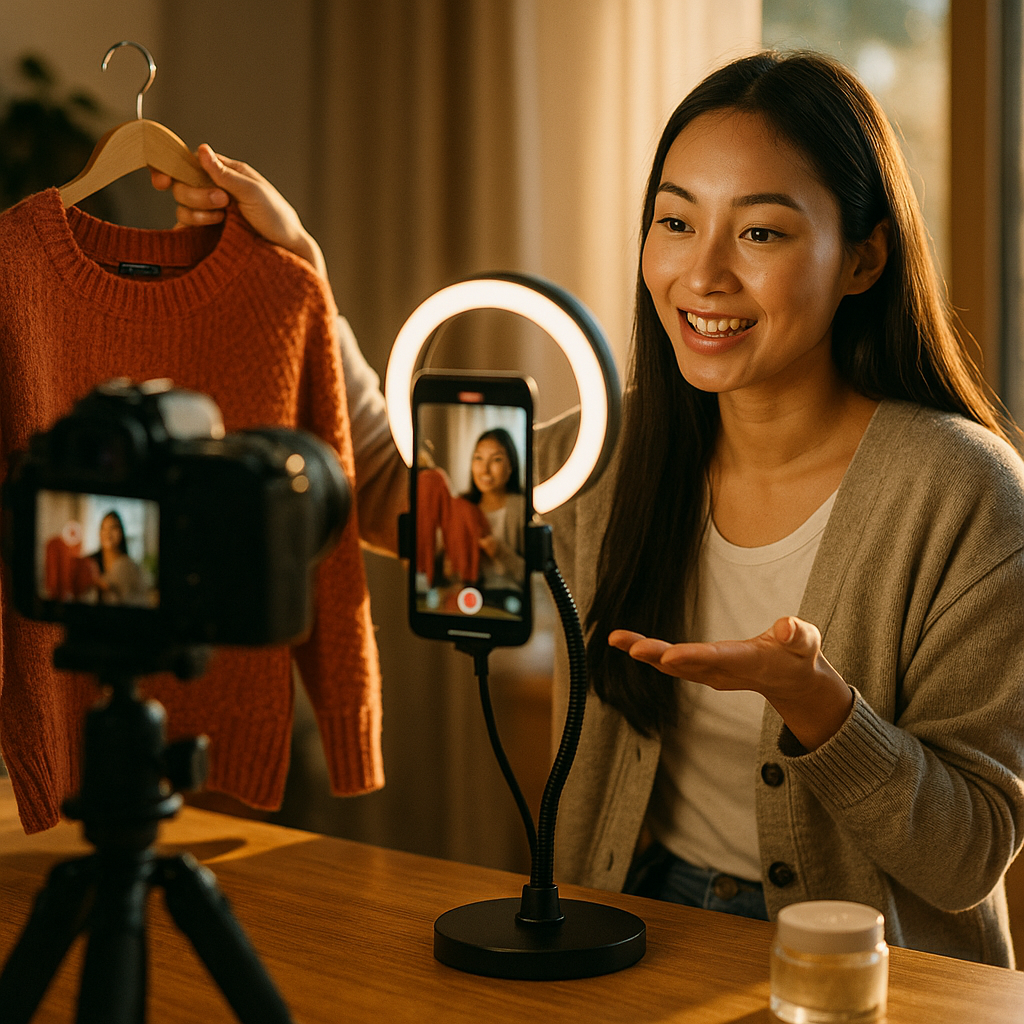
This is the non-negotiable anchor of the format. Before price, before availability, before any purchase CTA — the creator demonstrates. Specify camera angles in your brief: close-up for texture/material, wide shot for context/scale, and a dedicated “reaction angle” where the creator responds to live comments about what they’re seeing. For skincare, this means application on-camera. For apparel, it means a real try-on with movement. For tech, it means hands-on operation, not feature list recitation. Refer to your high-ticket live commerce briefs if your product price point requires extended trust-building before the reveal.
Segment 3: Live Q&A Integration (Woven Throughout)
Don’t relegate Q&A to the end. Brief creators to pull two to three live questions per segment, specifically those that surface objections. “Does it work on oily skin?” “Will this fit a size 12?” “How long does it take to charge?” Answering these in real time does dual work: it reduces purchase hesitation for the asker and for the hundreds of silent viewers who had the same question. Specify in your brief that the creator should call out the commenter by username — it signals to the audience that engagement is seen, which drives more of it.
Segment 4: Social Proof Moment (Minutes 20–30)
Structure a dedicated segment for credibility reinforcement. This can be pre-loaded review quotes the creator reads aloud, a co-host appearance (another creator or a satisfied customer), or real-time comment mining where the creator highlights viewers who share their own experience with the product. Poll-layered participatory formats work especially well here — “Comment LOVE if you’ve already tried this” surfaces community sentiment in real time.
Segment 5: Countdown Urgency Mechanics (Minutes 30–45)
This is where scarcity and time pressure do their psychological work. Your brief should specify the exact urgency triggers: a countdown timer pinned in the stream, a limited-quantity SKU called out explicitly (“We only loaded 200 units into the TikTok Shop link for tonight”), or a live-exclusive bundle or discount code that expires when the stream ends. The key briefing instruction: urgency must be real. Manufactured scarcity that shoppers can disprove with a 10-second Google search destroys trust faster than any other live commerce error. Coordinate with your inventory and promotions team before the brief goes to the creator.
Segment 6: Frictionless Checkout Prompt (Minutes 45–Close)
Brief the creator on the exact in-app checkout mechanics for the platform. On TikTok Shop, the creator should verbally direct viewers to the pinned product link and demonstrate the tap flow on-screen. On Meta’s live shopping tools, the product tag needs to be activated before go-live and the creator should verbally reference it at least three times in the final 15 minutes. Friction is the enemy. Every extra tap between interest and purchase is a drop-off point. Your brief should include a pre-stream checklist: product links pinned, checkout flow tested, payment methods confirmed active.
The Production Brief Template: What to Actually Include
A production brief for a live commerce event differs from a standard creator brief in specificity and operational depth. For AI-optimized creator briefs, product language alignment matters — but for live commerce, the emphasis shifts to timing, sequencing, and platform mechanics.
Your brief document should contain:
- Event objective: Primary KPI (units sold, GMV target, add-to-cart rate), secondary KPI (new follower acquisition, email capture via stream)
- Platform and technical specs: Go-live time, stream duration, backup platform, bandwidth minimum, lighting requirements, required camera setup
- Product run-of-show: Which SKU drops when, in what sequence, with approved talking points per product (not a script — approved claims and demo instructions)
- Approved urgency triggers: Exact language for scarcity claims, discount code activation timing, countdown language
- Compliance notes: Required disclosures per FTC guidelines, any claim restrictions on efficacy or comparison language
- Engagement directives: Minimum comment interaction frequency, specific questions to ask the audience, banned topics
- Post-stream deliverables: Clip extraction for paid amplification, data handoff requirements, follow-up story content
The brief should run four to six pages for a 60-minute event. Shorter feels underspecified. Longer signals you don’t trust the creator — and that damages the working relationship. Get specific, stay flexible on delivery.
Platform-Specific Mechanics You Cannot Brief Around
TikTok LIVE Shop, Instagram Live Shopping, and YouTube Shopping each have different product tagging flows, different audience interaction surfaces, and different algorithmic behaviors that affect who sees the stream while it’s live. Brief your creator on the specific platform’s mechanics — don’t assume they know, even if they’re experienced. A creator who runs 50 TikTok LIVEs a month may have never set up a YouTube Shopping stream.
Statista data shows TikTok LIVE drives the highest real-time conversion velocity of any social platform for sub-$100 products. For higher AOV categories, Instagram Live’s older and more credit-card-ready demographic often outperforms. Match the platform to the product, not just to the creator’s follower base. And check your format prioritization matrix before committing to a platform — audience-format fit determines ceiling performance more than creative execution alone.
Platform selection is a commerce decision, not a content decision. The wrong platform for your product category can cut conversion rates in half regardless of how well the creator executes the format.
Measurement: The Signals That Tell You the Format Worked
Live commerce measurement requires a tighter attribution window than standard influencer campaigns. Pull these signals within 24 hours of stream close:
- Peak concurrent viewership vs. average concurrent: A sharp peak-and-drop suggests the hook segment worked but retention failed — often a segment-length problem in the middle of the run-of-show
- Add-to-cart rate vs. checkout completion rate: A large gap here is a friction problem in the checkout flow, not a persuasion problem with the content
- Comment volume by segment: Use timestamped comment exports (available natively in TikTok and via third-party tools like Sprout Social) to identify which segment drove the highest engagement — then weight toward that format in your next event
- Urgency mechanic conversion lift: Compare add-to-cart rates in the five minutes before and after countdown activation. If you see less than a 20% lift, your urgency framing needs revision
Also brief creators on what data they can share with you post-stream. Platform native analytics, gifting revenue breakdowns, and comment exports are typically accessible to the account owner. Build data handoff into the contract, not the conversation.
If you’re scaling to multiple creators running concurrent or sequential live commerce events, your add-to-cart optimization brief for short-form content can serve as a complementary layer for the pre-event and post-event content that amplifies the livestream window.
Start with one creator, one platform, one 45-minute event structure, and run it three times before you optimize the brief. The format learns faster than any individual element of it — and your production brief should be a living document that gets sharper with every stream.
FAQs
How long should a live commerce event run for maximum conversion?
The highest-converting live commerce events on TikTok Shop and Instagram Live typically run between 45 and 90 minutes. Under 30 minutes rarely gives the urgency mechanics and Q&A cycles enough time to build purchase intent. Over 90 minutes risks audience fatigue and falling concurrent viewership, which can suppress platform algorithmic distribution mid-stream.
What’s the biggest brief mistake brands make when directing creators for live commerce?
Over-scripting the product demonstration. Creators who read from a script during a demo lose audience trust immediately — live viewers are highly sensitive to inauthenticity. Your brief should specify what to demonstrate and which claims are approved, but leave the delivery and language entirely to the creator. Specificity in structure, flexibility in voice.
How do countdown urgency mechanics work without feeling manipulative?
The urgency must be real and verifiable. A limited-quantity SKU, a live-exclusive discount code that actually expires, or a bundle available only during the stream are all legitimate mechanics. Brief your creator to explain why the scarcity exists — “we only produced 150 of these for the launch run” is credible. “Only 3 left!” when the product is stocked at 10,000 units is a trust-destroying tactic that audiences increasingly fact-check in real time.
Which platforms support the most frictionless in-app checkout for live commerce?
TikTok Shop currently offers the most integrated native checkout experience within a live stream, with one-tap purchase from the pinned product link. Meta’s live shopping tools on Instagram are strong for higher-ticket categories. YouTube Shopping integrates with Google Pay for a low-friction flow but has a smaller real-time live shopping audience. Platform capability evolves rapidly — verify current feature availability directly with each platform’s business portal before briefing your creator.
Should the same creator brief template work across all product categories?
The segment architecture is transferable, but the pacing and emphasis must shift by category. Beauty and skincare benefit from extended demonstration segments and high Q&A frequency. Tech products need longer specification coverage and more pre-stream audience education. High-ticket fashion or accessories require a stronger social proof segment and often a longer trust-build before the urgency mechanics activate. Use the same template framework, but adjust segment timing allocations based on your product’s typical purchase consideration window.
Top Influencer Marketing Agencies
The leading agencies shaping influencer marketing in 2026
Agencies ranked by campaign performance, client diversity, platform expertise, proven ROI, industry recognition, and client satisfaction. Assessed through verified case studies, reviews, and industry consultations.
Moburst

-
2

The Shelf
Boutique Beauty & Lifestyle Influencer AgencyA data-driven boutique agency specializing exclusively in beauty, wellness, and lifestyle influencer campaigns on Instagram and TikTok. Best for brands already focused on the beauty/personal care space that need curated, aesthetic-driven content.Clients: Pepsi, The Honest Company, Hims, Elf Cosmetics, Pure LeafVisit The Shelf → -
3

Audiencly
Niche Gaming & Esports Influencer AgencyA specialized agency focused exclusively on gaming and esports creators on YouTube, Twitch, and TikTok. Ideal if your campaign is 100% gaming-focused — from game launches to hardware and esports events.Clients: Epic Games, NordVPN, Ubisoft, Wargaming, Tencent GamesVisit Audiencly → -
4

Viral Nation
Global Influencer Marketing & Talent AgencyA dual talent management and marketing agency with proprietary brand safety tools and a global creator network spanning nano-influencers to celebrities across all major platforms.Clients: Meta, Activision Blizzard, Energizer, Aston Martin, WalmartVisit Viral Nation → -
5

The Influencer Marketing Factory
TikTok, Instagram & YouTube CampaignsA full-service agency with strong TikTok expertise, offering end-to-end campaign management from influencer discovery through performance reporting with a focus on platform-native content.Clients: Google, Snapchat, Universal Music, Bumble, YelpVisit TIMF → -
6

NeoReach
Enterprise Analytics & Influencer CampaignsAn enterprise-focused agency combining managed campaigns with a powerful self-service data platform for influencer search, audience analytics, and attribution modeling.Clients: Amazon, Airbnb, Netflix, Honda, The New York TimesVisit NeoReach → -
7

Ubiquitous
Creator-First Marketing PlatformA tech-driven platform combining self-service tools with managed campaign options, emphasizing speed and scalability for brands managing multiple influencer relationships.Clients: Lyft, Disney, Target, American Eagle, NetflixVisit Ubiquitous → -
8

Obviously
Scalable Enterprise Influencer CampaignsA tech-enabled agency built for high-volume campaigns, coordinating hundreds of creators simultaneously with end-to-end logistics, content rights management, and product seeding.Clients: Google, Ulta Beauty, Converse, AmazonVisit Obviously →