


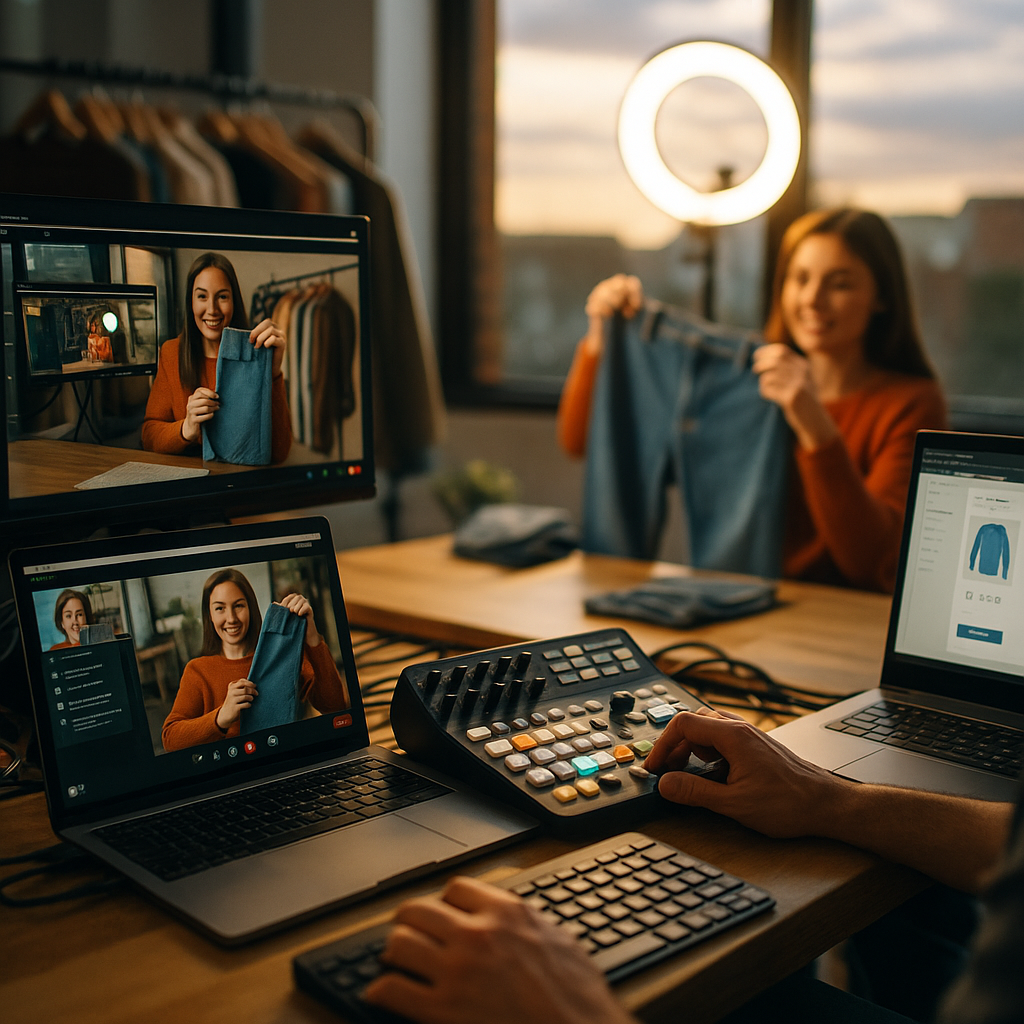
One Tap. 100-Plus Destinations. Your Creator Brief Just Changed.
Live commerce now drives over $500 billion in annual global GMV, yet most brand teams are still briefing creators as if a single-platform RTMP stream is the ceiling. Cloud-native live production — specifically tools like TVU Go with one-tap multi-platform streaming — is breaking that ceiling, and the operational implications for brand strategists run deeper than most marketing ops teams have acknowledged.
What “Cloud-Native Live Production” Actually Means for Brand Teams
Strip out the vendor language and here’s the practical definition: cloud-native live production moves the encoder, the switching logic, and the distribution layer off physical hardware and into managed cloud infrastructure. The creator needs a phone, a stable connection, and the app. The brand gets broadcast-grade reliability across 100-plus simultaneous destinations — TikTok Live, YouTube Live, Instagram Live, LinkedIn Events, Twitch, Shopify Live, custom RTMP endpoints — without a production truck parked outside.
TVU Go is one of the more mature players in this stack. Its architecture allows a solo creator to initiate a stream and push it to dozens of platforms in a single action. That’s not a cosmetic upgrade. That’s a fundamental shift in how you calculate cost-per-impression on a live activation, and it changes your briefing document from a platform-specific script to a multi-environment strategy.
When a creator can simultaneously stream to 100-plus destinations with one tap, the bottleneck is no longer distribution — it’s the brand brief. Teams that haven’t restructured their live creative briefs for multi-platform simultaneity are leaving measurable reach on the table.
The question brand teams need to answer first: are your current creator contracts and usage rights structured for simultaneous multi-platform distribution? If not, that’s the first operational risk to resolve before you touch any production tooling. For context on how content rights compound across distribution channels, the framework in creator content repurposing and rights routing is directly applicable here.
How This Changes the Live Commerce Brief
A traditional live commerce brief assumes a single platform. The creator knows their audience is on TikTok, or YouTube, or Instagram — and the CTA, product placement timing, and comment engagement are all calibrated to that one context. One-tap multi-platform streaming blows that assumption apart.
Simultaneous distribution means:
- Comment management multiplies. The creator is fielding live questions across TikTok, YouTube, and Instagram at the same time. Either the brand provides a moderation resource, or the brief must specify how the creator handles it — and most current briefs don’t address this.
- CTA sequencing needs platform awareness. “Swipe up to shop” is meaningless on YouTube. “Check the link in bio” doesn’t work in a LinkedIn Live context. Briefs must now include platform-specific CTA variants, even if the stream is technically identical.
- Compliance language must hold across jurisdictions. If the stream reaches UK audiences on YouTube and US audiences on TikTok simultaneously, FTC disclosure requirements and ICO/ASA standards are both in play at the same time.
The practical fix is building a modular brief: a core creative direction that works visually across all platforms, with a supplementary layer of platform-specific verbal cues the creator can drop in contextually. It’s more upfront work, but the efficiency gain downstream — one shoot reaching 100-plus audience touchpoints — justifies the investment.
Product Launches: The Multi-Platform Simultaneity Advantage
For product launches specifically, cloud-native live tools like TVU Go create a “premiere moment” at scale that previously required either a massive media buy or a very carefully coordinated creator network. Now a single creator, or a small coordinated group, can generate simultaneous first-impression content across every major platform in real time.
Consider a beauty brand launching a new foundation line. One lead creator streams the reveal on TikTok, YouTube, and Instagram simultaneously. Three supporting creators do the same with their own feeds — all using TVU Go’s multi-destination push. The brand isn’t paying for a coordinated media buy; they’re paying creator fees and a cloud production subscription. The earned-media equivalent of that simultaneous reach, if you run it through even a conservative CPM model, materially outperforms a standard paid placement strategy for launch moments.
Attribution gets complicated here, and that’s not a reason to avoid the strategy — it’s a reason to get your measurement infrastructure right before the activation. Multi-CRM attribution architecture for creator programs becomes essential when a single live event is generating conversion signals across a dozen platforms simultaneously.
Experiential Activations: Field-to-Feed Without a Satellite Truck
Live experiential — pop-ups, brand events, in-store activations, festival presence — has always had a production ceiling. You could have something incredible happening in a physical space, and the best you could get to digital audiences was a slightly laggy Instagram Live stream that dropped every ten minutes.
Cloud-native live production removes that ceiling. A creator at a brand pop-up can now stream to a LinkedIn audience watching a product demo, a TikTok audience watching the crowd energy, and a YouTube audience getting a longer-form narrative — all from the same device, same moment, same production quality. Sprout Social’s data consistently shows live video generates significantly higher engagement rates than pre-recorded content across platforms; the operational barrier was always reliable multi-platform distribution at the point of capture.
TVU’s bonding technology — which aggregates cellular, Wi-Fi, and other available connections to maintain stream stability — is particularly relevant in event environments where a single connection is unreliable. For brand teams, this means your experiential activation plan no longer needs a “what happens if the stream drops” contingency as a primary concern. It becomes a secondary one.
The operational brief for a live experiential activation in a cloud-native production model looks less like a traditional event brief and more like a multi-channel editorial calendar with real-time publishing logic built in.
Vendor Evaluation: What Brand Teams Should Ask
TVU Go is not the only player. Restream and Switcher Studio operate in adjacent spaces with different capability profiles. The evaluation criteria that matter for brand teams — as opposed to individual creators — break down into four areas:
- Destination breadth and reliability SLAs. How many simultaneous destinations? What’s the uptime guarantee for a live commerce event generating real transaction volume?
- Latency management. For live commerce specifically, comment-to-creator latency affects conversion. A creator who can’t see and respond to “does this come in blue?” in near-real-time loses the sale.
- Brand account integration. Can the brand’s owned channels receive the stream directly, or does everything route through the creator’s account? This has rights and brand safety implications.
- Post-stream asset handling. What happens to the recording? Does it auto-generate platform-native VOD? Can it feed into a creator content library with rights metadata attached?
The last point is underweighted in most vendor evaluations. Live content that disappears after the stream ends is a missed asset opportunity. The brands extracting the most value from cloud-native live production are the ones treating the live event as the acquisition moment and the VOD asset as the retention layer — and briefing creators accordingly.
If your team is still navigating how AI and data governance intersect with live production workflows, the MarTech readiness audit framework provides a useful diagnostic before you commit to any new production tooling. And for teams managing social commerce creative fatigue, live content’s inherent freshness is a tactical counter-strategy worth building into your rotation model.
For platform-level data on live commerce adoption trends, eMarketer’s commerce research provides useful benchmarks when building internal business cases for cloud-native production investment.
The immediate next step: audit your current live creator briefs against a multi-platform simultaneity checklist — CTA variants, comment moderation protocol, rights language, and VOD asset handling — before your next live activation. The technology is ready. Most briefs aren’t.
Frequently Asked Questions
What is TVU Go and how does it work for brand-led creator campaigns?
TVU Go is a cloud-native live production application that allows a creator to stream simultaneously to 100-plus platforms — including TikTok Live, YouTube Live, Instagram Live, LinkedIn Events, and custom RTMP endpoints — from a single mobile device. For brand campaigns, this means a single live activation can generate simultaneous reach across every major platform without requiring separate production setups or additional crew. TVU’s bonding technology stabilizes streams by aggregating multiple network connections, making it viable for event environments where Wi-Fi is unreliable.
How should brands update creator briefs for multi-platform live streaming?
Briefs need to shift from single-platform assumptions to a modular structure: a core creative direction that works visually across all environments, plus platform-specific CTA variants (since “swipe up” on TikTok is functionally different from a YouTube description link), comment moderation protocols for simultaneous multi-platform engagement, and explicit compliance language covering disclosure requirements across jurisdictions. The brief should also specify post-stream asset handling — whether the VOD is retained, where it’s stored, and how usage rights apply to it.
What are the attribution challenges of live commerce across 100-plus platforms?
When a single live event generates conversion signals across TikTok, YouTube, Instagram, and other platforms simultaneously, standard last-click or even multi-touch attribution models struggle to assign credit accurately. Platform-native analytics will each report different conversion counts for the same user journey. Brands need a multi-CRM or unified measurement layer that can deduplicate viewer and conversion data across platforms before the activation goes live, not after.
Is cloud-native live production only relevant for large brand budgets?
No. Cloud-native tools like TVU Go and competitors such as Restream operate on subscription models accessible to mid-market brands. The production cost reduction compared to hardware-based broadcast setups is substantial — eliminating encoding hardware, production trucks, and multi-platform manual configuration. The primary investment shifts from production infrastructure to creator fees, brief development, and post-stream asset management, which scales more proportionally with campaign size.
What rights and compliance issues arise from simultaneous multi-platform live streaming?
Three main areas: first, content usage rights must explicitly cover simultaneous multi-platform distribution, not just a named primary platform. Second, FTC disclosure requirements (for US audiences) and ASA/ICO standards (for UK audiences) must both be satisfied in real time if the stream reaches both markets. Third, the VOD recording generated after the live event may require separate licensing terms from the live broadcast rights, particularly if the brand intends to repurpose it for paid media. Legal review of creator contracts should precede any multi-destination live activation.
Top Influencer Marketing Agencies
The leading agencies shaping influencer marketing in 2026
Agencies ranked by campaign performance, client diversity, platform expertise, proven ROI, industry recognition, and client satisfaction. Assessed through verified case studies, reviews, and industry consultations.
Moburst

-
2

The Shelf
Boutique Beauty & Lifestyle Influencer AgencyA data-driven boutique agency specializing exclusively in beauty, wellness, and lifestyle influencer campaigns on Instagram and TikTok. Best for brands already focused on the beauty/personal care space that need curated, aesthetic-driven content.Clients: Pepsi, The Honest Company, Hims, Elf Cosmetics, Pure LeafVisit The Shelf → -
3

Audiencly
Niche Gaming & Esports Influencer AgencyA specialized agency focused exclusively on gaming and esports creators on YouTube, Twitch, and TikTok. Ideal if your campaign is 100% gaming-focused — from game launches to hardware and esports events.Clients: Epic Games, NordVPN, Ubisoft, Wargaming, Tencent GamesVisit Audiencly → -
4

Viral Nation
Global Influencer Marketing & Talent AgencyA dual talent management and marketing agency with proprietary brand safety tools and a global creator network spanning nano-influencers to celebrities across all major platforms.Clients: Meta, Activision Blizzard, Energizer, Aston Martin, WalmartVisit Viral Nation → -
5

The Influencer Marketing Factory
TikTok, Instagram & YouTube CampaignsA full-service agency with strong TikTok expertise, offering end-to-end campaign management from influencer discovery through performance reporting with a focus on platform-native content.Clients: Google, Snapchat, Universal Music, Bumble, YelpVisit TIMF → -
6

NeoReach
Enterprise Analytics & Influencer CampaignsAn enterprise-focused agency combining managed campaigns with a powerful self-service data platform for influencer search, audience analytics, and attribution modeling.Clients: Amazon, Airbnb, Netflix, Honda, The New York TimesVisit NeoReach → -
7

Ubiquitous
Creator-First Marketing PlatformA tech-driven platform combining self-service tools with managed campaign options, emphasizing speed and scalability for brands managing multiple influencer relationships.Clients: Lyft, Disney, Target, American Eagle, NetflixVisit Ubiquitous → -
8

Obviously
Scalable Enterprise Influencer CampaignsA tech-enabled agency built for high-volume campaigns, coordinating hundreds of creators simultaneously with end-to-end logistics, content rights management, and product seeding.Clients: Google, Ulta Beauty, Converse, AmazonVisit Obviously →