


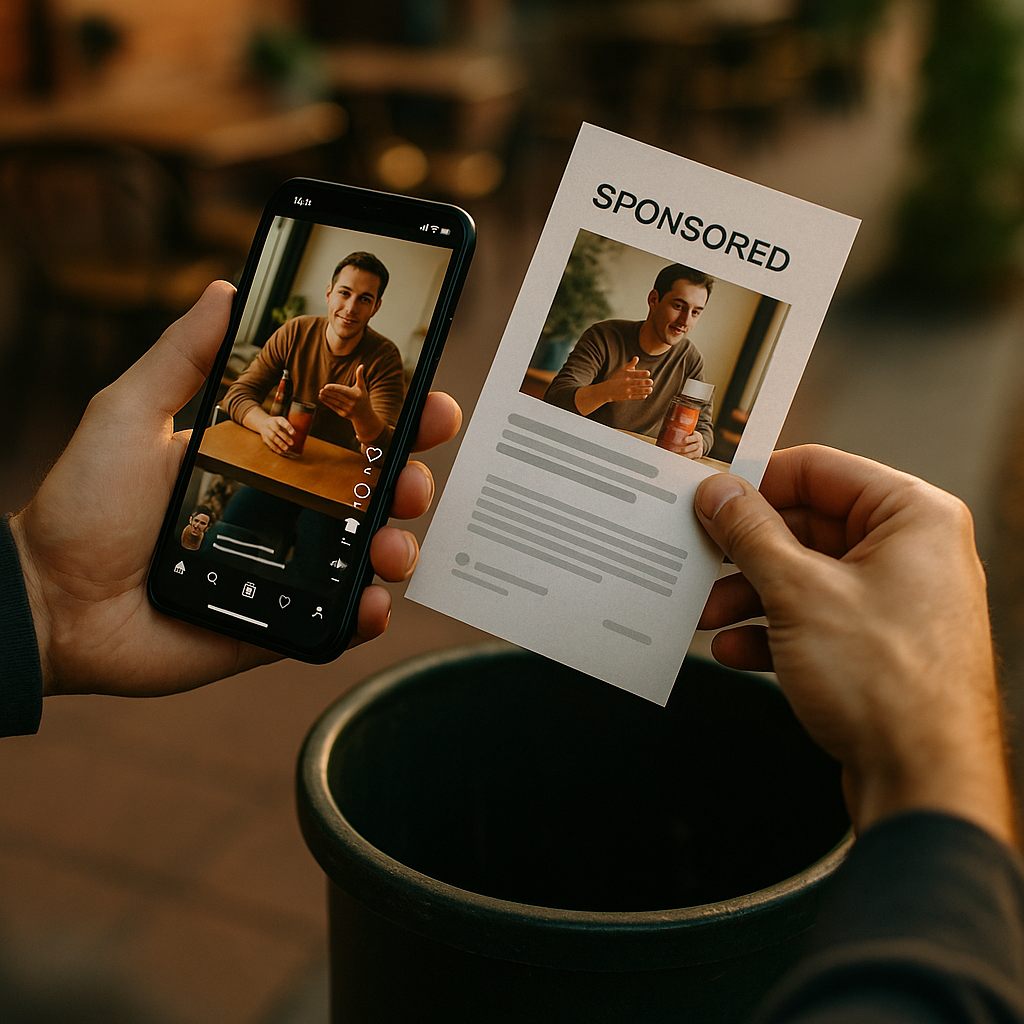
Sponsored post engagement rates have dropped by nearly 30% over the past three years, according to data tracked by Sprout Social. The #Ad label didn’t kill trust on its own — but it became shorthand for inauthenticity. Brands still treating sponsored posts as the backbone of influencer strategy are quietly hemorrhaging budget on a format audiences have learned to ignore.
The Sponsored Post Problem Nobody Wants to Admit Out Loud
Here’s the uncomfortable truth: the standard sponsored post — creator holds product, smiles at camera, drops a discount code — was always a borrowed-attention play. It worked when the creator economy was new and audiences hadn’t developed the reflexive swipe that now kicks in the moment they see “#ad” in the first line of a caption.
The format didn’t fail because disclosure killed it. It failed because brands optimized for volume over relevance, flooding feeds with posts that had no narrative tension, no stakes, and no reason to exist beyond a media buy. Platforms changed their algorithms to favor genuine dwell time. Audiences responded accordingly. And now the data is forcing the conversation brands were avoiding.
When a consumer sees “#Ad” before any value has been established, the post has already lost. The disclosure isn’t the problem — the missing story is.
The shift brands are navigating right now isn’t about compliance. The FTC’s disclosure requirements haven’t changed that logic. What’s changed is the architecture of how brands structure creative partnerships — moving from transactional post-for-pay agreements into outcome-linked, narrative-forward models that embed the brand into a story rather than interrupting one.
What “Performance-Linked Storytelling” Actually Means in Practice
The phrase gets thrown around in agency decks, but here’s what it looks like operationally. Instead of briefing a creator to mention a product in a post, brands are co-developing content arcs — multi-touch story sequences where the product or service plays a functional role in a real outcome the creator is pursuing. The creator documents a process. The brand’s offering is a genuine tool in that process. Performance metrics — saves, shares, link clicks, conversion events — are baked into the contract from day one.
This isn’t affiliate marketing rebranded. The key distinction is creative co-ownership. Brands using this model are giving creators genuine input on how the narrative is structured, which means the content reads like the creator’s work — because it largely is. The brand’s role shifts from “sponsor” to “supporting character in someone else’s story.”
Practical examples are already shaping up across categories. Skincare brands are funding 60-day transformation series where creators document routines with weekly check-ins and measurable outcomes. B2B SaaS companies are embedding their tools inside creator-led tutorials where the software solves a real workflow problem on camera. Fitness brands are co-producing long-form documentary content on YouTube rather than commissioning 30-second product spots.
The flat-fee contract model is a casualty of this transition. When content is performance-linked, flat fees become structurally misaligned — they reward completion, not outcomes. The contracts that fit this new architecture are hybrid structures: a base creative fee plus performance bonuses tied to defined KPIs.
Partnership Architecture: The Infrastructure Shift
Brands aren’t just changing creative formats. They’re redesigning the entire operating model behind how they source, contract, and manage creator relationships.
Longer partnership durations. Single-post deals are being replaced by quarterly or annual creator rosters. This isn’t just about continuity — longer relationships give creators enough context about a brand to actually tell a coherent story. A creator who has used a product for six months before posting about it is producing fundamentally different content than one who received a sample on Monday and posted on Thursday.
Tiered creative rights frameworks. As UGC ad spend scales toward nine-figure territory, brands are getting serious about what they own, what they license, and for how long. Performance-linked content that drives strong results gets promoted through paid amplification — which requires usage rights language that flat-fee transactional contracts never anticipated.
Measurement infrastructure before briefs are written. This is the part most brands skip and later regret. If you’re committing to a performance-linked model, your attribution stack needs to be capable of tracking the outcomes you’re promising to measure. Last-click attribution tells you almost nothing useful about a six-episode content series. Brands doing this well are using multi-touch models, creator-specific UTMs, and — increasingly — AI-assisted tools to parse dark social signals and share behavior that traditional dashboards miss.
The dark social attribution problem is particularly acute here. Narrative-driven content gets shared in DMs, saved to collections, and reshared in close-friends Stories — none of which shows up cleanly in platform analytics. Brands that don’t solve for this will consistently undervalue the partnerships that are actually working.
Why This Format Change Also Changes Who You Partner With
The migration toward performance-linked storytelling is, not coincidentally, accelerating the case for micro-creator performance advantages. Macro influencers with broad audiences are optimized for reach and awareness — the metrics that sponsor post models were built around. Creators with tighter, more specific communities are naturally better suited to narrative formats because their audiences follow them for the story, not just the content type.
A creator with 40,000 highly engaged followers in the personal finance space producing a multi-part series on eliminating debt — with a brand’s budgeting tool embedded authentically — will outperform a celebrity post on virtually every downstream metric that matters to a marketer with a conversion mandate.
The shift to performance-linked storytelling isn’t just a creative preference — it structurally favors smaller creators with higher audience trust, which changes roster strategy from the ground up.
This has implications for how brands approach creator discovery. Reach-based filters — the default in most platforms — are the wrong starting criteria for this model. Story consistency, content depth, audience conversation quality, and historical save rates are better signals. Tools like eMarketer’s creator benchmarking data and platform-native creator analytics are increasingly being paired with qualitative audits to find the right narrative fit.
Compliance Doesn’t Get Simpler — It Gets Different
One legitimate concern when moving away from overt #Ad formats: does looser-feeling sponsored content create disclosure risk? The answer is nuanced. The FTC and equivalents in other markets don’t care about format — they care about material connection transparency. A six-episode series where episode one discloses the brand partnership clearly, and subsequent episodes include a brief reference, is defensible. A “documentary” that buries sponsorship in episode five’s description is not.
The brands getting this right are treating disclosure as a narrative element rather than a legal disclaimer. Transparency, done well, can actually strengthen the story. A creator who openly says “Brand X is funding this series because I pitched them on this idea” is more credible, not less.
For brands operating across markets, the ICO’s digital advertising guidelines and equivalent national frameworks add complexity to longer-form content that spans multiple posts or platforms. Legal review of multi-touch content series needs to happen at the architecture stage, not the approval stage.
Budget Reallocation: Where the Money Actually Moves
Shifting partnership architecture isn’t budget-neutral. Narrative-driven content costs more per unit — longer shoots, more production time, creative development fees. The offset is fewer, better partnerships replacing a high-volume spray-and-pray model that was never as efficient as the CPM math made it look.
Brands making this transition successfully are reallocating the paid amplification budget that previously propped up underperforming sponsored posts. When content is genuinely performing organically, paid distribution across platforms amplifies something that’s already working — not something that needs life support from ad spend to hit viewability numbers.
The operational math typically works out as: fewer creators, longer engagements, higher base creative investment, significantly higher paid amplification ROI, and measurable improvement in downstream conversion metrics within the first two quarters of a redesigned program. Reference HubSpot’s benchmarks on content engagement longevity — narrative content generates meaningful traffic well past its initial publication window, which flat-format sponsored posts almost never do.
Start with one creator in one category. Build the story arc before writing the brief. Define the performance metrics before signing the contract. Everything else follows from getting those three steps right.
Frequently Asked Questions
What is performance-linked storytelling in influencer marketing?
Performance-linked storytelling is a partnership model where brand-sponsored content is structured as a narrative arc — typically multi-part and outcome-driven — and the creator’s compensation or bonus structure is tied to defined performance metrics like saves, conversions, or link clicks, rather than a flat fee for a single post.
Is the #Ad disclosure still legally required in performance-linked content?
Yes. Regardless of format, any content where a material connection exists between brand and creator requires clear disclosure under FTC guidelines and equivalent regulations in other markets. Performance-linked or narrative-format content must still disclose sponsorship — the best practice is to make that disclosure early, clearly, and ideally as part of the narrative rather than buried in captions.
How do brands measure ROI on narrative-driven creator content?
Effective measurement for narrative content requires multi-touch attribution models, creator-specific UTMs, and tools capable of capturing dark social signals like DM shares and saves. Last-click attribution significantly undervalues this format. Brands should define KPIs at the contract stage and build measurement infrastructure before briefing creative.
Do performance-linked contracts favor micro-creators over macro-influencers?
Structurally, yes. Creators with smaller but highly engaged communities are better suited to narrative formats because their audiences follow them for depth and story continuity. Macro-influencers optimized for reach metrics tend to underperform on the downstream conversion and engagement-depth KPIs that performance-linked deals are built around.
How long should a performance-linked creator partnership last?
Most brands seeing strong results are structuring these partnerships at a minimum of one quarter, with annual agreements becoming more common for high-performing creators. Longer engagements give creators enough product experience to tell authentic stories and give brands enough data to optimize content direction mid-partnership.
Top Influencer Marketing Agencies
The leading agencies shaping influencer marketing in 2026
Agencies ranked by campaign performance, client diversity, platform expertise, proven ROI, industry recognition, and client satisfaction. Assessed through verified case studies, reviews, and industry consultations.
Moburst

-
2

The Shelf
Boutique Beauty & Lifestyle Influencer AgencyA data-driven boutique agency specializing exclusively in beauty, wellness, and lifestyle influencer campaigns on Instagram and TikTok. Best for brands already focused on the beauty/personal care space that need curated, aesthetic-driven content.Clients: Pepsi, The Honest Company, Hims, Elf Cosmetics, Pure LeafVisit The Shelf → -
3

Audiencly
Niche Gaming & Esports Influencer AgencyA specialized agency focused exclusively on gaming and esports creators on YouTube, Twitch, and TikTok. Ideal if your campaign is 100% gaming-focused — from game launches to hardware and esports events.Clients: Epic Games, NordVPN, Ubisoft, Wargaming, Tencent GamesVisit Audiencly → -
4

Viral Nation
Global Influencer Marketing & Talent AgencyA dual talent management and marketing agency with proprietary brand safety tools and a global creator network spanning nano-influencers to celebrities across all major platforms.Clients: Meta, Activision Blizzard, Energizer, Aston Martin, WalmartVisit Viral Nation → -
5

The Influencer Marketing Factory
TikTok, Instagram & YouTube CampaignsA full-service agency with strong TikTok expertise, offering end-to-end campaign management from influencer discovery through performance reporting with a focus on platform-native content.Clients: Google, Snapchat, Universal Music, Bumble, YelpVisit TIMF → -
6

NeoReach
Enterprise Analytics & Influencer CampaignsAn enterprise-focused agency combining managed campaigns with a powerful self-service data platform for influencer search, audience analytics, and attribution modeling.Clients: Amazon, Airbnb, Netflix, Honda, The New York TimesVisit NeoReach → -
7

Ubiquitous
Creator-First Marketing PlatformA tech-driven platform combining self-service tools with managed campaign options, emphasizing speed and scalability for brands managing multiple influencer relationships.Clients: Lyft, Disney, Target, American Eagle, NetflixVisit Ubiquitous → -
8

Obviously
Scalable Enterprise Influencer CampaignsA tech-enabled agency built for high-volume campaigns, coordinating hundreds of creators simultaneously with end-to-end logistics, content rights management, and product seeding.Clients: Google, Ulta Beauty, Converse, AmazonVisit Obviously →