


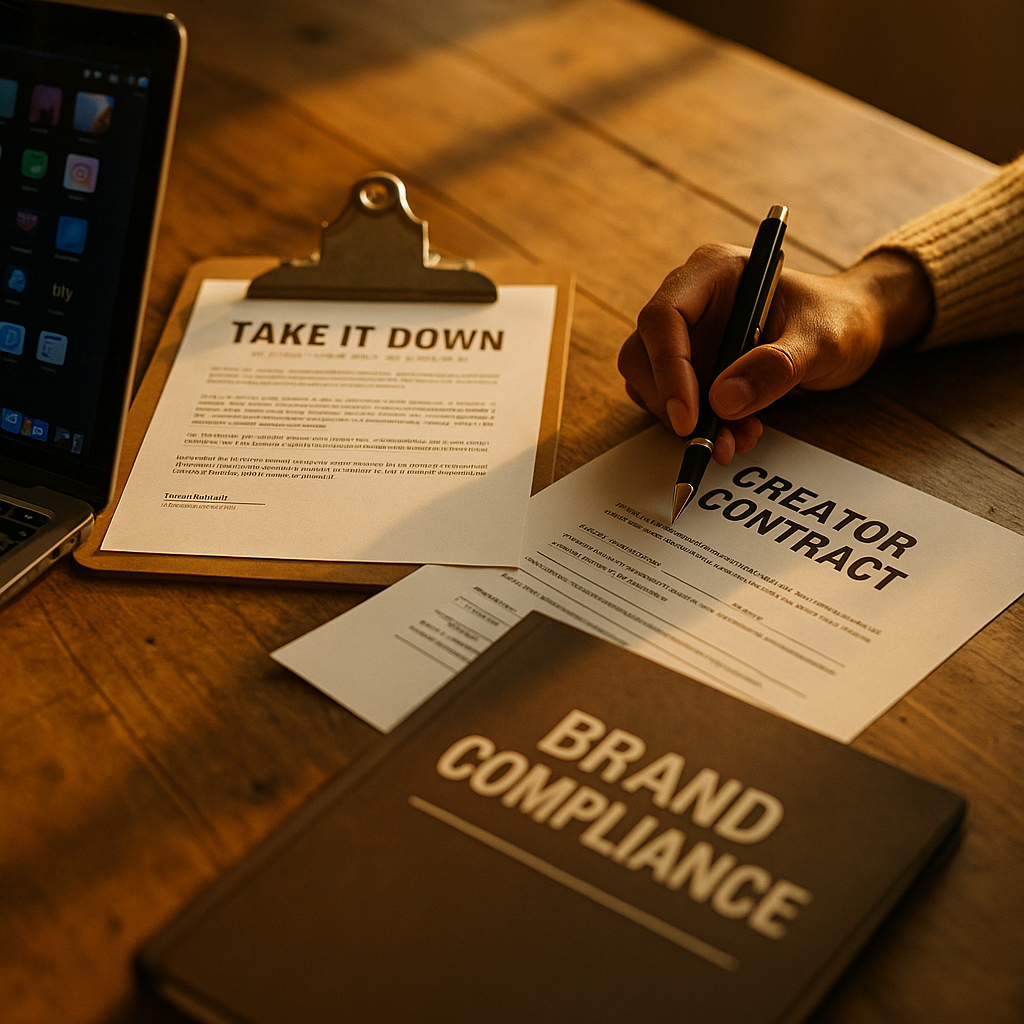
If your creator agreements don’t include explicit platform compliance assurances around non-consensual intimate image (NCII) removal, you have a contractual gap that the Take It Down Act just made materially riskier. The law isn’t abstract — it directly touches how platforms your creators operate on must behave, and by extension, how your brand’s association with those creators can become a liability.
What the Take It Down Act Actually Requires
Signed into law in 2026, the Take It Down Act mandates that online platforms remove non-consensual intimate imagery — including AI-generated deepfakes — within 48 hours of a verified complaint. The FTC holds enforcement authority. Platforms that fail to comply face significant penalties, and the law explicitly covers synthetic or AI-generated content that depicts real individuals without consent.
That last part matters enormously for brand marketers. AI-generated content is now standard production tooling across the creator economy. When a creator uses an AI tool to remix, reface, or synthesize imagery — even in a brand-sponsored post — and that output involves another person’s likeness without consent, the platform hosting that content is legally obligated to remove it fast. If your campaign is built around that content, the clock is ticking on your asset.
The 48-hour removal window isn’t just a platform problem — it’s a brand campaign continuity problem. A sponsored post pulled mid-flight doesn’t just disappear; it signals a compliance failure associated with your brand.
Why This Creates a Brand-Specific Compliance Obligation
Most brand legal teams are focused on FTC disclosure compliance and platform ad policy adherence. Fewer have stress-tested their creator agreements against the scenario where a platform is legally compelled to remove a creator’s content because it violates NCII law.
Think through the downstream exposure. Your brand has contracted a creator for a six-week campaign. The creator — or an AI tool they used — produces content that generates an NCII complaint. The platform removes it within 48 hours, as required. Your media investment evaporates. The association between your brand and the removal reason circulates on social. And your agreement with the creator almost certainly contains no indemnification clause, no content compliance warranty, and no obligation for the creator to disclose what AI tools they used in production.
That’s not hypothetical — that’s a contract gap most brands are carrying right now. For a structured look at where these gaps typically live, see our coverage of creator contract gaps and disclosure risk.
Platform Compliance Assurances: What That Term Actually Means in Practice
When we talk about “platform compliance assurances” in creator agreements, we mean contractual representations from your creator that they understand, and agree to operate within, the content policies of every platform on which they publish sponsored content on your behalf. Most agreements gesture at this vaguely. Few specify it by law or by platform policy version.
Under the Take It Down Act framework, a meaningful platform compliance assurance would need to cover at minimum:
- A representation that the creator will not produce or publish NCII or AI-generated NCII in connection with brand-sponsored content
- Disclosure of all AI tools used in content production, with confirmation those tools were used in compliance with their own terms of service
- Acknowledgment that the platform on which content is published has NCII removal obligations, and that violating content will be removed regardless of campaign timing
- An indemnification clause covering brand losses resulting from content removal due to NCII-related complaints
- A content audit right allowing the brand to request proof of production methodology before content goes live
This isn’t overreach. These are the logical contractual consequences of operating in an environment where a federal law can unilaterally remove your campaign assets. For a broader look at how to build protective language into agreements, our guide on creator contract clauses for brand leverage covers the foundational framework.
Auditing Your Existing Roster Agreements
If you manage an active creator roster — whether 10 partners or 1,000 — you need an immediate audit pass focused on three questions per agreement.
First: Does the agreement contain any representation about AI-generated content in production? If the answer is no, your creator can use any AI tool available without disclosure. Given that AI face-swapping, voice synthesis, and image generation tools are now accessible at consumer price points, this is not a theoretical risk.
Second: Does the agreement address content removal by platforms? Most agreements contain a “content takedown” clause focused on brand-initiated removal. Almost none address platform-initiated removal triggered by third-party complaints under federal law. That’s a different scenario with different liability implications.
Third: What remedies does the brand have if sponsored content is removed due to creator conduct? Contracts that are silent here leave the brand absorbing the loss — media spend, production cost, campaign disruption — with no contractual recourse against the creator whose content triggered the removal.
Running this audit in parallel with your standard campaign compliance review is the efficient path. Our campaign pre-flight compliance checklist provides a structured framework you can adapt to include NCII-specific checkpoints.
The AI Generation Angle Brands Are Underestimating
The Take It Down Act’s explicit coverage of AI-generated NCII is the provision that most brand legal teams haven’t fully digested yet. The law doesn’t require that a human creator intentionally produce NCII. It applies to synthetic content — which means a creator using an AI image tool who inadvertently generates likeness-adjacent imagery of a real person could trigger a complaint and a platform removal obligation.
Brands that are co-producing AI-generated creative with creators — or whose agencies are using AI production tools on behalf of creators — carry compounded exposure here. The question of who bears liability when an AI tool generates non-compliant content in a commercial production workflow is not yet settled law, but the FTC’s enforcement posture suggests they will follow the money upstream.
This connects directly to how you handle AI tool disclosure in creator agreements. See our analysis of AI remix tools and FTC disclosure risk for the contractual mechanics involved.
When a platform is legally compelled to remove content within 48 hours, your brand doesn’t get a grace period to negotiate. The only protection you have is what you negotiated before the campaign launched.
What Responsible Platforms Are Already Doing
Meta, TikTok, and YouTube have all updated their content moderation infrastructure to address NCII compliance ahead of enforcement deadlines. Meta’s business policies now include explicit NCII provisions across Instagram and Facebook. TikTok’s ad platform has integrated content flagging systems designed to surface potential NCII violations before distribution scales.
What this means practically: platforms are becoming more proactive in removal, not less. The legal floor is 48 hours, but proactive systems may act faster. And creator content that gets flagged — even erroneously — can trigger review queues that delay or disrupt campaign delivery. That’s another operational risk your agreements should address through a content dispute resolution clause.
For brands running youth-targeted programs, the compliance intersection deepens further. NCII protections have heightened legal sensitivity when minors are involved, and the age verification obligations that flow from Meta’s AI age restriction enforcement create adjacent compliance obligations worth reviewing in the same audit cycle.
Practical Next Step
Pull your five highest-spend creator agreements this week and run the three audit questions above against each one. If any agreement is silent on AI production tools, platform-initiated removal, or brand indemnification for creator conduct, flag it for amendment before your next campaign activation. That’s where your legal exposure is — not in your media plan, but in your contract templates.
Frequently Asked Questions
What is the Take It Down Act and who does it apply to?
The Take It Down Act is a federal law that requires online platforms to remove non-consensual intimate imagery (NCII), including AI-generated deepfakes, within 48 hours of a verified complaint. It applies to platforms that host user-generated content and is enforced by the FTC. Brands are not directly regulated, but their creator programs are exposed when sponsored content is removed under the law.
Do brands have direct liability under the Take It Down Act?
Brands are not the primary regulated party — platforms are. However, brands face indirect financial and reputational exposure when creator-produced sponsored content is removed under the Act. Without proper contractual protections, brands absorb the campaign losses with no recourse against the creator whose content triggered the removal.
What contract clauses should brands add to address NCII compliance?
At minimum, brands should add: (1) a representation that creators will not produce NCII or AI-generated NCII in sponsored content; (2) a disclosure requirement for all AI tools used in production; (3) an acknowledgment of platform removal obligations under federal law; (4) an indemnification clause covering brand losses from content removal due to NCII complaints; and (5) a production audit right prior to publication.
Does the Take It Down Act cover AI-generated content?
Yes. The law explicitly covers synthetic and AI-generated imagery that depicts real individuals in intimate contexts without consent. This means content produced using AI image generation, face-swapping, or video synthesis tools can trigger removal obligations even if no human was directly photographed.
How quickly can a platform remove sponsored content under this law?
Platforms are required to remove qualifying content within 48 hours of a verified complaint. However, proactive content moderation systems on platforms like Meta and TikTok may flag and review content faster than that. Brands should treat the 48-hour window as a maximum, not a guaranteed buffer.
Should this audit be part of a broader creator compliance review?
Yes. NCII compliance assurances should be integrated into your standard creator agreement audit cycle alongside FTC disclosure obligations, platform ad policy compliance, and AI production tool governance. Running these reviews together reduces operational overhead and ensures you don’t create compliance gaps by addressing requirements in isolation.
Top Influencer Marketing Agencies
The leading agencies shaping influencer marketing in 2026
Agencies ranked by campaign performance, client diversity, platform expertise, proven ROI, industry recognition, and client satisfaction. Assessed through verified case studies, reviews, and industry consultations.
Moburst

-
2

The Shelf
Boutique Beauty & Lifestyle Influencer AgencyA data-driven boutique agency specializing exclusively in beauty, wellness, and lifestyle influencer campaigns on Instagram and TikTok. Best for brands already focused on the beauty/personal care space that need curated, aesthetic-driven content.Clients: Pepsi, The Honest Company, Hims, Elf Cosmetics, Pure LeafVisit The Shelf → -
3

Audiencly
Niche Gaming & Esports Influencer AgencyA specialized agency focused exclusively on gaming and esports creators on YouTube, Twitch, and TikTok. Ideal if your campaign is 100% gaming-focused — from game launches to hardware and esports events.Clients: Epic Games, NordVPN, Ubisoft, Wargaming, Tencent GamesVisit Audiencly → -
4

Viral Nation
Global Influencer Marketing & Talent AgencyA dual talent management and marketing agency with proprietary brand safety tools and a global creator network spanning nano-influencers to celebrities across all major platforms.Clients: Meta, Activision Blizzard, Energizer, Aston Martin, WalmartVisit Viral Nation → -
5

The Influencer Marketing Factory
TikTok, Instagram & YouTube CampaignsA full-service agency with strong TikTok expertise, offering end-to-end campaign management from influencer discovery through performance reporting with a focus on platform-native content.Clients: Google, Snapchat, Universal Music, Bumble, YelpVisit TIMF → -
6

NeoReach
Enterprise Analytics & Influencer CampaignsAn enterprise-focused agency combining managed campaigns with a powerful self-service data platform for influencer search, audience analytics, and attribution modeling.Clients: Amazon, Airbnb, Netflix, Honda, The New York TimesVisit NeoReach → -
7

Ubiquitous
Creator-First Marketing PlatformA tech-driven platform combining self-service tools with managed campaign options, emphasizing speed and scalability for brands managing multiple influencer relationships.Clients: Lyft, Disney, Target, American Eagle, NetflixVisit Ubiquitous → -
8

Obviously
Scalable Enterprise Influencer CampaignsA tech-enabled agency built for high-volume campaigns, coordinating hundreds of creators simultaneously with end-to-end logistics, content rights management, and product seeding.Clients: Google, Ulta Beauty, Converse, AmazonVisit Obviously →