


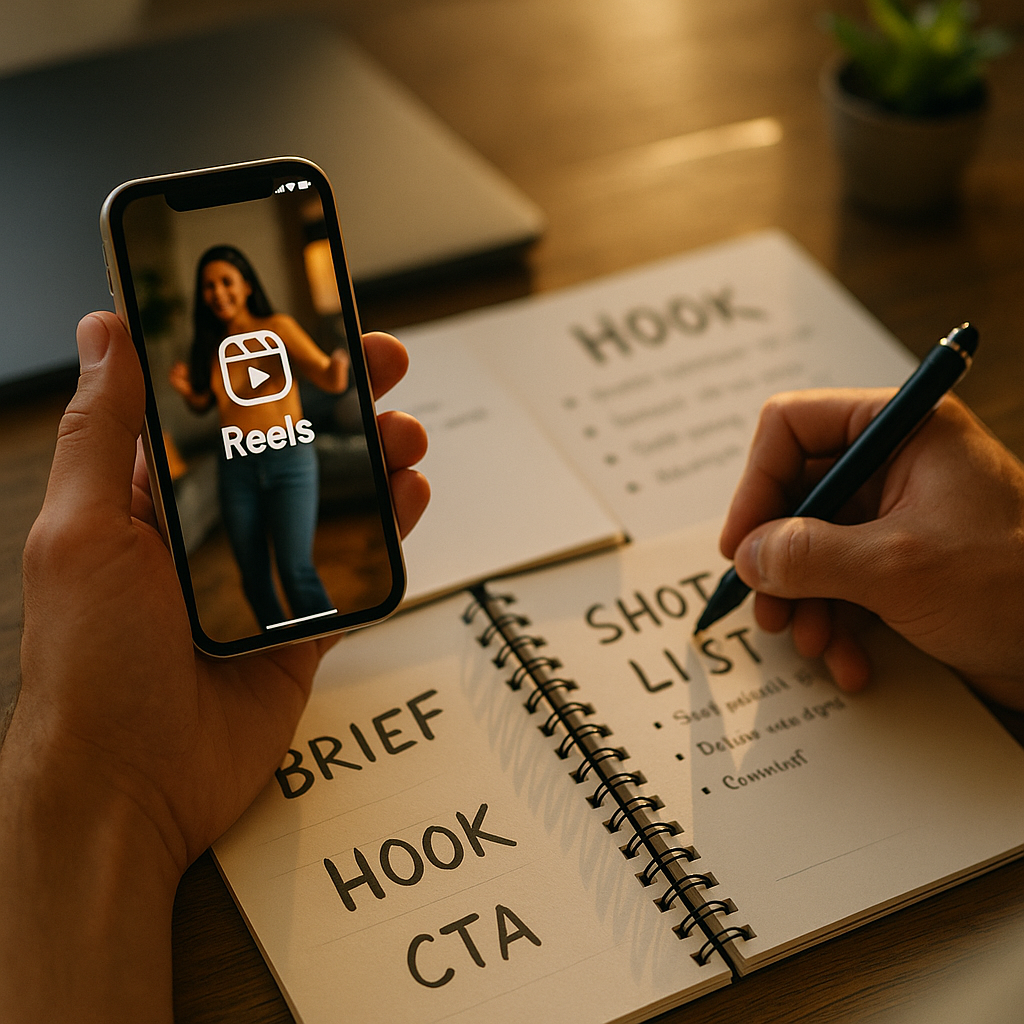
Half the Platform. Most of the Budget. Is Your Brief Built for It?
Reels now account for roughly 50% of all time spent on Instagram, according to Meta’s own business data. Ad spend has followed. Yet most creative briefs circulating inside brand marketing teams were architected for static posts, Stories, or polished 30-second pre-roll. That mismatch is costing performance.
This isn’t about making your brand feel “native.” It’s about rebuilding the brief as an engineering document for a specific content environment with specific attention physics.
Why Traditional Creative Briefs Break on Reels
The standard creative brief assumes a viewer who opted in. Someone who clicked play, loaded a webpage, or sat through a pre-roll gate. Reels viewers did none of that. They’re mid-scroll, one thumb movement from gone. The brief needs to start from that behavioral reality, not from brand guidelines written for a trade magazine spread.
Most legacy briefs front-load context: brand story, product category, campaign theme. On Reels, that structure is a death sentence. By the time your creator delivers the “here’s what I want to talk about today” setup, 70% of your audience has already left. The algorithm signals that matter, watch time, replays, shares, are decided in the first three seconds.
The second structural failure is CTA placement. Briefs inherited from YouTube or TV typically put the call to action at the end. On a 15-to-30-second Reel, a significant share of viewers never reach the end. Placing your only conversion driver there is a budget leak disguised as creative strategy.
Shot Composition: Rethink the Frame Before the Script
Vertical isn’t just a format. It’s a compositional grammar. The 9:16 frame forces subject proximity, eliminates horizon-line thinking, and shifts the visual weight to the center and upper-center of the screen. Brand creative directors who brief for 16:9 and then “reformat” are producing compromised assets, not Reels-native content.
Specific adjustments that belong in your brief:
- Face-forward framing within the first 1.5 seconds. Human eye contact triggers retention. Brief creators to open on face, not product, not logo.
- Text-safe zones. Meta’s interface elements (follow button, caption, audio tag) consume the bottom 20% of the frame. Any critical visual information placed there will be obscured on a meaningful percentage of placements.
- Environmental audio as a creative tool. Unlike pre-roll, Reels plays with sound on by default for a significant segment of mobile users. Brief for audio-driven hooks, not just visual ones.
- Motion in the first frame. Static opening frames perform worse. The brief should specify that the video must begin with movement, whether that’s the creator moving, a product being used, or a scene already in progress.
If your brand works with multiple creators across TikTok and Shorts simultaneously, the single-shoot multi-platform brief framework addresses how to capture Reels-optimized shots without a separate production day.
Hook Architecture: The First Three Seconds Are a Product
Treat the hook as its own deliverable. Not a preamble. Not a greeting. A standalone unit that must earn the next 20 seconds.
There are four hook structures that consistently outperform on Reels based on platform behavior data:
- The Pattern Interrupt: Open with something visually or tonally unexpected. A whisper instead of a shout. A close-up of something unidentifiable until context hits. Disruption arrests scroll.
- The Stated Paradox: “I stopped using sunscreen every morning and my skin got better.” Counterintuitive claims generate watch time because the brain needs resolution.
- The Mid-Action Drop: Begin in the middle of a process. Viewer psychology demands completion. “What is she making?” drives retention far better than “Hi, today I’m going to show you how to make…”
- The Social Proof Spike: Lead with a result, a number, a before-state that creates immediate credibility and relevance. “This got 2 million views in 48 hours” works because it borrows trust before earning it.
Your brief should specify which hook type aligns with the campaign objective, not leave it to creator discretion. For conversion-focused campaigns, the Stated Paradox and Social Proof Spike consistently drive stronger click-through. For awareness, Pattern Interrupt generates the share and save signals that expand reach.
The hook is not creative decoration. It is the first gate in a conversion funnel, and it needs to be briefed with the same precision as a landing page headline.
For campaigns where A/B testing creative variants is part of the plan, brief two to three distinct hook versions as mandatory deliverables. Hook testing on Reels consistently surfaces larger performance deltas than any other variable, including creator identity.
CTA Placement: Stop Treating It Like a Sign-Off
Here’s the operational shift most brands haven’t made: on Reels, the CTA is a mid-video event, not a closing statement.
The data from paid Reels campaigns is consistent. Industry benchmarks show that average view duration on 30-second Reels ads often drops off sharply after the 15-second mark. If your CTA lives at second 25, you’ve already lost a significant portion of your paid audience before they receive your conversion instruction.
The brief architecture that addresses this:
- Seconds 0-3: Hook (earned attention)
- Seconds 3-12: Core value delivery (the “why this matters” payload)
- Seconds 12-18: First CTA (soft, embedded naturally in the creator’s narrative)
- Seconds 18-25: Proof or resolution (reinforces the hook’s promise)
- Seconds 25-30: Second CTA (direct, link-in-bio or swipe-up reinforcement)
For shoppable content briefs, the first CTA moment should be synchronized with the product in-frame. Viewers who see a product and a CTA simultaneously convert at a meaningfully higher rate than those who hear a verbal CTA without concurrent product visibility.
One practical note: brief the CTA language specifically. “Check the link in bio” is a friction-heavy instruction. “Tap the link below for 20% off, expires Friday” gives the viewer a reason and a deadline. The brief should provide the exact CTA language as a non-negotiable deliverable, not a creative suggestion.
Paid Amplification Changes the Brief Requirements
Organic Reels and paid Reels are not the same brief. When a Reel runs as a paid placement, the viewer has even less psychological buy-in. They didn’t follow the creator. The content interrupted their experience without permission. That means the hook needs to work harder and the CTA needs to be more explicit.
For paid amplification, add these elements to the brief explicitly:
- No branded intro cards or logo animations in the first three seconds (they read as ads and trigger skip behavior).
- Closed-caption text for the entire duration (accessibility and sound-off viewing).
- A face or human presence in the first frame, not a product shot.
The paid amplification brief framework covers the full specification set for assets that need to perform across both organic and boosted placements without re-shooting.
When Meta’s ad delivery system reads early watch-time data on a boosted Reel, the first five seconds determine whether the algorithm scales spend or suppresses reach. Brief accordingly.
Also worth noting: platform analytics tools like Sprout Social and HubSpot’s social reporting now surface second-by-second audience retention data for Reels. That data should feed directly back into your next brief iteration. Treat every Reel as a brief-testing event, not just a content event.
Building the Reels-First Brief Template
The restructured brief has six mandatory sections that replace the traditional brand story-first format:
- Objective and platform context (Reels organic, boosted, or paid; conversion, awareness, or engagement priority)
- Hook specification (hook type, first-frame visual requirement, audio direction)
- Shot list with frame-specific annotations (9:16 composition notes, text-safe zones, motion requirements)
- Core message hierarchy (one primary claim, one supporting proof point, in priority order)
- CTA map (exact language, timing, on-screen text requirements)
- Deliverables specification (number of hook variants, caption copy, closed captions file)
Brand voice and visual guidelines belong in a separate reference document, not inside the brief. The brief should function as a production instruction, not a brand education document. Creators who need brand education before executing a brief represent an onboarding problem, not a briefing problem.
If your team is running Reels alongside other AI-driven content formats, the approach to localized video ad production at scale provides a useful parallel model for structuring creator deliverables across multiple content environments efficiently.
Rewrite your brief template this week. Not the brand guidelines, not the campaign strategy deck. The actual one-page brief that lands in a creator’s inbox. That document is where Reels performance is won or lost, and it’s the one most overdue for a rebuild.
Frequently Asked Questions
What makes a Reels creative brief different from a standard video brief?
A Reels-first brief is engineered around short attention windows and scroll behavior. It front-loads the hook specification, includes frame-by-frame shot composition notes for 9:16 vertical format, maps CTA placement to specific second ranges within the video, and treats deliverables like hook variants and closed captions as non-negotiables rather than optional extras.
Where should the CTA be placed in a Reels ad?
For Reels ads running 25-30 seconds, the first CTA should appear between seconds 12 and 18, embedded naturally in the creator’s narrative while the product is visible on screen. A second, more direct CTA should follow near the end. Placing the only CTA at the end of a Reel means a significant portion of viewers exit before receiving the conversion instruction.
How long should the hook be in a Reels creative brief?
The hook window is the first 1.5 to 3 seconds of the video. The brief should specify the hook type (pattern interrupt, stated paradox, mid-action drop, or social proof spike), the first-frame visual requirement, and whether the hook should be audio-driven or visually led. Treating the hook as a standalone deliverable with its own specification improves creator output significantly.
Should brands brief different hooks for organic versus paid Reels?
Yes. Paid Reels reach viewers with no prior relationship to the creator or brand, so the hook must work harder and faster. Paid briefs should also prohibit branded intro cards or logos in the first three seconds, require a human face in the opening frame, and mandate closed captions throughout. For paid placements, briefing two to three hook variants enables A/B testing that often reveals the largest performance variable in the entire creative package.
How should shot composition be specified in a Reels brief?
The brief should specify that all shooting is native 9:16 vertical, that the subject occupies the center and upper-center of the frame, that critical visual elements avoid the bottom 20% of the frame where platform UI overlaps, and that the opening frame contains visible motion rather than a static image. Environmental audio direction should also be included, since Reels plays with sound on for a meaningful share of mobile users.
Top Influencer Marketing Agencies
The leading agencies shaping influencer marketing in 2026
Agencies ranked by campaign performance, client diversity, platform expertise, proven ROI, industry recognition, and client satisfaction. Assessed through verified case studies, reviews, and industry consultations.
Moburst

-
2

The Shelf
Boutique Beauty & Lifestyle Influencer AgencyA data-driven boutique agency specializing exclusively in beauty, wellness, and lifestyle influencer campaigns on Instagram and TikTok. Best for brands already focused on the beauty/personal care space that need curated, aesthetic-driven content.Clients: Pepsi, The Honest Company, Hims, Elf Cosmetics, Pure LeafVisit The Shelf → -
3

Audiencly
Niche Gaming & Esports Influencer AgencyA specialized agency focused exclusively on gaming and esports creators on YouTube, Twitch, and TikTok. Ideal if your campaign is 100% gaming-focused — from game launches to hardware and esports events.Clients: Epic Games, NordVPN, Ubisoft, Wargaming, Tencent GamesVisit Audiencly → -
4

Viral Nation
Global Influencer Marketing & Talent AgencyA dual talent management and marketing agency with proprietary brand safety tools and a global creator network spanning nano-influencers to celebrities across all major platforms.Clients: Meta, Activision Blizzard, Energizer, Aston Martin, WalmartVisit Viral Nation → -
5

The Influencer Marketing Factory
TikTok, Instagram & YouTube CampaignsA full-service agency with strong TikTok expertise, offering end-to-end campaign management from influencer discovery through performance reporting with a focus on platform-native content.Clients: Google, Snapchat, Universal Music, Bumble, YelpVisit TIMF → -
6

NeoReach
Enterprise Analytics & Influencer CampaignsAn enterprise-focused agency combining managed campaigns with a powerful self-service data platform for influencer search, audience analytics, and attribution modeling.Clients: Amazon, Airbnb, Netflix, Honda, The New York TimesVisit NeoReach → -
7

Ubiquitous
Creator-First Marketing PlatformA tech-driven platform combining self-service tools with managed campaign options, emphasizing speed and scalability for brands managing multiple influencer relationships.Clients: Lyft, Disney, Target, American Eagle, NetflixVisit Ubiquitous → -
8

Obviously
Scalable Enterprise Influencer CampaignsA tech-enabled agency built for high-volume campaigns, coordinating hundreds of creators simultaneously with end-to-end logistics, content rights management, and product seeding.Clients: Google, Ulta Beauty, Converse, AmazonVisit Obviously →