


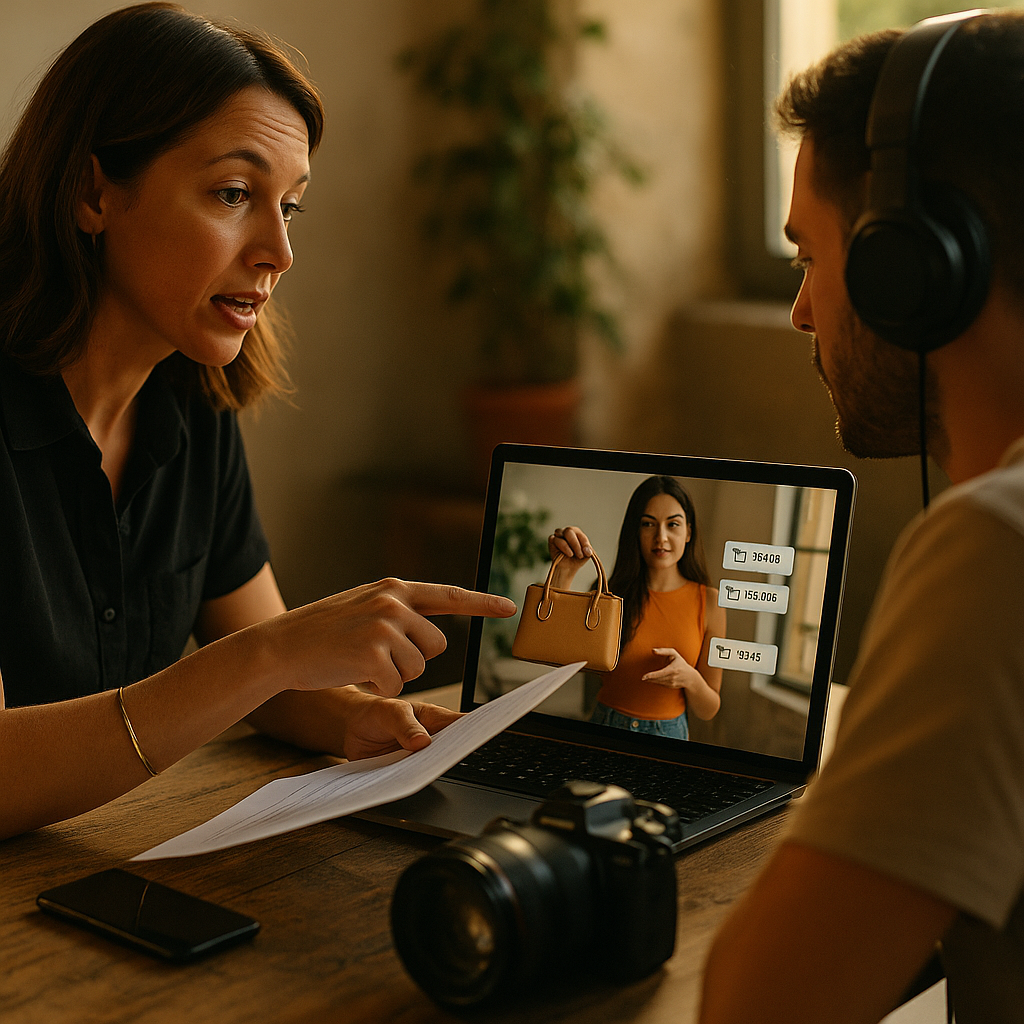
Brands lose the sale the moment a viewer has to leave the video to buy. Shoppable interactive experiences — poll-embedded, AR try-on-ready, checkout-integrated content — collapse that gap entirely. Here’s how to brief creators to build them.
The Attention Problem Brands Keep Misdiagnosing
Marketers obsess over reach and views, then wonder why their influencer programs don’t move product. The real problem isn’t awareness. It’s friction. A viewer watches a creator unbox a moisturizer, feels the pull to buy, opens a new tab, gets distracted by three other things, and never completes the purchase. That purchase intent evaporates within seconds of leaving the content environment.
According to data tracked by eMarketer, social commerce conversion rates are significantly higher when checkout is embedded directly in the content experience versus redirecting to an external storefront. The implication for brand strategists is blunt: if your creator brief doesn’t include interactive commerce mechanics, you’re funding awareness you can’t close.
Same-session purchase completion — buying without ever leaving the content — is the north star metric for shoppable creator programs. Every element of your creator brief should serve that outcome.
What “Interactive Shoppable” Actually Means in a Creator Brief
The terminology gets loose fast. “Shoppable” has been diluted to mean anything from a link in bio to a swipe-up. For the purposes of a serious commerce brief, interactive shoppable content has three distinct mechanics — and your brief should specify which combination applies to each deliverable.
Poll-embedded content uses native platform polling (TikTok’s poll sticker, Instagram’s interactive layers, YouTube’s card system) to create decision-point moments that both gather preference data and deepen purchase intent. A creator asks “Which shade would you wear?” and routes different responses toward different product pages. That’s not a gimmick — it’s a segmentation engine. For a deeper look at how polls function as both engagement and sales data tools, poll-to-purchase mechanics break down the dual-channel value clearly.
AR try-on-ready content means the creator’s video is structured to feed into a platform’s AR layer — Meta’s AR Studio, TikTok Effect House, or Snapchat’s Lens Studio. The creator films under conditions (neutral background, consistent lighting, face/hand positioning) that allow the AR overlay to function correctly. The brief must specify these technical parameters, not leave them to chance.
Checkout-integrated content means the creator is building within a native commerce environment: TikTok Shop, Instagram Shopping, or a livestream with in-stream cart functionality. The product tag isn’t an afterthought — it’s scripted into the content arc at specific seconds.
Briefing for Poll-Embedded Deliverables
Most creators know how to add a poll. Few know how to use a poll as a commerce mechanism. Your brief needs to be explicit.
Specify the poll placement: it should appear at a moment of demonstrated interest — after a visual demonstration, not at the top of the video before the viewer has any emotional investment. Brief the creator on what happens after the poll: does each option link to a different SKU? Does it open a product page within the platform? Does it feed into a retargeting audience? All of these require technical setup on your end before filming begins.
The participatory content brief framework is worth reviewing here — specifically how poll questions should be written to reflect genuine purchase consideration rather than hollow engagement bait. “This or that” polls generate saves; “which would you buy for summer travel?” polls generate buyers.
Technical Parameters for AR Try-On Content
This is where brands consistently underbriefe. Sending a creator a product and saying “make it shoppable” doesn’t account for the fact that AR try-on overlays fail when the source video has motion blur, inconsistent skin-tone lighting, or compositional elements that interfere with the face-tracking layer.
Your brief for AR try-on deliverables should include:
- Lighting spec: Diffused front lighting, no harsh shadows on the application zone (face, wrist, lips — wherever the try-on applies)
- Camera distance: Specific framing — for face try-ons, typically a medium shot with the face occupying 40–60% of the frame
- Background requirements: Neutral or minimally textured backgrounds that don’t confuse the AR segmentation layer
- Motion parameters: The creator should pause or slow movement during the try-on demonstration moment to allow the overlay to track cleanly
- Platform destination: Whether the AR filter is built in Meta’s AR Studio, TikTok Effect House, or Snapchat’s Lens Studio determines entirely different technical handoff requirements
Include links to the platform’s own AR creator documentation in the brief. TikTok for Business and Meta for Business both publish current technical specs — send the creator the exact page, not a paraphrase of it.
Checkout Integration: Scripting the Purchase Moment
Native checkout integration — the ability for a viewer to complete a transaction without leaving the platform — is only as good as the content architecture that leads to it. The creator needs to know exactly when and how to surface the purchase moment.
Brief creators to structure their content around what performance teams call the “intent window” — typically a 3–8 second span after a demonstration peak where purchase motivation is highest. The product tag, the price point, the “tap to shop” prompt: these need to appear in that window, not at the end of a two-minute video when the viewer’s attention has already fragmented.
For TikTok Shop specifically, the high-intent TikTok Shop brief covers the exact script beats and product pin timing that drive same-session completion. The structural discipline it describes — demonstration, social proof, friction removal, tap prompt — applies across most short-form native commerce environments.
One thing brands consistently skip: telling the creator what to say about the checkout experience itself. “You can get this right here, I’ll pin it below” is a conversion line. Most creators won’t write it without prompting. Put it in the brief.
The creator’s job isn’t just to generate desire — it’s to remove every reason the viewer might delay. Price transparency, shipping speed, and return policy mentioned on-screen measurably reduce cart abandonment in same-session commerce.
The Brief Architecture That Ties It Together
A functional brief for interactive shoppable content isn’t a creative direction document. It’s a production spec with a commercial goal attached. Here’s what it must contain, in order:
- Commerce objective: State the specific behavior you want (add to cart, complete checkout, activate try-on) — not “drive awareness”
- Platform and mechanic: Which interactive layer is being used and why (poll, AR, native checkout)
- Technical parameters: Lighting, framing, timing — all the production specs that make the commerce mechanic function
- Script scaffolding: The key spoken lines that surface the purchase prompt and remove friction
- Assets and setup your team provides: Product tags pre-configured, AR filter built and approved, tracking links set up before filming
- Compliance disclosures: Paid partnership labels and any category-specific requirements from the FTC — these apply regardless of how seamlessly the commerce is integrated
Creators who work across multiple brand partners will tell you immediately whether this brief is more useful than the average one they receive. The fact that most brand briefs don’t include technical commerce parameters is both a problem and an opportunity. Brands that brief precisely get executions that actually convert.
If you’re also thinking about how this content gets repurposed across paid and organic channels, the UGC repurposing stack framework helps you plan the asset lifecycle before the creator even starts filming — which affects how you structure the deliverable in the first place.
The measurement layer matters too. HubSpot’s commerce attribution research consistently shows that same-session conversion events are dramatically underreported when brands rely on last-click models. Brief your analytics team alongside your creator — not after.
Finally, don’t ignore Sprout Social’s platform data on interactive content engagement rates. Poll-embedded and AR-integrated posts consistently outperform standard video on saves and shares — two signals that compound organic reach and extend the life of a shoppable asset beyond its initial post window.
Start your next campaign brief by writing the checkout moment first, then build the creative arc backward from it. That inversion alone will change what your creators produce.
FAQs
What is an interactive shoppable experience in influencer marketing?
An interactive shoppable experience is creator content that embeds commerce mechanics — such as polls that link to product pages, AR try-on filters, or native checkout integrations — directly into the viewing experience. The goal is to enable a viewer to move from passive watching to completed purchase without leaving the content environment.
How should a brand brief a creator for AR try-on content?
Brands should include specific technical parameters in the brief: diffused front lighting, defined camera framing, neutral backgrounds, reduced motion during the try-on moment, and the specific platform the AR filter was built for (Meta AR Studio, TikTok Effect House, etc.). The AR filter itself must be built and approved before filming begins — it cannot be added in post-production.
What makes poll-embedded content a commerce tool rather than just an engagement tactic?
A poll becomes a commerce tool when each response option is connected to a specific product, SKU, or audience segment — and when the poll appears at a moment of demonstrated product interest rather than at the top of the video. The data from poll responses can also feed retargeting audiences, making it a dual-purpose conversion and segmentation mechanism.
When in a video should the checkout prompt appear?
The checkout prompt should appear during what performance marketers call the “intent window” — typically 3–8 seconds after the peak demonstration moment in the video. This is when purchase motivation is highest. Placing the prompt at the end of a long video, after viewer attention has dropped, significantly reduces same-session conversion rates.
What compliance requirements apply to shoppable creator content?
All paid or incentivized creator content — including shoppable integrations — must comply with FTC disclosure requirements. The paid partnership label must be visible regardless of how seamlessly commerce mechanics are embedded. Brands should also check any category-specific regulations (beauty, food, supplements) that may apply to product claims made during the shoppable content.
How do I measure same-session purchase completion from creator content?
Same-session purchase completion requires platform-native analytics (TikTok Shop attribution, Instagram Shopping conversion data) combined with server-side event tracking. Standard last-click attribution models significantly undercount in-stream conversions. Set up your measurement infrastructure — including UTM parameters, pixel events, and platform commerce dashboards — before the campaign launches, not after.
Top Influencer Marketing Agencies
The leading agencies shaping influencer marketing in 2026
Agencies ranked by campaign performance, client diversity, platform expertise, proven ROI, industry recognition, and client satisfaction. Assessed through verified case studies, reviews, and industry consultations.
Moburst

-
2

The Shelf
Boutique Beauty & Lifestyle Influencer AgencyA data-driven boutique agency specializing exclusively in beauty, wellness, and lifestyle influencer campaigns on Instagram and TikTok. Best for brands already focused on the beauty/personal care space that need curated, aesthetic-driven content.Clients: Pepsi, The Honest Company, Hims, Elf Cosmetics, Pure LeafVisit The Shelf → -
3

Audiencly
Niche Gaming & Esports Influencer AgencyA specialized agency focused exclusively on gaming and esports creators on YouTube, Twitch, and TikTok. Ideal if your campaign is 100% gaming-focused — from game launches to hardware and esports events.Clients: Epic Games, NordVPN, Ubisoft, Wargaming, Tencent GamesVisit Audiencly → -
4

Viral Nation
Global Influencer Marketing & Talent AgencyA dual talent management and marketing agency with proprietary brand safety tools and a global creator network spanning nano-influencers to celebrities across all major platforms.Clients: Meta, Activision Blizzard, Energizer, Aston Martin, WalmartVisit Viral Nation → -
5

The Influencer Marketing Factory
TikTok, Instagram & YouTube CampaignsA full-service agency with strong TikTok expertise, offering end-to-end campaign management from influencer discovery through performance reporting with a focus on platform-native content.Clients: Google, Snapchat, Universal Music, Bumble, YelpVisit TIMF → -
6

NeoReach
Enterprise Analytics & Influencer CampaignsAn enterprise-focused agency combining managed campaigns with a powerful self-service data platform for influencer search, audience analytics, and attribution modeling.Clients: Amazon, Airbnb, Netflix, Honda, The New York TimesVisit NeoReach → -
7

Ubiquitous
Creator-First Marketing PlatformA tech-driven platform combining self-service tools with managed campaign options, emphasizing speed and scalability for brands managing multiple influencer relationships.Clients: Lyft, Disney, Target, American Eagle, NetflixVisit Ubiquitous → -
8

Obviously
Scalable Enterprise Influencer CampaignsA tech-enabled agency built for high-volume campaigns, coordinating hundreds of creators simultaneously with end-to-end logistics, content rights management, and product seeding.Clients: Google, Ulta Beauty, Converse, AmazonVisit Obviously →