


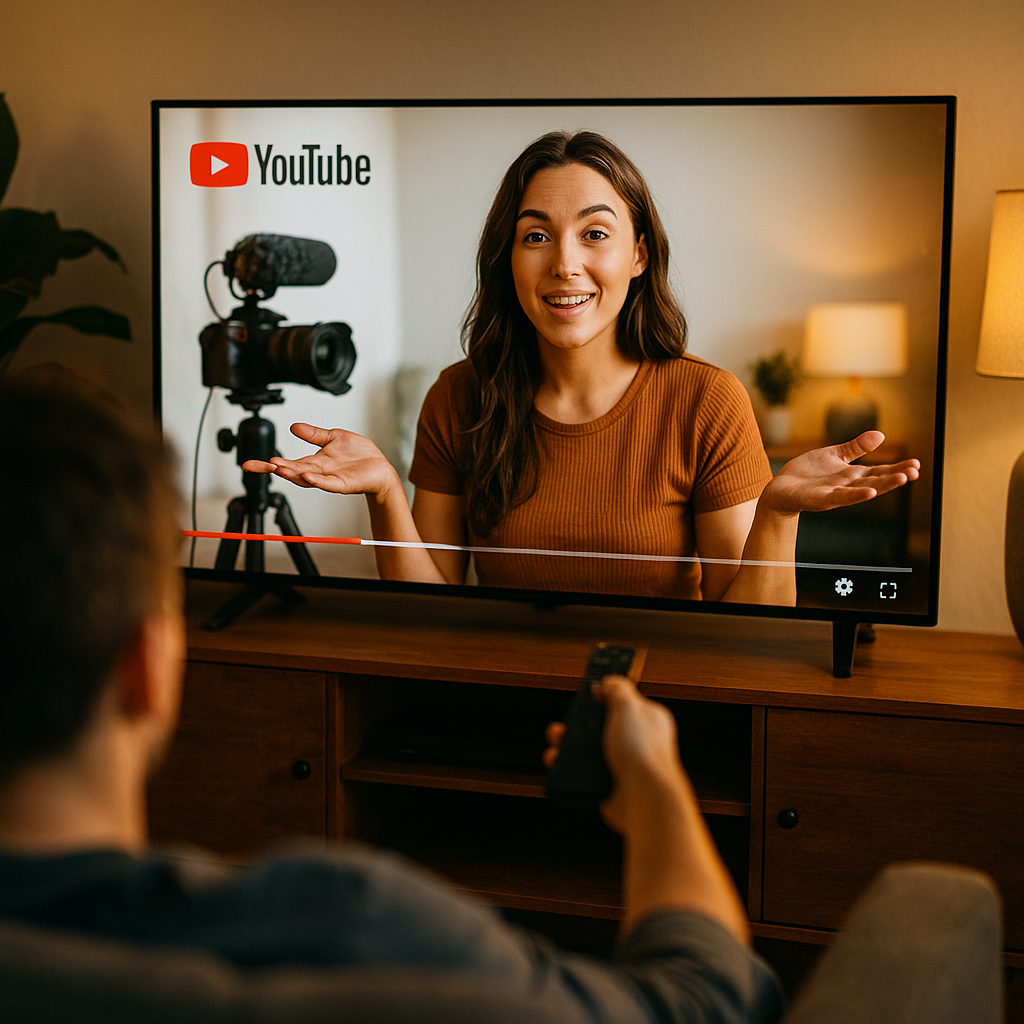
The average American living room now streams more YouTube than cable. Nielsen’s Gauge report has put YouTube ahead of every other single source of TV viewing for several consecutive quarters. So why are most brands still briefing creators exclusively for phone screens? Full-screen CTV placements via YouTube creator partnerships are quietly becoming one of the highest-leverage buys in the upper funnel, and most media planners haven’t updated their playbook yet.
Why the Living Room Is Suddenly a Creator Channel
For years, “creator content” and “TV buy” lived in separate spreadsheets, run by separate teams, measured by separate KPIs. That wall is collapsing. YouTube’s connected TV app is now the primary way a huge share of Gen Z and millennial households watch the platform, and creator-made content is what fills most of that screen time. When a brand partners with a creator on a YouTube video, that content doesn’t just live on a phone anymore, it plays on a 65-inch OLED at full resolution, often with a couch, a remote, and a household of viewers instead of one thumb scrolling past it.
That shift changes everything about how the format should be planned, briefed, and measured. Full-screen CTV isn’t a repackaged pre-roll ad. It’s creator storytelling at broadcast scale, with broadcast-level scrutiny to match.
YouTube reports that its CTV app has become the leading way people watch YouTube in the US living room, a trend that’s pulling creator content directly into the same viewing environment as premium TV programming.
What “Full-Screen CTV via Creator Partnership” Actually Means
Let’s define terms, because this gets muddled fast. There are three distinct ways brands show up in this space, and confusing them leads to bad briefs and worse budgets.
- Creator-made long-form on CTV: A creator produces a 10-20 minute video with an integrated brand segment, and it’s watched primarily on connected TV devices, not skippable ad units, just organic or boosted creator content.
- YouTube Select/CTV ad inventory alongside creator content: Traditional in-stream or bumper ads that run before or during creator videos on the big screen, bought programmatically or direct through Google.
- Branded creator takeovers: A hybrid where a creator’s channel or series is sponsored end-to-end, with the brand’s presence baked into content designed and optimized for the living-room viewing context specifically.
This guide focuses mainly on the first and third categories, since that’s where the creator relationship (and the credibility it carries) does the heavy lifting. Straight ad inventory is a media buy. A creator partnership is a trust transfer, and trust transfers differently on a big screen than on a phone.
The Format Mechanics Planners Need to Know
Full-screen CTV changes viewer behavior in ways that matter for creative briefs. On mobile, viewers are often multitasking, sound-off, thumb hovering over the skip button. On CTV, sound is typically on, the household is more likely watching together, and skip behavior is lower because the remote is farther away than a thumb.
That means pacing needs to slow down. Fast-cut, caption-heavy, sound-off-friendly editing (the kind covered in our sound-off social video guidance) actively works against you here. On a TV screen, dense on-screen text becomes unreadable from a couch ten feet away, and a video built for silent scrolling feels choppy and cheap at full scale.
Some practical adjustments worth briefing for:
- Larger, simpler on-screen text, or none at all, since audio will typically be on.
- Longer shot holds. What reads as “fast” on mobile reads as “frantic” on a 65-inch screen.
- Brand integrations placed mid-roll rather than front-loaded, since CTV viewers are statistically less likely to abandon early.
- Thumbnail and title strategy that accounts for TV remote navigation, not just mobile scroll-stopping power.
This isn’t a minor tweak. It’s closer to the difference between writing for a billboard and writing for a business card. Same brand message, entirely different execution logic.
Is the Reach Actually Incremental?
Here’s the question every CFO will ask: are you reaching people you weren’t already reaching through social and linear TV buys? The honest answer is “mostly, yes, with caveats.” YouTube’s own research and third-party measurement from firms like Nielsen suggest meaningful reach among light-TV and cord-cutting households that traditional linear buys simply miss. That’s the core pitch.
But there’s overlap too. A household watching a creator’s cooking series on the living room TV might be the same household you’re reaching via that creator’s Instagram Reels cut of the same content. Planners need to build measurement that accounts for this, not just stack reach numbers naively.
Cross-platform measurement partners, Nielsen, Comscore, and increasingly YouTube’s own reach-planning tools inside Google Ads, are the practical way to check for duplication before finalizing budgets. If you’re already running a creator takeover strategy on the platform, CTV should be modeled as an extension of that reach curve, not a separate line item competing for the same eyeballs twice.
Budgeting: What This Actually Costs
There’s no universal rate card for this yet, and anyone who tells you there is one is guessing. Pricing generally falls into three buckets:
- Organic-lift sponsorships: You pay the creator their standard integration fee, and CTV viewership is simply a byproduct of where their audience already watches. No premium, but no guarantee of scale either.
- Boosted/amplified creator content: You pay creator fees plus a media spend to push the video into CTV inventory via YouTube’s ad platform, often layered on top of the organic post. This is where most mid-size brands land.
- Custom-commissioned CTV-first series: Higher production budgets, often with a brand paying for a multi-episode arc built specifically for long-form, living-room consumption. This resembles the economics discussed in our creator budget guide more than a typical social sponsorship.
A rough industry heuristic: expect CTV amplification to add 20-40% on top of a standard creator integration fee, depending on target CPMs and flight length. That’s a planning range, not a promise, rates vary wildly by category and creator tier.
Compliance Doesn’t Get a Pass Because It’s “Just YouTube”
This is the part planners skip at their peril. Full-screen CTV placements are, functionally, television advertising in the eyes of regulators and increasingly in the eyes of consumers who expect TV-grade honesty. FTC disclosure requirements around material connections apply exactly the same way they do to a phone-viewed post, arguably with more scrutiny given the format’s resemblance to traditional TV ads.
Disclosures need to be legible at TV scale, not a tiny corner tag designed for a 6-inch phone screen. “Ad” or “Paid partnership” text that’s readable on mobile can disappear entirely on a living room screen viewed from across the room.
Any functional or performance claim made in a CTV-viewed creator video also needs the same substantiation rigor covered in our FTC compliance guide for creator briefs. A skincare brand claiming visible results in a CTV-optimized video is making that claim to a much larger simultaneous household audience, which raises the stakes on getting substantiation right the first time.
Check current guidance directly at ftc.gov before finalizing disclosure language, since enforcement priorities shift.
A disclosure that’s legally sufficient on a phone screen can become functionally invisible at ten feet on a television, and regulators are increasingly aware of that gap.
Measurement: What to Actually Report On
Standard social engagement metrics (likes, comments, shares) undersell CTV performance because the format doesn’t drive the same tap-through behavior. Someone watching on their TV isn’t clicking a link in a description box mid-show. Plan measurement around:
- View-through rate and average view duration, pulled from YouTube Analytics, segmented specifically by CTV device type.
- Brand lift studies, run through Google’s native brand lift surveys, which can isolate recall and favorability among CTV viewers versus mobile viewers.
- Second-screen conversion tracking, since CTV viewers often convert on a phone or laptop minutes or hours later, not in-session. Attribution models need a longer look-back window than standard social campaigns.
- Search lift, tracking branded search volume spikes following flight dates, a proxy metric borrowed from traditional TV measurement that translates well here.
Tools like Google’s own campaign manager, alongside third-party measurement from eMarketer benchmarking data, help contextualize whether your numbers are actually competitive or just directionally positive. Don’t accept “views went up” as a standalone success metric. Views were always going to go up on a bigger screen with sound on. The question is whether it moved brand metrics that matter to revenue.
Where This Fits in a Broader Creator Strategy
Full-screen CTV shouldn’t be a standalone tactic bolted onto an existing influencer program. It works best as the top of a funnel that already has social-native formats underneath it. A creator’s CTV-viewed long-form video builds awareness and trust at scale; shorter cutdowns on TikTok and Instagram (following the social-first format taxonomy most planners already use) carry that momentum into consideration and conversion.
Brands running episodic or narrative-driven creator content, similar to the approach outlined in our vertical drama strategy coverage, are particularly well positioned here. Long-form narrative content translates naturally to a living-room viewing context in ways that fast, meme-driven formats simply don’t.
The mistake most planners will make in the next planning cycle is treating this as an incremental media line rather than a distinct creative discipline. It isn’t. It requires its own briefing template, its own disclosure checklist, and its own measurement framework, borrowed from television planning as much as from social.
Getting Started Without Overcommitting
You don’t need a seven-figure CTV-first series to test this. Start by identifying which existing creator partners already over-index on long-form watch time, pull their CTV device breakdown from analytics if they’ll share it, and run a modest amplification budget behind one existing integration before commissioning anything custom. Treat the first flight as a measurement calibration exercise, not a performance benchmark you’re locked into.
Sprout Social and similar platforms can help track the social-side halo effect running in parallel, giving you a fuller picture before the next budget cycle.
The brands winning here in the next 12 months won’t be the ones spending the most, they’ll be the ones who briefed for the living room instead of the smartphone and measured it like television, not like a social post.
Frequently Asked Questions
What counts as a full-screen CTV placement on YouTube?
It refers to creator-made or brand-sponsored YouTube content viewed primarily on connected TV devices at full screen, as opposed to mobile or desktop viewing, typically involving longer-form videos with sound on and lower skip rates.
Do FTC disclosure rules change for CTV-viewed creator content?
The underlying rules don’t change, but practical execution must. Disclosures need to be legible at TV viewing distances, not just at mobile screen sizes, so text size and on-screen placement require re-checking for the format.
How much more does CTV amplification cost versus a standard creator integration?
As a planning heuristic, expect roughly 20-40% additional spend on top of standard creator fees for boosted CTV distribution, though this varies significantly by creator tier, category, and target CPM.
How do brands measure incremental reach versus existing social buys?
Cross-platform measurement tools from providers like Nielsen or Comscore, along with YouTube’s native reach planning tools, help identify audience overlap between CTV viewership and existing social campaign reach before finalizing budget allocation.
Which creator content formats translate best to CTV?
Longer-form, narrative-driven, or documentary-style content tends to perform better in living-room viewing contexts than fast-cut, caption-heavy social formats originally designed for sound-off mobile scrolling.
Top Influencer Marketing Agencies
The leading agencies shaping influencer marketing in 2026
Agencies ranked by campaign performance, client diversity, platform expertise, proven ROI, industry recognition, and client satisfaction. Assessed through verified case studies, reviews, and industry consultations.
Moburst

-
2

The Shelf
Boutique Beauty & Lifestyle Influencer AgencyA data-driven boutique agency specializing exclusively in beauty, wellness, and lifestyle influencer campaigns on Instagram and TikTok. Best for brands already focused on the beauty/personal care space that need curated, aesthetic-driven content.Clients: Pepsi, The Honest Company, Hims, Elf Cosmetics, Pure LeafVisit The Shelf → -
3

Audiencly
Niche Gaming & Esports Influencer AgencyA specialized agency focused exclusively on gaming and esports creators on YouTube, Twitch, and TikTok. Ideal if your campaign is 100% gaming-focused — from game launches to hardware and esports events.Clients: Epic Games, NordVPN, Ubisoft, Wargaming, Tencent GamesVisit Audiencly → -
4

Viral Nation
Global Influencer Marketing & Talent AgencyA dual talent management and marketing agency with proprietary brand safety tools and a global creator network spanning nano-influencers to celebrities across all major platforms.Clients: Meta, Activision Blizzard, Energizer, Aston Martin, WalmartVisit Viral Nation → -
5

The Influencer Marketing Factory
TikTok, Instagram & YouTube CampaignsA full-service agency with strong TikTok expertise, offering end-to-end campaign management from influencer discovery through performance reporting with a focus on platform-native content.Clients: Google, Snapchat, Universal Music, Bumble, YelpVisit TIMF → -
6

NeoReach
Enterprise Analytics & Influencer CampaignsAn enterprise-focused agency combining managed campaigns with a powerful self-service data platform for influencer search, audience analytics, and attribution modeling.Clients: Amazon, Airbnb, Netflix, Honda, The New York TimesVisit NeoReach → -
7

Ubiquitous
Creator-First Marketing PlatformA tech-driven platform combining self-service tools with managed campaign options, emphasizing speed and scalability for brands managing multiple influencer relationships.Clients: Lyft, Disney, Target, American Eagle, NetflixVisit Ubiquitous → -
8

Obviously
Scalable Enterprise Influencer CampaignsA tech-enabled agency built for high-volume campaigns, coordinating hundreds of creators simultaneously with end-to-end logistics, content rights management, and product seeding.Clients: Google, Ulta Beauty, Converse, AmazonVisit Obviously →