


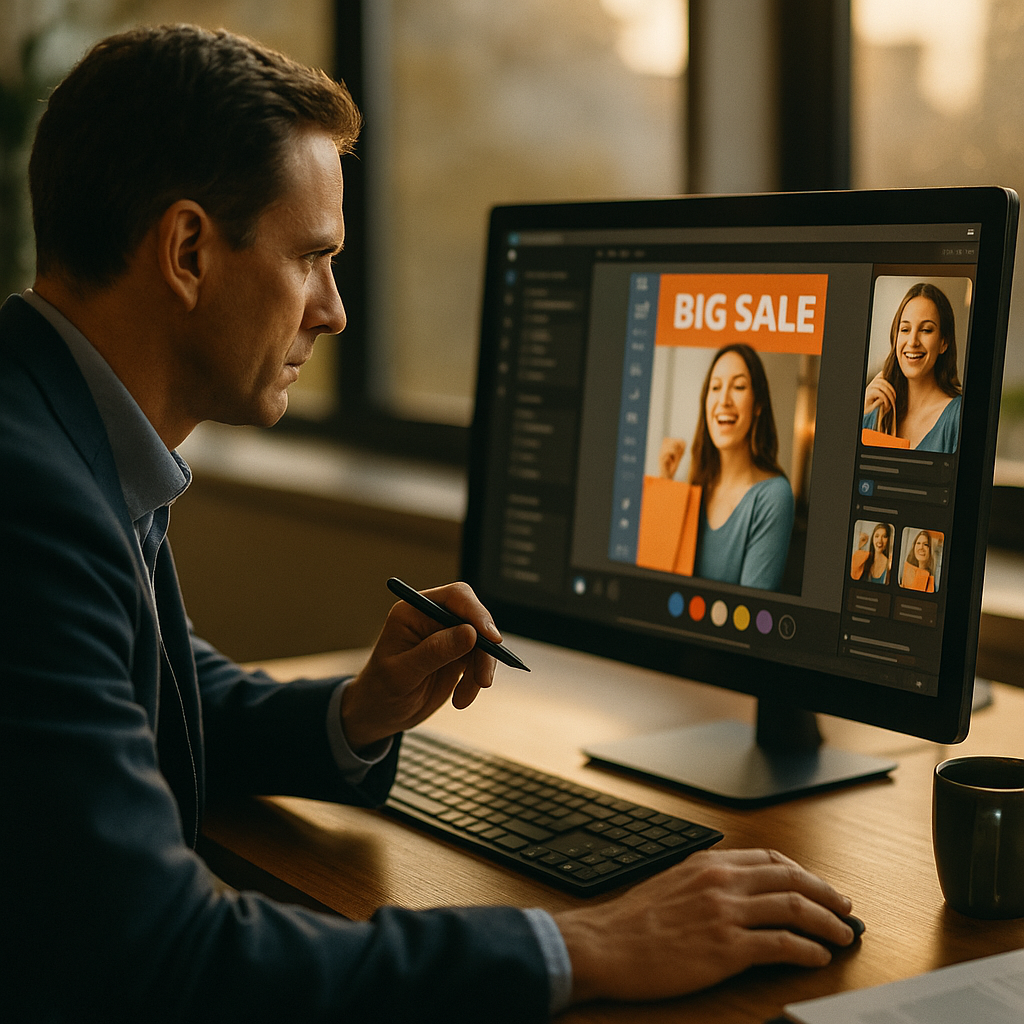
Nearly 60% of marketing leaders say they cannot consistently identify which assets in their pipeline were produced by generative AI. That gap is not a workflow problem. It is a brand trust liability. Defining human oversight policies for generative AI creative is now a core CMO responsibility, and the brands getting it right are pulling ahead on both performance and compliance.
Why “AI-Assisted” Is No Longer Enough of a Policy
Most marketing teams adopted generative AI fast. Midjourney for concept imagery, Runway for short video, ChatGPT and Claude for copy scaffolding. The tools moved quicker than the governance, and now leadership is sitting on a sprawling library of AI-touched assets with no documented chain of custody, no disclosure framework, and no clear standard for what “human-approved” actually means.
The regulatory environment is tightening around that ambiguity. The FTC has signaled that AI-generated claims in advertising carry the same liability as human-written ones. California’s deepfakes legislation has sharpened obligations around synthetic likenesses. The EU’s Digital Services Act imposes transparency requirements that reach directly into how algorithmically amplified content is labeled. If your policy simply says “AI-assisted content requires review,” you are not covered. You need a policy that defines who reviews it, at what stage, against what criteria, and with what sign-off documentation.
A documented human oversight policy for AI creative is not just a compliance asset. It is a brand equity asset. Audiences and regulators are both asking the same question: who is accountable for this?
The Three Failure Modes CMOs Need to Prevent
Before building the policy, it helps to name what goes wrong without one. There are three patterns showing up repeatedly across enterprise marketing teams right now.
Tone drift. AI tools trained on broad internet data will regress toward the mean. Left without tight creative constraints and human editorial passes, AI-generated copy and imagery gradually loses what makes a brand distinctive. It becomes competent and generic, which is fatal in saturated categories.
Compliance blind spots. Generative models do not know your disclosure obligations, your category-specific ad restrictions, or your platform’s current content policies. A CPG brand running AI-generated influencer ad content on TikTok needs human review that covers FTC disclosure requirements and platform-specific creative rules simultaneously. The AI will not flag either issue on its own.
Synthetic likeness risk. Any asset that features a realistic human face or voice generated by AI falls into legally sensitive territory, especially if it resembles a real person or is designed to read as authentic user-generated content. The rules here are still forming, but the California deepfake ad law has established enforceable precedent that compliance teams need to understand before creative ships.
Building the Oversight Framework: Four Operational Layers
A practical human oversight policy for AI creative operates on four distinct layers. Each layer addresses a different failure point.
Layer 1: Input governance. Define which brand inputs the AI is permitted to use. Approved brand voice documents, cleared asset libraries, licensed visual references. This is where most teams are sloppy. If a creative team is prompting an image generator with a competitor’s visual language or using a likeness reference that hasn’t cleared legal, the problem starts here, not at review.
Layer 2: Generation checkpoints. Not every AI output needs a full creative review. But every output needs a classification. Is this a final asset, a concept for human development, or a production scaffold? Each classification should trigger a different review pathway. Concepts get a fast brand-fit check. Final assets get a full compliance and authenticity pass. Scaffolds get editorial review before a human finishes the creative work.
Layer 3: Human sign-off with documentation. The sign-off is meaningless without the documentation. Your policy should specify that the reviewing human must confirm four things: the asset meets brand standards, it meets legal and platform compliance requirements, it does not misrepresent AI generation in a misleading way, and it was reviewed against the most current version of the relevant compliance checklist. That last point matters more than it sounds. A pre-flight compliance checklist that gets updated when regulations shift is a living governance tool, not a one-time audit form.
Layer 4: Post-launch monitoring. Human oversight does not end at publication. Generative AI assets sometimes perform in unexpected ways when amplified by recommendation algorithms. An asset that reads as neutral in review can read very differently when the algorithm serves it to a narrow audience segment the brand did not intend to target. Build performance monitoring into your policy with specific escalation thresholds. Tools like Sprout Social and Meta’s Business Suite offer sentiment and engagement anomaly detection that can surface these issues quickly.
Preserving Authentic Creative Quality Inside the Guardrails
The governance conversation often gets separated from the creative quality conversation. That separation is a mistake. The same policies that protect your brand from compliance risk are the policies that protect your brand’s creative distinctiveness from AI-induced mediocrity.
The highest-performing brands using generative AI are not using it to replace human creative judgment. They are using it to accelerate the ideation and production phases while keeping human creative directors firmly in the decision seat on what actually ships. That model produces assets that feel genuinely brand-specific because a human who cares about the brand had the last word.
This matters for algorithmic performance as much as it matters for human audiences. Platforms like TikTok and Instagram reward content that drives genuine engagement signals: saves, shares, comments, watch completion. Generic AI output typically underperforms on those metrics even when it looks technically polished. Authentic creative specificity, the kind that only comes from human editorial investment, is what earns those signals. The TikTok for Business creative guidelines make this explicit: creative that mirrors authentic user behavior outperforms studio-polished content across nearly every metric category.
One practical mechanism that works: pair every AI creative output with a “specificity audit” before sign-off. Ask one question: does this creative contain something only our brand would say, show, or do? If the answer is no, send it back for a human creative pass before it ships.
Where AI Agent Governance Overlaps with Creative Policy
CMOs building AI creative policies also need to account for the emerging layer of AI agents that are beginning to operate inside marketing workflows autonomously. Media buying agents, content scheduling agents, and dynamic creative optimization systems can select and deploy AI-generated assets without a human triggering each individual decision. That capability requires a separate policy layer that defines override thresholds and escalation conditions.
This is not hypothetical. It is happening in programmatic and paid social today. If your oversight policy only covers human-initiated creative production and not agent-initiated asset selection and deployment, you have a governance gap that regulators and platform compliance teams are increasingly equipped to identify. Resources on AI campaign override thresholds and FTC liability gaps in AI agent workflows provide practical policy templates worth reviewing before this gap becomes a liability.
The brands that separate “AI creative policy” from “AI agent policy” are operating with a false boundary. In a world of autonomous campaign systems, every asset decision is potentially an agent decision.
The Disclosure Question You Cannot Ignore
Should brands disclose when ad creative is AI-generated? The regulatory answer is still evolving, but the brand strategy answer is becoming clearer. Proactive disclosure, handled well, builds trust faster than silence followed by external exposure. The FTC has been explicit that material facts about ad production methods may require disclosure when consumers would reasonably care. Research from Edelman’s Trust Barometer consistently shows that audiences penalize perceived deception far more harshly than they penalize AI use itself.
The smarter frame is not “do we have to disclose?” It is “how do we disclose in a way that reinforces rather than undermines our brand authority?” Brands in beauty, fashion, and consumer tech that have leaned into transparent AI-assisted creative, contextualizing it as part of their innovation story, are seeing stronger engagement with disclosed AI content than with undisclosed content that later gets identified as AI-produced by their audiences. Authenticity is the variable that determines whether disclosure helps or hurts you.
Start this week by auditing every AI-generated asset currently in active rotation and mapping it against your current disclosure policy. If that map reveals gaps, you have your immediate action item.
FAQs
What should a human oversight policy for AI ad creative actually include?
At minimum, the policy should define which AI tools are approved for use, what types of brand inputs can be fed into those tools, how outputs are classified (concept, scaffold, or final asset), who is authorized to approve each classification, what the sign-off documentation requires, and how post-launch monitoring is handled. The policy should also specify how it intersects with disclosure obligations and platform content rules.
How does AI-generated creative affect FTC compliance?
The FTC treats AI-generated advertising claims with the same liability standard as human-written ones. If an AI-generated asset makes a product claim that cannot be substantiated, or if it creates a materially misleading impression about how the ad was produced, the brand is liable. Human oversight policies that include a compliance review step specifically checking AI output against FTC standards are the primary risk mitigation tool here.
Does AI-generated creative perform worse than human-created content?
It depends heavily on how it is used. AI output used as a final asset without meaningful human editorial investment tends to underperform on engagement metrics like saves, shares, and watch completion because it lacks the specificity that audiences and recommendation algorithms reward. AI output used as a production scaffold, with human creative direction applied before shipping, often performs on par with or better than traditional production because it enables faster iteration and volume testing.
Do brands need to disclose AI-generated ad content?
Regulatory requirements vary by jurisdiction and are still evolving. The FTC’s position is that material facts consumers would care about may require disclosure. California’s deepfake advertising law imposes specific obligations around synthetic likenesses. Beyond compliance, brand strategy research consistently shows that transparent disclosure of AI use, when framed thoughtfully, builds more trust than undisclosed use that audiences later identify on their own.
How should AI agent systems be incorporated into a creative oversight policy?
AI agents that can select or deploy creative assets autonomously, such as dynamic creative optimization systems and media buying agents, require a specific policy layer separate from human-initiated creative production. This layer should define which asset types an AI agent is permitted to deploy without human approval, what performance or compliance thresholds trigger mandatory human review, and how override decisions are documented. Treating agent-initiated and human-initiated creative decisions as governed by the same policy is a significant gap.
Top Influencer Marketing Agencies
The leading agencies shaping influencer marketing in 2026
Agencies ranked by campaign performance, client diversity, platform expertise, proven ROI, industry recognition, and client satisfaction. Assessed through verified case studies, reviews, and industry consultations.
Moburst

-
2

The Shelf
Boutique Beauty & Lifestyle Influencer AgencyA data-driven boutique agency specializing exclusively in beauty, wellness, and lifestyle influencer campaigns on Instagram and TikTok. Best for brands already focused on the beauty/personal care space that need curated, aesthetic-driven content.Clients: Pepsi, The Honest Company, Hims, Elf Cosmetics, Pure LeafVisit The Shelf → -
3

Audiencly
Niche Gaming & Esports Influencer AgencyA specialized agency focused exclusively on gaming and esports creators on YouTube, Twitch, and TikTok. Ideal if your campaign is 100% gaming-focused — from game launches to hardware and esports events.Clients: Epic Games, NordVPN, Ubisoft, Wargaming, Tencent GamesVisit Audiencly → -
4

Viral Nation
Global Influencer Marketing & Talent AgencyA dual talent management and marketing agency with proprietary brand safety tools and a global creator network spanning nano-influencers to celebrities across all major platforms.Clients: Meta, Activision Blizzard, Energizer, Aston Martin, WalmartVisit Viral Nation → -
5

The Influencer Marketing Factory
TikTok, Instagram & YouTube CampaignsA full-service agency with strong TikTok expertise, offering end-to-end campaign management from influencer discovery through performance reporting with a focus on platform-native content.Clients: Google, Snapchat, Universal Music, Bumble, YelpVisit TIMF → -
6

NeoReach
Enterprise Analytics & Influencer CampaignsAn enterprise-focused agency combining managed campaigns with a powerful self-service data platform for influencer search, audience analytics, and attribution modeling.Clients: Amazon, Airbnb, Netflix, Honda, The New York TimesVisit NeoReach → -
7

Ubiquitous
Creator-First Marketing PlatformA tech-driven platform combining self-service tools with managed campaign options, emphasizing speed and scalability for brands managing multiple influencer relationships.Clients: Lyft, Disney, Target, American Eagle, NetflixVisit Ubiquitous → -
8

Obviously
Scalable Enterprise Influencer CampaignsA tech-enabled agency built for high-volume campaigns, coordinating hundreds of creators simultaneously with end-to-end logistics, content rights management, and product seeding.Clients: Google, Ulta Beauty, Converse, AmazonVisit Obviously →