


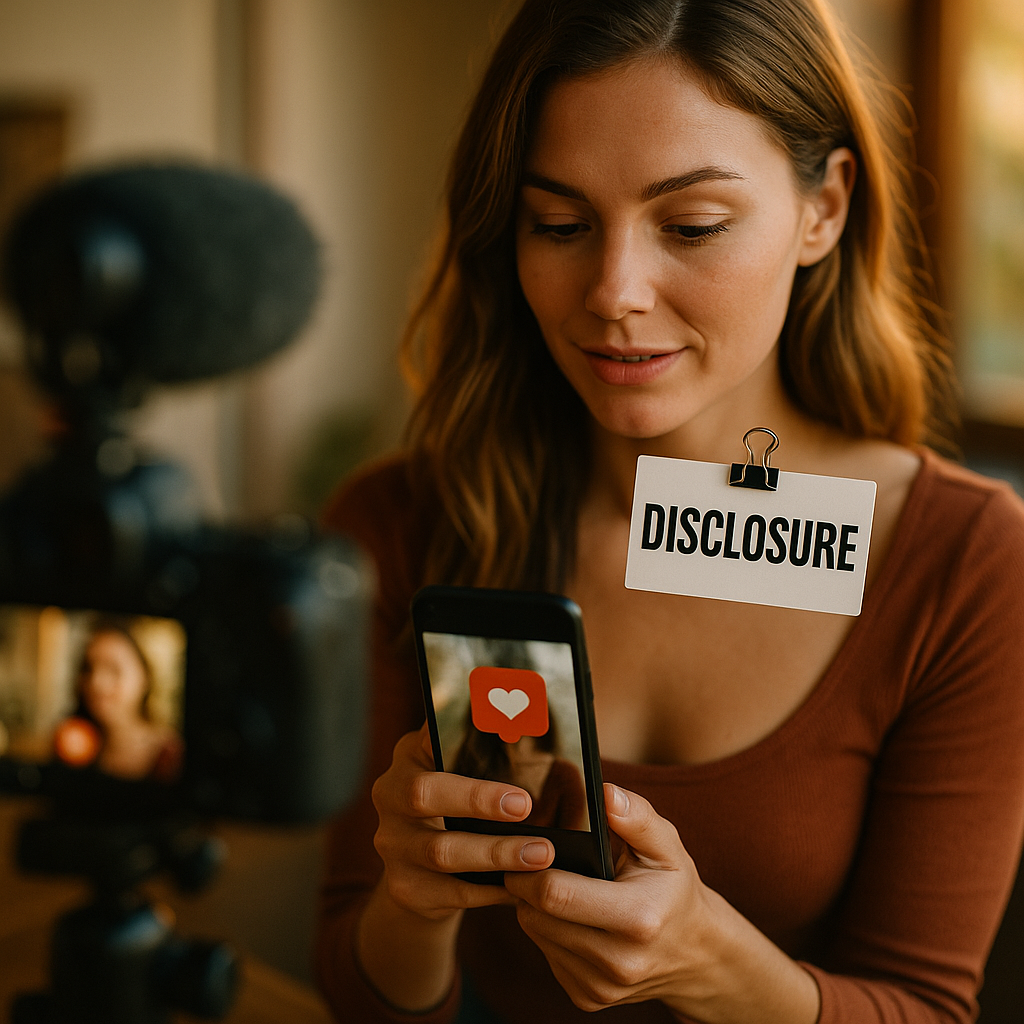
The Disclosure Architecture Problem Nobody Is Talking About
Sixty-three percent of consumers say they can’t reliably identify paid content when sponsorships are woven into a creator’s storytelling — and the FTC is paying close attention to exactly that gap. FTC disclosure in integrated storytelling formats has become one of the most consequential compliance blind spots in influencer marketing right now, and most brand teams haven’t updated their governance frameworks to match.
The shift away from “#Ad” and “Sponsored” labels feels like a creative win. Audiences respond better to authentic narrative. Engagement rates climb. Brand recall improves. But “performs better” and “complies with FTC standards” are not the same sentence, and confusing the two is how a campaign becomes a consent order.
What “Clear and Conspicuous” Actually Means in a Narrative Context
The FTC’s Guides Concerning Use of Endorsements and Testimonials don’t require the words “#Ad” or “Sponsored.” What they require is that the material connection between the creator and brand be disclosed in a way that consumers notice, understand, and process — before the endorsement influences them. That distinction matters enormously for integrated content.
“Clear” means the language is unambiguous. “Conspicuous” means placement, timing, and visual weight make it impossible to miss. When a creator spends six minutes narrating a cooking routine and the brand mention is embedded in minute four as a natural ingredient — that’s a disclosure architecture problem, not a creative choice.
The FTC’s updated guidance is explicit: disclosures buried in description boxes, hidden in hashtag strings, or voiced over b-roll at low volume fail the conspicuous standard. Platform-native disclosure tools — Instagram’s “Paid Partnership” tag, TikTok’s branded content toggle — satisfy conspicuous placement only when creators actually activate them, which brand teams often don’t verify. You can review the FTC’s most current enforcement guidance directly at ftc.gov.
Platform-native disclosure labels (Instagram’s Paid Partnership tag, TikTok’s Branded Content toggle) are necessary but not sufficient. If the label disappears when a viewer scrolls or the audio runs under it, your disclosure architecture has a structural flaw — not just a creative one.
Why Narrative Integration Makes Compliance Harder, Not Just Different
Traditional “#Ad” placement was blunt but defensible. You put it at the top, visible before any persuasive content. Integrated storytelling inverts that sequence. The emotional arc, the trust-building, the recommendation — all of it lands before the viewer consciously registers that a commercial relationship exists. That’s precisely what the FTC’s “before the endorsement influences them” language is designed to prevent.
Consider how top-tier lifestyle creators operate: the brand isn’t introduced as a product; it’s introduced as part of a life. A skincare creator who says “I’ve been using this for three months and my skin has genuinely changed” and then mentions a brand name four sentences later has created a disclosure sequencing problem. The persuasion happened first. This is why the FTC scrutinizes audio timing, scroll depth, and visual hierarchy — not just whether a disclosure exists somewhere in the content.
For brands working with creators across multiple formats simultaneously — long-form YouTube, Instagram Reels, TikTok, and podcast integrations — each surface has different disclosure mechanics, different audience consumption patterns, and different technical constraints. A single brief template doesn’t cover all of them. That’s a gap your campaign pre-flight checklist needs to address explicitly by format.
Recalibrating Your Disclosure Architecture: Five Operational Moves
1. Map the persuasion moment, not just the brand mention. For every piece of integrated content, identify the exact moment the recommendation lands — the emotional peak, the product name drop, the “you should try this” inflection. Disclosure must precede or coincide with that moment, not follow it.
2. Require verbal disclosure in video, regardless of on-screen labels. On-screen text disappears when a viewer screenshots or scrubs. Verbal disclosure — “this video is sponsored by [Brand]” — is persistent and format-agnostic. Make it a non-negotiable contract clause, not a guideline. For contract language that holds up, your creator contract clauses framework is a logical starting point.
3. Audit platform toggle activation, not just content review. Your compliance team needs backend confirmation that TikTok’s branded content toggle or Instagram’s paid partnership label was activated — not just visual confirmation from a screenshot the creator sent you. Require API-level reporting or direct account access for verification.
4. Apply format-specific disclosure briefs. A 90-second Reel needs disclosure in the first 3 seconds on-screen and verbally within the first 10. A 20-minute YouTube video needs it in the opening sequence, in a chapter marker, and in the description. A podcast integration needs verbal disclosure before the segment begins — not at the end of the host read. These aren’t creative preferences; they’re structural requirements.
5. Document everything your creator does, not just what you approved. The FTC’s enforcement posture holds brands responsible for disclosures they “knew or should have known” were inadequate. If a creator modifies the approved script and removes the verbal disclosure, your brand still has exposure. Build monitoring checkpoints into your workflow — disclosure risk in creator contracts is a documented vulnerability that brands consistently underestimate.
The AI-Generated Content Wrinkle
Brands using AI tools to generate creator-style content or to remix existing creator footage face an additional disclosure layer. If an AI-generated voice, avatar, or script is used in a sponsored context, the FTC’s position is that both the commercial relationship and the AI-generated nature of the content may require disclosure. The FTC disclosure risk around AI remix tools has created a secondary compliance surface that most legal teams haven’t fully mapped yet.
This matters for integrated storytelling because AI personalization tools can dynamically adjust which product is featured in a creator’s content depending on viewer segment. If the disclosure architecture was built around a static script, it won’t hold when the content varies by audience. Your governance model needs to account for dynamic content variation, not just static approvals.
When AI tools dynamically substitute products within creator content by audience segment, a disclosure approved for one version of the content doesn’t automatically cover every version. Your compliance architecture must be as dynamic as your personalization engine.
What Enforcement Actually Looks Like
FTC enforcement in this space has moved from warning letters toward formal actions with meaningful financial consequences. The agency has also signaled interest in holding brands — not just creators — liable when disclosure systems are structurally inadequate. That’s a significant shift. It means your internal governance, your brief templates, your contract language, and your content review process are all potential evidence in an enforcement inquiry.
Brands operating in sectors with heightened regulatory sensitivity — financial products, health and wellness, supplements, alcohol — face compounded exposure. The FTC coordinates with the FDA and CFPB on category-specific enforcement, which means an integrated storytelling campaign for a wellness brand isn’t just an FTC problem if the disclosure fails; it may trigger multi-agency scrutiny. For brands navigating FTC disclosure rules across multiple touchpoints, the risk surface is wider than most compliance budgets assume.
The practical implication: if your current disclosure governance was built around the “#Ad era,” it is almost certainly inadequate for integrated narrative formats. Audit it now, before a campaign goes live — not after a complaint lands.
For a broader view of how EU algorithmic design rules are also reshaping creator campaign compliance standards globally, brands operating internationally face an even more complex disclosure matrix.
Start with one concrete action: pull your three most recent integrated campaigns and map where the persuasion moment occurred versus where the disclosure appeared. If there’s a gap — and there almost certainly will be — you now have the operational brief for your next compliance sprint.
Frequently Asked Questions
Does using Instagram’s Paid Partnership label satisfy FTC disclosure requirements on its own?
Not necessarily. The Paid Partnership label satisfies the conspicuous placement requirement for static posts and Reels on Instagram when it’s visible above the fold. However, for video content, the FTC expects disclosure to be noticeable before the persuasive content begins. If the label is the only disclosure and the video’s commercial message lands before a viewer sees or processes the label, the disclosure may still be considered inadequate. Verbal disclosure within the first few seconds of video content provides stronger compliance coverage.
Can a creator’s natural mention of a product — without scripted language — count as an FTC-compliant disclosure?
No. A product mention is not a disclosure. The FTC requires that the material connection between the creator and the brand be explicitly communicated to the audience in a way they will notice and understand. The creator saying “I love this product” while holding it up does not disclose that they were paid to feature it. Disclosure must be explicit: language like “this is a paid partnership with [Brand]” or “sponsored by [Brand]” is required.
Who is legally responsible if a creator removes the disclosure from approved content?
Both the creator and the brand can face FTC exposure. The FTC has taken the position that brands are responsible for disclosure systems they control or should have monitored. If your contract required disclosure but you had no verification mechanism in place, you may still be held liable. Brands should require creators to provide confirmation of disclosure activation (including platform toggle screenshots or backend access), and monitor published content against approved scripts.
Does the FTC require disclosure for every format when a creator runs an integrated campaign across multiple platforms?
Yes. Each piece of content that contains a commercial endorsement requires its own disclosure, calibrated to the format’s consumption behavior. A disclosure in a YouTube description does not cover a TikTok posted the same day. A verbal disclosure in a podcast does not cover an Instagram Reel. Brands must build format-specific disclosure requirements into their briefs and contracts for every platform the creator posts to as part of the campaign.
How should brands handle disclosure when AI tools generate or personalize creator-style content?
The FTC’s current position is that AI-generated content used in a commercial context must still carry clear disclosure of both the commercial relationship and, where material, the AI-generated nature of the content. For dynamic content that varies by audience segment, brands need disclosure architecture that covers every content variant — not just the version submitted for approval. Legal review of AI-generated sponsored content is strongly recommended before any campaign goes live.
Top Influencer Marketing Agencies
The leading agencies shaping influencer marketing in 2026
Agencies ranked by campaign performance, client diversity, platform expertise, proven ROI, industry recognition, and client satisfaction. Assessed through verified case studies, reviews, and industry consultations.
Moburst

-
2

The Shelf
Boutique Beauty & Lifestyle Influencer AgencyA data-driven boutique agency specializing exclusively in beauty, wellness, and lifestyle influencer campaigns on Instagram and TikTok. Best for brands already focused on the beauty/personal care space that need curated, aesthetic-driven content.Clients: Pepsi, The Honest Company, Hims, Elf Cosmetics, Pure LeafVisit The Shelf → -
3

Audiencly
Niche Gaming & Esports Influencer AgencyA specialized agency focused exclusively on gaming and esports creators on YouTube, Twitch, and TikTok. Ideal if your campaign is 100% gaming-focused — from game launches to hardware and esports events.Clients: Epic Games, NordVPN, Ubisoft, Wargaming, Tencent GamesVisit Audiencly → -
4

Viral Nation
Global Influencer Marketing & Talent AgencyA dual talent management and marketing agency with proprietary brand safety tools and a global creator network spanning nano-influencers to celebrities across all major platforms.Clients: Meta, Activision Blizzard, Energizer, Aston Martin, WalmartVisit Viral Nation → -
5

The Influencer Marketing Factory
TikTok, Instagram & YouTube CampaignsA full-service agency with strong TikTok expertise, offering end-to-end campaign management from influencer discovery through performance reporting with a focus on platform-native content.Clients: Google, Snapchat, Universal Music, Bumble, YelpVisit TIMF → -
6

NeoReach
Enterprise Analytics & Influencer CampaignsAn enterprise-focused agency combining managed campaigns with a powerful self-service data platform for influencer search, audience analytics, and attribution modeling.Clients: Amazon, Airbnb, Netflix, Honda, The New York TimesVisit NeoReach → -
7

Ubiquitous
Creator-First Marketing PlatformA tech-driven platform combining self-service tools with managed campaign options, emphasizing speed and scalability for brands managing multiple influencer relationships.Clients: Lyft, Disney, Target, American Eagle, NetflixVisit Ubiquitous → -
8

Obviously
Scalable Enterprise Influencer CampaignsA tech-enabled agency built for high-volume campaigns, coordinating hundreds of creators simultaneously with end-to-end logistics, content rights management, and product seeding.Clients: Google, Ulta Beauty, Converse, AmazonVisit Obviously →