


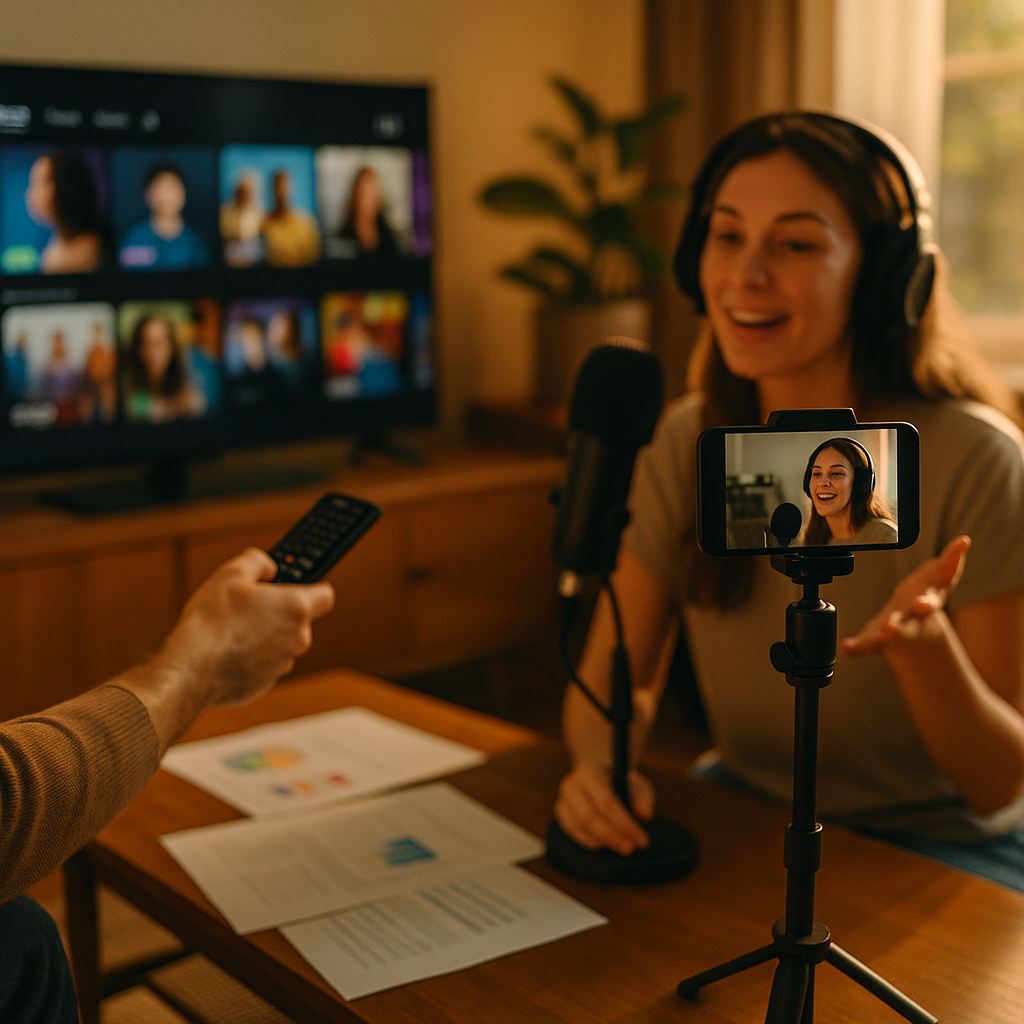
CTV ad spend is projected to surpass $42 billion in the US alone, and the three platforms controlling the majority of that inventory — Google (YouTube), Netflix, and Amazon — are actively pulling creator-produced content into their premium ad ecosystems. If your influencer program still treats streaming and social as separate budget lines, you’re structuring around a distinction that no longer exists.
The Consolidation No One in Influencer Marketing Is Talking About
For most brand teams, “CTV” has meant buying against traditional TV-style content on platforms like Hulu or Paramount+. That framing is outdated. The real story is how Google, Netflix, and Amazon have each moved aggressively to create closed-loop ad environments where creator content, streaming inventory, and audience data converge into a single, buyable surface.
Google’s position is the most mature. YouTube Select and YouTube TV now sit inside the same demand-side infrastructure as Google Display and Search. A creator video that earns organic traction on YouTube can be served as a pre-roll or mid-roll inside YouTube’s CTV experience, with the same brand-safety controls and audience targeting you’d apply to a traditional digital campaign. That’s not a theoretical capability — it’s an operational reality that most mid-market brand teams haven’t fully operationalized yet.
Netflix’s ad tier, which launched with Microsoft as its ad-tech partner before integrating more directly with demand-side platforms, has matured into a credible CTV buy. More interesting for brand strategists: Netflix has begun exploring co-produced and brand-sponsored content formats that sit somewhere between traditional sponsorship and creator-style storytelling. Amazon, through Prime Video’s ad tier and its Streaming TV ad products inside Amazon DSP, brings the closed-loop purchase attribution that no pure-play streaming platform can match.
The real competitive moat isn’t reach — it’s attribution. Amazon’s ability to connect a streaming ad impression to an actual purchase, without relying on third-party cookies, gives creator-produced content distributed through Prime Video inventory a measurement advantage that social platforms simply can’t replicate.
What “Creator-Produced Content” Actually Means in a CTV Context
This is where the vocabulary gets slippery, and where brand teams make expensive mistakes. Creator-produced content for CTV distribution isn’t the same as repurposing a TikTok or Reels clip and running it as a pre-roll. The format requirements, production values, and audience expectations are meaningfully different.
CTV viewers are leaning back, not leaning forward. A 15-second vertical video optimized for a phone scroll will underperform on a 65-inch screen in someone’s living room. The creator content that’s earning legitimate CTV distribution rights — the kind that platforms like MrBeast brought to the upfronts table — is produced at a quality level that meets TV buyers’ expectations while retaining the authentic voice and audience relationship that makes creator content worth buying in the first place.
What this means practically for brand partnerships: you need creator agreements that explicitly address distribution rights across streaming platforms. Most standard influencer contracts don’t cover CTV distribution, and many creators have separate representation for their longer-form or TV-adjacent work. For a deeper look at how contracts need to evolve to cover these expanded use cases, the frameworks around hybrid creator contracts are a useful starting point.
Platform Economics: Why Each of the Three Plays a Different Role
Google (YouTube) gives you scale and algorithmic amplification. A piece of creator content that performs organically can earn earned distribution alongside its paid placement, which changes the effective CPM calculation significantly. YouTube’s Brand Connect marketplace now surfaces creator inventory specifically for YouTube CTV buyers, bridging the gap between influencer marketing and programmatic TV buying.
Netflix brings premium context. Ads on Netflix carry an implicit association with prestige content — something brand safety teams have historically paid a premium to achieve on traditional TV. The platform’s ad load is deliberately low, which means higher attention per impression. The trade-off is less flexible targeting and a smaller overall addressable audience compared to YouTube.
Amazon’s value proposition is fundamentally different from both. Through Amazon DSP, brands can target streaming audiences using purchase behavior data, then close the loop with actual conversion measurement. For performance-oriented brand teams, this is the most defensible CTV buy available. Creator content that can be produced to Amazon’s ad specs and distributed through Prime Video inventory gets the benefit of that attribution infrastructure.
The strategic implication: these three platforms shouldn’t compete for the same budget line. They serve different roles in a funnel that now spans living room screens, mobile, and everywhere in between. Mapping creator content assets to each platform’s specific strengths is the planning work most brand teams aren’t doing yet.
Rethinking the Value Proposition for Creator Content
The traditional argument for creator-produced content has centered on authenticity, audience trust, and cost efficiency relative to traditional production. All of that still holds. But CTV consolidation adds a new dimension: distribution leverage.
When a single piece of creator-produced content can be used as a YouTube Select sponsorship, distributed as a streaming pre-roll on Amazon Prime Video, and potentially licensed for a Netflix branded content format — the per-unit economics of that content investment change dramatically. The production cost amortizes across multiple high-value placements, each with different audience profiles and measurement capabilities.
This is why restructuring video budgets around creator content rather than traditional TV production is becoming a genuine strategic option rather than an experimental one. A $200,000 investment in a creator-produced mini-series can buy YouTube Select placement, Prime Video pre-roll distribution, and organic social amplification. A comparable spend on a traditional TV spot buys one placement, one audience, and no organic tail.
That said, the operational complexity is real. Rights management, platform-specific versioning, brand safety compliance across three different ad ecosystems, and creator relationship management at this level of distribution require infrastructure most influencer teams aren’t staffed for. The creator economy cloud stack question — which platforms, which measurement tools, which workflow systems — becomes significantly more complex when CTV distribution is in scope.
The Measurement Problem Nobody Has Fully Solved
Attribution across social, streaming, and CTV remains fragmented. Nielsen, IAB measurement standards, and platform-native analytics each tell a different part of the story, and they don’t reconcile cleanly. Amazon is closest to a closed-loop solution, but only within its own ecosystem. For brands running creator content across all three major CTV platforms simultaneously, measurement strategy needs to be decided before production begins, not retrofitted afterward.
The practical implication: define your primary KPI for each distribution channel at the brief stage. YouTube creator content might be optimized for view-through rate and search lift. Amazon streaming inventory should be connected to conversion events inside Amazon’s ecosystem wherever possible. Netflix buys should be evaluated on brand lift and frequency metrics, not direct response. Mixing measurement frameworks across these three platforms without clear segmentation produces noise, not insight.
For brands exploring how budget allocation decisions across different content channels interact, the same measurement discipline applies — define the role of each channel before you try to compare performance across them.
Creator content that earns CTV distribution rights is no longer a social asset with a longer shelf life. It’s a media asset with fundamentally different production, rights, and measurement requirements — and brand teams that treat it as an afterthought will consistently undervalue and under-deliver it.
What Smart Brand Teams Are Doing Right Now
The brands getting ahead of this are doing a few specific things. First, they’re briefing creators with CTV distribution in mind from the start, specifying format requirements for 16:9 horizontal delivery, minimum resolution standards, and clean audio — even when the primary deliverable is social content. Second, they’re negotiating broader distribution rights in creator contracts upfront, accepting a modest fee premium in exchange for streaming and broadcast rights that would otherwise require a separate licensing deal. Third, they’re mapping creator content assets to platform-specific inventory types inside their media plans, rather than treating creator content as a separate budget silo.
The upfronts marketplace is increasingly where this conversation is happening at scale, and brands that aren’t showing up with creator-first video strategies are leaving negotiating leverage on the table.
The FTC’s disclosure requirements apply regardless of distribution channel, so ensure creator content running as paid CTV inventory carries appropriate disclosures formatted for the platform. A social disclosure format doesn’t automatically translate to a compliant CTV format — this is a detail that compliance teams often miss until a campaign is already in market.
Finally, budget the rights conversation properly. CTV distribution rights for creator content aren’t free, and creators with genuine audiences valuable to streaming platforms know their leverage. Plan for a 20-40% rights premium over standard social-only rates as a baseline, and build that into your content investment models before the negotiation starts.
Next step: Audit your current creator roster for CTV-ready content capabilities, then cross-reference your media plan to identify the highest-leverage placements within Google, Netflix, and Amazon’s streaming ad ecosystems. The brands that close that gap first will hold structural advantages in streaming inventory that compound over time.
Frequently Asked Questions
What is CTV consolidation and why does it matter for influencer marketing?
CTV consolidation refers to the growing dominance of Google (YouTube), Netflix, and Amazon over connected TV ad inventory. For influencer marketers, it matters because creator-produced content can now be distributed across premium streaming environments — not just social feeds — which changes how brands should value, produce, and contract for that content.
Can creator content actually run as CTV ad inventory?
Yes. YouTube Select already surfaces creator content as CTV inventory. Amazon’s streaming ad products allow brands to run creator-produced video inside Prime Video content. Netflix is exploring branded and sponsored content formats. The key requirements are appropriate production quality (16:9 format, broadcast-grade audio), proper distribution rights in the creator contract, and platform-specific ad spec compliance.
How should brands negotiate CTV distribution rights with creators?
Negotiate streaming and broadcast distribution rights at the point of initial contract, before production begins. Expect to pay a rights premium of roughly 20-40% above standard social-only rates. Specify the platforms, territories, and duration of CTV distribution rights explicitly. Creators with larger, more valuable audiences may have separate representation for TV and streaming work, so identify this early in the partnership development process.
How does measurement work for creator content distributed across CTV?
Measurement varies significantly by platform. Amazon offers the most direct purchase attribution through its DSP. YouTube provides view-through rate, search lift, and audience overlap data. Netflix buys are best measured through brand lift studies and third-party panel data. Because these measurement frameworks don’t reconcile automatically, define the primary KPI for each distribution channel before production begins rather than trying to apply a single unified metric across all three.
What FTC disclosure rules apply to creator content running as CTV ads?
FTC disclosure requirements apply regardless of the distribution channel. If a creator was paid or received compensation in connection with the content, the material connection must be disclosed in a format that is clear and conspicuous on the platform where it runs. A disclosure format that meets requirements on Instagram or TikTok may not meet requirements when the same content runs as a CTV pre-roll. Review FTC guidelines and consult legal counsel when repurposing creator content for streaming ad environments.
Top Influencer Marketing Agencies
The leading agencies shaping influencer marketing in 2026
Agencies ranked by campaign performance, client diversity, platform expertise, proven ROI, industry recognition, and client satisfaction. Assessed through verified case studies, reviews, and industry consultations.
Moburst

-
2

The Shelf
Boutique Beauty & Lifestyle Influencer AgencyA data-driven boutique agency specializing exclusively in beauty, wellness, and lifestyle influencer campaigns on Instagram and TikTok. Best for brands already focused on the beauty/personal care space that need curated, aesthetic-driven content.Clients: Pepsi, The Honest Company, Hims, Elf Cosmetics, Pure LeafVisit The Shelf → -
3

Audiencly
Niche Gaming & Esports Influencer AgencyA specialized agency focused exclusively on gaming and esports creators on YouTube, Twitch, and TikTok. Ideal if your campaign is 100% gaming-focused — from game launches to hardware and esports events.Clients: Epic Games, NordVPN, Ubisoft, Wargaming, Tencent GamesVisit Audiencly → -
4

Viral Nation
Global Influencer Marketing & Talent AgencyA dual talent management and marketing agency with proprietary brand safety tools and a global creator network spanning nano-influencers to celebrities across all major platforms.Clients: Meta, Activision Blizzard, Energizer, Aston Martin, WalmartVisit Viral Nation → -
5

The Influencer Marketing Factory
TikTok, Instagram & YouTube CampaignsA full-service agency with strong TikTok expertise, offering end-to-end campaign management from influencer discovery through performance reporting with a focus on platform-native content.Clients: Google, Snapchat, Universal Music, Bumble, YelpVisit TIMF → -
6

NeoReach
Enterprise Analytics & Influencer CampaignsAn enterprise-focused agency combining managed campaigns with a powerful self-service data platform for influencer search, audience analytics, and attribution modeling.Clients: Amazon, Airbnb, Netflix, Honda, The New York TimesVisit NeoReach → -
7

Ubiquitous
Creator-First Marketing PlatformA tech-driven platform combining self-service tools with managed campaign options, emphasizing speed and scalability for brands managing multiple influencer relationships.Clients: Lyft, Disney, Target, American Eagle, NetflixVisit Ubiquitous → -
8

Obviously
Scalable Enterprise Influencer CampaignsA tech-enabled agency built for high-volume campaigns, coordinating hundreds of creators simultaneously with end-to-end logistics, content rights management, and product seeding.Clients: Google, Ulta Beauty, Converse, AmazonVisit Obviously →