


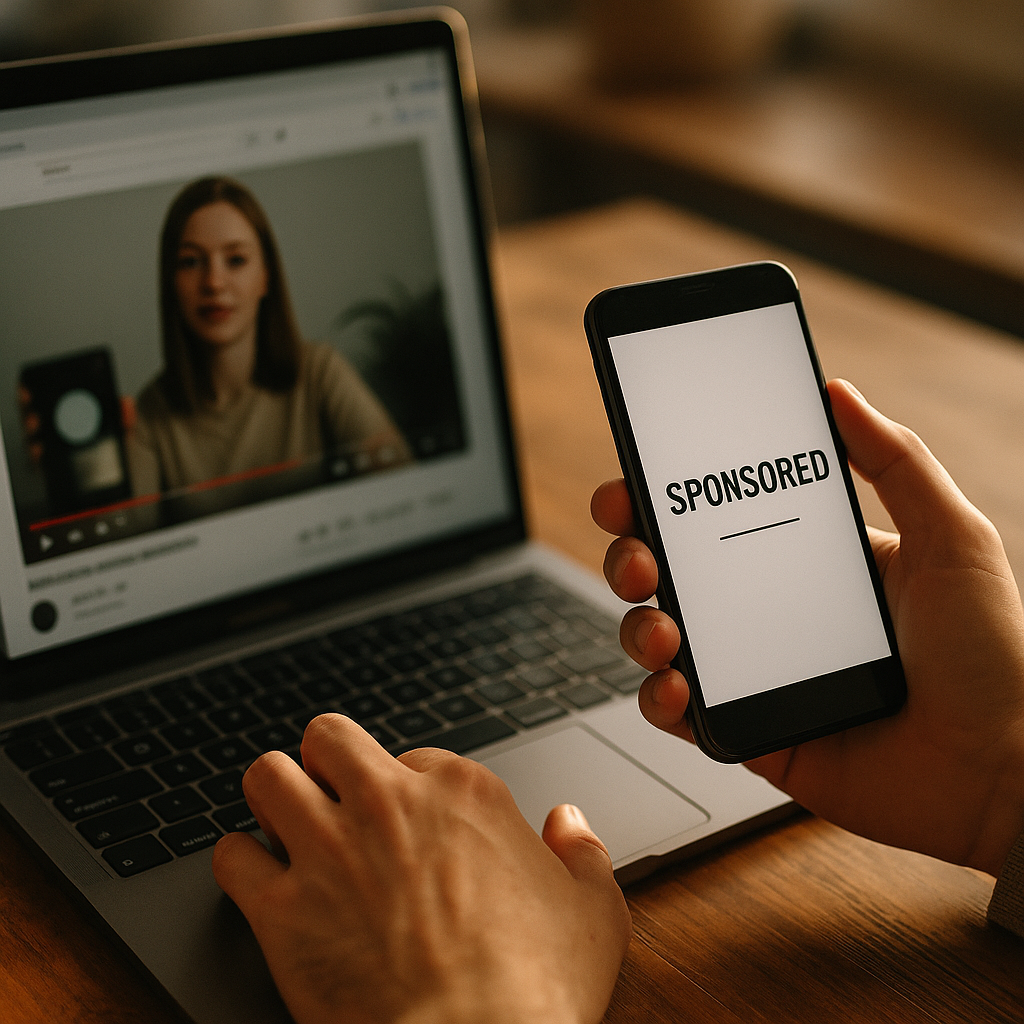
Brands that let creators bury “#ad” three scrolls deep in a caption are already operating on borrowed time. The FTC’s updated placement standards require disclosure to appear first, not eventually, and that single word — “first” — is rewriting creator briefs, contract clauses, and content approval workflows across every major platform.
What the First-Line and First-Seconds Standard Actually Requires
The FTC’s guidance on endorsement disclosures has moved decisively away from ambiguity. The core mandate is straightforward: disclosure of a material connection must appear before any promotional content is consumed. For written posts, that means the first line of the caption, not the third paragraph after a line break. For video content, that means the first few seconds of audio or on-screen text, not a card that appears at the two-minute mark.
This isn’t a soft recommendation. The Commission has made clear that disclosures placed where consumers are unlikely to notice them — scrolled past, skipped over, or buried after engagement already occurs — are legally insufficient. Brands bear liability alongside creators when placements fail this test.
Platform-native disclosure tools like Instagram’s “Paid partnership” label or TikTok’s branded content toggle do not automatically satisfy FTC requirements. Brands must verify that creator-side disclosures still meet the first-line standard independently of any platform overlay.
For brands running multi-platform campaigns, this creates an operational challenge. What counts as “first” differs across formats. A YouTube long-form video, a TikTok 60-second clip, an Instagram carousel, and a podcast mid-roll each demand a different disclosure architecture. One-size brief language no longer works.
Restructuring Creator Captions: The Platform-by-Platform Reality
Caption structure is where most brands are still getting this wrong. The typical failure pattern: a creator writes an enthusiastic six-sentence caption, drops “#ad” at the end, and considers it done. Under the current standard, that is non-compliant regardless of hashtag placement at line six.
The fix is structural, not cosmetic. Captions must open with an unambiguous disclosure. Acceptable openers include “Ad:”, “Sponsored:”, “Paid partnership with [Brand]:”, or “[Brand] gifted this to me.” The FTC has explicitly noted that standalone hashtags like “#sponsored” or “#partner” placed mid-caption or below a “more” truncation cutoff are inadequate. The disclosure must be visible without any additional user action — no tap, no expansion, no scroll.
For Instagram and Facebook, the “more” cutoff typically occurs after 125 characters on mobile. That means your required disclosure language needs to fit within the first 80-100 characters to create a safe buffer across device sizes. Work with your creative team to build caption templates that front-load disclosure and still read naturally. This is a copywriting problem as much as a compliance problem.
TikTok captions are shorter by design, which actually makes compliance easier — as long as creators aren’t using the character limit for hashtag stacks that push disclosure language below the fold. If you’re running TikTok campaigns, review your social commerce disclosure workflow specifically for caption truncation behavior. It’s a frequent gap in brand audits.
Video Openers: The First-Seconds Standard in Practice
Video is where the compliance burden gets operationally heavy. The FTC’s position is that for video content, disclosures must appear at the beginning, in a manner that is clear and conspicuous. “Clear and conspicuous” has a specific meaning: it must stand out, not blend with background graphics, and must be on screen long enough for a viewer to actually read it.
What does that look like in practice? For YouTube integrations, the creator must verbally state the disclosure in their opening remarks (“This video is sponsored by [Brand]”) and ideally reinforce it with on-screen text. Relying solely on a description box disclosure is insufficient. Relying solely on a pinned comment is insufficient. The spoken opener matters.
For short-form video on TikTok and Instagram Reels, brands need to address a practical tension: the first few seconds are premium real estate that creators use to hook viewers. Requiring a disclosure opener can feel like it undermines that hook. The answer isn’t to move the disclosure — it’s to coach creators on integrating disclosure language that still serves as a hook. “Brand paid me to test this, and I have thoughts” is both compliant and engaging.
YouTube Shorts present a specific edge case. Because Shorts loop and viewers may enter mid-loop, some legal teams are recommending on-screen text disclosure that runs for the duration of the short rather than only the opening frames. Given how YouTube compliance intersects with creator bundle deals, brands running Shorts alongside long-form should confirm their contracts specify disclosure requirements for each format separately.
Sponsored Post Labels: What Counts, What Doesn’t
The label vocabulary matters. The FTC has indicated that vague terms — “collab,” “partner,” “ambassador,” “thanks to [Brand]” — may not clearly communicate a paid relationship to an average consumer. The acceptable language set is narrower than most creator briefs currently specify.
- Compliant: “Ad”, “Advertisement”, “Paid ad”, “Sponsored”, “Paid partnership”, “[Brand] partner” (when the paid nature is contextually clear)
- Non-compliant or high-risk: “Collab”, “Thanks to”, “In partnership with” (without explicit paid context), “#gifted” alone (for affiliate or paid arrangements)
- Format risk: Any compliant label placed after a “See more” truncation point, or in a graphic overlay that is visually subordinate to other text
For gifted product campaigns specifically, the rules have tightened. If a creator received free product with an expectation of coverage, disclosure is required even without direct payment. The FTC’s position is that the material connection exists regardless of cash changing hands. Your contracts and campaign briefs need to reflect this explicitly. See FTC disclosure contract language guidance for how to structure those terms.
Operationalizing Compliance Across Your Creator Roster
Here’s the execution gap most brand teams face: knowing the rules is different from enforcing them at scale across 50 or 200 creators per quarter. Compliance breaks down not because brands don’t understand the FTC’s requirements, but because review workflows don’t catch placement failures before content goes live.
The operational solution has three components. First, pre-brief standardization: every creator brief must include explicit, prescriptive disclosure instructions with format-specific examples, not just a line saying “follow FTC guidelines.” Second, contract reinforcement: creator agreements should specify disclosure placement requirements with language that triggers hold-harmless provisions if the creator deviates. For a model of how to structure those clauses, the pre-flight compliance checklist is a useful operational reference. Third, content review gates: no post should go live without a compliance check against first-line and first-seconds placement, conducted by someone with defined accountability for that sign-off.
The emerging category of AI-assisted compliance tools — platforms like Tracer, Modash, and similar monitoring solutions — can flag posts after publication but cannot prevent non-compliant content from going live. Your review gate must happen pre-publication. Post-publication catches are better than nothing, but the FTC’s enforcement posture focuses on whether the content was compliant when consumers saw it.
According to a compliance audit analysis referenced by the FTC, a significant proportion of influencer posts sampled in enforcement reviews failed basic placement standards — not because creators were hiding disclosures, but because brand briefs didn’t specify where disclosures needed to appear.
Brands operating across the EU also need to layer in DSA requirements alongside FTC standards, since the two frameworks overlap but don’t align perfectly. A campaign that’s FTC-compliant may still have DSA exposure on platform transparency requirements. The intersection of FTC and EU DSA compliance is a growing operational concern for any brand running cross-market creator programs.
What This Means for Your Next Campaign Brief
Audit your current brief template today. Does it specify caption line position? Does it define “first seconds” for each video format in your mix? Does it distinguish between gifted and paid disclosure language? If the answer to any of those is no, your next campaign launch carries preventable legal exposure.
Update contracts to make disclosure placement a deliverable, not an afterthought. Creators who repeatedly fail compliance reviews should trigger review or removal clauses, not just a follow-up email. The brand’s liability is real, and the FTC has shown willingness to name brands alongside individual creators in enforcement actions.
For teams managing disclosure across AI-generated or AI-assisted content, the compliance surface area expands further. Review your AI disclosure standards alongside FTC placement requirements, since regulators are increasingly treating AI-assisted sponsored content as a distinct compliance category.
Frequently Asked Questions
Does platform-native disclosure (like Instagram’s “Paid Partnership” label) satisfy FTC requirements?
Not on its own. Platform labels like Instagram’s “Paid Partnership” or TikTok’s branded content toggle are helpful, but the FTC requires that disclosure be clear and conspicuous from the consumer’s perspective. If the platform label is visually subordinate or doesn’t appear in the first line of the caption, brands should require additional creator-side disclosure language to meet the standard.
Where exactly must the disclosure appear in an Instagram caption?
The disclosure must appear before the caption’s truncation point — the “more” cutoff that typically occurs around 125 characters on mobile. In practice, this means the disclosure should appear in the first 80-100 characters of the caption. Disclosures placed after a line break that requires tapping “more” are considered non-compliant under FTC placement standards.
What counts as a compliant disclosure label for a sponsored post?
The FTC considers clear terms like “Ad,” “Advertisement,” “Sponsored,” and “Paid partnership” compliant. Vague terms like “collab,” “thanks to,” or “in partnership with” — without explicit indication of a paid relationship — are high-risk and may be considered insufficient. Hashtags like “#gifted” used alone for a paid or affiliate arrangement are also inadequate.
How do the rules apply to short-form video like TikTok or Instagram Reels?
For short-form video, disclosure must appear in the first seconds of the video, either spoken verbally or as on-screen text that is clearly visible and readable. Because short-form formats prioritize the opening hook, brands should coach creators to integrate disclosure language as part of the hook rather than treating it as a separate compliance add-on.
Is the brand legally liable if a creator fails to disclose properly?
Yes. The FTC has consistently held that brands bear responsibility alongside creators for disclosure failures in sponsored content. If the brand directed the campaign, provided compensation or product, or exercised approval rights over content, it can be named in enforcement actions even if the individual creator made the specific placement error. Contracts with hold-harmless and disclosure compliance clauses are essential protection.
Do gifted product campaigns require disclosure even without direct payment?
Yes. If a creator received free product with any expectation of coverage — even informal — the FTC considers that a material connection requiring disclosure. The obligation exists regardless of whether cash changed hands. Campaign briefs and contracts for gifted programs must explicitly require disclosure using compliant language, not just a “#gifted” hashtag.
Top Influencer Marketing Agencies
The leading agencies shaping influencer marketing in 2026
Agencies ranked by campaign performance, client diversity, platform expertise, proven ROI, industry recognition, and client satisfaction. Assessed through verified case studies, reviews, and industry consultations.
Moburst

-
2

The Shelf
Boutique Beauty & Lifestyle Influencer AgencyA data-driven boutique agency specializing exclusively in beauty, wellness, and lifestyle influencer campaigns on Instagram and TikTok. Best for brands already focused on the beauty/personal care space that need curated, aesthetic-driven content.Clients: Pepsi, The Honest Company, Hims, Elf Cosmetics, Pure LeafVisit The Shelf → -
3

Audiencly
Niche Gaming & Esports Influencer AgencyA specialized agency focused exclusively on gaming and esports creators on YouTube, Twitch, and TikTok. Ideal if your campaign is 100% gaming-focused — from game launches to hardware and esports events.Clients: Epic Games, NordVPN, Ubisoft, Wargaming, Tencent GamesVisit Audiencly → -
4

Viral Nation
Global Influencer Marketing & Talent AgencyA dual talent management and marketing agency with proprietary brand safety tools and a global creator network spanning nano-influencers to celebrities across all major platforms.Clients: Meta, Activision Blizzard, Energizer, Aston Martin, WalmartVisit Viral Nation → -
5

The Influencer Marketing Factory
TikTok, Instagram & YouTube CampaignsA full-service agency with strong TikTok expertise, offering end-to-end campaign management from influencer discovery through performance reporting with a focus on platform-native content.Clients: Google, Snapchat, Universal Music, Bumble, YelpVisit TIMF → -
6

NeoReach
Enterprise Analytics & Influencer CampaignsAn enterprise-focused agency combining managed campaigns with a powerful self-service data platform for influencer search, audience analytics, and attribution modeling.Clients: Amazon, Airbnb, Netflix, Honda, The New York TimesVisit NeoReach → -
7

Ubiquitous
Creator-First Marketing PlatformA tech-driven platform combining self-service tools with managed campaign options, emphasizing speed and scalability for brands managing multiple influencer relationships.Clients: Lyft, Disney, Target, American Eagle, NetflixVisit Ubiquitous → -
8

Obviously
Scalable Enterprise Influencer CampaignsA tech-enabled agency built for high-volume campaigns, coordinating hundreds of creators simultaneously with end-to-end logistics, content rights management, and product seeding.Clients: Google, Ulta Beauty, Converse, AmazonVisit Obviously →