


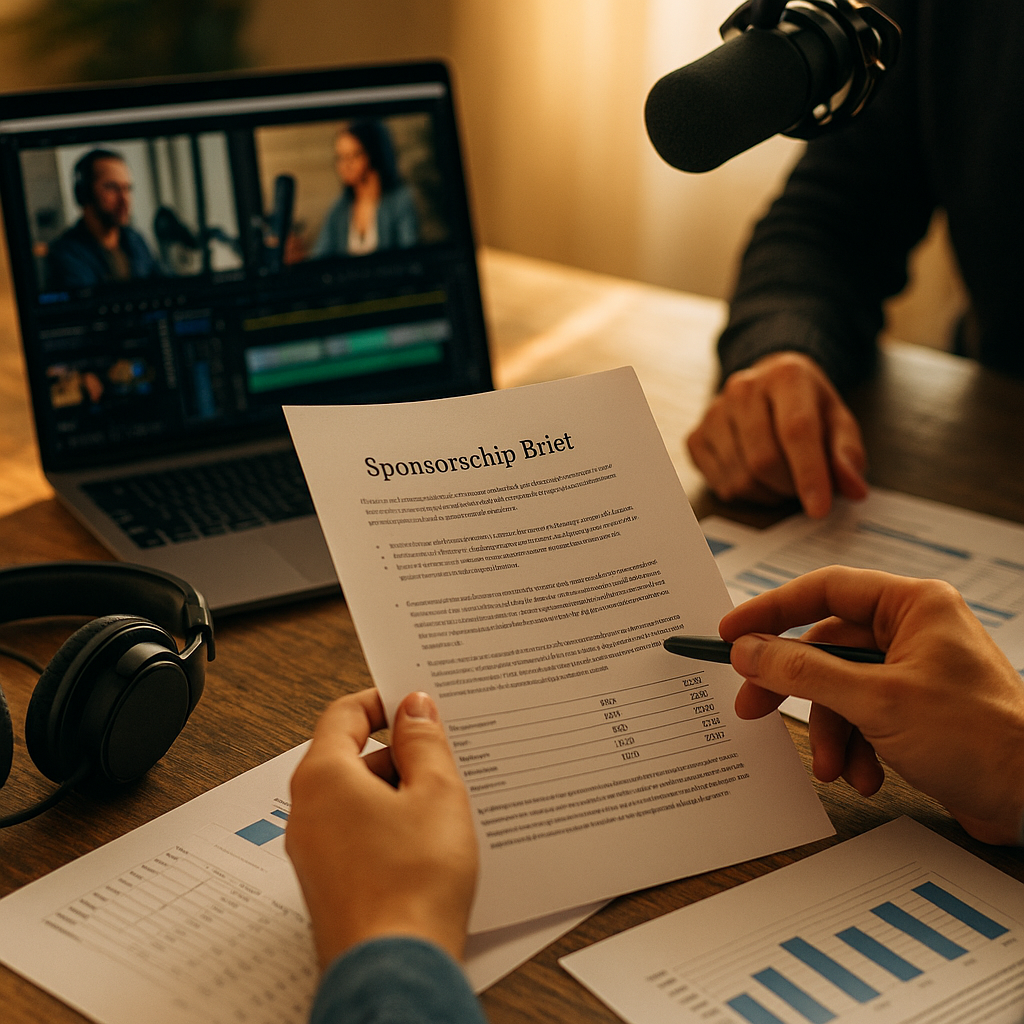
Brands running podcast sponsorships on audio alone are leaving roughly 40% of their audience reach on the table. Hybrid video-podcast formats — creator-hosted shows that publish simultaneously as YouTube video and distributed audio — are now the dominant long-form creator vehicle. Writing a sponsorship brief that actually works for both surfaces requires a fundamentally different approach than a traditional podcast brief or a YouTube integration document.
Why Hybrid Shows Demand a New Brief Architecture
Most sponsorship briefs were designed for a single-channel world. A podcast brief tells the host what to say in a mid-roll. A YouTube brief specifies b-roll, lower thirds, and visual demonstration windows. Hybrid formats break both frameworks simultaneously.
When Joe Rogan, Diary of a CEO, or Call Her Daddy-style productions distribute the same session as both video and audio, every sponsor integration must function in two distinct consumption contexts. Audio listeners get no visual cues. YouTube viewers can skip, pause, and screenshot. A brief that doesn’t account for both will produce integrations that feel clunky in at least one environment, often both.
The operative question isn’t “what should the host say?” It’s “what must survive audio-only stripping, and what can we layer on top for video?” That reframe changes everything from messaging architecture to deliverable specifications.
A well-constructed hybrid brief treats audio as the floor and video as the ceiling. Every brand message must function without visuals. Any visual enhancement is additive, not load-bearing.
CPM Logic for Dual-Distribution Deals
Pricing is where most brand teams get tripped up. Hybrid shows report two separate audience metrics: YouTube views and podcast downloads. Neither number represents the full picture, and smart media buyers know not to pay for the same listener twice.
The industry has largely converged on a combined reach model, sometimes called a “blended CPM.” You negotiate against total unique listeners/viewers, with deduplication applied where the show has data (Spotify for Podcasters, YouTube Analytics, and tools like Chartable or Podtrac can help estimate crossover). Expect significant overlap — research from eMarketer suggests that for top-tier hybrid shows, 25-35% of the YouTube audience also consumes the audio version.
A practical approach: anchor your CPM to the larger of the two audience numbers, then apply a 15-20% premium for the dual-distribution reach. This is defensible to finance, fair to the creator, and avoids double-counting. For more on video podcast CPM strategy, the fundamentals of blended pricing apply directly here.
One more wrinkle: YouTube impressions are measured differently from IAB-certified podcast downloads. Build that discrepancy into your KPI framework before the campaign launches, not after.
Anatomy of a Hybrid Sponsorship Brief
Here’s what a brief for a hybrid format must contain that a standard podcast or YouTube brief would omit:
- Dual-context messaging architecture: Provide a primary audio script (or talking points) that communicates the full brand message without any visual dependency. Then specify optional visual overlays, product demonstrations, or on-screen text the host can layer in for the video version.
- Integration placement specifications per platform: Specify timestamp windows separately for YouTube (where viewers can seek) and audio (where mid-roll placement is more rigid). A 35-minute show might place a pre-roll at 0:00, a mid-roll at 18:00, and a post-roll at close for audio. YouTube might shift that mid-roll to a natural chapter break at 22:00 based on audience retention data.
- URL and CTA protocol: Audio listeners cannot click a link. Your CTA must include a memorable vanity URL or promo code that works aurally. YouTube gets a clickable link in the description and, for eligible channels, an on-screen card. Specify both in the brief.
- Host read vs. produced segment: Hybrid formats increasingly allow for produced ad segments (pre-recorded video ads that play within the YouTube version) while maintaining a live host read for audio. If your brand wants both, the brief must specify the produced asset specs alongside the host read guidance.
- FTC disclosure requirements: Disclosures must be verbal for audio and both verbal and visual (on-screen text) for video. This is non-negotiable. For comprehensive guidance on FTC-compliant creator briefs, the principles translate directly to hybrid formats.
A brief that omits any of these components is incomplete. Period.
What Host Freedom Actually Means in This Format
Hybrid show hosts are not voice actors. They’re editorial authorities with established audience trust. Brands that send over a scripted 90-second read with mandatory phrasing requirements will get a technically compliant integration and an audience that tunes out.
The brief should provide: the non-negotiables (claims that must be made, claims that cannot be made, required disclosures), the preferred proof points (stats, features, or outcomes you want mentioned), and the tone guardrails (what the brand is not). Everything else should be left to the host’s judgment.
This is especially true for hybrid formats, where the host’s visual presence on camera creates a parasocial trust layer that audio-only shows don’t have. The audience is watching the host’s face when they talk about your product. Inauthenticity reads on camera in ways it doesn’t in audio. For deeper thinking on authenticity in creator briefs, see how brief design affects authentic delivery across platforms.
Repurposing the Integration Across the Campaign Lifecycle
One underutilized advantage of hybrid show sponsorships: the sponsor integration itself becomes repurposable content. The video version of the mid-roll can be clipped, licensed, and run as a paid social ad. The audio version can be extracted and used in programmatic podcast ad networks.
Build repurposing rights explicitly into the brief and the contract. Specify: the clip window (e.g., the 60-second integration segment), the licensing term, the platforms where the brand may redistribute, and whether the host’s likeness and name can appear in paid amplification. Most creators will negotiate this; most brand teams forget to ask.
This single step can dramatically improve your cost-per-acquisition from the campaign, since you’re amortizing the creative production cost (the host’s fee) across multiple placements. For a broader framework on multi-platform content repurposing, the same licensing logic applies at scale.
Repurposing rights are often worth more than the original placement. If your brief doesn’t address them, you’re negotiating blind — and almost certainly leaving performance on the table.
Measuring What Actually Matters
Hybrid format measurement is messier than either pure podcast or pure YouTube. Accept that upfront. Your measurement stack needs to track: branded search lift (a proxy for audio-driven awareness that can’t be directly attributed), YouTube traffic to the linked URL, promo code redemptions (separated by platform where possible), and view-through attribution on any video retargeting running in parallel.
Tools like Sprout Social can help track earned social conversation around a show episode post-launch. Combine that with direct response signals and you have a defensible multi-touch attribution picture. It won’t be perfect. It will be good enough to optimize against.
Set KPI expectations with your internal stakeholders before the campaign, not during reporting. Hybrid formats are awareness and consideration vehicles first. Brands expecting bottom-funnel ROAS comparable to search will be disappointed. Brands expecting brand lift, share of voice, and qualified traffic will find the format delivers.
For AI-era attribution considerations, see how AI tools are reshaping podcast sponsorship briefs and measurement in ways that apply directly to hybrid shows.
The Operational Checklist Before You Send the Brief
Before a hybrid sponsorship brief goes to a creator or their management, run it through this filter:
- Does every brand message in the brief work without any visual aid?
- Have you specified the CTA separately for audio (verbal/code) and video (link card + verbal)?
- Have you defined timestamp windows for both the YouTube and audio versions independently?
- Does the brief distinguish between non-negotiable brand requirements and preferred talking points?
- Are FTC disclosure requirements spelled out for both verbal and on-screen formats?
- Have you addressed repurposing rights, clip windows, and paid amplification terms?
- Have you confirmed which measurement tools will track performance across both platforms?
Seven questions. If you can answer yes to all seven, the brief is ready. If not, it isn’t — regardless of how polished the document looks.
The FTC’s endorsement guidelines and IAB podcast measurement standards are the two regulatory and technical frameworks every brand team should have open while finalizing any hybrid sponsorship brief. Neither document is optional reading.
Your next step is concrete: audit your most recent podcast or YouTube sponsorship brief against the seven-question checklist above, and identify the gaps before you enter your next hybrid show negotiation.
Frequently Asked Questions
What is a hybrid video-podcast format?
A hybrid video-podcast is a creator-hosted show recorded in a single session that distributes simultaneously as a video on YouTube (and sometimes other video platforms) and as an audio file on podcast platforms like Spotify, Apple Podcasts, and others. The host speaks to camera during recording, and the resulting content serves two distinct audience consumption modes from one production session.
How should brands calculate CPM for hybrid podcast-YouTube sponsorships?
The most defensible approach is a blended CPM based on total unique listeners and viewers, with estimated deduplication applied for audience overlap. Brands typically anchor the CPM rate to the larger of the two audience numbers and apply a 10-20% premium to account for dual-distribution reach. Avoid simply adding YouTube views and podcast downloads together, as this double-counts the crossover audience.
What makes a sponsorship brief specifically suited for a hybrid format?
A hybrid-specific brief must include dual-context messaging (audio-only talking points plus optional visual enhancements), separate CTA and URL specifications for audio and video environments, FTC disclosures for both verbal and on-screen formats, platform-specific integration placement windows, and explicit terms for repurposing the integration as paid social or programmatic audio ads.
Can brands use the host’s integration segment as a paid ad?
Yes, but only if repurposing rights are negotiated and included in the contract upfront. The video version of the integration can be clipped and run as a paid social ad; the audio version can be used in programmatic podcast networks. Brands must specify the clip window, licensing term, platforms, and whether the host’s name and likeness may appear in paid media. Most creators will negotiate these terms if asked.
How do FTC disclosure rules apply to hybrid formats?
FTC guidelines require that sponsorship disclosures be clear and conspicuous to the audience. For hybrid formats, this means a verbal disclosure in the audio version and both a verbal disclosure and an on-screen text disclosure in the video version. The brief should specify exact disclosure language and placement to ensure compliance across both distribution channels.
Top Influencer Marketing Agencies
The leading agencies shaping influencer marketing in 2026
Agencies ranked by campaign performance, client diversity, platform expertise, proven ROI, industry recognition, and client satisfaction. Assessed through verified case studies, reviews, and industry consultations.
Moburst

-
2

The Shelf
Boutique Beauty & Lifestyle Influencer AgencyA data-driven boutique agency specializing exclusively in beauty, wellness, and lifestyle influencer campaigns on Instagram and TikTok. Best for brands already focused on the beauty/personal care space that need curated, aesthetic-driven content.Clients: Pepsi, The Honest Company, Hims, Elf Cosmetics, Pure LeafVisit The Shelf → -
3

Audiencly
Niche Gaming & Esports Influencer AgencyA specialized agency focused exclusively on gaming and esports creators on YouTube, Twitch, and TikTok. Ideal if your campaign is 100% gaming-focused — from game launches to hardware and esports events.Clients: Epic Games, NordVPN, Ubisoft, Wargaming, Tencent GamesVisit Audiencly → -
4

Viral Nation
Global Influencer Marketing & Talent AgencyA dual talent management and marketing agency with proprietary brand safety tools and a global creator network spanning nano-influencers to celebrities across all major platforms.Clients: Meta, Activision Blizzard, Energizer, Aston Martin, WalmartVisit Viral Nation → -
5

The Influencer Marketing Factory
TikTok, Instagram & YouTube CampaignsA full-service agency with strong TikTok expertise, offering end-to-end campaign management from influencer discovery through performance reporting with a focus on platform-native content.Clients: Google, Snapchat, Universal Music, Bumble, YelpVisit TIMF → -
6

NeoReach
Enterprise Analytics & Influencer CampaignsAn enterprise-focused agency combining managed campaigns with a powerful self-service data platform for influencer search, audience analytics, and attribution modeling.Clients: Amazon, Airbnb, Netflix, Honda, The New York TimesVisit NeoReach → -
7

Ubiquitous
Creator-First Marketing PlatformA tech-driven platform combining self-service tools with managed campaign options, emphasizing speed and scalability for brands managing multiple influencer relationships.Clients: Lyft, Disney, Target, American Eagle, NetflixVisit Ubiquitous → -
8

Obviously
Scalable Enterprise Influencer CampaignsA tech-enabled agency built for high-volume campaigns, coordinating hundreds of creators simultaneously with end-to-end logistics, content rights management, and product seeding.Clients: Google, Ulta Beauty, Converse, AmazonVisit Obviously →