


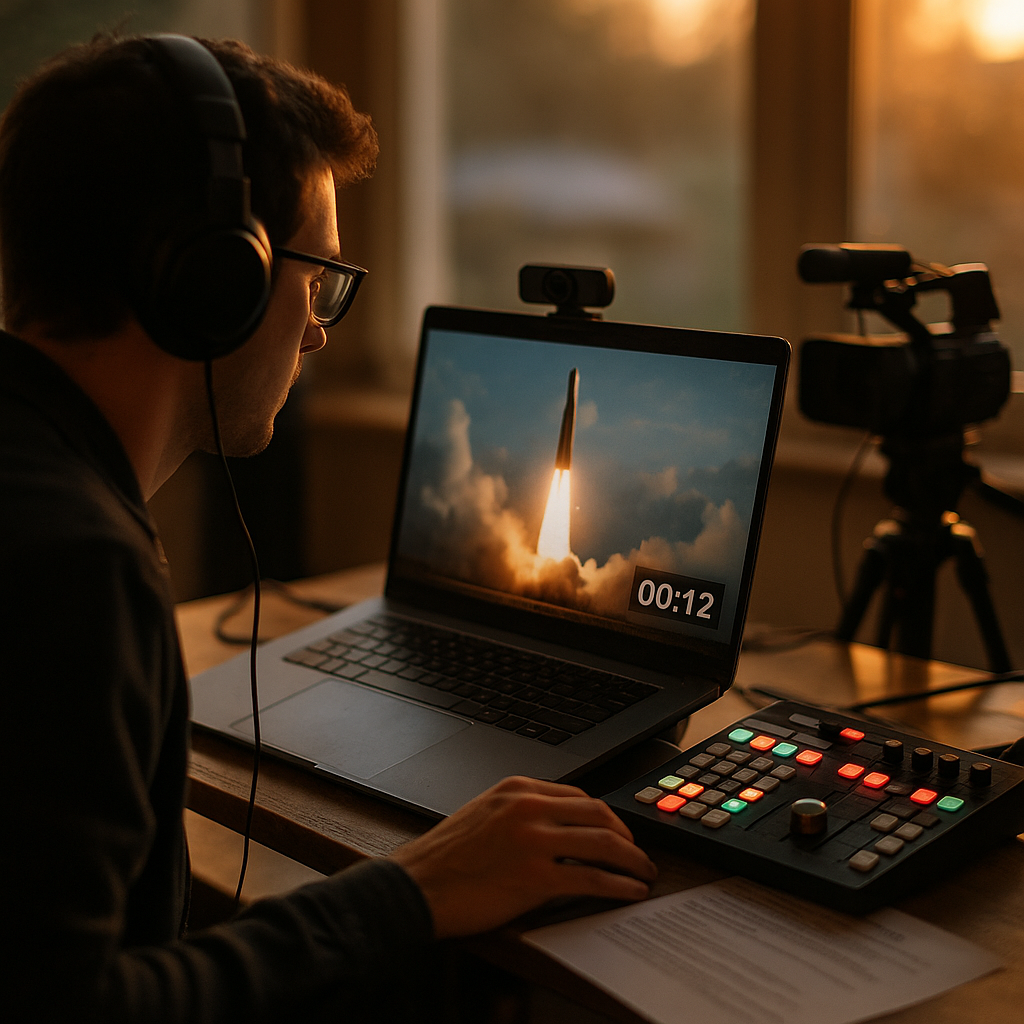
TikTok Shop’s biggest launch livestreams now run four, six, even eight hours before the product goes live — and the brands that pull it off correctly see conversion spikes that a 20-minute stream can’t touch. The countdown-to-launch livestream format isn’t just a longer version of a shoppable stream. It’s a different animal entirely, built on pacing, tension, and a viewer’s willingness to sit in a chat room waiting for something to happen. Get the structure wrong and you’ve made expensive dead air.
Why Duration Is the Whole Point
Most brands treat livestream length as a cost to minimize. Countdown formats flip that logic. The multi-hour runtime is the mechanism — it manufactures scarcity in real time, lets algorithmic discovery compound (longer streams get pushed harder by TikTok’s and YouTube’s live-ranking systems), and gives fence-sitters multiple entry points to join before the drop actually happens.
Think about how a product launch used to work: a single post, a single moment, gone in seconds. A countdown stream turns that moment into an event with a runway. Viewers who missed minute one can still catch minute 90. That’s the entire value proposition, and it’s why brands like Pop Mart, e.l.f. Cosmetics, and various sneaker resellers have leaned into six-hour-plus formats on TikTok Shop and Whatnot rather than fighting for a single viral clip.
A countdown livestream isn’t one moment stretched thin — it’s a series of smaller moments, each engineered to re-hook viewers who wandered off and came back.
The Four-Act Structure That Actually Retains Viewers
Brands that treat a six-hour stream as one continuous script lose viewers by hour two. The ones that win break it into distinct acts, each with its own pacing and purpose.
- Act One — The Setup (first 20-25% of runtime): Low-stakes, high-context. Introduce the product story, answer FAQs, do casual Q&A. This is where you front-load SEO-friendly product explanations and let latecomers catch up without missing anything critical.
- Act Two — The Build (middle 40-50%): Escalate. Bring in guest creators, run mini-games, tease exclusive details (packaging reveal, limited colorway, restock numbers). This is the meat of the stream and where most retention drop-off happens if you don’t vary the format every 15-20 minutes.
- Act Three — The Countdown (final 15-20%): Explicit numeric countdown on screen. Tension-building visuals. Host energy shifts noticeably higher. This is where chat velocity should be climbing, and where you push hardest on notification opt-ins and “turn on live alerts” prompts.
- Act Four — The Drop (final 5-10 minutes plus aftermath): Product goes live. Cart links activate. Then — critically — don’t end the stream immediately. Stay on for 10-15 minutes post-drop to handle sell-out FOMO, restock announcements, and social proof (“847 people just bought this”).
Skip a phase and the whole thing feels off. Too much Act One and you lose casual viewers before the payoff. Too little Act Two and there’s no story to justify the wait. Brands often under-invest in Act Four, which is a mistake — post-drop momentum is where UGC and screenshots of “sold out in 4 minutes” get harvested for future marketing.
What’s Actually Driving the ROI Here?
Three mechanisms, and none of them are “views.”
Algorithmic amplification. Live platforms reward watch-time and concurrent viewer counts more than almost any other signal. A stream that holds 500 concurrent viewers for four hours gets pushed to more For You pages than one that spikes to 2,000 for ten minutes and craters. TikTok’s advertising resources confirm live content gets distinct algorithmic treatment separate from standard video ranking.
Compounding urgency. Every 30 minutes someone doesn’t buy, the countdown clock re-anchors that decision. Behavioral economists call this “goal gradient” — motivation intensifies as the finish line approaches. A well-run countdown stream essentially runs that experiment on a loop for hours, catching viewers at whatever point in the gradient they happen to tune in.
Social proof density. Long streams accumulate visible proof — comment counts, gift counts, live purchase notifications — that a five-minute stream simply can’t. By hour three, new viewers arrive to an already-buzzing room. That’s a fundamentally different trust signal than arriving to an empty one.
This isn’t dissimilar to the tension-and-payoff mechanics brands use in the overnight wait-in-line format, just compressed into a single continuous broadcast instead of a multi-day arc.
Staffing a Multi-Hour Stream Without Burning Out Your Host
Here’s the part brands underestimate: no single host should carry a six-hour stream alone. Energy craters, mistakes multiply, and by hour four the host sounds like they’ve given up. The production standard emerging across agencies is a rotating cast — a primary host anchors the stream, with 2-3 co-hosts or guest creators cycling in every 60-90 minutes.
This does double duty. It resets viewer energy every time a new face appears (a subtle re-hook), and it means the brand isn’t dependent on one creator’s stamina or mood for the entire event. Smart production teams script handoff moments explicitly — “and now I’m handing this off to [creator] for the next hour” — rather than leaving transitions ambiguous.
Staffing checklist for a genuine multi-hour countdown stream:
- Primary host (anchors intro, Act One, and the final drop)
- 2-3 rotating co-hosts or micro-influencers for Act Two coverage
- A dedicated live moderator managing chat, answering FAQs off-mic, and flagging compliance issues in real time
- A backend producer watching concurrent viewer counts and adjusting pacing live (cut a segment short if energy’s dropping, extend a game if chat’s hot)
- Technical support for cart-link activation, inventory syncing, and platform-side troubleshooting
This staffing model mirrors what’s already standard for high-volume shoppable formats — see the production benchmarks in our shoppable livestream production standards breakdown for the full technical checklist.
Compliance Doesn’t Pause for Six Hours
Disclosure obligations don’t reset just because the stream is long. If a stream runs six hours and a paid partnership disclosure only appears in the first ten minutes, that’s a real FTC exposure problem — most viewers weren’t there for it. The safest practice is a repeating on-screen disclosure banner plus verbal disclosure at the top of every new act or host rotation.
The FTC’s endorsement guidance is explicit that disclosures need to be clear and conspicuous to a reasonable viewer — not buried in a description or mentioned once at the start of a multi-hour broadcast. Brands running countdown streams should treat every act transition as a fresh disclosure checkpoint, not a one-and-done box to tick.
Giveaways and games during Act Two also need their own compliance pass — sweepstakes rules vary by state and platform, and “gift this creator to enter” mechanics can trigger regulatory scrutiny if prizes have real monetary value. Loop in legal before the stream, not during it.
Six hours of live content means six hours of potential compliance exposure. Treat disclosure as a recurring production beat, not a one-time checkbox.
Metrics That Actually Matter Mid-Stream
Vanity metrics (peak concurrent viewers) look good in a recap deck but don’t tell you if the format is working while it’s happening. The metrics worth watching live:
- Retention curve by act — are you losing viewers at a specific transition point every time? That’s a pacing problem, not a content problem.
- Chat velocity relative to baseline — a spike during Act Three’s countdown is expected; a spike during Act One means you front-loaded too much excitement and have nowhere to go.
- Cart-link clicks pre-drop — if people are clicking before the product’s even live, your Act Two teasing is working.
- New-viewer join rate per hour — this tells you whether the algorithm is actively promoting the stream or whether you’re coasting on an initial audience.
Data from platforms like eMarketer continues to show livestream shopping engagement in the U.S. trailing far behind China’s mature market, which means brands here are still in an experimentation phase — the format rewards those willing to iterate on structure rather than copy a template wholesale.
Format Fatigue Is Real — Plan the Next One Differently
Run the exact same six-hour structure three launches in a row and your most loyal viewers will start tuning in only for Act Four. That defeats the purpose. Rotate mechanics: change which act features guest creators, vary the countdown visual, introduce a new mini-game format borrowed from adjacent trends like the comment-section format for real-time audience engagement, or restructure Act Two around a one-take challenge demo instead of a straightforward Q&A.
The underlying four-act skeleton should stay consistent for brand recognition. The connective tissue between acts is where you innovate season over season.
Next Step
Before your next drop, storyboard the four acts on paper with exact time blocks and named hosts for each — if you can’t fill in every box, you’re not ready to go live for six hours. Run a two-hour version first, measure the retention curve, then scale runtime once you know where viewers actually drop off.
FAQs
How long should a countdown-to-launch livestream actually run?
Most successful formats run between four and eight hours. Shorter than four and you lose the algorithmic amplification benefit of sustained watch-time; longer than eight and host fatigue and viewer drop-off usually outweigh the gains. Start with a two-to-three-hour test run before committing to a full-length broadcast.
What’s the ideal team size for a multi-hour shoppable stream?
A minimum viable team includes a primary host, 2-3 rotating co-hosts or creators, a dedicated live moderator, and a backend producer monitoring pacing and technical performance. Smaller teams tend to burn out and lose energy well before the drop.
Does the FTC require repeated disclosures throughout a long livestream?
The FTC’s guidance requires disclosures to be clear and conspicuous to a reasonable viewer at the time they’re watching. For multi-hour streams, that generally means repeating disclosures at each act transition or host rotation rather than relying on a single mention at the start.
What’s the biggest mistake brands make with countdown livestream structure?
Treating the entire stream as one continuous script instead of distinct acts. Without clear pacing shifts (setup, build, countdown, drop), viewers lose interest and the algorithm stops promoting the stream to new audiences.
Can smaller brands run this format without a huge production budget?
Yes, though the runtime should scale to the resources available. A two-to-three-hour version with one host and a moderator can still use the four-act structure effectively; it’s the pacing logic that matters, not the absolute length.
Top Influencer Marketing Agencies
The leading agencies shaping influencer marketing in 2026
Agencies ranked by campaign performance, client diversity, platform expertise, proven ROI, industry recognition, and client satisfaction. Assessed through verified case studies, reviews, and industry consultations.
Moburst

-
2

The Shelf
Boutique Beauty & Lifestyle Influencer AgencyA data-driven boutique agency specializing exclusively in beauty, wellness, and lifestyle influencer campaigns on Instagram and TikTok. Best for brands already focused on the beauty/personal care space that need curated, aesthetic-driven content.Clients: Pepsi, The Honest Company, Hims, Elf Cosmetics, Pure LeafVisit The Shelf → -
3

Audiencly
Niche Gaming & Esports Influencer AgencyA specialized agency focused exclusively on gaming and esports creators on YouTube, Twitch, and TikTok. Ideal if your campaign is 100% gaming-focused — from game launches to hardware and esports events.Clients: Epic Games, NordVPN, Ubisoft, Wargaming, Tencent GamesVisit Audiencly → -
4

Viral Nation
Global Influencer Marketing & Talent AgencyA dual talent management and marketing agency with proprietary brand safety tools and a global creator network spanning nano-influencers to celebrities across all major platforms.Clients: Meta, Activision Blizzard, Energizer, Aston Martin, WalmartVisit Viral Nation → -
5

The Influencer Marketing Factory
TikTok, Instagram & YouTube CampaignsA full-service agency with strong TikTok expertise, offering end-to-end campaign management from influencer discovery through performance reporting with a focus on platform-native content.Clients: Google, Snapchat, Universal Music, Bumble, YelpVisit TIMF → -
6

NeoReach
Enterprise Analytics & Influencer CampaignsAn enterprise-focused agency combining managed campaigns with a powerful self-service data platform for influencer search, audience analytics, and attribution modeling.Clients: Amazon, Airbnb, Netflix, Honda, The New York TimesVisit NeoReach → -
7

Ubiquitous
Creator-First Marketing PlatformA tech-driven platform combining self-service tools with managed campaign options, emphasizing speed and scalability for brands managing multiple influencer relationships.Clients: Lyft, Disney, Target, American Eagle, NetflixVisit Ubiquitous → -
8

Obviously
Scalable Enterprise Influencer CampaignsA tech-enabled agency built for high-volume campaigns, coordinating hundreds of creators simultaneously with end-to-end logistics, content rights management, and product seeding.Clients: Google, Ulta Beauty, Converse, AmazonVisit Obviously →