


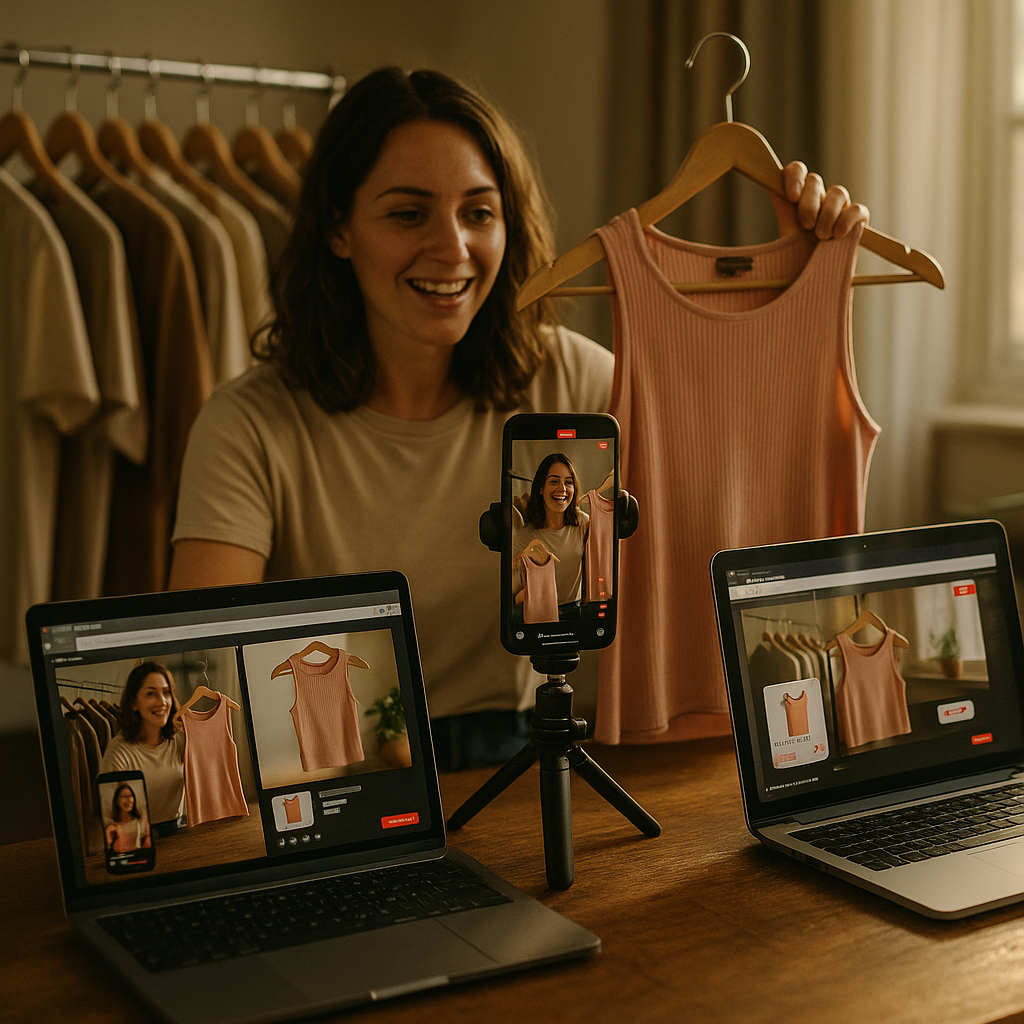
Livestream commerce is projected to hit $50 billion in U.S. sales before the decade closes, according to eMarketer estimates, yet most mid-market brands still can’t tell you the difference between a livestream commerce platform built for scale and one built for speed. Picking wrong costs you six figures in wasted implementation. Picking right builds a channel your competitors can’t easily copy.
This guide breaks down three of the most-cited platforms in the space, Bambuser, CommentSold, and TalkShopLive, and where each actually fits for a brand doing somewhere between $10M and $250M in revenue. Not enterprise. Not a solo creator with a Shopify store. The messy middle, where budget discipline matters and every platform decision needs a defensible ROI case.
Why Mid-Market Brands Can’t Just Copy Enterprise Playbooks
Walmart and L’Oréal run livestream commerce with dedicated production teams, in-house studios, and seven-figure platform contracts. That’s not your reality, and it shouldn’t be your benchmark. Mid-market brands need platforms that work with lean teams: a social manager, maybe a part-time producer, and a merchandising lead who’s also doing three other jobs.
The three platforms in this guide solve that constraint differently. Bambuser leans enterprise-adjacent but has scaled down its offering. CommentSold grew out of the boutique and reseller community, so it’s built for volume and simplicity. TalkShopLive sits in between, with a media-network feel that suits brands wanting broadcast-style credibility without broadcast-style cost.
The real cost of livestream commerce isn’t the platform fee. It’s the operational overhead of hosting, moderating, and fulfilling live shopping events every week without burning out your team.
Bambuser: Built for Brands That Want Owned-Channel Control
Bambuser has positioned itself as the platform for brands that want livestream shopping embedded directly into their own site and app, not routed through a third-party marketplace. Its clients include names like Klarna and various fashion and beauty retailers running “shop the show” experiences on owned domains.
For mid-market brands, the appeal is control. Bambuser’s One-to-Many streaming architecture lets you run shows to thousands of concurrent viewers without the lag issues that plague lower-tier tools. It integrates with Shopify, Salesforce Commerce Cloud, and other major commerce stacks, so checkout stays on your domain rather than sending shoppers to a separate app.
The tradeoff? Implementation is heavier. You’re not clicking a plugin and going live in an afternoon. Expect a real onboarding process, some development resource from your side, and a pricing structure that scales with stream volume and viewership, not a flat SaaS fee.
Best fit: Brands with existing dev resources who want livestream commerce as a native extension of their site, not a bolted-on app. If your team already manages a complex tech stack, and you’re comfortable with the kind of vendor evaluation you’d apply to a customer data platform decision, Bambuser rewards that rigor.
CommentSold: The Volume Play
CommentSold built its reputation in the resale and boutique retail world, where sellers run dozens of live shopping events a week and need a system that turns comments into cart adds automatically. That heritage shows. The platform is optimized for speed and repetition, not polish.
If your brand does high-frequency, lower-production-value live shopping, think daily or near-daily drops, CommentSold’s comment-to-cart automation is genuinely hard to replicate elsewhere. Viewers comment a product code, CommentSold’s system auto-adds it to their cart, and checkout happens without them leaving the stream.
Pricing tends to run lower than Bambuser and TalkShopLive on a monthly basis, which matters when you’re testing whether livestream commerce works for your category before committing serious budget. The catch: the platform’s roots in reseller and boutique commerce mean its interface and reporting can feel dated next to more enterprise-polished tools. Brand teams coming from a traditional retail media background sometimes find the UI clunky.
CommentSold’s comment-to-cart mechanic converts at rates boutique sellers report as dramatically higher than standard e-commerce, but that lift depends entirely on host skill and community trust, not the platform alone.
Best fit: Apparel, beauty, and lifestyle brands running frequent, high-cadence shows with a host-driven, community feel. Less suited to brands wanting a polished, broadcast-quality production value.
TalkShopLive: Media-Network Credibility Without the Media-Network Price
TalkShopLive has carved a niche by positioning itself closer to a broadcast network than a plugin. It’s partnered with retailers like Macy’s and hosted celebrity-driven shows, giving it a media credibility that resonates with brand marketing teams used to thinking in terms of earned media value, not just conversion rate.
The platform supports multi-destination streaming, so a single show can broadcast to your site, Amazon Live, Facebook, and other channels simultaneously. That’s a meaningful differentiator if your team is already stretched thin and can’t produce separate content for every platform.
TalkShopLive also handles a chunk of the production and hosting logistics that Bambuser and CommentSold generally leave to the brand. For mid-market teams without in-house livestream production experience, that support can be the difference between launching in a quarter versus a year.
Best fit: Brands wanting a partly managed-service feel, especially those looking to simulcast across owned and third-party channels rather than build a single destination experience.
How to Actually Compare These Platforms
Feature checklists are useful, but they miss the operational reality. Ask these questions instead:
- Who hosts the shows? Bambuser and CommentSold assume you bring your own talent and host training. TalkShopLive offers more support here.
- What’s your cadence? Weekly or monthly shows favor Bambuser or TalkShopLive’s production quality. Daily or multiple-times-daily shows favor CommentSold’s automation.
- Where does checkout happen? On your own domain (Bambuser), inside the platform’s ecosystem (CommentSold), or distributed across multiple channels (TalkShopLive)?
- What’s your attribution setup? None of these platforms replace a proper measurement stack. You still need clean tracking back to your analytics environment, similar to closing gaps discussed in attribution gap analysis for other channels.
- How does data flow into your CRM? Livestream commerce generates first-party engagement data that’s genuinely valuable, but only if it lands somewhere useful. This is where CRM attribution setups become relevant to the platform decision, not an afterthought.
The Budget Conversation Nobody Wants to Have
Platform fees are the visible cost. The invisible cost is everything around it: host training, production equipment, moderation staffing during live events, and the content repurposing needed to get value out of a 45-minute stream beyond its live window.
A realistic mid-market budget for livestream commerce, inclusive of platform, production, and staffing, tends to land somewhere between $8,000 and $30,000 monthly depending on show frequency. Brands that budget only for the platform subscription and skip the production line item are the ones who abandon livestream commerce within two quarters, chalking it up as “didn’t work” when really it was under-resourced.
It’s also worth stress-testing vendor claims the way you would any AI-adjacent marketing tool. Livestream platforms increasingly bolt on AI features, automated highlight clipping, real-time sentiment analysis, predictive product tagging, and those claims deserve the same scrutiny outlined in an AI vendor governance scorecard. Ask for a live demo, not a sizzle reel.
Compliance and Disclosure Still Apply
Livestream commerce sits at the intersection of advertising, e-commerce, and influencer content, which means FTC endorsement guidelines still apply in full. If a host is compensated or has a material connection to the brand, that needs clear, unambiguous on-screen disclosure throughout the stream, not just in the opening seconds. Review the FTC’s endorsement guidance before your first show, not after a complaint.
Platforms vary in how much disclosure tooling they build in. This is worth confirming during your evaluation rather than assuming it’s handled. None of the three platforms covered here fully automate compliance, so your team still owns that responsibility contractually and operationally.
Making the Final Call
There’s no universal winner here, and any vendor who tells you otherwise is selling, not advising. Bambuser suits brands with development resources and a long-term owned-channel strategy. CommentSold suits high-frequency sellers who prioritize conversion mechanics over production polish. TalkShopLive suits brands wanting managed production and multi-channel distribution without building that infrastructure in-house.
Run a 90-day pilot before signing an annual contract with any of them. Track cost per show, conversion rate, and repeat-viewer retention, then decide. That data will tell you more than any vendor pitch deck.
Frequently Asked Questions
Which livestream commerce platform is cheapest for a mid-market brand?
CommentSold generally has the lowest entry-level monthly cost of the three, making it a common starting point for brands testing livestream commerce before scaling investment.
Do these platforms integrate with Shopify?
Yes. Bambuser, CommentSold, and TalkShopLive all offer Shopify integrations, though the depth of integration and checkout experience varies by platform. Confirm current integration specifics directly with each vendor, since capabilities update frequently.
How long does implementation typically take?
CommentSold and TalkShopLive can often go live within weeks. Bambuser’s owned-channel integration model typically requires a longer implementation timeline involving development resources, often one to three months depending on your existing tech stack.
Can livestream commerce data feed into existing marketing analytics?
It can, but not automatically in most cases. Brands need to plan the data pipeline from the livestream platform into their CRM or analytics environment as part of the initial setup, not as an afterthought.
Is influencer talent required, or can brand employees host shows?
Either works. Many mid-market brands start with internal staff or founders hosting, then add creator partnerships once they’ve validated the format and audience response.
Frequently Asked Questions
Which livestream commerce platform is cheapest for a mid-market brand?
CommentSold generally has the lowest entry-level monthly cost of the three, making it a common starting point for brands testing livestream commerce before scaling investment.
Do these platforms integrate with Shopify?
Yes. Bambuser, CommentSold, and TalkShopLive all offer Shopify integrations, though the depth of integration and checkout experience varies by platform. Confirm current integration specifics directly with each vendor, since capabilities update frequently.
How long does implementation typically take?
CommentSold and TalkShopLive can often go live within weeks. Bambuser’s owned-channel integration model typically requires a longer implementation timeline involving development resources, often one to three months depending on your existing tech stack.
Can livestream commerce data feed into existing marketing analytics?
It can, but not automatically in most cases. Brands need to plan the data pipeline from the livestream platform into their CRM or analytics environment as part of the initial setup, not as an afterthought.
Is influencer talent required, or can brand employees host shows?
Either works. Many mid-market brands start with internal staff or founders hosting, then add creator partnerships once they’ve validated the format and audience response.
Start with a 90-day pilot on whichever platform matches your show cadence, not the one with the flashiest demo, and let real conversion and retention data make the renewal decision for you.
Top Influencer Marketing Agencies
The leading agencies shaping influencer marketing in 2026
Agencies ranked by campaign performance, client diversity, platform expertise, proven ROI, industry recognition, and client satisfaction. Assessed through verified case studies, reviews, and industry consultations.
Moburst

-
2

The Shelf
Boutique Beauty & Lifestyle Influencer AgencyA data-driven boutique agency specializing exclusively in beauty, wellness, and lifestyle influencer campaigns on Instagram and TikTok. Best for brands already focused on the beauty/personal care space that need curated, aesthetic-driven content.Clients: Pepsi, The Honest Company, Hims, Elf Cosmetics, Pure LeafVisit The Shelf → -
3

Audiencly
Niche Gaming & Esports Influencer AgencyA specialized agency focused exclusively on gaming and esports creators on YouTube, Twitch, and TikTok. Ideal if your campaign is 100% gaming-focused — from game launches to hardware and esports events.Clients: Epic Games, NordVPN, Ubisoft, Wargaming, Tencent GamesVisit Audiencly → -
4

Viral Nation
Global Influencer Marketing & Talent AgencyA dual talent management and marketing agency with proprietary brand safety tools and a global creator network spanning nano-influencers to celebrities across all major platforms.Clients: Meta, Activision Blizzard, Energizer, Aston Martin, WalmartVisit Viral Nation → -
5

The Influencer Marketing Factory
TikTok, Instagram & YouTube CampaignsA full-service agency with strong TikTok expertise, offering end-to-end campaign management from influencer discovery through performance reporting with a focus on platform-native content.Clients: Google, Snapchat, Universal Music, Bumble, YelpVisit TIMF → -
6

NeoReach
Enterprise Analytics & Influencer CampaignsAn enterprise-focused agency combining managed campaigns with a powerful self-service data platform for influencer search, audience analytics, and attribution modeling.Clients: Amazon, Airbnb, Netflix, Honda, The New York TimesVisit NeoReach → -
7

Ubiquitous
Creator-First Marketing PlatformA tech-driven platform combining self-service tools with managed campaign options, emphasizing speed and scalability for brands managing multiple influencer relationships.Clients: Lyft, Disney, Target, American Eagle, NetflixVisit Ubiquitous → -
8

Obviously
Scalable Enterprise Influencer CampaignsA tech-enabled agency built for high-volume campaigns, coordinating hundreds of creators simultaneously with end-to-end logistics, content rights management, and product seeding.Clients: Google, Ulta Beauty, Converse, AmazonVisit Obviously →