


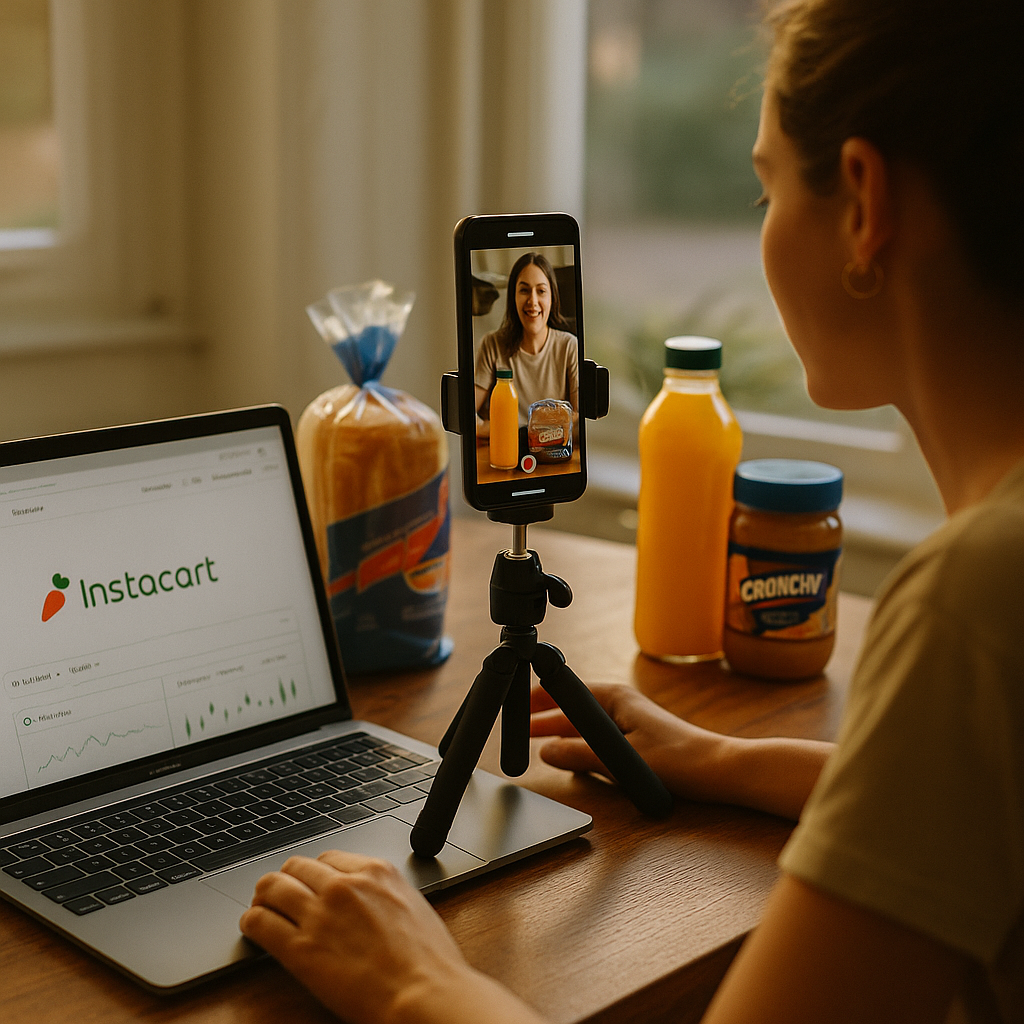
Grocery Commerce Has a Creator Problem — And Instacart Just Changed the Math
Grocery brands running influencer programs convert less than 3% of social-driven traffic into actual purchase, largely because the path from “I saw that on Instagram” to “it’s in my cart” has too many steps. Instacart Ads Manager’s expanded self-serve placement for sponsored products, paired with its growing social commerce integrations, closes that gap. For CPG brand managers, this is the most operationally significant shift in grocery performance marketing in years.
What Instacart Ads Manager Actually Offers Now
Most CPG teams are still treating Instacart as a retail media afterthought — budget allocated after Meta, TikTok, and Amazon. That’s a mistake. Instacart’s self-serve ads platform now gives brand managers direct access to sponsored product placements across its retailer network, display banners on category and search pages, and shoppable storefronts that can be linked from off-platform content.
The platform’s expanded API access means third-party tools can now sync creator content calendars with Instacart campaign flight dates. That’s the unlock. When a creator posts on Tuesday, your sponsored product placement on Instacart can be live and prioritized in the same 48-hour window, capturing demand at the exact moment it’s created.
The brands winning grocery social commerce aren’t just running creator content. They’re engineering simultaneous inventory: social discovery on one screen, shoppable cart on the other — activated within hours of each other.
Instacart also introduced brand pages that function like mini storefronts, which creators can now link to directly through UTM-tagged URLs. This matters because it creates a closed attribution loop: you can see which creator drove which cart adds, not just which creator drove clicks.
How to Structure Creator Partnerships for Dual-Channel Activation
The old brief model for grocery brands was simple: show the product in use, mention the retailer, drop a link. That model produces awareness. It does not produce conversions at scale. The new model requires a different brief architecture entirely.
Brief for two moments, not one. The creator’s content should generate immediate social discovery — the scroll-stopping recipe video, the pantry haul, the cooking segment. But the brief also needs to embed a second call to action: an Instacart storefront link, a “add to cart” prompt, or a promo code that only activates on Instacart. Creators who understand the dual-moment structure will produce content that serves both functions. Most won’t figure this out without explicit guidance in the brief.
Your brief should specify:
- The exact Instacart storefront URL (with UTM parameters per creator)
- Language around availability (“available on Instacart from [retailer]”)
- Timing alignment with your sponsored product flight window
- Whether you want the CTA verbal, on-screen, or both
- Any platform-specific format requirements (Instagram Reels link sticker vs. TikTok bio link vs. YouTube description)
For platform-specific brief construction, the same principles that apply to TikTok Shop product link briefs translate well here. The commerce CTA architecture is similar; only the destination platform changes.
Creator Tier Selection: Who Actually Converts Grocery Shoppers?
Not every creator tier performs equally in grocery social commerce. Macro-influencers with 500K+ followings generate strong awareness metrics but notoriously weak conversion rates for CPG. The audiences are too broad and the trust signal for a specific food or beverage product is diluted.
Mid-tier creators in the 50K–200K range, particularly those with food, home, family, or wellness content niches, tend to show the strongest Instacart cart-add attribution. Their audiences are more intentional shoppers. When a food creator their followers trust says “I order this every week on Instacart,” the behavioral signal is credible.
Micro-creators deserve serious consideration here. The economics of micro-creator amplification for niche audiences often outperform macro partnerships on a cost-per-cart-add basis, particularly for emerging CPG brands without mass recognition. Ten micro-creators posting in the same week with the same Instacart link creates a frequency effect that a single macro post cannot replicate.
A practical allocation: for a $150K creator program budget tied to an Instacart campaign, consider putting 40% toward 3–4 mid-tier creators for reach, 40% toward 15–20 micro-creators for conversion density, and 20% toward paid amplification of the top-performing organic posts.
Attribution: The Part Most Brands Get Wrong
Instacart’s attribution window for sponsored products currently defaults to a 14-day view-through and 7-day click-through model, which means if a consumer sees your creator’s post, lands on Instacart, and adds your product to their cart within that window, you can connect those dots. But only if you’ve done the UTM architecture correctly from the start.
Each creator should receive a unique UTM source tag. The campaign parameter should correspond to your Instacart campaign flight. This sounds basic, but the majority of CPG teams running creator programs still use generic UTM strings that make it impossible to differentiate creator-driven cart adds from organic search or sponsored placement traffic.
Instacart’s Ads Manager dashboard will show you sponsored product performance. Your creator management platform (whether that’s GRIN, Aspire, or another tool) will show you creator-level social metrics. The gap between those two data streams is where most brands lose the attribution thread. Build a shared reporting document that maps creator post dates, UTM parameters, Instacart campaign flight windows, and cart-add spikes in a single view. It’s manual work upfront, but it’s the only way to prove program ROI to a CFO.
For brands managing complex attribution across multiple platforms simultaneously, the frameworks around Reels attribution windows offer a useful parallel for thinking through conversion credit standards.
UTM discipline is not a technical detail. It’s the difference between a creator program you can scale with confidence and one you have to justify with gut instinct every quarter.
Compliance and Disclosure in a Commerce-Integrated Context
When creator content is directly linked to a purchasable product and the creator is compensated, the FTC disclosure requirements are unambiguous: clear, conspicuous disclosure is required. This applies whether the creator posts on Instagram, TikTok, YouTube, or any other platform.
The added complexity in Instacart-integrated campaigns is the affiliate or promo code layer. If creators earn a commission on cart adds traced to their link, that’s an affiliate relationship and must be disclosed as such, not simply labeled as a brand partnership. Brief language should specify disclosure requirements explicitly, and your legal or compliance team should review creator posts before they go live, particularly for regulated categories like supplements, baby food, or alcohol-adjacent products.
Failure here is not just a brand reputation risk. It’s an FTC enforcement risk. Build the compliance review step into your campaign calendar, not as an afterthought after creator content is drafted.
Syncing the Calendar: When Timing Is the Strategy
The single most underutilized lever in Instacart creator programs is timing synchronization. Brands that launch their Instacart sponsored product campaign 48–72 hours before creator posts go live capture the first wave of search and browse traffic. Brands that activate creator posts first and then scramble to get sponsored placements live are leaving conversion on the table during the window of peak social attention.
Map your campaign calendar in reverse. Set the Instacart sponsored product activation date first. Work backward to creator post dates, content approval deadlines, and brief delivery. This is the same discipline that drives results in coordinated TikTok Shop omnichannel campaigns and it applies directly to grocery commerce.
Seasonal and occasion-based timing amplifies this effect significantly. A creator series around weeknight dinner solutions posted Wednesday through Friday, aligned with an Instacart campaign running Thursday through Sunday, targets the exact decision window when consumers are planning grocery orders for the week. That’s not coincidence. That’s program architecture.
For broader multi-platform thinking on coordinated creator activation, the multi-platform creator strategy framework is worth adapting to your grocery commerce calendar.
Start here: audit your last three creator campaigns and map the actual post dates against your Instacart sponsored product flight windows. If there’s a gap of more than three days between them in either direction, you identified the conversion gap. Closing it is the first optimization worth making before anything else.
Frequently Asked Questions
How does Instacart Ads Manager integrate with creator content campaigns?
Instacart Ads Manager allows CPG brands to run sponsored product placements across its retailer network and create shoppable brand pages that creators can link to directly. By using the platform’s API integrations and UTM-tagged storefront URLs, brands can sync creator post dates with sponsored product flight windows, creating simultaneous social discovery and on-platform conversion opportunities.
What creator tier works best for driving Instacart cart conversions?
Mid-tier creators (50K–200K followers) in food, home, and wellness niches typically show the strongest cart-add attribution for grocery brands on Instacart. Micro-creators can outperform macros on a cost-per-cart-add basis, particularly when multiple micro-creators post in the same week to create a frequency effect. Macro-influencers are better reserved for broad awareness, not conversion-focused campaigns.
What disclosure requirements apply to Instacart-linked creator content?
All creator content promoting a brand in exchange for compensation requires clear and conspicuous FTC disclosure. If creators earn affiliate commissions or promo-code bonuses tied to Instacart cart adds, this must be disclosed as an affiliate relationship, not simply a brand partnership. Brands should include disclosure language in creator briefs and build a compliance review step into the campaign calendar.
How should brands structure UTM parameters for Instacart creator campaigns?
Each creator should receive a unique UTM source tag so their individual performance can be tracked separately. The campaign parameter should align with the specific Instacart flight window. Avoid generic UTM strings shared across multiple creators, as this makes it impossible to distinguish creator-driven cart adds from sponsored product or organic traffic in Instacart’s dashboard.
How far in advance should the Instacart sponsored product campaign launch relative to creator posts?
Brands should activate Instacart sponsored product placements 48–72 hours before creator content goes live. This ensures that when social audiences land on Instacart after seeing creator content, the sponsored product is already visible and prioritized in search and browse pages, maximizing the conversion window during peak social attention.
Top Influencer Marketing Agencies
The leading agencies shaping influencer marketing in 2026
Agencies ranked by campaign performance, client diversity, platform expertise, proven ROI, industry recognition, and client satisfaction. Assessed through verified case studies, reviews, and industry consultations.
Moburst

-
2

The Shelf
Boutique Beauty & Lifestyle Influencer AgencyA data-driven boutique agency specializing exclusively in beauty, wellness, and lifestyle influencer campaigns on Instagram and TikTok. Best for brands already focused on the beauty/personal care space that need curated, aesthetic-driven content.Clients: Pepsi, The Honest Company, Hims, Elf Cosmetics, Pure LeafVisit The Shelf → -
3

Audiencly
Niche Gaming & Esports Influencer AgencyA specialized agency focused exclusively on gaming and esports creators on YouTube, Twitch, and TikTok. Ideal if your campaign is 100% gaming-focused — from game launches to hardware and esports events.Clients: Epic Games, NordVPN, Ubisoft, Wargaming, Tencent GamesVisit Audiencly → -
4

Viral Nation
Global Influencer Marketing & Talent AgencyA dual talent management and marketing agency with proprietary brand safety tools and a global creator network spanning nano-influencers to celebrities across all major platforms.Clients: Meta, Activision Blizzard, Energizer, Aston Martin, WalmartVisit Viral Nation → -
5

The Influencer Marketing Factory
TikTok, Instagram & YouTube CampaignsA full-service agency with strong TikTok expertise, offering end-to-end campaign management from influencer discovery through performance reporting with a focus on platform-native content.Clients: Google, Snapchat, Universal Music, Bumble, YelpVisit TIMF → -
6

NeoReach
Enterprise Analytics & Influencer CampaignsAn enterprise-focused agency combining managed campaigns with a powerful self-service data platform for influencer search, audience analytics, and attribution modeling.Clients: Amazon, Airbnb, Netflix, Honda, The New York TimesVisit NeoReach → -
7

Ubiquitous
Creator-First Marketing PlatformA tech-driven platform combining self-service tools with managed campaign options, emphasizing speed and scalability for brands managing multiple influencer relationships.Clients: Lyft, Disney, Target, American Eagle, NetflixVisit Ubiquitous → -
8

Obviously
Scalable Enterprise Influencer CampaignsA tech-enabled agency built for high-volume campaigns, coordinating hundreds of creators simultaneously with end-to-end logistics, content rights management, and product seeding.Clients: Google, Ulta Beauty, Converse, AmazonVisit Obviously →