


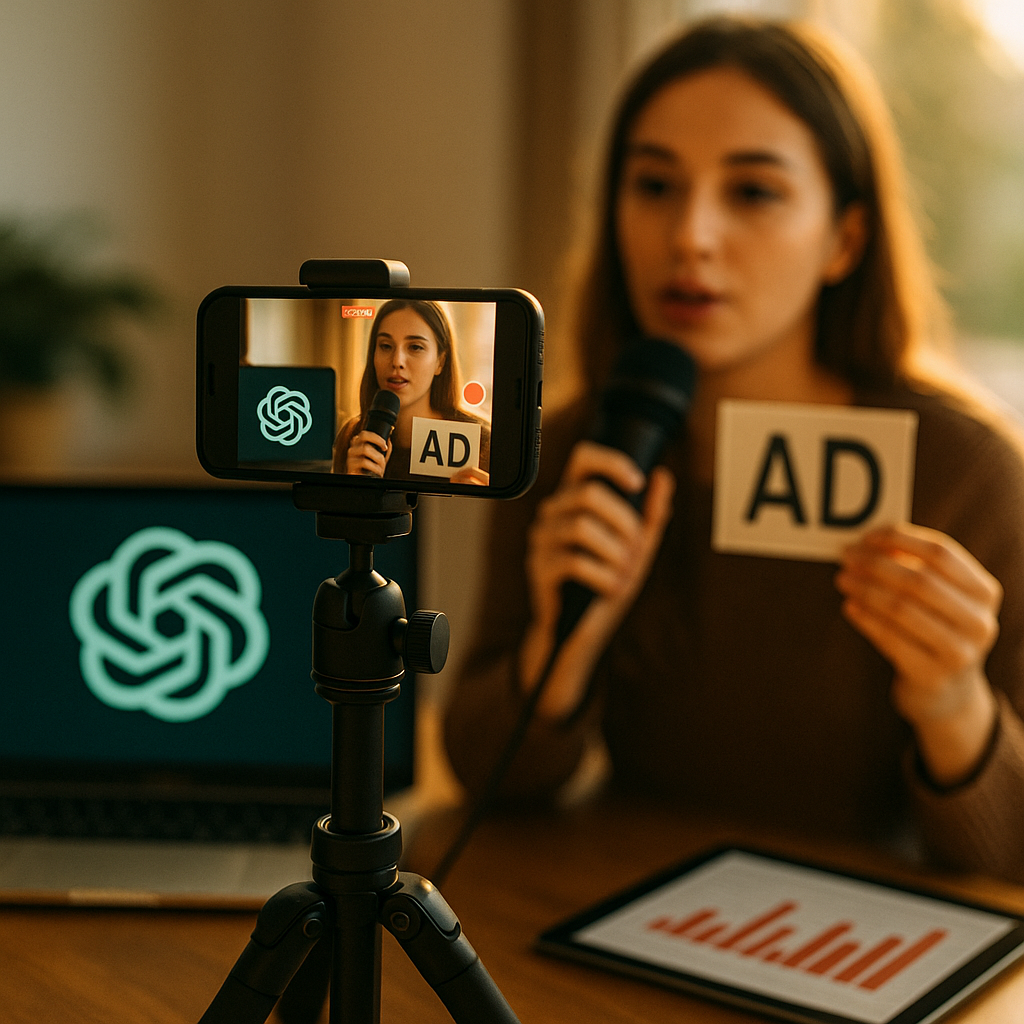
What happens when the AI answering your customer’s shopping question is also running your ad? OpenAI’s emerging click-based ad product inside ChatGPT isn’t a banner play — it’s a structural shift in how brand discovery, influencer content, and autonomous purchase recommendations can exist inside a single consumer journey. Brand teams that treat this as just another paid channel will miss the point entirely.
The Format, Actually Explained
OpenAI has been quietly developing a click-based advertising model that surfaces brand results within ChatGPT’s conversational interface. Unlike traditional display or search ads, these placements respond to the context of the conversation itself. A user asking ChatGPT for “the best lightweight running shoes for wide feet” doesn’t see a banner — they see a contextually embedded recommendation with a brand link, structured around the AI’s response logic.
This is not Google’s keyword auction dressed in new clothes. The mechanism is closer to a hybrid between native content and programmatic intent targeting. OpenAI has reportedly explored revenue-sharing structures with publishers and content sources that inform its responses, which means the content your brand produces — and the creator content associated with your brand — can directly influence whether and how you surface in that ad slot. According to eMarketer, AI-powered search and recommendation interfaces are projected to capture a significant share of upper-funnel brand discovery spend as traditional search click-through rates continue declining.
The ad unit is the answer. When the AI’s recommended response becomes the commercial placement, the line between organic brand authority and paid visibility collapses — and that changes everything about how you brief creators.
What This Does to Creator Content Strategy
If ChatGPT’s ad logic draws on content it ingests, crawls, or is trained on — including review content, editorial coverage, and creator-published material — then your influencer program becomes an input into your AI ad relevance score. That’s not a stretch. It’s the logical extension of how large language models weigh entity authority and topical associations.
Practically, this means a few things change in how you brief and structure creator deliverables:
- Structured claims matter more than vibes. Creator content that makes specific, verifiable product claims (dimensions, ingredients, use-case fit) has higher training and indexing value than aspirational lifestyle content. Briefs need to reflect this.
- Long-form written content from creators isn’t dead. Blog posts, Substack reviews, and detailed YouTube descriptions feed LLM training data in ways that a 15-second Reel does not. Consider pairing short-form social with creator-authored long-form.
- Brand-adjacent authority signals compound. When multiple credible creators discuss your product in the same category context, the AI’s associative weighting for your brand in that category strengthens. This is similar to how GEO (Generative Engine Optimization) frameworks approach brand entity building.
The implication for creative directors is uncomfortable but important: the creator brief has to serve two audiences simultaneously — the human viewer and the AI systems that will later process that content as training signal or retrieval context.
Attribution Window Design in a Non-Linear Journey
Here’s where most brand teams will stumble. Traditional attribution models — last-click, even time-decay — were built for linear funnels. A consumer sees an Instagram post from a creator, clicks a link, lands on a PDP, converts. Clean. The ChatGPT ad model breaks that linearity in two directions.
First, the influence flows upstream. A user who consumed three creator reviews of your skincare line six weeks ago now asks ChatGPT for a recommendation. The AI surfaces your brand (organically or via the click-based placement). The attribution question becomes: does the influencer content that shaped that user’s implicit preference get any credit? Under current last-touch models, no. The ChatGPT click gets it all.
Second, the AI may compress the funnel entirely. OpenAI has signaled interest in agentic purchasing capabilities — scenarios where the AI doesn’t just recommend but can initiate a transaction. If that scales, the gap between “discovery moment” and “purchase moment” could collapse to near-zero inside a single interface. Your 30-day attribution window was designed for a world where those moments were days apart.
The operational fix requires rethinking your measurement stack. CRM identity resolution for creator attribution becomes essential infrastructure — not a nice-to-have — when you need to stitch together an influencer touchpoint from weeks ago with a ChatGPT-assisted conversion today. Brands without a unified identity graph will systematically undervalue their creator programs in post-campaign reporting.
Connecting Influencer Discovery to AI Purchase Recommendations
The consumer journey that should concern you most looks like this: a user encounters a creator’s content on TikTok or YouTube, develops brand familiarity, and later asks an AI assistant for a category recommendation. The AI, drawing on its training data and potentially its ad auction, surfaces your brand. The user clicks, converts. Two completely different systems, one journey.
This isn’t theoretical. HubSpot’s research on AI-assisted purchasing behavior shows a growing proportion of consumers using conversational AI as a product research intermediary before making purchase decisions. The influencer’s role in that journey is to build the semantic association between your brand and the category language that the AI later matches against the user’s query.
Think about what that means for AI-powered creator discovery. When you select creators, you’re not just selecting for audience demographics. You’re selecting for the lexical and contextual fingerprint their content will leave in the AI’s understanding of your brand. A creator who consistently frames your protein powder in the context of “muscle recovery for recreational athletes over 40” is training the AI’s category associations differently than one who frames it as “gym motivation fuel.” Both might have the same follower count. Only one serves your AI ad strategy.
Creator selection is now a form of semantic investment. The language your chosen creators use to describe your brand shapes how AI systems categorize and recommend you — months after the campaign ends.
Risk Vectors Brand Teams Should Flag Now
The FTC’s disclosure requirements don’t disappear because the distribution channel changed. If a brand is paying for placement in a ChatGPT-style interface and that placement surfaces alongside or as part of an AI recommendation, the disclosure obligations are unresolved but real. The FTC has been explicit that AI-generated endorsements require the same transparency standards as human ones when commercial relationships are involved. Compliance teams need to be in the room on this product category before spend scales.
There’s also a brand safety configuration question. Unlike YouTube or Meta, where brand safety tooling is relatively mature (see how YouTube’s AI brand safety config handles adjacency controls), OpenAI’s ad product is early-stage. Brands have limited visibility into what conversational context their placement appears within. A luxury skincare brand appearing in a conversation about budget alternatives is a brand equity problem, not just a targeting inefficiency.
Vendor evaluation matters here too. As you assess which AI tool consolidation path makes sense for your marketing stack, the ability to integrate ChatGPT ad data into your existing attribution and brand safety workflows should be an active criterion, not a future roadmap item.
What the Budget Conversation Actually Looks Like
This format will attract search budget first — it competes most directly with Google’s AI Overviews and Bing’s AI-integrated results for the same intent signals. But the smarter allocation argument is that a portion of your influencer and content budget now generates AI ad relevance as a downstream output. That’s a dual-value proposition that most CFOs haven’t been pitched yet.
The conversation to have internally: if your creator program is generating content that shapes AI brand associations and improves your relevance score in emerging AI ad auctions, the ROI calculation for that creator spend now includes a new line item. It’s not just impressions and engagement rate. It’s AI semantic authority — measurable, eventually, through share-of-model metrics that vendors like Statista and emerging AI measurement firms are beginning to track.
Start by auditing what your current creator content actually says about your brand at a semantic level. Pull transcripts. Tag the category language. Then compare it against the queries your target customer is actually typing into AI interfaces. The gap between those two datasets is your content strategy problem — and your biggest opportunity.
Frequently Asked Questions
What is OpenAI’s click-based ad product and how does it differ from traditional search ads?
OpenAI’s click-based ad product embeds brand placements within ChatGPT’s conversational responses, triggered by the intent and context of a user’s query rather than a keyword match. Unlike Google’s auction model, the placement is contextually native — it appears as part of or alongside the AI’s answer, making the ad unit functionally inseparable from the recommendation itself.
How should brands adjust their influencer briefs to account for AI ad relevance?
Briefs should prioritize structured, specific product claims over lifestyle sentiment, include long-form written content formats alongside short-form social, and ensure creators use the exact category language your target customers are likely to use in AI queries. The goal is to shape the semantic associations the AI builds around your brand.
What attribution model works best when influencer touchpoints and AI recommendations are both part of the journey?
No single attribution model handles this natively yet. The practical approach is to invest in CRM identity resolution so you can stitch cross-channel touchpoints at the individual user level, extend attribution windows beyond 30 days to capture delayed AI-assisted conversions, and layer in incrementality testing to isolate the creator program’s true contribution.
Are there FTC disclosure requirements for AI ad placements?
The FTC’s endorsement guidelines require transparency whenever a commercial relationship influences a recommendation — regardless of whether the delivery mechanism is human or AI. Brands running paid placements inside AI interfaces should work with legal and compliance teams to ensure disclosure standards are met, even as regulatory clarity around this specific format continues to develop.
How do AI-driven purchase recommendations affect the role of influencer content in the funnel?
Influencer content increasingly operates as upper-funnel semantic investment rather than a direct conversion driver. It shapes the AI’s brand-category associations, which then influence whether and how the AI recommends the brand to users making purchase queries — sometimes weeks or months after the original content exposure. This compresses the visible funnel while extending the invisible influence window.
Top Influencer Marketing Agencies
The leading agencies shaping influencer marketing in 2026
Agencies ranked by campaign performance, client diversity, platform expertise, proven ROI, industry recognition, and client satisfaction. Assessed through verified case studies, reviews, and industry consultations.
Moburst

-
2

The Shelf
Boutique Beauty & Lifestyle Influencer AgencyA data-driven boutique agency specializing exclusively in beauty, wellness, and lifestyle influencer campaigns on Instagram and TikTok. Best for brands already focused on the beauty/personal care space that need curated, aesthetic-driven content.Clients: Pepsi, The Honest Company, Hims, Elf Cosmetics, Pure LeafVisit The Shelf → -
3

Audiencly
Niche Gaming & Esports Influencer AgencyA specialized agency focused exclusively on gaming and esports creators on YouTube, Twitch, and TikTok. Ideal if your campaign is 100% gaming-focused — from game launches to hardware and esports events.Clients: Epic Games, NordVPN, Ubisoft, Wargaming, Tencent GamesVisit Audiencly → -
4

Viral Nation
Global Influencer Marketing & Talent AgencyA dual talent management and marketing agency with proprietary brand safety tools and a global creator network spanning nano-influencers to celebrities across all major platforms.Clients: Meta, Activision Blizzard, Energizer, Aston Martin, WalmartVisit Viral Nation → -
5

The Influencer Marketing Factory
TikTok, Instagram & YouTube CampaignsA full-service agency with strong TikTok expertise, offering end-to-end campaign management from influencer discovery through performance reporting with a focus on platform-native content.Clients: Google, Snapchat, Universal Music, Bumble, YelpVisit TIMF → -
6

NeoReach
Enterprise Analytics & Influencer CampaignsAn enterprise-focused agency combining managed campaigns with a powerful self-service data platform for influencer search, audience analytics, and attribution modeling.Clients: Amazon, Airbnb, Netflix, Honda, The New York TimesVisit NeoReach → -
7

Ubiquitous
Creator-First Marketing PlatformA tech-driven platform combining self-service tools with managed campaign options, emphasizing speed and scalability for brands managing multiple influencer relationships.Clients: Lyft, Disney, Target, American Eagle, NetflixVisit Ubiquitous → -
8

Obviously
Scalable Enterprise Influencer CampaignsA tech-enabled agency built for high-volume campaigns, coordinating hundreds of creators simultaneously with end-to-end logistics, content rights management, and product seeding.Clients: Google, Ulta Beauty, Converse, AmazonVisit Obviously →