


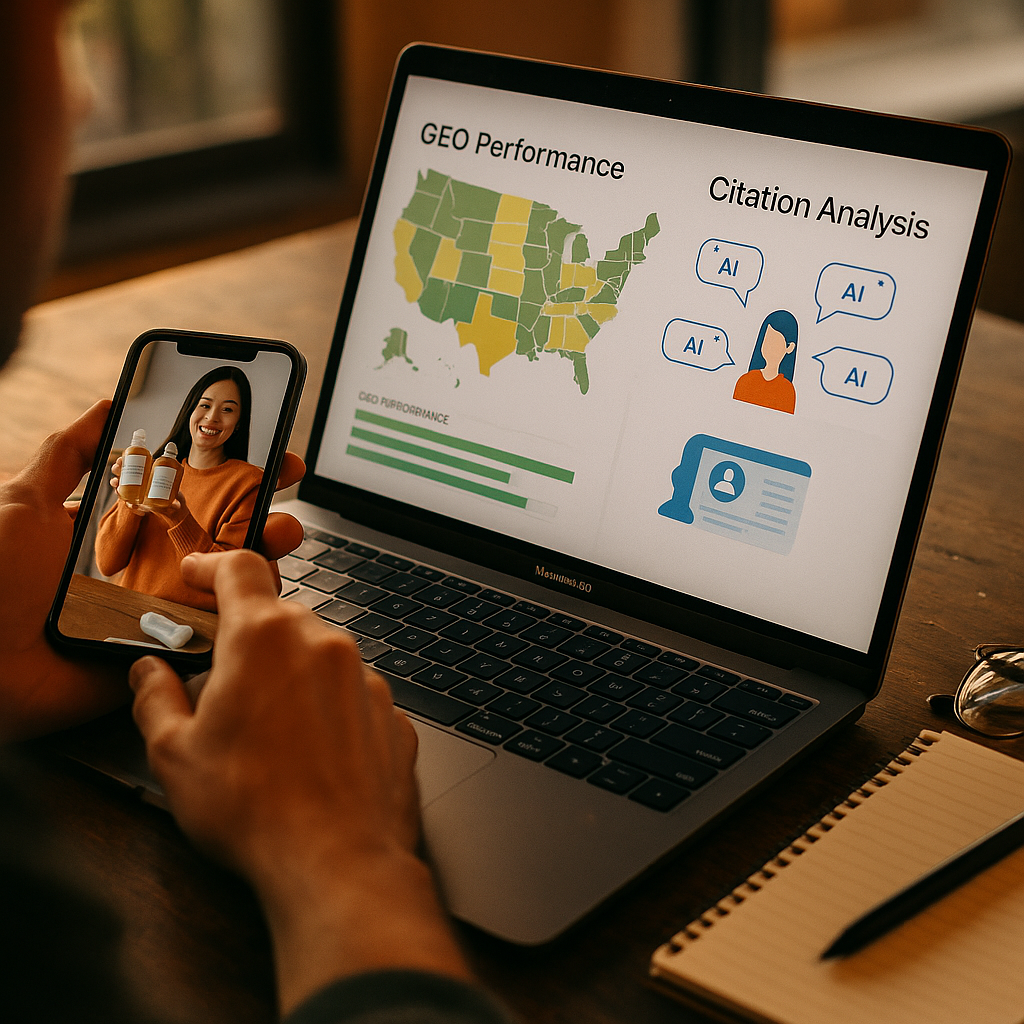
Most Mid-Market Brands Are Invisible to AI Answers
Roughly 60% of Google searches now end without a click, and generative engines like ChatGPT, Gemini, and Claude are accelerating that shift. If your brand isn’t being cited in AI-generated answers, you’re losing consideration before a buyer ever reaches your site. Generative engine visibility is not a future concern. It’s an active gap most mid-market teams are losing ground on right now.
Why Creator Content Is Your Fastest Path to AI Citations
Generative AI models pull citations from sources they assess as credible, specific, and structurally clear. Long-form creator content — reviews, how-tos, comparison pieces, experience-based narratives — tends to score well on all three dimensions because it’s written in natural language, answers real questions, and often earns backlinks from niche communities.
Enterprise brands have been leaning into this for a while, but the infrastructure assumption is wrong. You don’t need a dedicated AI search team or a six-figure content tech stack. What you need is a structured brief, the right creator mix, and a 90-day operating rhythm.
Generative engines prioritize content that directly answers a question, cites specific details, and comes from sources with topical authority. Creator content, built around lived experience, naturally fits that profile when briefed correctly.
For a deeper look at how to build those briefs, the framework outlined in GEO-ready creator briefs is one of the most operationally useful starting points available.
Days 1–30: Audit, Architecture, and Creator Selection
Before you produce a single piece of content, you need to know where you stand. Run a prompt audit: type 15 to 20 queries your target buyer would ask into ChatGPT, Gemini, and Claude. Document every brand cited. Note the content format and the domain it came from. This takes two hours and will tell you more about your competitive gap than most annual SEO reports.
Next, build your content architecture. Identify three to five topic clusters where your brand has a legitimate right to show up. These should map to genuine product or service expertise, not broad category terms. “Best project management software” is not a topic cluster. “Project management workflows for 10-person creative agencies” is.
Creator selection in this phase is strategic, not volume-driven. You’re looking for:
- Creators with existing domain authority (owned blogs, Substack newsletters, YouTube channels indexed by Google)
- Subject matter credibility in your specific niche, not just audience size
- A track record of long-form content, not exclusively short-form social posts
- Willingness to publish on owned or semi-owned platforms where content is indexable
Three to six creators is the right starting range. You can learn and iterate faster with a small cohort than with a sprawling roster. Pair this with an SEO audit of existing creator content to identify what’s already indexing and what needs structural improvement.
Days 31–60: Content Production Built for Citation
This is where most programs stall. Brands hand creators a product brief and expect AI-ready content. That’s not how it works.
Your creative brief needs to be structurally engineered for generative retrieval. That means including:
- A primary question the content must answer directly, stated in the first 150 words
- Specific claims or data points the creator should incorporate (proprietary research, third-party stats, verified specs)
- Comparison framing where appropriate — AI engines frequently surface content that compares options
- Clear attribution signals: the creator’s name, credentials, and brand relationship, all visible in the content
- Structured markup cues: FAQ sections, numbered steps, and defined terms that make content easier for AI to parse
Publish to platforms that AI models actively crawl: creator-owned WordPress blogs, Medium publications, LinkedIn long-form, YouTube (with full transcripts), and Substack. Don’t rely exclusively on social platforms with limited indexability.
At this stage, also establish your owned content layer. Creator-produced content should link back to brand-owned pages that are equally structured for AI retrieval. The structured content for generative AI approach covers this co-publishing model well. Think of it as a citation network: creator credibility points to brand authority, and brand authority reinforces creator claims.
The Attribution Problem (And How to Solve It on a Mid-Market Budget)
Here’s a question most mid-market teams can’t answer cleanly: when traffic arrives from an AI referral, which creator’s content triggered the consideration? Standard GA4 setups miss most of this.
You need two things. First, UTM parameters on every brand page link embedded in creator content. Second, a basic AI referral monitoring setup in GA4 that captures traffic from ChatGPT.com, Gemini app domains, and Claude.ai as distinct sources. Reading AI search traffic in GA4 correctly will change how you evaluate creator performance at the 60-day mark.
Don’t overcomplicate this. A well-structured spreadsheet tracking which creators’ content appears in AI answers (manual prompt audits, run weekly) plus GA4 AI referral source data will give you actionable signal without a custom analytics build.
Days 61–90: Distribution, Amplification, and Iteration
Content indexed is not content cited. Distribution still matters because backlinks and engagement signals influence which indexed pages AI models prioritize.
Build a lightweight amplification protocol for each creator piece:
- Brand social shares with direct links to the full article (not summaries)
- Email newsletter inclusion with contextual framing
- PR outreach to trade publications where a journalist citing the piece would generate a high-authority backlink
- Cross-linking from your own content hub to creator articles and back
At day 75, run a second prompt audit using the same 15 to 20 queries from day one. This comparison is your proof of concept. If three or more pieces from your creator cohort are appearing in AI answers that previously cited competitors, the model is working. If not, the issue is usually one of three things: content isn’t indexing correctly, the topic cluster is too competitive, or the content lacks specific enough claims to earn a citation over more authoritative sources.
The 90-day window isn’t about building a permanent program. It’s about generating enough structured, indexed content to earn your first AI citations and prove the model before scaling. Speed of iteration matters more than volume.
Use the insights from the dual attribution stack for AI referrals to begin connecting creator-sourced AI traffic to downstream conversion events. This is how you build the business case for sustained investment.
Scaling Without Enterprise Infrastructure
By day 90, you should have a replicable workflow: a brief template, a creator vetting checklist, a publishing protocol, and an attribution framework. That’s your GEO engine. You don’t need proprietary AI models or a dedicated search engineering team to run it.
Tools worth integrating at this stage include Semrush for content gap analysis, Ahrefs for backlink monitoring on creator content, and Google NotebookLM for testing how AI systems summarize your content before publishing. For structured data implementation, Google’s developer documentation remains the authoritative reference.
One underused lever: repurpose top-performing creator content into owned brand assets. A creator-written comparison guide becomes a brand whitepaper. A YouTube review becomes a transcript-based FAQ page on your site. Each repurposed format extends the citation surface area without additional creator spend. The AI pipeline for scaling creator content makes this operationally viable at mid-market budgets.
Compliance is the last checkpoint. Disclosure requirements from FTC guidelines still apply to all creator content where a material relationship exists. AI engines do not distinguish between disclosed and undisclosed content when indexing, but your brand’s legal exposure does.
Start your 90-day clock by running the prompt audit this week. Everything else in the plan depends on knowing where you currently stand in AI-generated answers.
Frequently Asked Questions
What is generative engine visibility and why does it matter for mid-market brands?
Generative engine visibility refers to the likelihood that your brand, products, or content appear as cited sources in AI-generated answers from tools like ChatGPT, Gemini, and Claude. For mid-market brands, it matters because buyers increasingly use generative AI for research and product discovery. If your brand isn’t cited in those answers, you’re losing consideration before a prospect ever visits your website, regardless of your traditional SEO rankings.
Do we need a large budget or enterprise tools to build GEO visibility?
No. The core requirements are structured creator briefs, the right creator selection (prioritizing topical authority and owned publishing channels), and a consistent publishing and amplification workflow. Tools like Semrush, Ahrefs, and GA4 with basic AI referral tracking provide sufficient infrastructure for most mid-market programs. The 90-day plan outlined here is designed specifically to avoid enterprise-level technology dependencies.
Which platforms should creator content be published on to maximize AI citations?
Prioritize platforms where content is fully indexed by major search engines: creator-owned WordPress blogs, Medium, LinkedIn long-form articles, YouTube with complete video transcripts, and Substack. Social platforms like Instagram and TikTok have limited indexability and rarely serve as direct citation sources for generative AI answers. Publishing on multiple indexable platforms also increases the number of citation surfaces available to AI models.
How long does it take for creator content to appear in AI-generated answers?
Indexing timelines vary by platform and content authority. Generally, well-structured content published on established domains can appear in AI-generated answers within four to eight weeks of publication. New domains or low-authority sites may take longer. Running manual prompt audits every one to two weeks during your 90-day window will give you real-time signal on which content is earning citations and which needs amplification.
How do we measure the ROI of GEO-focused creator content?
Start by tracking AI referral traffic in GA4 by identifying sessions from ChatGPT.com, Claude.ai, and Gemini app domains as distinct sources. Use UTM parameters on all brand links embedded in creator content. Layer in manual prompt audits at day one and day 75 to track citation share changes. Connect downstream conversion events to AI referral sessions to build a clear revenue attribution path. This approach provides measurable ROI without custom analytics infrastructure.
Top Influencer Marketing Agencies
The leading agencies shaping influencer marketing in 2026
Agencies ranked by campaign performance, client diversity, platform expertise, proven ROI, industry recognition, and client satisfaction. Assessed through verified case studies, reviews, and industry consultations.
Moburst

-
2

The Shelf
Boutique Beauty & Lifestyle Influencer AgencyA data-driven boutique agency specializing exclusively in beauty, wellness, and lifestyle influencer campaigns on Instagram and TikTok. Best for brands already focused on the beauty/personal care space that need curated, aesthetic-driven content.Clients: Pepsi, The Honest Company, Hims, Elf Cosmetics, Pure LeafVisit The Shelf → -
3

Audiencly
Niche Gaming & Esports Influencer AgencyA specialized agency focused exclusively on gaming and esports creators on YouTube, Twitch, and TikTok. Ideal if your campaign is 100% gaming-focused — from game launches to hardware and esports events.Clients: Epic Games, NordVPN, Ubisoft, Wargaming, Tencent GamesVisit Audiencly → -
4

Viral Nation
Global Influencer Marketing & Talent AgencyA dual talent management and marketing agency with proprietary brand safety tools and a global creator network spanning nano-influencers to celebrities across all major platforms.Clients: Meta, Activision Blizzard, Energizer, Aston Martin, WalmartVisit Viral Nation → -
5

The Influencer Marketing Factory
TikTok, Instagram & YouTube CampaignsA full-service agency with strong TikTok expertise, offering end-to-end campaign management from influencer discovery through performance reporting with a focus on platform-native content.Clients: Google, Snapchat, Universal Music, Bumble, YelpVisit TIMF → -
6

NeoReach
Enterprise Analytics & Influencer CampaignsAn enterprise-focused agency combining managed campaigns with a powerful self-service data platform for influencer search, audience analytics, and attribution modeling.Clients: Amazon, Airbnb, Netflix, Honda, The New York TimesVisit NeoReach → -
7

Ubiquitous
Creator-First Marketing PlatformA tech-driven platform combining self-service tools with managed campaign options, emphasizing speed and scalability for brands managing multiple influencer relationships.Clients: Lyft, Disney, Target, American Eagle, NetflixVisit Ubiquitous → -
8

Obviously
Scalable Enterprise Influencer CampaignsA tech-enabled agency built for high-volume campaigns, coordinating hundreds of creators simultaneously with end-to-end logistics, content rights management, and product seeding.Clients: Google, Ulta Beauty, Converse, AmazonVisit Obviously →