


If AI Is Running Your Creator Program, Who’s Actually Responsible?
Nearly 60% of enterprise marketing teams now use AI tools for at least one stage of creator program management, according to data from Sprout Social. Yet fewer than one in five of those teams has a documented org chart that assigns human accountability for AI-driven decisions. That gap is not a technology problem. It’s a governance problem.
The AI-native creator program org chart isn’t about headcount reduction. It’s about redesigning accountability so that speed and scale don’t come at the expense of brand safety, creator relationships, and legal exposure.
What AI Actually Owns Now
Let’s be precise about what modern AI tools handle well, because the org design follows from the task map.
Discovery is largely solved. Platforms like Grin, Creator.co, and Sprinklr’s influencer module can ingest millions of creator profiles, score them against audience quality metrics, brand safety signals, and historical performance benchmarks, and return a shortlist in minutes. Outreach sequencing, including personalized first-contact messages, follow-up cadences, and rate negotiation parameters, is increasingly handled by agentic workflows. Contract generation using standardized templates with variable fields for usage rights, exclusivity windows, and revision limits is now table-stakes functionality in tools like Creator.co and AspireIQ.
Distribution scheduling, content amplification triggers, and performance reporting close the loop on the operational side. For a creator onboarding framework running hundreds of activations quarterly, this automation is not optional. It’s the only way the math works.
AI can optimize for the variables you define. It cannot tell you which variables matter to your brand, your legal team, or the creator sitting across from you in a relationship that has compounded over three years.
So the org chart question becomes: when AI is executing, who is thinking?
The Four Roles Your Org Chart Must Define
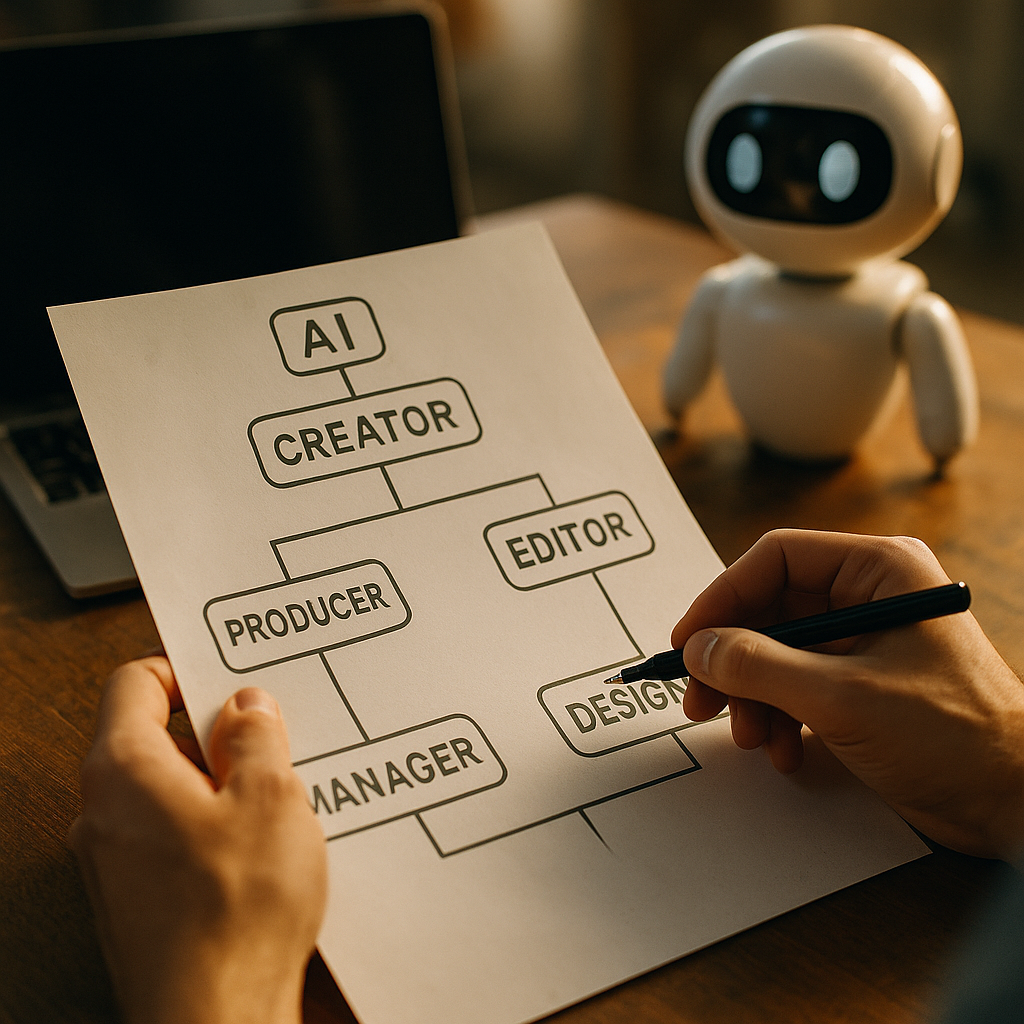
Most brands currently distribute AI oversight responsibilities informally, which means nobody truly owns them. Here’s the structure that actually works.
1. AI Program Strategist (owns the decision logic)
This is the person who sets the parameters AI operates within. What audience overlap thresholds disqualify a creator? What engagement rate floor applies to Tier 2 activations? What brand safety categories trigger automatic rejection versus human review? This role isn’t a technologist. It’s a senior marketer who understands both the brand’s risk tolerance and the performance economics of the program. They work upstream of every AI workflow and are responsible for auditing whether AI decisions are producing the right outcomes over time. If your agentic campaign governance model doesn’t have this role filled by name, you have a gap.
2. Creator Relationship Lead (owns the human layer)
AI discovered the creator. AI sent the first email. AI generated the contract. And now a human being who has been in the industry for a decade needs to take the call, because the top 5% of your creator roster will never fully commit to a brand that treats them like a transaction. This role is not coordinator-level work. It requires judgment, taste, and the ability to read what a creator actually needs to produce their best work for your brand.
3. Compliance and Risk Officer (owns the override authority)
Every AI-native program needs a designated person with actual authority to stop a workflow. Not the ability to flag something for committee review. The authority to halt an outreach sequence, pull a contract, or pause a distribution run. FTC disclosure regulations and emerging data protection requirements mean that AI errors in the contracting or outreach stages carry real legal consequences. Someone needs to own that exposure by name, not by org chart proximity.
4. Performance Intelligence Analyst (owns the learning loop)
AI optimizes toward the metrics it’s given. This role is responsible for questioning whether those metrics are the right ones. They feed insights from creator KPI performance back into the AI’s parameter set, ensuring the system improves rather than calcifies around early assumptions. They also translate program performance into the language finance leadership needs, connecting to the broader work of making the ROI case when budgets come under scrutiny.
Reporting Lines: Centralized vs. Embedded
The structural debate most teams are having right now is whether AI oversight roles sit inside a centralized Center of Excellence or get embedded in individual campaign or channel teams.
The honest answer is: neither model works alone. A centralized AI Program Strategist maintains consistency in decision logic and vendor governance, which is critical when you’re managing enterprise creator program infrastructure across multiple brands or markets. But centralized models slow down when individual campaign teams need fast decisions on creator negotiations or compliance questions.
The hybrid that’s emerging in practice: centralize the AI Program Strategist and Compliance Officer, embed the Creator Relationship Lead and Performance Intelligence Analyst within campaign teams. This lets you maintain governance consistency while keeping execution agility. The reporting line for embedded roles runs to both the campaign lead (day-to-day) and the centralized function (standards and escalations).
Escalation protocols need to be written down. If an AI outreach sequence generates a response from a creator who wants to negotiate terms outside the standard parameters, who picks up the thread and in what timeframe? If a contract AI flags a potential exclusivity conflict, who adjudicates? These are not edge cases. They happen weekly in active programs.
What Remains Irreplaceably Human
This question gets asked with increasing frequency as AI tooling matures, and the answer is more specific than most people expect.
AI cannot evaluate cultural fit. It can score audience demographics and brand safety signals, but it cannot tell you whether a creator’s voice will feel authentic to your category or whether their audience will receive a brand integration with genuine enthusiasm versus visible skepticism. That requires a human with category knowledge and platform intuition.
AI cannot manage a relationship in distress. When a creator misses a deadline, publishes something off-brief, or goes through a personal crisis that affects their deliverables, the response cannot be algorithmic. How you handle those moments defines your reputation in the creator economy for years.
AI cannot exercise editorial judgment on brand voice risk. The brand safety filters AI uses are probabilistic and backward-looking. They’ll catch creators who’ve been flagged before. They won’t catch the creator who’s about to become a controversy. That requires someone with their finger on the cultural pulse. For teams thinking seriously about brand voice risk at scale, this is the oversight gap that causes the most expensive failures.
And AI cannot make the strategic call about which creator relationships deserve investment beyond transactional activations. Building a genuine creative partnership with a creator who grows with your brand over three years generates compounding returns that no single activation ROI metric captures.
The brands that will lead in AI-native creator programs are not the ones that automate the most. They’re the ones that automate the right things and protect human judgment where it actually creates competitive advantage.
Building the Audit Trail Into the Org Chart
One structural requirement that gets overlooked: every AI decision in the creator workflow needs a human-readable audit trail, and someone needs to own the review of that trail on a regular cadence.
When an AI system rejects a creator during discovery, that decision should be logged with the scoring rationale. When an outreach sequence sends a rate offer, the parameters that generated that offer should be retrievable. When a contract is auto-generated, the version of the template and the variable inputs should be documented. This isn’t bureaucratic overhead. It’s what lets your Compliance Officer investigate a dispute, lets your AI Program Strategist recalibrate decision logic, and lets your legal team respond to a creator who claims the process was unfair.
For teams moving toward more autonomous AI systems, governance overrides and audit trail design deserve dedicated process investment. It’s also what your CMO needs to defend the program’s decisions upward, especially as agentic marketing adoption accelerates across the organization.
Assign audit review to the Performance Intelligence Analyst on a monthly cadence and the Compliance Officer on a quarterly cadence. Give both roles standing access to the AI platform’s decision logs, not just the output reports. That distinction matters more than it sounds.
The practical next step: map every stage of your current creator workflow against these four roles, identify which stages have no named human owner, and fill those gaps before you expand AI automation further. Automation without accountability scales your risk as fast as it scales your reach.
Frequently Asked Questions
What is an AI-native creator program org chart?
An AI-native creator program org chart defines the human roles, reporting relationships, and oversight responsibilities within a brand team that uses AI to automate core functions like creator discovery, outreach, contracting, and content distribution. It clarifies who owns AI decision logic, who manages creator relationships, who holds override authority, and who ensures performance data feeds back into system improvement.
Which creator program tasks should remain human-owned even with AI automation?
Cultural fit evaluation, relationship management in high-stakes or distressed situations, brand voice and editorial judgment, and strategic decisions about long-term creator partnerships should remain under direct human ownership. AI tools are not equipped to assess nuanced cultural signals, manage interpersonal dynamics, or make forward-looking brand risk calls with the context that experienced marketers bring.
How should escalation authority be structured in an AI-native creator program?
A designated Compliance and Risk Officer should hold named authority to halt AI-driven workflows at any stage, including outreach sequences, contract generation, and distribution triggers. Escalation protocols should be documented and specify response timeframes. Embedded campaign team members should have a clear escalation path to centralized governance roles rather than resolving compliance questions ad hoc.
How does AI creator program governance affect legal and compliance exposure?
AI-driven outreach and contracting can create legal exposure if disclosure requirements, exclusivity conflicts, or data handling errors go undetected. FTC regulations require accurate disclosure of material connections regardless of whether AI or humans initiated the outreach. Brands need documented audit trails for all AI decisions and a named compliance owner who can investigate disputes and produce records if challenged.
Should AI oversight roles be centralized or embedded in campaign teams?
A hybrid model works best for most enterprise programs. The AI Program Strategist and Compliance Officer should sit in a centralized function to ensure governance consistency across campaigns and markets. Creator Relationship Leads and Performance Intelligence Analysts are more effective when embedded in individual campaign teams, with reporting lines that connect back to the centralized governance function for standards and escalation.
Top Influencer Marketing Agencies
The leading agencies shaping influencer marketing in 2026
Agencies ranked by campaign performance, client diversity, platform expertise, proven ROI, industry recognition, and client satisfaction. Assessed through verified case studies, reviews, and industry consultations.
Moburst

-
2

The Shelf
Boutique Beauty & Lifestyle Influencer AgencyA data-driven boutique agency specializing exclusively in beauty, wellness, and lifestyle influencer campaigns on Instagram and TikTok. Best for brands already focused on the beauty/personal care space that need curated, aesthetic-driven content.Clients: Pepsi, The Honest Company, Hims, Elf Cosmetics, Pure LeafVisit The Shelf → -
3

Audiencly
Niche Gaming & Esports Influencer AgencyA specialized agency focused exclusively on gaming and esports creators on YouTube, Twitch, and TikTok. Ideal if your campaign is 100% gaming-focused — from game launches to hardware and esports events.Clients: Epic Games, NordVPN, Ubisoft, Wargaming, Tencent GamesVisit Audiencly → -
4

Viral Nation
Global Influencer Marketing & Talent AgencyA dual talent management and marketing agency with proprietary brand safety tools and a global creator network spanning nano-influencers to celebrities across all major platforms.Clients: Meta, Activision Blizzard, Energizer, Aston Martin, WalmartVisit Viral Nation → -
5

The Influencer Marketing Factory
TikTok, Instagram & YouTube CampaignsA full-service agency with strong TikTok expertise, offering end-to-end campaign management from influencer discovery through performance reporting with a focus on platform-native content.Clients: Google, Snapchat, Universal Music, Bumble, YelpVisit TIMF → -
6

NeoReach
Enterprise Analytics & Influencer CampaignsAn enterprise-focused agency combining managed campaigns with a powerful self-service data platform for influencer search, audience analytics, and attribution modeling.Clients: Amazon, Airbnb, Netflix, Honda, The New York TimesVisit NeoReach → -
7

Ubiquitous
Creator-First Marketing PlatformA tech-driven platform combining self-service tools with managed campaign options, emphasizing speed and scalability for brands managing multiple influencer relationships.Clients: Lyft, Disney, Target, American Eagle, NetflixVisit Ubiquitous → -
8

Obviously
Scalable Enterprise Influencer CampaignsA tech-enabled agency built for high-volume campaigns, coordinating hundreds of creators simultaneously with end-to-end logistics, content rights management, and product seeding.Clients: Google, Ulta Beauty, Converse, AmazonVisit Obviously →