


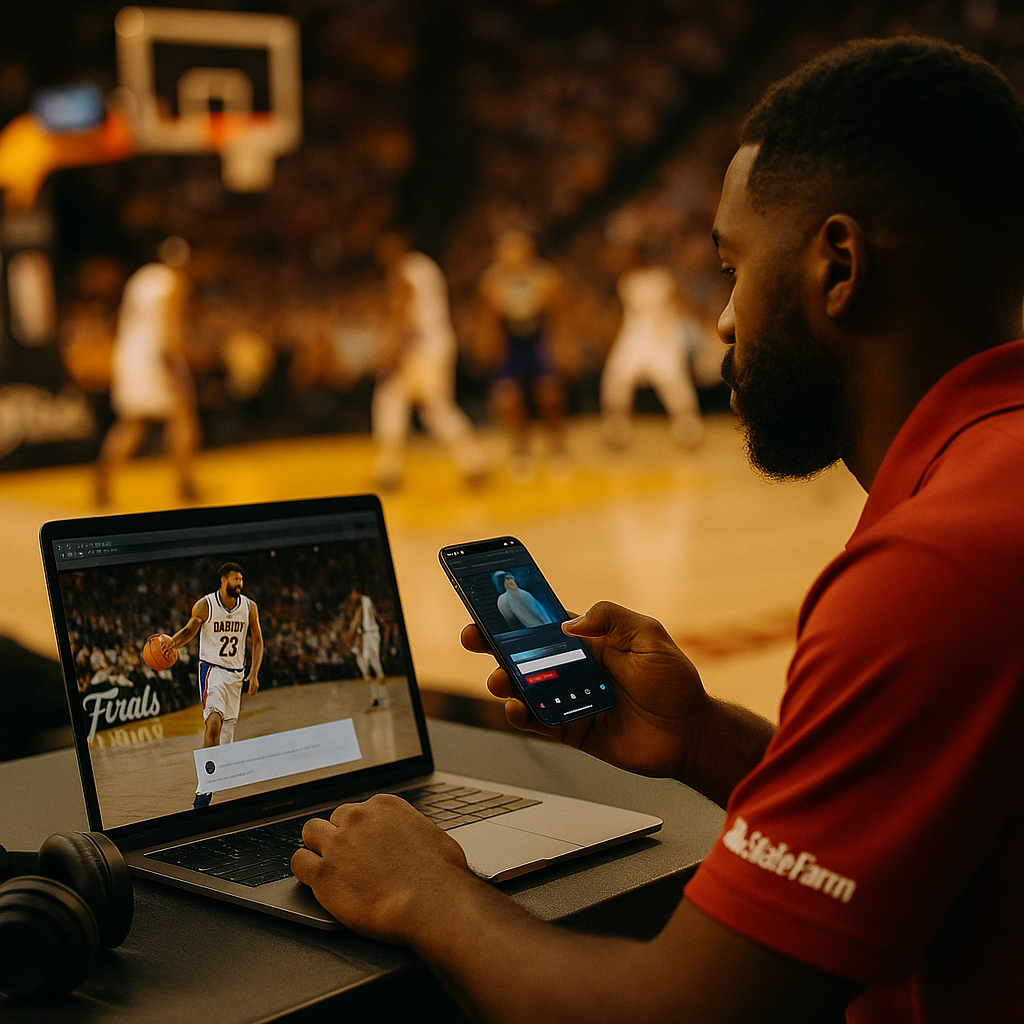
During the NBA Finals, State Farm published brand-relevant social content within minutes of key game moments. Not hours. Minutes. That operational capability is what separates brands running genuine generative AI for real-time social content from those still routing every asset through a four-person approval chain.
Why Live Events Are the Hardest Test for AI-Speed Creative
Live sports are unscripted. That’s the entire point for audiences, and the entire problem for brand marketers. You can pre-produce content for a product launch. You cannot pre-produce a reaction to a buzzer-beater. The content window for a major game moment is roughly 8-12 minutes before social conversation moves on, according to engagement timing data from Sprout Social. Traditional creative workflows, which average 48-72 hours from brief to publish, are structurally incompatible with that window.
State Farm’s approach during the NBA Finals was notable not because they used AI, but because they used it systematically. The brand had pre-built creative templates, a real-time trigger layer tied to game data, and a human review step compressed to under three minutes. That’s an operational architecture, not a prompt experiment.
The brands winning at live-event content aren’t faster creatives — they’re better infrastructure builders. The AI is just the production layer on top of a pre-approved system.
The Three-Layer Infrastructure Behind Real-Time AI Deployment
Breaking down what State Farm (and brands replicating this model) actually built reveals three distinct infrastructure layers.
Layer 1: Pre-approved creative architecture. Before the event starts, the brand defines a constrained creative system. Approved color palettes, lockup rules, copy tone parameters, and a library of modular visual assets. The generative AI (in most enterprise deployments, this is a combination of tools like Adobe Firefly for visuals and a fine-tuned LLM for copy) operates inside that constraint set, not as a blank canvas. This is what keeps output on-brand without requiring a full creative review every time.
Layer 2: Real-time data triggers. Game state data (score changes, player milestones, officiating calls) flows through an API integration into the content generation layer. The system knows when a trigger condition is met and initiates asset generation automatically. Some brands pipe this through platforms like Salesforce Marketing Cloud or Adobe Experience Platform for CRM-connected personalization.
Layer 3: Compressed human review. This is non-negotiable. Every brand running live AI content successfully has a human in the loop, just a faster one. State Farm’s model reportedly compressed legal and brand review to a single approver with a mobile interface, reviewing AI-generated options against a checklist rather than building from scratch. The approver selects, modifies marginally, or rejects — not writes.
For brands considering replicating this model, the real-time brand influence stack framework is a useful starting point for mapping these layers against your existing martech.
Brand Safety Is Not an Afterthought — It’s an Input
The risk surface during live events is significant. Athlete controversies, unexpected game outcomes, crowd incidents, or geopolitical context can make a pre-planned content angle tone-deaf within seconds. This is where AI-speed deployment goes wrong publicly and why most brand marketers are rightly cautious.
The protocols that work aren’t reactive filters applied after generation. They’re constraint inputs applied before generation. Specifically:
- Exclusion libraries: Lists of topics, phrases, player names under legal review, and competitor references that the system is hard-blocked from including
- Sentiment guardrails: Copy tone parameters that prevent the system from generating content that could read as mocking, partisan, or culturally insensitive
- Context monitoring feeds: Real-time brand safety tools (many brands use Integral Ad Science or DoubleVerify’s monitoring APIs) that flag if broader social sentiment shifts in a way that would make content inappropriate
- Kill switches: A single command that pauses all AI content generation instantly, bypassing the normal workflow
For a deeper look at how governance structures support these protocols at scale, the guide on AI campaign automation and brand safety covers the governance frameworks worth adapting.
The FTC’s disclosure requirements don’t pause for live events either. FTC guidance on AI-generated content and material connections applies regardless of how quickly content is produced. Brands need disclosure language baked into templates, not added manually after the fact.
Performance Benchmarks: What “Good” Actually Looks Like
Speed is measurable. But speed without performance data is just a vanity metric. What benchmarks should brands be targeting if they invest in this infrastructure?
Based on publicly reported campaigns and platform data from eMarketer and comparable live-event programs:
- Time to publish: Sub-15 minutes from trigger event to live post is the operational threshold. Brands hitting under 8 minutes see meaningfully higher organic reach because they’re surfacing in real-time search and trending feeds
- Engagement rate lift: Real-time contextual content during live events consistently outperforms scheduled brand content by 3-5x on engagement rate, according to platform-reported benchmarks
- Brand safety incident rate: Top-performing programs report near-zero brand safety incidents because of constraint-based generation, versus reactive moderation approaches
- Human review cycle time: Best-in-class is under 3 minutes per asset, achieved through checklist-based approvals rather than creative judgment calls
Speed-to-publish alone is not the right KPI. Brands should be tracking campaign speed-to-activation as a composite metric that includes approval cycle time, platform upload time, and audience reach within the first 30 minutes of posting.
The Org Design Question Nobody Asks Until It’s Too Late
Who owns live AI content? In most brand organizations, this falls into a gap between social, legal, brand creative, and marketing technology. State Farm’s reported model had a dedicated “game day” team with pre-assigned roles: one AI operator, one brand approver, one legal clearance contact on standby. That’s a small team running a high-stakes operation, which only works because the guardrails are built in advance.
The CMO-level skill gap here is real. Many marketing leaders understand conceptually that AI can accelerate content production but have not mapped the org implications of running a live production infrastructure. AI marketing fluency for CMOs addresses exactly this gap, particularly around building cross-functional AI workflows.
There’s also a vendor dependency question. Brands relying on a single generative AI platform for live content have a single point of failure. Redundancy planning for live events means having a fallback content queue (pre-approved static posts) if the AI pipeline fails. This sounds obvious. It is routinely overlooked.
If your AI content pipeline doesn’t have a documented failure protocol, you don’t have a pipeline — you have a demo that hasn’t broken yet.
What This Means for Brands Without State Farm’s Budget
Enterprise-scale live AI content infrastructure is not cheap to build. But the principles are replicable at smaller scales. A mid-market brand sponsoring a regional sports property or a major concert series can implement a version of this model using existing tools like HubSpot’s content workflows combined with off-the-shelf generative tools, a constrained template library, and a single trained approver.
The investment required isn’t primarily budget. It’s process design time. Building the exclusion libraries, defining the creative constraints, and running tabletop exercises before the live event are the unglamorous work that separates brands that execute well from those that publish something embarrassing at 9:47 PM during Game 5.
Attribution matters here too. Brands running real-time social content need to connect engagement spikes to downstream outcomes, not just celebrate reach numbers. Combining live content data with AI identity resolution methods gives you a cleaner read on which moments actually drove brand lift versus which ones just went briefly viral.
For video-first brands, the tooling landscape has matured significantly. Agentic AI for real-time video optimization is now practical at mid-market scale, not just for platform-native placements but for Stories, Reels, and live-adjacent short-form content. Platform capabilities from Meta for Business increasingly support real-time creative variant testing that pairs well with this kind of infrastructure.
The concrete next step: Before your next major live event sponsorship, run a pre-mortem on your content pipeline. Map every approval step, identify where the constraint inputs live, and assign a single owner to the kill switch. If you can’t complete that exercise in under two hours, you’re not ready to deploy at AI speed.
FAQs
What is generative AI for real-time social content?
Generative AI for real-time social content refers to using AI systems, typically large language models for copy and diffusion models for visuals, to automatically produce brand-relevant social posts in response to live event triggers. Rather than a human team drafting and designing each post, the AI generates options within pre-approved creative constraints, which a human approver reviews and publishes in minutes.
How did State Farm use AI during the NBA Finals?
State Farm deployed a real-time content infrastructure during the NBA Finals that combined game-state data triggers, pre-approved creative templates, and a compressed human review process. When key game moments occurred, the system generated on-brand social content automatically, with a designated approver reviewing and publishing assets in under three minutes. This allowed the brand to publish contextually relevant content within the engagement window of each major moment.
What brand safety protocols are required for live AI content?
Effective brand safety for live AI content requires exclusion libraries (blocked topics and phrases), sentiment guardrails built into generation parameters, real-time context monitoring feeds, and a kill switch that halts all AI content generation immediately. Safety protocols must be inputs to the generation process, not filters applied afterward, to prevent problematic content from being created in the first place.
What performance benchmarks should brands target for real-time AI social content?
Brands should target sub-15-minute time-to-publish from trigger event to live post, with sub-8-minutes being best-in-class for maximum organic reach. Real-time contextual content typically outperforms scheduled brand content by 3-5x on engagement rate. Human review cycle time should be under 3 minutes per asset, achieved through checklist-based approvals. Brand safety incident rates should be near-zero when constraint-based generation is properly implemented.
Do FTC disclosure rules apply to AI-generated live event content?
Yes. FTC disclosure requirements for AI-generated content and material connections apply regardless of how quickly content is produced. Brands must build disclosure language directly into content templates so it is included automatically, rather than relying on manual additions during a fast-paced live event workflow.
Can smaller brands replicate State Farm’s live AI content model?
Yes, at a scaled-down version. Mid-market brands can implement the core principles using existing tools like HubSpot workflows combined with off-the-shelf generative AI tools, a constrained template library, and a single trained approver. The primary investment required is process design time: building exclusion libraries, defining creative constraints, and running practice exercises before the live event.
Top Influencer Marketing Agencies
The leading agencies shaping influencer marketing in 2026
Agencies ranked by campaign performance, client diversity, platform expertise, proven ROI, industry recognition, and client satisfaction. Assessed through verified case studies, reviews, and industry consultations.
Moburst

-
2

The Shelf
Boutique Beauty & Lifestyle Influencer AgencyA data-driven boutique agency specializing exclusively in beauty, wellness, and lifestyle influencer campaigns on Instagram and TikTok. Best for brands already focused on the beauty/personal care space that need curated, aesthetic-driven content.Clients: Pepsi, The Honest Company, Hims, Elf Cosmetics, Pure LeafVisit The Shelf → -
3

Audiencly
Niche Gaming & Esports Influencer AgencyA specialized agency focused exclusively on gaming and esports creators on YouTube, Twitch, and TikTok. Ideal if your campaign is 100% gaming-focused — from game launches to hardware and esports events.Clients: Epic Games, NordVPN, Ubisoft, Wargaming, Tencent GamesVisit Audiencly → -
4

Viral Nation
Global Influencer Marketing & Talent AgencyA dual talent management and marketing agency with proprietary brand safety tools and a global creator network spanning nano-influencers to celebrities across all major platforms.Clients: Meta, Activision Blizzard, Energizer, Aston Martin, WalmartVisit Viral Nation → -
5

The Influencer Marketing Factory
TikTok, Instagram & YouTube CampaignsA full-service agency with strong TikTok expertise, offering end-to-end campaign management from influencer discovery through performance reporting with a focus on platform-native content.Clients: Google, Snapchat, Universal Music, Bumble, YelpVisit TIMF → -
6

NeoReach
Enterprise Analytics & Influencer CampaignsAn enterprise-focused agency combining managed campaigns with a powerful self-service data platform for influencer search, audience analytics, and attribution modeling.Clients: Amazon, Airbnb, Netflix, Honda, The New York TimesVisit NeoReach → -
7

Ubiquitous
Creator-First Marketing PlatformA tech-driven platform combining self-service tools with managed campaign options, emphasizing speed and scalability for brands managing multiple influencer relationships.Clients: Lyft, Disney, Target, American Eagle, NetflixVisit Ubiquitous → -
8

Obviously
Scalable Enterprise Influencer CampaignsA tech-enabled agency built for high-volume campaigns, coordinating hundreds of creators simultaneously with end-to-end logistics, content rights management, and product seeding.Clients: Google, Ulta Beauty, Converse, AmazonVisit Obviously →