


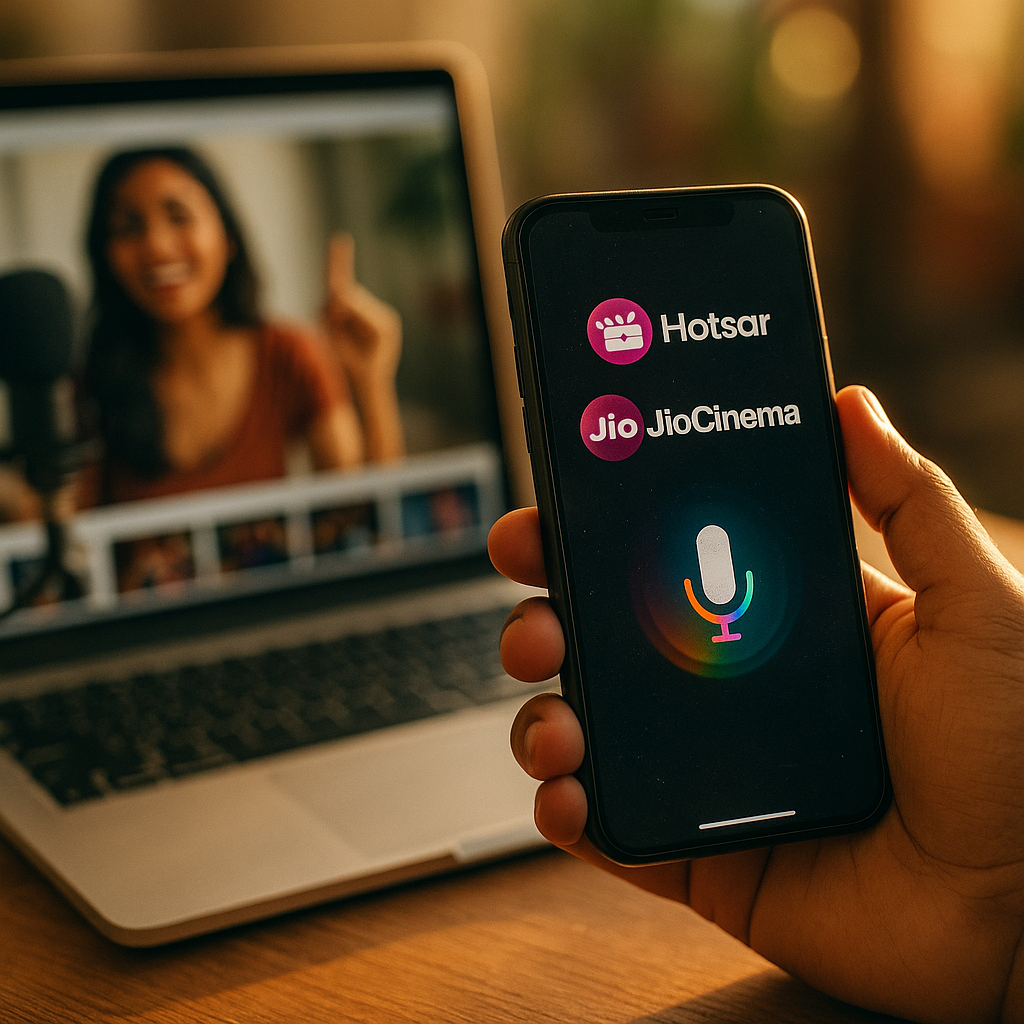
Sixty percent of JioHotstar’s active users discover content through voice commands. If that number doesn’t make you rethink your distribution strategy for creator-led campaigns, you’re not paying attention. Voice-activated content discovery is no longer a UX novelty — it’s a genuine audience behavior shaping how brand campaigns get found, watched, and shared in the world’s largest consumer market.
The Stat Western Marketers Keep Scrolling Past
JioHotstar, the merged streaming entity formed from Disney+ Hotstar and Reliance’s JioCinema, now commands over 500 million registered users across India. That’s not a rounding error — it’s a distribution footprint that dwarfs Netflix and Prime Video combined in any Western market. And within that base, a majority of users are navigating the platform using voice queries rather than typed searches or manual browsing.
This matters for brand strategists for one specific reason: voice-driven content discovery changes the metadata game entirely. When a user says “show me cricket brand videos” or “find me cooking shows with product deals,” the platform’s recommendation engine interprets intent differently than a keyboard search. Keyword stuffing in a show description doesn’t win that race. Contextual relevance, creator authority, and conversational title structures do.
Voice search on streaming platforms favors creator authority and conversational content framing over traditional keyword optimization — a fundamental shift most Western brand teams aren’t briefing into their India distribution playbooks.
Why This Is an India-First Signal, Not an India-Only Story
India moved to voice-first digital behavior faster than Western markets because of a simple infrastructure reality: a large segment of the population came online via affordable smartphones before they developed keyboard-typing habits. Voice input solved a literacy and convenience problem simultaneously. The behavior normalized quickly, and platforms like JioHotstar, YouTube India, and Google Assistant in Hindi and regional languages accelerated adoption.
But the trajectory matters here. What India’s 500 million-user base is doing today is what Southeast Asian markets, parts of Latin America, and even Western working-class mobile users will be doing within the next few years. Earned authority in AI search is already reshaping how brand content gets surfaced in text-based environments. Voice layers another discovery filter on top of that shift.
For brand teams running global influencer programs, India isn’t just a market to localize for. It’s a testing ground for distribution behaviors that will eventually migrate outward.
What Voice-Activated Discovery Actually Changes for Creator Campaigns
Let’s be specific, because the operational implications are real.
When content is discovered through voice, the title, creator name, and content category carry disproportionate weight. On JioHotstar specifically, voice queries are processed in 12 regional Indian languages in addition to English, which means a creator campaign built around Hindi conversational hooks performs differently in voice discovery than one built around English SEO terms. Brands that brief creators with English-language title structures for a Bengali or Marathi-speaking voice user base are essentially invisible in those discovery moments.
The second operational implication is content length and format. Voice users on streaming platforms tend to navigate toward episodic, familiar content rather than one-off brand spots. A branded integration inside an ongoing creator series outperforms a standalone 90-second campaign video in voice-discovery environments because the platform’s recommendation engine already has behavioral data on that series. It knows where to serve it. Brands investing in creator program scale with episodic formats rather than campaign-by-campaign production will have a structural advantage here.
Third: spoken keyword optimization. This isn’t SEO in the traditional sense. It’s about how creators verbally frame brand mentions within content. If a creator says a brand’s name clearly in the first 30 seconds of a video, voice-recognition indexing on platforms like JioHotstar and YouTube picks that up as a content signal. Brands should be briefing creators on verbal brand placement with the same rigor they apply to visual placement guidelines.
The Distribution Arbitrage Most Agencies Are Missing
Here’s the uncomfortable truth for Western-centric agencies running influencer AOR for global brands: most campaign distribution briefs don’t mention voice at all. They optimize for click-through on Instagram, view duration on YouTube, and swipe behavior on TikTok. Voice-activated discovery on streaming platforms like JioHotstar sits in a different activation layer that most agency workflow templates haven’t been built to address.
This creates real arbitrage. Brands that invest now in voice-optimized creator content for JioHotstar’s platform — conversational titles, regional language hooks, episodic formats, verbal brand placement — are competing against almost nobody at the moment. The CPMs are lower, the competition for creator talent in regional Indian markets is thinner, and the audience engagement data from voice-driven discovery tends to show higher intent signals than passive scroll-based consumption.
If you’re evaluating video budget reallocation decisions right now, the case for testing a voice-optimized JioHotstar creator strategy alongside your standard YouTube India budget is genuinely strong. The incremental cost is low. The learning is high.
For context on platform scale: Statista data consistently ranks India as the world’s largest market for digital video consumption by volume. The voice-behavior layer on top of that scale is a distribution multiplier, not a niche edge case.
Building the Brief: Practical Adjustments for Voice-First Creator Content
This doesn’t require rebuilding your entire creator program infrastructure. It requires adding specific voice-first parameters to your existing creator briefs and distribution specs.
- Title structure: Brief creators to use conversational, question-based or intent-based titles. “Best skincare routine for monsoon season” outperforms “Brand X Skincare Review” in voice queries.
- Regional language hooks: For Indian market campaigns, require at least one language variation per major regional audience. Partner with creators who have native fluency, not just translation overlays.
- Verbal brand placement: Add a spoken brand mention requirement in the first 30 seconds to your content spec sheet, alongside visual placement requirements.
- Episodic format preference: Shift budget toward ongoing creator series rather than one-off sponsored posts. This feeds platform recommendation algorithms and voice-discovery engines simultaneously.
- Metadata briefing: Work with the platform or your DSP to ensure content metadata (description, tags, category) reflects natural language phrasing, not just traditional SEO keywords.
Agencies running AI-first creator infrastructure should already have the tooling to automate regional language metadata variations at scale. If your tech stack can’t do this, it’s a capability gap worth addressing before voice-discovery behavior spreads further across markets.
The compliance dimension is also worth flagging. Voice-activated content on streaming platforms that includes brand integrations needs disclosure frameworks that work in audio and visual formats simultaneously. The FTC’s disclosure guidelines have clear positions on spoken disclosures in video content. India’s ASCI (Advertising Standards Council of India) has equivalent requirements that apply to branded creator content on platforms like JioHotstar. Brief your creators accordingly.
The Attribution Challenge — and How to Frame It for Finance
Voice-driven discovery creates an attribution gap that performance marketers will flag immediately. When a user finds your creator campaign through a voice query on JioHotstar and later converts through a different touchpoint, the voice discovery moment is invisible in standard last-click or even multi-touch attribution models.
This isn’t a reason to avoid the channel. It’s a reason to frame it correctly internally. Voice-activated content discovery is an upper-funnel awareness and intent-building mechanism. The right KPIs are branded search volume lift, aided recall in brand surveys, and creator content consumption rate (not click-through). If your finance team needs tighter ROI metrics they can approve, structure the JioHotstar voice-discovery test as an incrementality experiment with a holdout group in a comparable metro market.
Platforms like EMARKETER track digital video engagement metrics across India regularly, and the data on streaming platform engagement rates versus social media video is compelling for brands making the internal business case. Voice-discovery sessions on streaming platforms average longer engagement times than algorithmically served social video — a metric that matters when you’re selling brand consideration, not just impressions.
Voice-driven streaming discovery sessions generate longer average engagement times than socially served video. For brand campaigns where consideration depth matters more than raw reach, that’s a meaningful efficiency gain to surface in your media mix model.
One tool worth evaluating for cross-market voice search behavior analysis: TikTok’s creative center has begun publishing voice search trend data in select markets, which gives brand strategists a proxy signal for the types of conversational queries driving content discovery even outside the JioHotstar ecosystem. Use it to pressure-test your title structures before production.
The creator economy intelligence angle matters here too. As AI mediates more content discovery decisions across streaming and search environments, the brands building voice-optimized creator programs now will have distribution infrastructure that compounds over time. Every episodic creator series that accumulates voice-discovery behavioral data on JioHotstar becomes a stronger recommendation target for the platform’s AI. The early investment pays compound returns.
Start with one regional creator, one episodic format, and one market segment. Brief the voice-first parameters outlined above, run the content for eight to twelve weeks, and measure branded search lift in that cohort. That’s your proof-of-concept data for the larger budget conversation.
Frequently Asked Questions
What is voice-activated content discovery on streaming platforms?
Voice-activated content discovery refers to users navigating and finding content on streaming platforms through spoken queries rather than typed searches or manual browsing. On platforms like JioHotstar, users speak commands or questions into their device, and the platform’s recommendation engine interprets that spoken intent to surface relevant content, including creator-led and branded programming.
Why does JioHotstar’s voice-user base matter for brand campaign strategy?
JioHotstar reports that approximately 60 percent of its active users discover content through voice commands, across a registered base of over 500 million users. This scale means a significant volume of content discovery decisions — including branded creator content — are being made through voice-query interfaces rather than traditional browsing or text search, requiring brands to adapt their content briefing, metadata, and title structures accordingly.
How should brands optimize creator content for voice-first discovery?
Brands should brief creators on conversational, intent-based title structures rather than keyword-heavy titles. They should also require verbal brand mentions in the first 30 seconds of video content, invest in regional language variations for Indian market campaigns, and prioritize episodic creator formats over one-off campaign videos. Metadata descriptions should use natural language phrasing that mirrors how audiences actually speak their queries.
Is voice-activated content discovery only relevant for the Indian market?
No. India’s voice-first streaming behavior is an early and scaled signal of a broader global trend. Similar voice-adoption patterns are emerging in Southeast Asia, parts of Latin America, and among mobile-first audiences in Western markets. Brands that develop voice-optimized creator content strategies in India now are building distribution capabilities that will transfer to other markets as voice-first behavior expands globally.
How do you measure ROI for creator campaigns discovered through voice on streaming platforms?
Voice-driven discovery is primarily an upper-funnel mechanism, so standard last-click or direct conversion attribution won’t capture its impact accurately. Recommended KPIs include branded search volume lift, aided recall in brand surveys, and content consumption rate (watch time per session). Structuring the campaign as an incrementality experiment with a holdout market group is the most defensible method for presenting the results to finance stakeholders.
What compliance requirements apply to branded creator content on JioHotstar?
In India, the Advertising Standards Council of India (ASCI) has disclosure requirements for branded and sponsored creator content, including on streaming platforms like JioHotstar. Disclosures must be visible and, for video content with voice components, audible. Western brands running campaigns in this market should also ensure their disclosures satisfy both ASCI guidelines and any home-market regulatory requirements from bodies like the FTC for U.S.-based brands.
Top Influencer Marketing Agencies
The leading agencies shaping influencer marketing in 2026
Agencies ranked by campaign performance, client diversity, platform expertise, proven ROI, industry recognition, and client satisfaction. Assessed through verified case studies, reviews, and industry consultations.
Moburst

-
2

The Shelf
Boutique Beauty & Lifestyle Influencer AgencyA data-driven boutique agency specializing exclusively in beauty, wellness, and lifestyle influencer campaigns on Instagram and TikTok. Best for brands already focused on the beauty/personal care space that need curated, aesthetic-driven content.Clients: Pepsi, The Honest Company, Hims, Elf Cosmetics, Pure LeafVisit The Shelf → -
3

Audiencly
Niche Gaming & Esports Influencer AgencyA specialized agency focused exclusively on gaming and esports creators on YouTube, Twitch, and TikTok. Ideal if your campaign is 100% gaming-focused — from game launches to hardware and esports events.Clients: Epic Games, NordVPN, Ubisoft, Wargaming, Tencent GamesVisit Audiencly → -
4

Viral Nation
Global Influencer Marketing & Talent AgencyA dual talent management and marketing agency with proprietary brand safety tools and a global creator network spanning nano-influencers to celebrities across all major platforms.Clients: Meta, Activision Blizzard, Energizer, Aston Martin, WalmartVisit Viral Nation → -
5

The Influencer Marketing Factory
TikTok, Instagram & YouTube CampaignsA full-service agency with strong TikTok expertise, offering end-to-end campaign management from influencer discovery through performance reporting with a focus on platform-native content.Clients: Google, Snapchat, Universal Music, Bumble, YelpVisit TIMF → -
6

NeoReach
Enterprise Analytics & Influencer CampaignsAn enterprise-focused agency combining managed campaigns with a powerful self-service data platform for influencer search, audience analytics, and attribution modeling.Clients: Amazon, Airbnb, Netflix, Honda, The New York TimesVisit NeoReach → -
7

Ubiquitous
Creator-First Marketing PlatformA tech-driven platform combining self-service tools with managed campaign options, emphasizing speed and scalability for brands managing multiple influencer relationships.Clients: Lyft, Disney, Target, American Eagle, NetflixVisit Ubiquitous → -
8

Obviously
Scalable Enterprise Influencer CampaignsA tech-enabled agency built for high-volume campaigns, coordinating hundreds of creators simultaneously with end-to-end logistics, content rights management, and product seeding.Clients: Google, Ulta Beauty, Converse, AmazonVisit Obviously →