


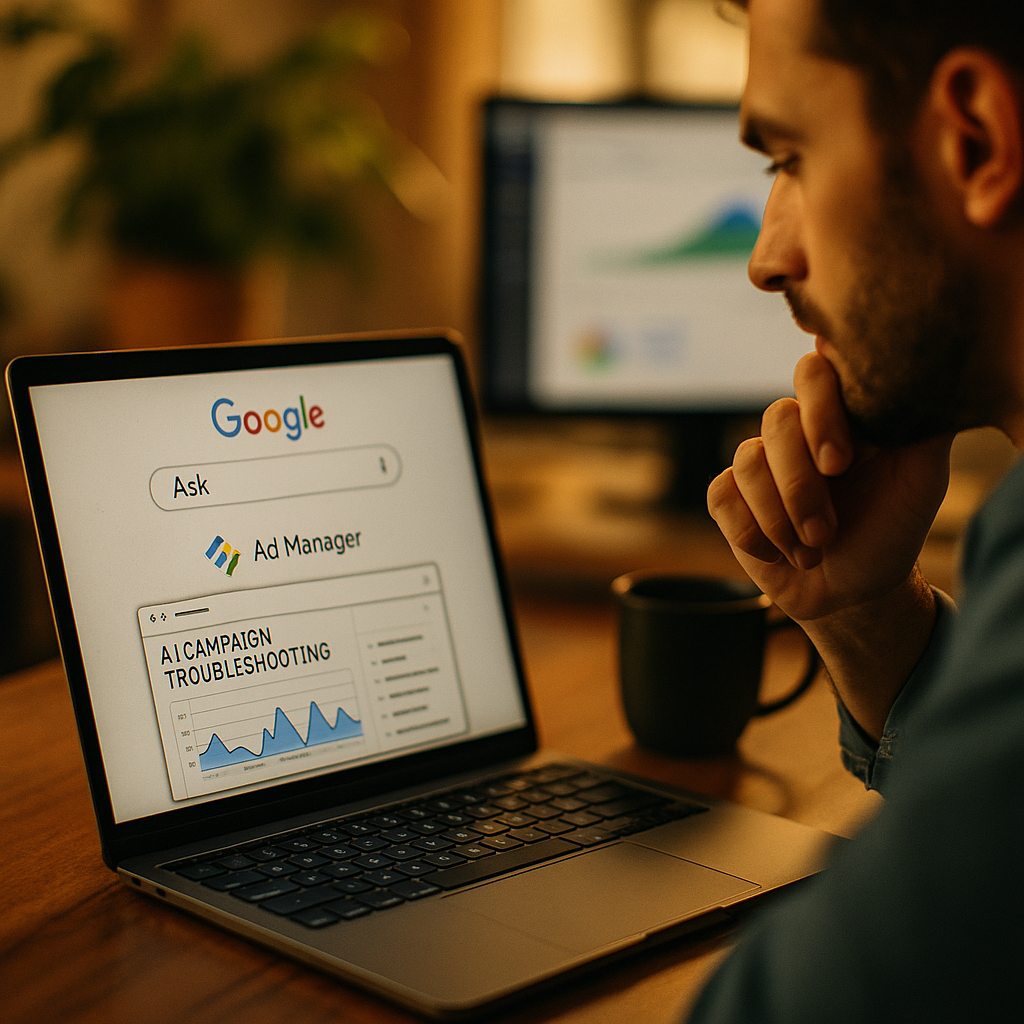
What if your ad ops team could interrogate campaign performance in plain English, get a diagnosis in seconds, and still hold final approval on every fix? That’s the premise behind Google Ask Ad Manager, and it’s reshaping how brand teams think about agentic advertising infrastructure.
What Ask Ad Manager Actually Does
Launched inside Google Ad Manager, Ask Ad Manager is a conversational AI assistant designed to help publishers and buy-side teams troubleshoot campaign delivery, surface performance anomalies, and navigate the platform’s more arcane settings without filing a support ticket or digging through documentation. You type a question. It answers in context. Then — and this is the critical part — nothing happens until a human says so.
That last sentence matters more than it sounds. Every action suggestion the assistant generates sits behind a human approval gate. The system is explicitly non-autonomous. Google has engineered the tool so that AI recommendation and human execution are structurally separate steps, not a single automated sequence.
In an era where “agentic AI” often implies autonomous action, Ask Ad Manager’s mandatory human approval layer is the feature, not a limitation. Brand teams that understand this distinction will build faster, lower-risk AI workflows around it.
For brand teams, this distinction is operationally significant. It means the assistant accelerates diagnosis without creating new approval-chain exposure. Your compliance team can relax — slightly.
Why “Human-in-the-Loop” Is a Strategic Posture, Not a Temporary Guardrail
The broader ad tech industry is sprinting toward agentic automation. Google’s Performance Max, Meta’s Advantage+, and Amazon’s AI campaign tools all move toward varying degrees of autonomous budget reallocation, creative rotation, and audience expansion. Many brand teams have already had the uncomfortable experience of waking up to a campaign that optimized itself into a placement their legal team would not have approved.
Ask Ad Manager is designed differently. It operates as a diagnostic and advisory layer, not an execution engine. Think of it less like an autopilot and more like a co-pilot who can read every instrument simultaneously but keeps both hands off the controls until you nod.
This architecture aligns with where governance-conscious brand teams are heading. If you’ve been building AI governance frameworks for your creator and influencer programs, the same logic applies here: AI-generated recommendations require a documented approval trail before any media dollar moves.
The question worth asking internally: does your team actually have a defined approval workflow for acting on AI-generated ad recommendations? Most don’t. Most are improvising.
What Brand Teams Can Realistically Use It For
Concrete use cases separate useful AI tools from demo-ware. Ask Ad Manager has real operational value in several specific scenarios.
- Campaign delivery troubleshooting: When a campaign underdelivers, the assistant can identify whether the issue is targeting, inventory availability, bid floors, or creative rejection without requiring an analyst to manually audit each variable.
- Policy and setting clarification: Ad Manager’s interface carries years of accumulated complexity. The assistant can explain what a specific setting does in plain language, reducing configuration errors during setup.
- Performance anomaly investigation: Sudden drops in fill rate or eCPM? The assistant can surface probable causes faster than any dashboard drill-down, flagging which variable changed and when.
- Workflow guidance: For teams that run Ad Manager without dedicated ad ops staff, it functions as a knowledgeable first responder for platform questions.
What it does not do: it won’t autonomously adjust bids, pause line items, or reallocate budgets. Every suggested action requires deliberate human confirmation. For teams managing large brand safety exclusion lists or strict frequency caps, that constraint is a feature.
The Agentic Ecosystem Context: Where This Fits
Ask Ad Manager doesn’t exist in isolation. It’s one piece of a broader shift toward what Google Ads calls an agentic workflow, where AI systems collaborate with human marketers across the campaign lifecycle. Understanding where Ask Ad Manager sits in that stack matters for how you allocate team time.
Google has been layering AI assistance across its ad products for several cycles now. Ask Ad Manager represents the conversational interface layer, while Performance Max handles autonomous bidding and creative optimization at the execution layer. These are different tools solving different problems. Conflating them creates governance blind spots.
For context: agentic AI in advertising doesn’t mean one AI agent running your entire media plan. It means a network of specialized AI functions, each operating within a defined scope, surfacing recommendations, and passing them to humans at defined handoff points. Ask Ad Manager is a handoff-point tool. Understanding that framing keeps your team from over-trusting it or under-using it.
If you’re mapping your organization’s broader agentic AI governance strategy across platforms like Adobe, Google, and Zoho, Ask Ad Manager fits into the “advisory AI” tier, alongside tools that inform rather than act.
The real operational risk with tools like Ask Ad Manager isn’t that they do too much — it’s that teams use AI-generated recommendations as a shortcut past the approval processes they’ve already built. Document every suggestion you act on.
Practical Governance Implications for Brand Teams
Three things your team should establish before leaning into Ask Ad Manager at scale.
First, define who can act on its suggestions. The assistant surfaces recommendations to anyone with access. But not everyone who can see a suggestion should have authority to implement it. Map the tool to your existing RACI framework. If you don’t have one for AI-generated ad recommendations, build one now.
Second, create an audit trail for AI-assisted decisions. When a campaign change is prompted by an AI recommendation, that lineage should be documented. If your campaign delivers a problematic placement after an AI-suggested adjustment, you need to reconstruct the decision path. This matters for both internal post-mortems and any external compliance inquiries. The same principle applies to AI-driven influencer campaign automation: document the recommendation, document the approval, document the outcome.
Third, establish escalation thresholds. Not all suggestions carry the same risk. A recommendation to adjust creative rotation carries different stakes than one touching audience exclusion lists. Define which suggestion categories require single-approver sign-off versus cross-functional review before execution.
These aren’t theoretical governance exercises. FTC guidance on AI-assisted advertising decisions is evolving, and having documented approval chains will matter when regulators start asking questions about automated campaign behavior.
What This Means for AI Fluency on Your Team
Ask Ad Manager is also a capability-building tool, whether Google markets it that way or not. Teams that use it consistently get faster at diagnosing campaign problems, learn the platform more deeply through its explanations, and develop a shared vocabulary for AI-assisted decision-making.
This is the upskilling angle most brand teams are missing. The AI isn’t just resolving your immediate problem; it’s teaching your team how to think about the problem. That compounds over time.
The AI fluency gap in marketing organizations is real and measurable. Tools like Ask Ad Manager can narrow that gap at the practitioner level if teams approach them as learning instruments rather than answer machines.
For CMOs thinking about internal capability development, the question isn’t whether to allow teams to use AI assistants. It’s whether you’ve built the judgment framework for evaluating AI recommendations critically, not reflexively accepting them.
The Real-Time Performance Signal Connection
One area where Ask Ad Manager becomes particularly valuable is in-flight campaign monitoring. When performance signals shift mid-campaign, the speed advantage of AI-assisted diagnosis is significant. The assistant can surface what’s happening and why faster than manual analysis, compressing the time between anomaly detection and informed human decision.
This connects to a broader capability that high-performance brand teams are building: AI-assisted channel mix rebalancing using real-time signals. Ask Ad Manager doesn’t execute those rebalancing decisions, but it can accelerate the diagnostic phase that precedes them. Combined with a team that has clear decision rights and fast approval cycles, that compression is where competitive advantage lives.
Separately, eMarketer data consistently shows that campaign response time to performance anomalies correlates with efficiency outcomes. Getting to the “what happened” faster, even by hours, translates to recoverable media value.
Looking at the Competitive Landscape
Google isn’t alone here. Meta’s Ads Manager has been adding AI-assisted features to its interface, and Amazon’s advertising console is moving in a similar direction. The pattern is consistent: conversational AI as a diagnostic layer over complex ad infrastructure, with human approval as the execution gate.
What differentiates these tools is the depth of platform integration. Ask Ad Manager has the advantage of native access to Ad Manager’s full data model, meaning its diagnoses are grounded in actual campaign state rather than surface-level metrics. That’s a meaningful accuracy advantage over third-party tools trying to replicate the same function via API.
For teams running multi-platform media, the practical implication is that platform-native AI assistants will often outperform generic AI tools for platform-specific troubleshooting, while cross-platform analytics layers retain value for comparative performance and budget allocation decisions.
Start here: Audit which team members currently have authority to act on ad platform recommendations (AI-generated or otherwise), formalize that as a written policy, and apply it specifically to Ask Ad Manager before your next campaign cycle. The governance infrastructure you build now will scale across every AI-assisted tool your stack adds over the next two years.
Frequently Asked Questions
What is Google Ask Ad Manager?
Google Ask Ad Manager is a conversational AI assistant built into Google Ad Manager that helps publishers and advertising teams troubleshoot campaign delivery issues, clarify platform settings, and investigate performance anomalies using plain-language questions. It surfaces recommendations but requires human approval before any suggested changes are executed.
Does Ask Ad Manager make changes to campaigns automatically?
No. Ask Ad Manager is explicitly designed with a mandatory human approval layer. The assistant can diagnose problems and suggest actions, but no changes are applied to campaigns without deliberate human confirmation. This makes it different from Google’s autonomous optimization tools like Performance Max.
How does Ask Ad Manager fit into an agentic AI advertising strategy?
Ask Ad Manager operates as an advisory or diagnostic AI layer within a broader agentic ecosystem. It handles the investigation and recommendation phase of campaign management, while humans retain execution authority. In an agentic ad stack, it sits between passive analytics dashboards and fully autonomous optimization tools.
What governance steps should brand teams take before using Ask Ad Manager?
Brand teams should define who has authority to act on AI-generated recommendations, create audit trails documenting which suggestions were approved and implemented, and establish escalation thresholds for higher-risk recommendation types such as audience exclusion changes or significant budget adjustments.
How does Ask Ad Manager compare to similar tools from Meta or Amazon?
All three platforms are building conversational AI layers over their ad infrastructure with human-approval gates. Ask Ad Manager’s primary advantage is its native integration with Google Ad Manager’s complete data model, giving it more accurate campaign-state awareness than third-party tools or platform interfaces with limited API access.
Top Influencer Marketing Agencies
The leading agencies shaping influencer marketing in 2026
Agencies ranked by campaign performance, client diversity, platform expertise, proven ROI, industry recognition, and client satisfaction. Assessed through verified case studies, reviews, and industry consultations.
Moburst

-
2

The Shelf
Boutique Beauty & Lifestyle Influencer AgencyA data-driven boutique agency specializing exclusively in beauty, wellness, and lifestyle influencer campaigns on Instagram and TikTok. Best for brands already focused on the beauty/personal care space that need curated, aesthetic-driven content.Clients: Pepsi, The Honest Company, Hims, Elf Cosmetics, Pure LeafVisit The Shelf → -
3

Audiencly
Niche Gaming & Esports Influencer AgencyA specialized agency focused exclusively on gaming and esports creators on YouTube, Twitch, and TikTok. Ideal if your campaign is 100% gaming-focused — from game launches to hardware and esports events.Clients: Epic Games, NordVPN, Ubisoft, Wargaming, Tencent GamesVisit Audiencly → -
4

Viral Nation
Global Influencer Marketing & Talent AgencyA dual talent management and marketing agency with proprietary brand safety tools and a global creator network spanning nano-influencers to celebrities across all major platforms.Clients: Meta, Activision Blizzard, Energizer, Aston Martin, WalmartVisit Viral Nation → -
5

The Influencer Marketing Factory
TikTok, Instagram & YouTube CampaignsA full-service agency with strong TikTok expertise, offering end-to-end campaign management from influencer discovery through performance reporting with a focus on platform-native content.Clients: Google, Snapchat, Universal Music, Bumble, YelpVisit TIMF → -
6

NeoReach
Enterprise Analytics & Influencer CampaignsAn enterprise-focused agency combining managed campaigns with a powerful self-service data platform for influencer search, audience analytics, and attribution modeling.Clients: Amazon, Airbnb, Netflix, Honda, The New York TimesVisit NeoReach → -
7

Ubiquitous
Creator-First Marketing PlatformA tech-driven platform combining self-service tools with managed campaign options, emphasizing speed and scalability for brands managing multiple influencer relationships.Clients: Lyft, Disney, Target, American Eagle, NetflixVisit Ubiquitous → -
8

Obviously
Scalable Enterprise Influencer CampaignsA tech-enabled agency built for high-volume campaigns, coordinating hundreds of creators simultaneously with end-to-end logistics, content rights management, and product seeding.Clients: Google, Ulta Beauty, Converse, AmazonVisit Obviously →