


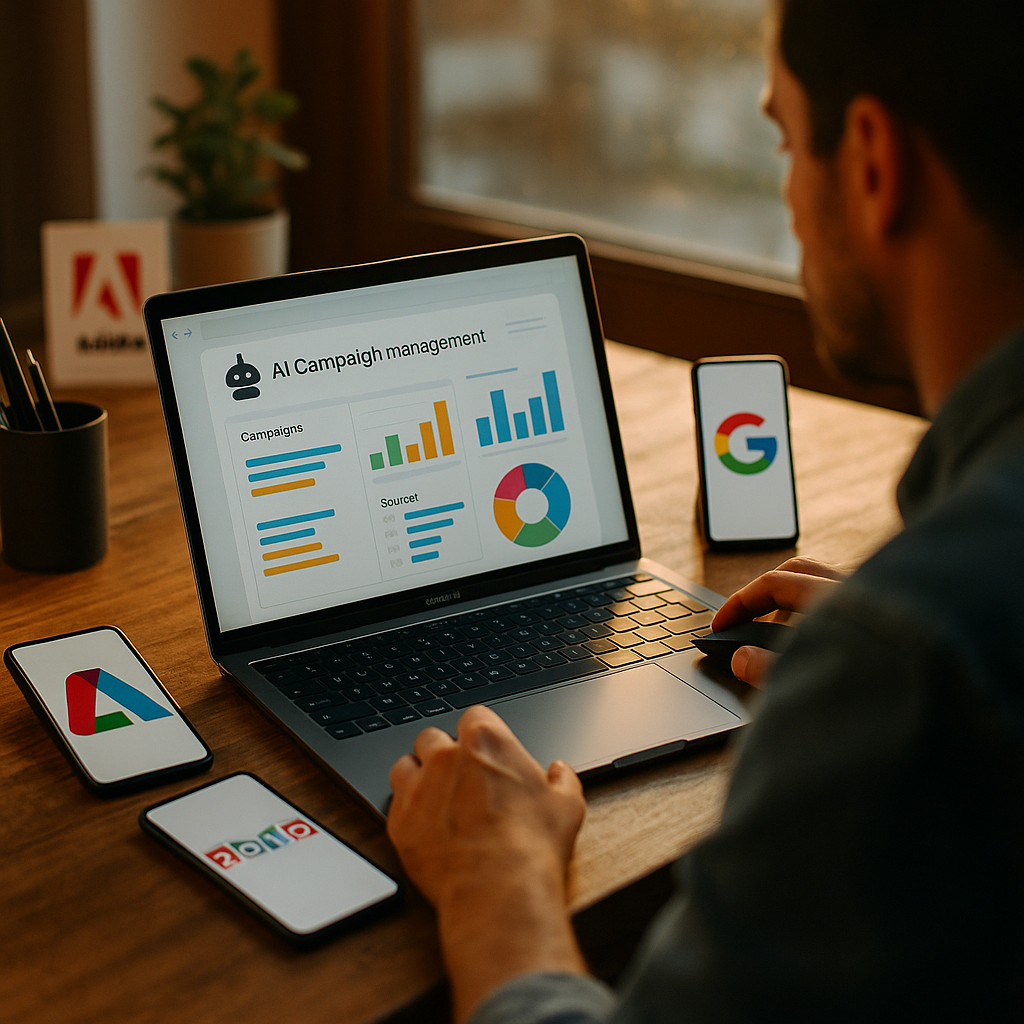
By the end of this year, more than 40% of enterprise marketing decisions will involve some degree of autonomous AI action, according to Gartner projections. The AI agentic campaign ecosystem is no longer a roadmap item. It’s operating live inside your media buying, customer engagement, and creative workflows right now.
Three Platforms, One Structural Warning
Adobe’s CX Enterprise Coworker, Google’s Ask Ad Manager, and Zoho’s SalesIQ Agentic Intelligence each represent a distinct layer of the campaign stack. Adobe handles creative orchestration and customer experience at scale. Google’s Ask Ad Manager brings conversational, autonomous media buying into the DV360/GAM ecosystem. Zoho SalesIQ Agentic Intelligence operates at the bottom of the funnel, triggering sales engagement sequences without human initiation.
Separately, each is impressive. Together, they describe a world where an AI agent can conceive a campaign variant, buy the inventory, and close the lead, with no human touchpoint in between. That’s not a dystopian hypothetical. That’s a live architecture brands can assemble today.
The governance question isn’t whether to use these tools. It’s whether your organization has any policies that would stop them from doing something your legal, compliance, or brand team would regret.
What Each Tool Actually Does (And Where the Risk Lives)
Adobe CX Enterprise Coworker is positioned as a collaborative AI agent inside the Adobe Experience Cloud. It ingests brand guidelines, customer data, and campaign performance signals to autonomously generate, test, and route creative assets across channels. The risk: if brand guardrails aren’t encoded at the system level, the agent will optimize for the metric it’s given, not the brand identity you care about. We’ve covered how GenStudio asset governance works in practice, and the same principle applies here — the governance layer has to be built before the automation runs, not after.
Google Ask Ad Manager allows buyers to interact with Google’s Ad Manager via natural language prompts, letting the system autonomously adjust targeting parameters, frequency caps, deal terms, and budget pacing. The risk is velocity. A well-constructed prompt can shift six figures in spend within minutes. Without tiered approval workflows, a junior operator or a misconfigured prompt can do real financial damage before a human reviews anything.
Zoho SalesIQ Agentic Intelligence extends AI decision-making into live chat, lead scoring, and outbound engagement. The agent reads behavioral signals, qualifies leads, and initiates contact sequences. The risk here is regulatory: autonomous outreach touching PII, especially in the EU, requires explicit lawful basis under GDPR frameworks that most marketing ops teams haven’t mapped to agentic triggers.
When AI agents operate across creative, buying, and engagement simultaneously, a single misconfigured policy can propagate errors at a speed and scale no human team can manually reverse.
The Governance Gap Most Brands Are Ignoring
Here’s the structural problem. Most enterprise brands have governance frameworks built for human decision-making: approval chains, brand review cycles, legal sign-off on copy. Those frameworks assume a human is making each decision and can be held accountable for it.
Agentic AI breaks that assumption entirely.
When Adobe CX Coworker generates a new creative variant and deploys it, who approved that? When Ask Ad Manager shifts budget away from a premium publisher deal toward programmatic open exchange because CTR was 0.2% better, was that aligned with your brand safety commitments? When Zoho SalesIQ contacts a high-value prospect at 11pm based on a behavioral trigger, did anyone check whether that prospect is in a regulated industry with specific contact restrictions?
These aren’t edge cases. They’re the default operating mode of agentic systems optimizing against narrow metrics. The FTC’s guidance on automated decision systems is increasingly clear: brands bear accountability for decisions made by tools they deploy, regardless of whether a human was in the loop.
The Four-Layer Governance Model for Agentic Campaigns
Brands that are getting this right are building governance in four distinct layers, each corresponding to a different type of autonomous decision.
1. Creative Boundary Policies. Define what an AI agent can and cannot generate without human review. This includes prohibited claim types, restricted visual assets, mandatory legal disclaimers, and brand voice parameters. Adobe CX Coworker can ingest these as structured rules, but someone has to write them first. Think of this as a campaign automation governance layer applied to generative output.
2. Spend Authorization Thresholds. Every autonomous buying action needs a financial ceiling. Ask Ad Manager should operate within pre-approved budget bands, with escalation triggers that pause autonomous action and route to a human approver above a defined spend velocity. Set these at the campaign, line item, and daily cap levels, not just the overall budget.
3. Data and Consent Mapping. Before any agentic tool touches customer data, you need a documented mapping of what data is available to the agent, under what consent basis, and with what usage restrictions. Zoho SalesIQ Agentic Intelligence pulling behavioral data to trigger outreach requires the same consent architecture as any other marketing automation, but the speed of agentic triggers makes errors far harder to catch retroactively.
4. Audit and Override Protocols. Every autonomous action should generate a log entry that a human can review. More importantly, every agent needs a documented kill switch: a process by which a campaign manager can halt autonomous decision-making on a specific channel, campaign, or customer segment within minutes. This isn’t paranoia; it’s operational hygiene for AI-driven channel rebalancing at scale.
Where Influencer and Creator Campaigns Intersect
Brand and agency teams running creator programs need to think about this intersection specifically. Agentic tools don’t yet fully understand the relational and reputational dynamics of influencer marketing. An autonomous system optimizing for CPM or CPA might route creator content to placements that violate an influencer’s contractual brand safety requirements, or repurpose UGC in ways that breach usage rights agreements.
The AI contract automation audit framework we’ve outlined previously becomes directly relevant here: if AI agents can trigger creative deployment or paid amplification, the usage rights encoded in your influencer contracts need to be machine-readable and connected to the agent’s permission layer. That’s a technical integration most brands haven’t done yet.
Similarly, UGC routing pipelines that feed into agentic buying systems need explicit content category controls so that an autonomous buyer doesn’t place user-generated content in contextually inappropriate environments.
Governance for agentic AI isn’t a legal checkbox. It’s a technical architecture. The policies have to be encoded into the system, not written in a PDF that no one connects to the platform.
The Readiness Audit: Five Questions for Your Team
Before expanding agentic AI across your campaign stack, run your team through these five questions:
- Do we have documented creative boundary policies that are encoded into our AI tools, not just stored in a brand guidelines PDF?
- Do our media buying AI tools have spend velocity limits and escalation triggers that are actively configured, not just theoretically available?
- Have we mapped every customer data source that feeds our agentic tools to a specific consent basis and retention policy?
- Can we halt autonomous decision-making on any channel or campaign within five minutes if something goes wrong?
- Have we reviewed our influencer and creator contracts to ensure usage rights are compatible with AI-driven content deployment?
If the honest answer to more than two of these is “not yet,” you’re operating with meaningful governance exposure. Given how AI campaign activation speed has compressed timelines, exposure compounds faster than most teams expect.
The platforms from Adobe, Google, and Zoho are genuinely capable. The gap isn’t in the tools. It’s in the organizational infrastructure brands need to deploy them responsibly at scale.
The next step is concrete: assign a single owner, ideally someone who sits across marketing ops, legal, and brand, to map every agentic action your current stack can take against your existing governance policies. That gap analysis is the foundation everything else depends on.
FAQs
What is an AI agentic campaign ecosystem?
An AI agentic campaign ecosystem refers to an interconnected set of AI-powered tools that can autonomously execute campaign decisions, including creative generation, media buying, and customer engagement, without requiring a human to initiate each individual action. Platforms like Adobe CX Enterprise Coworker, Google Ask Ad Manager, and Zoho SalesIQ Agentic Intelligence each handle a different layer of this stack.
Why do brands need governance policies for agentic AI before scaling?
Agentic AI systems optimize against the metrics they’re given, not broader brand, legal, or ethical considerations. Without governance policies encoded at the system level, autonomous tools can make decisions that violate brand safety standards, exceed authorized spend, breach data privacy regulations, or conflict with influencer contract terms, often faster than any human team can intervene.
How does Google Ask Ad Manager differ from standard programmatic buying?
Google Ask Ad Manager allows media buyers to issue natural language prompts that the system translates into autonomous adjustments across targeting, pacing, frequency, and deal parameters. Unlike standard programmatic buying, which executes rules a human has pre-configured, Ask Ad Manager can interpret intent and act on it dynamically, which increases efficiency but also increases the risk of unintended actions without proper authorization thresholds.
What are the GDPR implications of Zoho SalesIQ Agentic Intelligence?
Zoho SalesIQ Agentic Intelligence can autonomously trigger outbound customer engagement based on behavioral signals. Under GDPR, any automated processing that leads to direct marketing contact requires a documented lawful basis, typically consent or legitimate interest with a valid balancing test. Brands must ensure that the data inputs feeding the agent are mapped to explicit consent records, and that suppression lists are integrated into the agent’s decision logic before deployment.
How should influencer and creator contracts be updated for agentic AI deployment?
Influencer and creator contracts should be reviewed to ensure usage rights clauses specify whether AI systems can trigger paid amplification, contextual placement, or creative repurposing of the creator’s content. Usage rights need to be machine-readable and connected to the permission layers of any agentic buying or content deployment tool. Brands that haven’t updated contracts to reflect agentic use cases face meaningful legal and reputational exposure.
What is a reasonable spend authorization threshold for autonomous media buying?
Thresholds vary by organization size and campaign scale, but a reasonable starting framework sets autonomous action limits at the daily campaign level (for example, no single autonomous action can exceed 10% of daily budget), with escalation triggers that pause the agent and notify a human approver for any action above that threshold. These limits should be configured at the platform level, not just documented in policy, and reviewed quarterly as campaign parameters change.
Top Influencer Marketing Agencies
The leading agencies shaping influencer marketing in 2026
Agencies ranked by campaign performance, client diversity, platform expertise, proven ROI, industry recognition, and client satisfaction. Assessed through verified case studies, reviews, and industry consultations.
Moburst

-
2

The Shelf
Boutique Beauty & Lifestyle Influencer AgencyA data-driven boutique agency specializing exclusively in beauty, wellness, and lifestyle influencer campaigns on Instagram and TikTok. Best for brands already focused on the beauty/personal care space that need curated, aesthetic-driven content.Clients: Pepsi, The Honest Company, Hims, Elf Cosmetics, Pure LeafVisit The Shelf → -
3

Audiencly
Niche Gaming & Esports Influencer AgencyA specialized agency focused exclusively on gaming and esports creators on YouTube, Twitch, and TikTok. Ideal if your campaign is 100% gaming-focused — from game launches to hardware and esports events.Clients: Epic Games, NordVPN, Ubisoft, Wargaming, Tencent GamesVisit Audiencly → -
4

Viral Nation
Global Influencer Marketing & Talent AgencyA dual talent management and marketing agency with proprietary brand safety tools and a global creator network spanning nano-influencers to celebrities across all major platforms.Clients: Meta, Activision Blizzard, Energizer, Aston Martin, WalmartVisit Viral Nation → -
5

The Influencer Marketing Factory
TikTok, Instagram & YouTube CampaignsA full-service agency with strong TikTok expertise, offering end-to-end campaign management from influencer discovery through performance reporting with a focus on platform-native content.Clients: Google, Snapchat, Universal Music, Bumble, YelpVisit TIMF → -
6

NeoReach
Enterprise Analytics & Influencer CampaignsAn enterprise-focused agency combining managed campaigns with a powerful self-service data platform for influencer search, audience analytics, and attribution modeling.Clients: Amazon, Airbnb, Netflix, Honda, The New York TimesVisit NeoReach → -
7

Ubiquitous
Creator-First Marketing PlatformA tech-driven platform combining self-service tools with managed campaign options, emphasizing speed and scalability for brands managing multiple influencer relationships.Clients: Lyft, Disney, Target, American Eagle, NetflixVisit Ubiquitous → -
8

Obviously
Scalable Enterprise Influencer CampaignsA tech-enabled agency built for high-volume campaigns, coordinating hundreds of creators simultaneously with end-to-end logistics, content rights management, and product seeding.Clients: Google, Ulta Beauty, Converse, AmazonVisit Obviously →