


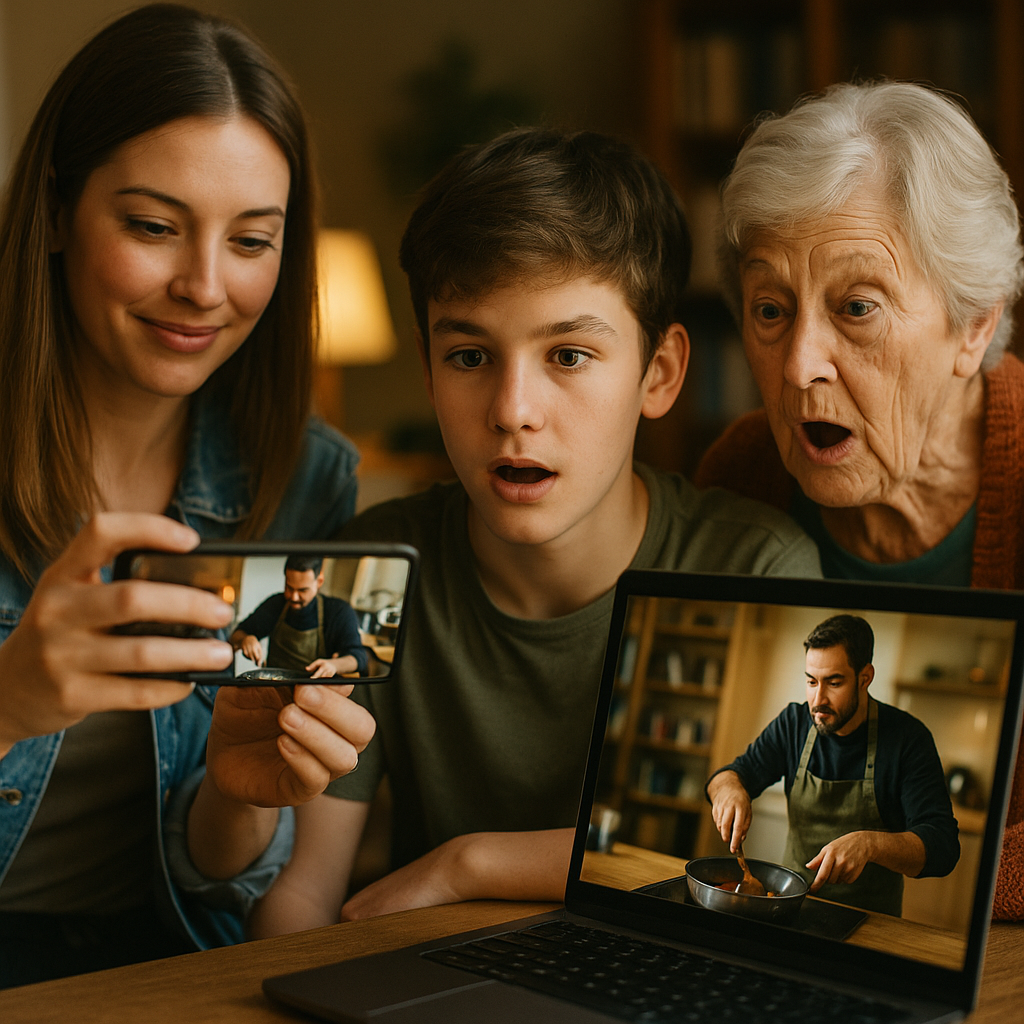
A single skincare brand ran the same serum past a 68-year-old, her daughter, and her granddaughter on camera. That one video pulled 40% more comments than the brand’s average post, and half the thread was arguing about which generation’s reaction was funniest. That’s the multi-generational reaction format working exactly as designed: one product, three audiences, one shoot.
Brands have spent years chasing single-demographic creators, hoping niche relevance would translate to conversion. It sometimes does. But it also caps your reach at whatever slice of the algorithm that creator already owns. The multi-generational format flips the math: instead of one creator speaking to one audience, you get three (or more) reactions in a single video, each one tuned to resonate with a different age cohort watching for different reasons.
What the Format Actually Looks Like
The mechanics are simple, which is exactly why they work. A brand sends one product to a family, or briefs three separate creators who represent different generations, and films each person’s genuine first reaction. Grandma might comment on the packaging feeling flimsy. Mom cares about the ingredient list. The teenager just wants to know if it works in under ten seconds because that’s her attention span for skincare content.
You’re not writing three different scripts. You’re pointing a camera at three different lived experiences reacting to the same stimulus. That authenticity is the entire value proposition, and it’s why this format tends to outperform polished multi-cut ads on watch time.
The format doesn’t manufacture cross-demographic appeal. It reveals appeal that was already there, then lets the algorithm distribute it to whichever generation clicks with whichever reaction.
Why It Works Better Than Demographic Targeting Alone
Paid social targeting has gotten narrower and, frankly, less reliable. iOS privacy changes gutted a lot of the granular targeting marketers used to lean on, and platforms have pushed advertisers toward broader, algorithm-driven delivery instead of hyper-segmented audiences. eMarketer has tracked this shift for several years now: broad targeting frequently outperforms narrow targeting because the algorithm finds pockets of engagement you didn’t anticipate.
Content that’s engineered for one demographic literally cannot get discovered by another. A video of a 22-year-old reviewing a supplement, styled for other 22-year-olds, will rarely surface to a 55-year-old’s feed even if that older viewer is a more likely buyer. The multi-generational format sidesteps this by baking cross-demographic relevance into the content itself, not the targeting settings.
It also solves a trust problem. Gen Z audiences are famously skeptical of overt advertising, but they trust their parents’ and grandparents’ unscripted reactions more than they trust another 20-something’s polished review. Multi-generational format content reads less like an ad and more like a home video that happens to feature your product. That’s a similar trust mechanic to what we’ve covered in the no-script video format: the less produced it feels, the more it converts.
The Data Behind Cross-Generational Households
Purchasing decisions aren’t as age-siloed as brands like to assume. Statista data on multigenerational household trends shows a steady rise in adult children living with parents and grandparents across major markets, which means buying decisions increasingly get made, or influenced, across three generations under one roof. A grandmother’s opinion on a product might directly shape whether her granddaughter buys it, and vice versa. Content that models this dynamic isn’t just relatable, it mirrors how real households actually shop.
Brands selling household goods, food, skincare, and even financial products are sitting on an underused asset: the family unit itself as a testing panel.
Directing the Shoot Without Killing the Authenticity
Here’s where most brands mess this up. They over-brief. They hand each creator a script, a list of talking points, and a shot list that turns three generations into three identical actors reading the same lines with different haircuts. That defeats the entire purpose.
Good direction for this format means giving structure, not dialogue.
- Set the constraint, not the copy. Ask each generation to try the product and describe it in their own words, on camera, without hearing what the other generations said first.
- Film reactions blind. Don’t let grandma see mom’s take before she gives hers. Cross-contamination kills the format’s core appeal: independent, unfiltered reactions.
- Keep questions open-ended. “What’s your honest first impression?” beats “Tell us how the moisturizing formula feels on your skin” every time.
- Let contradictions stay in the edit. If grandma hates the scent and the teenager loves it, that tension is the content. Don’t smooth it over.
- Brief for length variance. Older participants often talk longer and more descriptively; younger ones deliver quick, punchy verdicts. Let the edit reflect natural pacing instead of forcing uniform clip lengths.
This is the same philosophy behind formats like the blind ranking format: remove the opportunity for creators to perform for each other, and you get reactions audiences actually trust.
Casting: Real Families vs. Creator Trios
You’ve got two casting paths here, and they solve different problems.
Real families deliver maximum authenticity. The chemistry is unforced because it’s actual chemistry. The downside: coordinating three people’s schedules, personalities, and camera comfort is logistically harder, and you’re limited to families willing to participate as a unit. Agencies working with creator marketplaces are increasingly building “family creator” rosters specifically to solve this sourcing problem.
Unrelated creators grouped by generation give you more control over quality and availability. You can cast a polished 60-something lifestyle creator, a mid-career parent-influencer, and a Gen Z micro-creator without needing them to share a last name. The tradeoff is a slightly more constructed feel, though skilled editing usually closes that gap. Most brands running this at scale use a hybrid: one real family for the hero video, then individual generational creators for scaled variations across campaigns.
Platform Fit: Where This Format Actually Performs
TikTok and Instagram Reels are the natural home for this format because both platforms reward the pattern interrupt of seeing an 80-year-old and a 19-year-old react to the same thing in one video. The generational contrast itself functions as a hook in the first two seconds, which is exactly what the algorithm needs to keep people watching. TikTok’s ad platform and Meta’s ad tools both support boosting organic creator content directly, which means a strong multi-generational video can go from organic post to paid spark ad without a reshoot.
YouTube Shorts and long-form YouTube also work well for this format when you want to lean into the documentary angle, letting each generation’s segment run longer and capturing more nuance than a 15-second TikTok cut allows.
Where the FTC Risk Actually Sits
Multi-generational content isn’t inherently riskier than any other creator format, but brands still trip over the basics. If any participant, at any age, received the product for free or was compensated, disclosure rules apply to that person specifically, not just to the “lead” creator in the video. A grandmother appearing in a sponsored family video needs the same #ad disclosure as her influencer daughter would.
The FTC’s endorsement guidelines don’t carve out exceptions for family members or non-professional participants. If they’re on camera reacting to a product they were given, that’s an endorsement, full stop.
Brands that have gotten burned on disclosure gaps in unscripted formats will recognize this pattern from our breakdown of the confession-booth format: the more “real” a video feels, the more tempting it is to skip disclosure, and the more damage skipping it does when caught.
Every generation on screen who received free product or payment needs individual disclosure. “Family video” isn’t a legal exemption from FTC rules.
Measuring Cross-Demographic Lift
Standard creator metrics undersell this format if you only look at aggregate engagement. Break performance down by the age-segment analytics most platforms now offer (TikTok’s Creative Center and Meta’s Audience Insights both support this), and compare completion rates across age brackets against your single-demographic content baseline.
What you’re looking for: does the video hold attention across multiple age groups, not just spike with one? A video that scores well only among 45-64 viewers isn’t actually delivering cross-demographic appeal, it’s just a boomer-targeted ad that happened to include younger cast members. True cross-generational lift shows relatively even completion and share rates across at least two, ideally three, age brackets.
Pair this with a simple efficiency comparison: cost per shoot divided by number of distinct demographic segments reached. One multi-generational shoot replacing three single-demographic shoots is often the actual budget story here, not just the engagement story. This mirrors the efficiency logic in our multi-format creator brief approach: maximize what one production day delivers before commissioning another.
Common Mistakes That Flatten the Format
- Casting for looks, not chemistry. Picking a grandparent, parent, and child who don’t have natural rapport (even as strangers) shows on camera immediately.
- Over-editing to smooth generational differences. The friction is the content. Cutting it out for a “cleaner” narrative kills the hook.
- Ignoring the youngest and oldest voices in the edit. Brands often unconsciously favor the middle-aged reaction as the “credible” one and bury the others. Give equal screen time or you lose the whole premise.
- Skipping disclosure for non-professional participants. Covered above, but worth repeating because it’s the most common compliance gap in this format specifically.
FAQs
What products work best for the multi-generational reaction format?
Household staples, food and beverage, skincare, and tech gadgets with a low barrier to first-use tend to perform best, since each generation can form an opinion within seconds of trying the product on camera.
How many creators or family members do you need?
Three is the sweet spot: one older adult, one middle-generation adult, and one younger adult or teen. Adding a fourth generation is possible but tends to dilute pacing in short-form video.
Does this format require a real family, or can you cast unrelated creators?
Either works. Real families deliver more natural chemistry, while casting unrelated generational creators gives you more control over availability, quality, and messaging consistency.
Do all participants need FTC disclosure, even non-influencer family members?
Yes. Anyone who received free product or compensation and appears endorsing it on camera must disclose the material connection, regardless of whether they’re a professional creator.
Which platforms perform best for this format?
TikTok and Instagram Reels for short, punchy generational contrast; YouTube Shorts or long-form YouTube when you want each generation’s reaction to breathe with more detail.
How do you measure success beyond standard engagement metrics?
Segment completion and share rates by age bracket using platform analytics tools, and confirm the content holds attention across at least two distinct generations rather than spiking with just one.
Stop briefing this format like a script and start briefing it like a documentary constraint: same product, independent reactions, zero cross-contamination. That’s what turns one shoot into three audiences.
FAQs
What products work best for the multi-generational reaction format?
Household staples, food and beverage, skincare, and tech gadgets with a low barrier to first-use tend to perform best, since each generation can form an opinion within seconds of trying the product on camera.
How many creators or family members do you need?
Three is the sweet spot: one older adult, one middle-generation adult, and one younger adult or teen. Adding a fourth generation is possible but tends to dilute pacing in short-form video.
Does this format require a real family, or can you cast unrelated creators?
Either works. Real families deliver more natural chemistry, while casting unrelated generational creators gives you more control over availability, quality, and messaging consistency.
Do all participants need FTC disclosure, even non-influencer family members?
Yes. Anyone who received free product or compensation and appears endorsing it on camera must disclose the material connection, regardless of whether they’re a professional creator.
Which platforms perform best for this format?
TikTok and Instagram Reels for short, punchy generational contrast; YouTube Shorts or long-form YouTube when you want each generation’s reaction to breathe with more detail.
How do you measure success beyond standard engagement metrics?
Segment completion and share rates by age bracket using platform analytics tools, and confirm the content holds attention across at least two distinct generations rather than spiking with just one.
Top Influencer Marketing Agencies
The leading agencies shaping influencer marketing in 2026
Agencies ranked by campaign performance, client diversity, platform expertise, proven ROI, industry recognition, and client satisfaction. Assessed through verified case studies, reviews, and industry consultations.
Moburst

-
2

The Shelf
Boutique Beauty & Lifestyle Influencer AgencyA data-driven boutique agency specializing exclusively in beauty, wellness, and lifestyle influencer campaigns on Instagram and TikTok. Best for brands already focused on the beauty/personal care space that need curated, aesthetic-driven content.Clients: Pepsi, The Honest Company, Hims, Elf Cosmetics, Pure LeafVisit The Shelf → -
3

Audiencly
Niche Gaming & Esports Influencer AgencyA specialized agency focused exclusively on gaming and esports creators on YouTube, Twitch, and TikTok. Ideal if your campaign is 100% gaming-focused — from game launches to hardware and esports events.Clients: Epic Games, NordVPN, Ubisoft, Wargaming, Tencent GamesVisit Audiencly → -
4

Viral Nation
Global Influencer Marketing & Talent AgencyA dual talent management and marketing agency with proprietary brand safety tools and a global creator network spanning nano-influencers to celebrities across all major platforms.Clients: Meta, Activision Blizzard, Energizer, Aston Martin, WalmartVisit Viral Nation → -
5

The Influencer Marketing Factory
TikTok, Instagram & YouTube CampaignsA full-service agency with strong TikTok expertise, offering end-to-end campaign management from influencer discovery through performance reporting with a focus on platform-native content.Clients: Google, Snapchat, Universal Music, Bumble, YelpVisit TIMF → -
6

NeoReach
Enterprise Analytics & Influencer CampaignsAn enterprise-focused agency combining managed campaigns with a powerful self-service data platform for influencer search, audience analytics, and attribution modeling.Clients: Amazon, Airbnb, Netflix, Honda, The New York TimesVisit NeoReach → -
7

Ubiquitous
Creator-First Marketing PlatformA tech-driven platform combining self-service tools with managed campaign options, emphasizing speed and scalability for brands managing multiple influencer relationships.Clients: Lyft, Disney, Target, American Eagle, NetflixVisit Ubiquitous → -
8

Obviously
Scalable Enterprise Influencer CampaignsA tech-enabled agency built for high-volume campaigns, coordinating hundreds of creators simultaneously with end-to-end logistics, content rights management, and product seeding.Clients: Google, Ulta Beauty, Converse, AmazonVisit Obviously →