


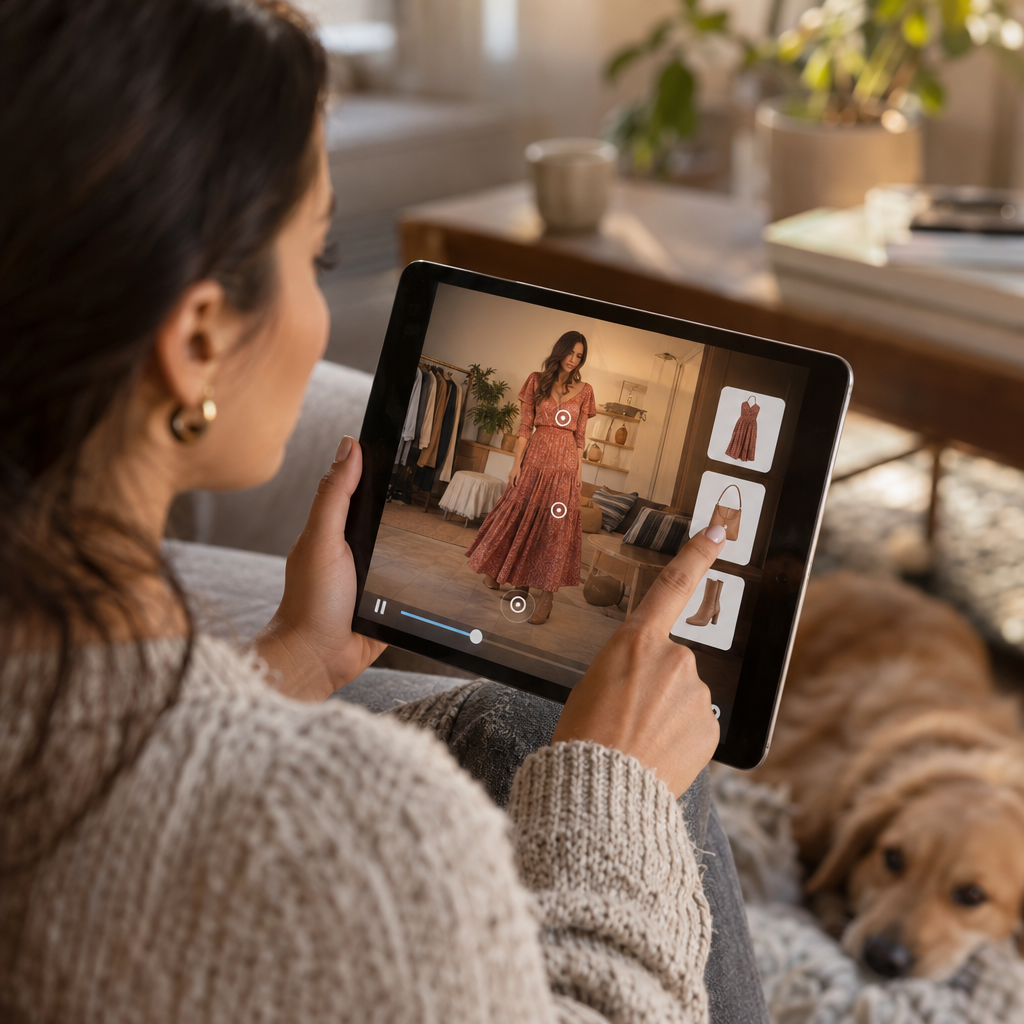
Most shoppable video fails at the same point. The viewer wants the product, and the tag shows up four seconds late or covers the thing they wanted to see. Shoppable interactive video is a scripting problem before it is a technology problem. The platform gives you the button. Your script decides whether anyone has a reason to press it.
The tag is not the hook
Teams often brief a creator, shoot the video, and then ask an editor to “add the shopping layer.” That is backwards. A tag is an answer, and it only works if the viewer has already asked the question.
Think of each clickable moment as a three-beat unit:
- Trigger: something on screen makes the viewer want to know what it is, how it works, or what it costs.
- Proof: a few seconds of demonstration, texture, or result that justifies the curiosity.
- Handoff: the tag appears while the desire is still warm, and the creator’s line or visual points to it.
Skip the trigger and the tag looks like an ad. Skip the proof and the click is a coin flip. Skip the handoff and you have built a product catalog nobody opens.
Where does the platform shape the script?
Each surface behaves differently, and a script written for one will underperform on another. Here is what the official documentation tells us.
TikTok. TikTok describes in-feed shopping as tagged products shoppable directly from videos and LIVEs in the For You feed. It also runs an affiliate program where creators earn commission by sharing products in short videos and livestreams. For a brand, that means the creator’s incentive is tied to the click, which is useful but needs guardrails (more on that below).
YouTube. YouTube’s help documentation says you can tag up to 60 products per video. For Shorts, the order of the list decides which product appears as the Shopping sticker, and creators can adjust its size and placement inside the app. Sixty tags is a ceiling, not a target. A script built around one hero product and two supporting ones will beat a “everything I used” tour almost every time.
The practical consequence: write the sticker’s job into the brief. Which product leads the list? When does it appear? What on screen should it avoid covering? Those are scripting decisions, not post-production afterthoughts.
A product tag does not create intent. It collects the intent your script already built, so brief the trigger and the proof before you ever mention the button.
Scripting the moment: a working template
Here is the structure we recommend when briefing creators for a 30 to 45 second shoppable piece. Adjust timing to the format, but keep the order.
- 0-3 seconds, the problem or the reveal. Show the situation the product solves, or the product mid-use. No logo cards.
- 3-12 seconds, the first proof beat. One demonstration, one result. This is where the hero product earns its tag.
- 12-15 seconds, first handoff. The creator names the product naturally and the tag is visible and unobstructed.
- 15-30 seconds, the supporting product. Same pattern, shorter. Give the second item a different job, such as the accessory or the upgrade.
- Final 5 seconds, the reason to act now. A bundle, a stock note, a code, or a comparison. Not a recap.
Why not tag everything at once? Because every extra tag competes with the last one. If the viewer faces five choices, the likeliest outcome is zero clicks.
Write for sound off
A large share of viewing happens muted, and a clickable moment that depends on a spoken price or product name will be missed. Put the product name and the single benefit on screen as text, aligned with the tag. Our guides on silent selling videos and dialogue-free scripting cover how to carry the sale visually.
Proof beats pitch
The strongest clickable moments sit right after evidence. A before-and-after, a side-by-side, a stress test. Viewers click when they believe, not when they are told to.
That is why comparison formats pair so well with product tags. If you go this route, pressure-test the claims before the shoot. Our pieces on comparison swipe videos and claims that pass legal review walk through how to keep the proof persuasive and defensible.
One more question brand teams ask: should the creator say the price? Usually only if price is the proof (a dupe, a value bundle, a clear saving). Otherwise, let the product page carry it and use the video to build the reason to look.
Compliance lives in the script
Here is the part that gets skipped when a team is chasing conversion. A shoppable video is still an endorsement, and a clickable tag does not change the disclosure rules.
The FTC’s endorsement guidance is direct on this point. In its Q&A, the agency says a material connection should be disclosed clearly and conspicuously when a significant minority of consumers wouldn’t expect it and it would affect how they evaluate the endorsement. It also states that the guidance on when to disclose is the same no matter what format a review takes or where it appears.
Commission-based creators raise the stakes. If a creator earns from affiliate sales, that is a connection viewers may not assume. Build the disclosure into the script itself:
- Put it in the first few seconds on screen and in the creator’s words, not only in a caption that gets truncated.
- Keep it visible in a spot the product tag will not cover.
- State it again if the video is long or the tagged products appear much later.
- Require the same language in paid amplification of the post.
For formats where storytelling can blur the line, see our guidance on scripting disclosure inside narrative content. The same principle applies here: disclosure that feels native is disclosure that holds up.
If a creator earns commission on the click, the disclosure belongs in the script, on screen, and clear of the product tag.
Measuring what the clickable moment did
Platform dashboards will show you taps and orders, but they will not tell you which line of the script earned them. Build your own read.
- Tag-to-view timing: compare performance across videos where the tag appeared early versus late.
- Hero versus supporting: check whether the lead product takes most clicks, and whether the second product cannibalizes it.
- Creator variance: give two creators the same product and the same template. The gap shows you what is script and what is talent.
- Post-click drop-off: a strong click rate with weak purchases points to the product page, not the video.
Label every test in your tracking sheet before the content goes live. Without that, you will have data and no lessons.
FAQs
What is shoppable interactive video?
It is video where viewers can tap or click on products shown in the content and move to a product page or checkout. On platforms like TikTok and YouTube, this happens through product tags and stickers attached to the video, without the viewer leaving the app.
How many products should I tag in one video?
Fewer than the platform allows. YouTube permits up to 60 tags per video, but a script centered on one hero product and one or two supporting items gives viewers a clear choice and makes your results easier to read.
When should the product tag appear?
After the proof beat, while the viewer is still interested. A common pattern is a demonstration first, then the product name and the tag in the following seconds. Test early against late placement on your own audience.
Do shoppable videos need an FTC disclosure?
Yes, if there is a material connection such as payment, free product, or affiliate commission. The FTC says disclosure guidance is the same regardless of format or where the content appears, and the disclosure must be clear and conspicuous.
Who should write the script, the brand or the creator?
Both. The brand should brief the product hierarchy, claims, disclosure language, and tag timing. The creator should own the voice, the trigger, and how the proof is shown, because that is what makes the content feel native.
How do I know if the video or the product page is the problem?
Compare click activity with completed purchases. High clicks and low sales usually point to the landing page, price, or checkout friction. Low clicks on a well-viewed video point to the script, tag timing, or a weak trigger.
Next step: pick your top-performing creator video, mark every second a product is on screen, and rewrite the brief so one hero product gets a trigger, a proof beat, and a tag that never covers the disclosure.
Top Influencer Marketing Agencies
The leading agencies shaping influencer marketing in 2026
Agencies ranked by campaign performance, client diversity, platform expertise, proven ROI, industry recognition, and client satisfaction. Assessed through verified case studies, reviews, and industry consultations.
Moburst

-
2

The Shelf
Boutique Beauty & Lifestyle Influencer AgencyA data-driven boutique agency specializing exclusively in beauty, wellness, and lifestyle influencer campaigns on Instagram and TikTok. Best for brands already focused on the beauty/personal care space that need curated, aesthetic-driven content.Clients: Pepsi, The Honest Company, Hims, Elf Cosmetics, Pure LeafVisit The Shelf → -
3

Audiencly
Niche Gaming & Esports Influencer AgencyA specialized agency focused exclusively on gaming and esports creators on YouTube, Twitch, and TikTok. Ideal if your campaign is 100% gaming-focused — from game launches to hardware and esports events.Clients: Epic Games, NordVPN, Ubisoft, Wargaming, Tencent GamesVisit Audiencly → -
4

Viral Nation
Global Influencer Marketing & Talent AgencyA dual talent management and marketing agency with proprietary brand safety tools and a global creator network spanning nano-influencers to celebrities across all major platforms.Clients: Meta, Activision Blizzard, Energizer, Aston Martin, WalmartVisit Viral Nation → -
5

The Influencer Marketing Factory
TikTok, Instagram & YouTube CampaignsA full-service agency with strong TikTok expertise, offering end-to-end campaign management from influencer discovery through performance reporting with a focus on platform-native content.Clients: Google, Snapchat, Universal Music, Bumble, YelpVisit TIMF → -
6

NeoReach
Enterprise Analytics & Influencer CampaignsAn enterprise-focused agency combining managed campaigns with a powerful self-service data platform for influencer search, audience analytics, and attribution modeling.Clients: Amazon, Airbnb, Netflix, Honda, The New York TimesVisit NeoReach → -
7

Ubiquitous
Creator-First Marketing PlatformA tech-driven platform combining self-service tools with managed campaign options, emphasizing speed and scalability for brands managing multiple influencer relationships.Clients: Lyft, Disney, Target, American Eagle, NetflixVisit Ubiquitous → -
8

Obviously
Scalable Enterprise Influencer CampaignsA tech-enabled agency built for high-volume campaigns, coordinating hundreds of creators simultaneously with end-to-end logistics, content rights management, and product seeding.Clients: Google, Ulta Beauty, Converse, AmazonVisit Obviously →