


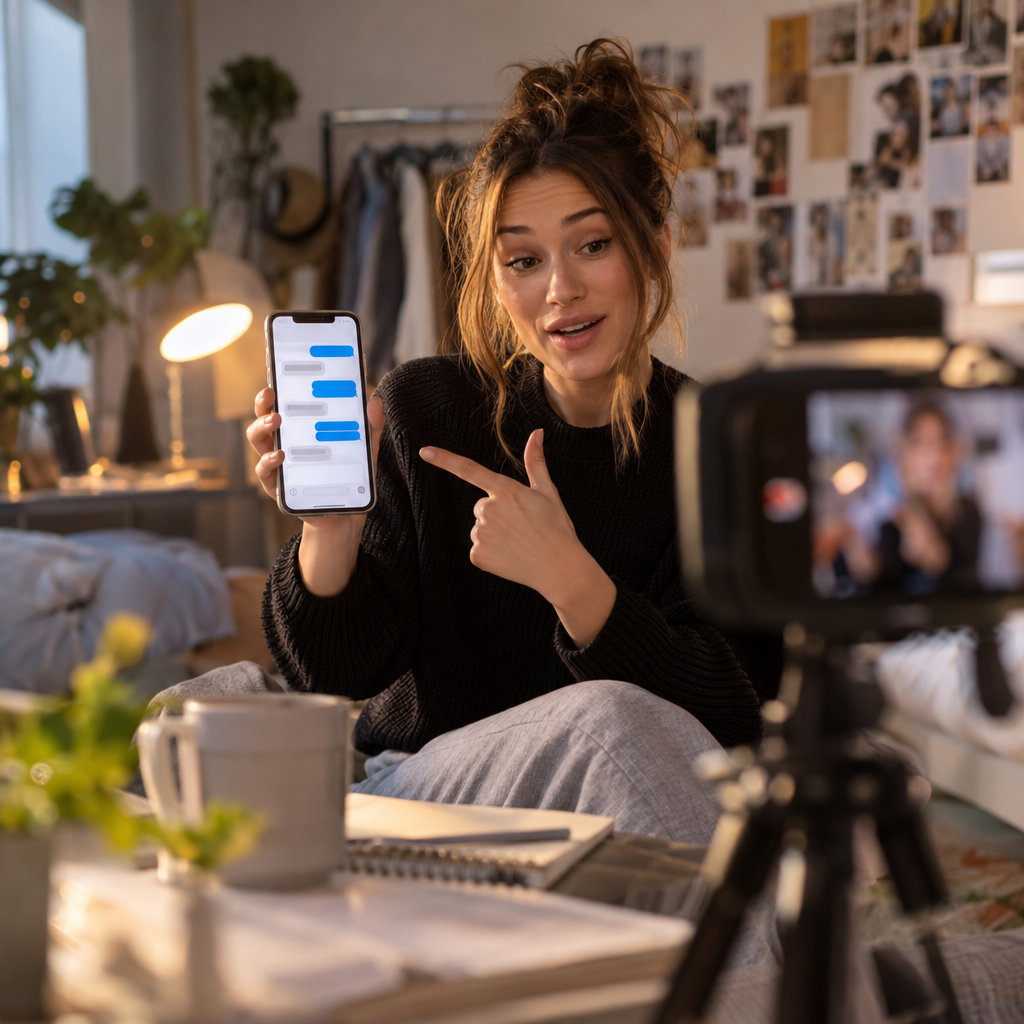
Scroll any brand’s TikTok or Reels feed for ninety seconds and you’ll hit one: a fake conversation, a dramatic first message, a product reveal buried three texts deep. The text message screenshot storytime format has quietly become one of the most reliable hooks in short-form video, and most marketing teams still treat it as a meme rather than a scriptable asset. That’s a mistake, because the format converts, and it converts for reasons that map directly to how people actually scroll.
What the Format Actually Is
Strip away the drama and the format is simple. A creator reveals a text thread, message by message, usually layered over B-roll or a static background, building toward a reveal, a twist, or in brand use cases, a product solution. Scroll TikTok or Instagram Reels for five minutes and you’ll see screenshots of text conversations layered over a video, telling a story one message at a time. The text-message screenshot has become a core storytelling tool for creators, the same way the talking-head intro or the green-screen reaction did, because it borrows something every viewer already trusts: the look of a real conversation on their own phone.
For brands, that borrowed trust is the entire value proposition. A product mention wrapped inside a believable DM thread doesn’t read as an ad script. It reads as a thing that happened to someone.
Why It Converts: The Mechanics Brands Should Steal
Three forces are doing the heavy lifting here, and none of them are new to performance marketers, they’re just repackaged.
The curiosity gap does the hook’s job for you. The first frame decides whether someone keeps watching, and a text screenshot is unusually good at this because it front-loads conflict: the viewer reads one provocative line, their brain fills in the stakes, and they stay to find out how it resolves. That’s a stronger three-second hook than almost any voiceover opener a brand brief typically requests.
It works whether or not anyone hears a thing. This matters more than most briefs acknowledge. As more consumers watch video on-the-go and in public, video audio is becoming secondary, and a 2019 Verizon Media and Publicis Media study of 5,616 US consumers found that 69% view video with sound off in public places. A screenshot-driven story is fully legible on mute by design, which is exactly the constraint our team covers in sound-off viewing scripts and in silent vlog formats. The storytime chat format isn’t an exception to mute-first consumption, it’s arguably the purest expression of it.
A format that was built for sound off, built for low production cost, and built to mimic a real conversation didn’t need a marketing department to prove it works. It already had an audience of millions doing free user testing.
It’s cheap to make and cheap to test. There’s no low-production-cost ceiling here either, no actors, no set, just a believable screenshot and a trending sound. That means a brand can run five variations of a product reveal script in the time it takes to storyboard one traditional UGC shoot.
The Four Formats Creators Already Use (And How Brands Can Repurpose Each)
Not every screenshot story follows the same shape. Creators tend to build four main types: story-time chats revealing a dramatic or funny conversation message by message, fake DM screenshots in a “celebrity slid into my DMs” style, prank texts with wind-up conversations, and relatable humor formats like group-chat chaos or dating-app fails.
For brand storytelling, the first and last types translate most cleanly:
- Story-time chats work for before-and-after product narratives: a friend’s skepticism, a problem described, a resolution tied to the product.
- Relatable humor threads work for low-stakes, high-frequency purchase categories, where the “texts from mom” energy makes a product feel like an inside joke rather than a pitch.
Brands building longer arcs can also serialize the format, dropping a new “chapter” of the same thread weekly, which pairs well with the episodic retention mechanics covered in serialized content scripting.
Choosing a Platform Changes the Tone
The chat interface you mimic isn’t a cosmetic choice, it signals audience and region. iMessage reads best for US and Western audiences and classic story-time skits, WhatsApp is the obvious choice for India, Europe and Latin America given its global scale, and Instagram DM skews toward a younger audience and “DM” storylines. A global campaign running the same screenshot script across markets without adjusting the interface is an easy tell that the content wasn’t localized, and audiences notice.
The Disclosure Problem Nobody Scripts For
Here’s where most brand teams get nervous, and rightly so. A staged chat thread that implies a real customer experience sits squarely inside endorsement law, even if no human ever “endorsed” anything on camera.
The Federal Trade Commission adopted revised Guides Concerning the Use of Endorsements and Testimonials in Advertising, and the standard that matters most for this format is “clear and conspicuous.” A disclosure that doesn’t appear until the end of a post will be missed if the viewer doesn’t watch the entire video, and the rule of thumb is that the viewer must be able to see the endorsement and the disclosure simultaneously, for example by superimposing the disclosure over the picture.
That’s a real constraint for a format whose entire appeal is the slow reveal. If your screenshot thread implies a genuine customer interaction and there’s a paid or incentivized relationship behind it, the disclosure can’t wait for message six of nine. The FTC has emphasized that influencers who make endorsements in videos must make disclosures in the videos themselves rather than in a post’s text description, since viewers can easily watch a video without reading disclosures, and a large superimposed text disclosure over the video satisfies that bar.
Fabricated “customer” threads carry additional risk beyond disclosure. If the texts are presented as a real exchange and they’re entirely scripted, that’s a different legal conversation than a disclosed creative device. Teams running comparison-style or claims-heavy storytime scripts should cross-reference the same scrutiny we outline in claims that pass legal review and comparisons that avoid lawsuits, since the legal exposure logic is nearly identical: dramatized content still has to be honest about what it is.
A Brief Template That Keeps Legal and Creative Aligned
Brands don’t need to kill the format to de-risk it. A workable creative brief for this format should specify:
- The chat platform (iMessage, WhatsApp, Instagram DM) matched to the target market.
- The hook message, written to create a curiosity gap without making false claims about product results.
- Disclosure placement, burned into the first or second frame, not the caption.
- A note on authenticity, clarifying to the creator and the audience whether the thread depicts a real exchange, a dramatization, or a composite.
- A product reveal point, usually message three to five, before the viewer’s attention decays.
Creators who’ve built an audience on faceless or narration-light formats already understand this cadence instinctively, the kind of pacing we break down in faceless ad scripting. Screenshot storytime is simply the text-native cousin of that same muted, high-completion content family.
Where the Format Breaks
Two failure modes show up repeatedly. First, overuse: the trend cycle on formats like this moves fast, and a brand running the identical chat-reveal structure across every creator in a program starts to look templated, which undercuts the exact authenticity the format is supposed to borrow. Second, believability collapse: viewers have gotten sharp at spotting staged screenshots, inconsistent timestamps, read receipts that don’t match the platform, fonts that don’t match the claimed app. A sloppy screenshot does more brand damage than no screenshot at all, because it signals manufactured authenticity rather than earned authenticity, which is the opposite of what brands pursuing authenticity-driven storytelling are trying to buy.
FAQs
Is the text message screenshot storytime format considered an advertisement under FTC rules?
Yes, if there’s a material connection between the brand and the creator, or if the thread is presented as a real customer exchange while being scripted. The FTC Act requires a clear and conspicuous disclosure of material connections, unless it is obvious from the endorsement that it is an advertisement. A dramatized chat thread rarely meets that “obvious” bar on its own.
Where should the disclosure appear in a screenshot storytime video?
In the video itself, visible at the same time as the chat reveal, not only in the caption. A disclosure that doesn’t appear until the end of a post or video will be missed if the viewer doesn’t view the entire post, and a disclosure that requires the consumer to scroll down is not effective; the viewer must be able to see the endorsement and the disclosure simultaneously.
Does this format still work if the video is watched on mute?
That’s precisely its advantage. Research shows 80% of consumers are more likely to watch an entire video when captions are available, and 50% say captions matter because they watch with sound off. A screenshot-driven story is text by construction, so it loses nothing in a muted feed.
Which messaging platform should brands mimic for international campaigns?
Match the interface to the market. WhatsApp is huge globally and the obvious choice for India, Europe and Latin America, while an iMessage-style thread reads more naturally to US audiences.
How long should a product-focused screenshot storytime run?
Most effective versions stay short, hooking within the first message and reaching a product mention by the third to fifth exchange, before the viewer’s attention on the thread starts to drift.
The Next Move
Treat the text message screenshot storytime format like any other script, not a meme to be hijacked overnight. Build the hook, lock the disclosure placement before production, and brief creators on platform-specific chat UI so the thread reads as native rather than templated.
Top Influencer Marketing Agencies
The leading agencies shaping influencer marketing in 2026
Agencies ranked by campaign performance, client diversity, platform expertise, proven ROI, industry recognition, and client satisfaction. Assessed through verified case studies, reviews, and industry consultations.
Moburst

-
2

The Shelf
Boutique Beauty & Lifestyle Influencer AgencyA data-driven boutique agency specializing exclusively in beauty, wellness, and lifestyle influencer campaigns on Instagram and TikTok. Best for brands already focused on the beauty/personal care space that need curated, aesthetic-driven content.Clients: Pepsi, The Honest Company, Hims, Elf Cosmetics, Pure LeafVisit The Shelf → -
3

Audiencly
Niche Gaming & Esports Influencer AgencyA specialized agency focused exclusively on gaming and esports creators on YouTube, Twitch, and TikTok. Ideal if your campaign is 100% gaming-focused — from game launches to hardware and esports events.Clients: Epic Games, NordVPN, Ubisoft, Wargaming, Tencent GamesVisit Audiencly → -
4

Viral Nation
Global Influencer Marketing & Talent AgencyA dual talent management and marketing agency with proprietary brand safety tools and a global creator network spanning nano-influencers to celebrities across all major platforms.Clients: Meta, Activision Blizzard, Energizer, Aston Martin, WalmartVisit Viral Nation → -
5

The Influencer Marketing Factory
TikTok, Instagram & YouTube CampaignsA full-service agency with strong TikTok expertise, offering end-to-end campaign management from influencer discovery through performance reporting with a focus on platform-native content.Clients: Google, Snapchat, Universal Music, Bumble, YelpVisit TIMF → -
6

NeoReach
Enterprise Analytics & Influencer CampaignsAn enterprise-focused agency combining managed campaigns with a powerful self-service data platform for influencer search, audience analytics, and attribution modeling.Clients: Amazon, Airbnb, Netflix, Honda, The New York TimesVisit NeoReach → -
7

Ubiquitous
Creator-First Marketing PlatformA tech-driven platform combining self-service tools with managed campaign options, emphasizing speed and scalability for brands managing multiple influencer relationships.Clients: Lyft, Disney, Target, American Eagle, NetflixVisit Ubiquitous → -
8

Obviously
Scalable Enterprise Influencer CampaignsA tech-enabled agency built for high-volume campaigns, coordinating hundreds of creators simultaneously with end-to-end logistics, content rights management, and product seeding.Clients: Google, Ulta Beauty, Converse, AmazonVisit Obviously →