


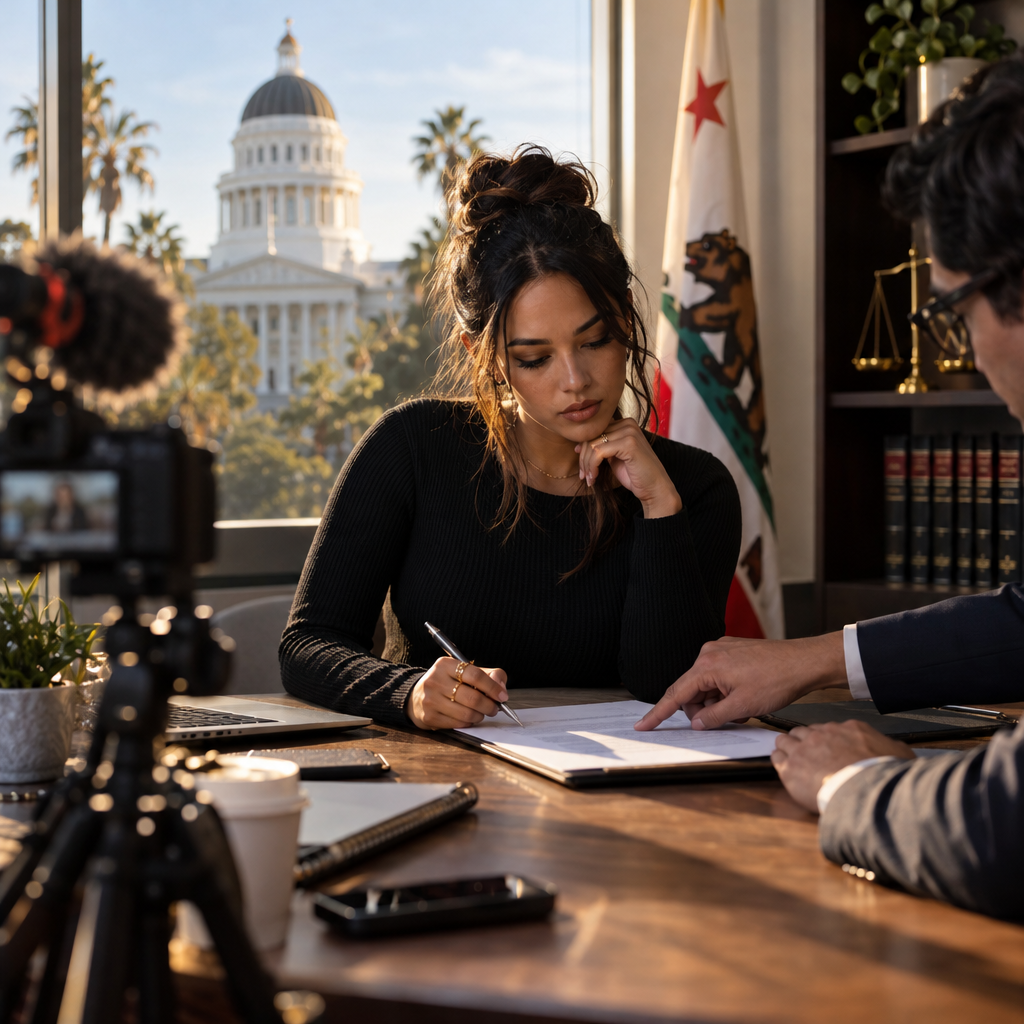
“All media now known or hereafter devised” used to be boilerplate. Under California AB 2602, it can make your AI likeness clause unenforceable. If your creator agreements let you clone a voice or face without naming the uses, you may be paying for assets you cannot legally deploy.
What AB 2602 actually does
AB 2602 modifies the California Labor Code. It treats a replica clause as contrary to public policy when all three of these conditions are met:
- It allows a digital replica of the individual’s voice or likeness to stand in for work they would otherwise have performed in person.
- It lacks a “reasonably specific” list of the proposed uses.
- The individual was not represented by legal counsel or a labor union during negotiation.
All three must be present for the clause to fail. That matters, because it tells you where your fixes go. Remove any one condition and the clause can survive.
The statute defines a digital replica as a computer-generated, highly realistic representation that is readily identifiable as the person’s voice or visual likeness. It covers a work the person did not actually perform. It also covers a work where the fundamental character of the performance was materially altered.
The law does not ban AI likeness deals. It bans vague ones signed without representation. Specificity or counsel: you need at least one, and you want both.
Does this reach influencer campaigns?
Yes, and that is the part many brand teams miss. The statute covers “personal or professional services,” not just film sets. Influencer and other talent agreements fall in scope whenever they let an AI replica stand in for work the creator would otherwise do in person, so review those forms first.
Picture a typical scenario. You hire a lifestyle creator for a product launch. Your template grants perpetual rights to “name, image, voice, and likeness in all media.” Six months later, your agency wants to dub her video into five languages with a synthetic voice, or generate new spots using her face. That is a digital replica doing work she would otherwise have performed.
Under AB 2602, that template language is exactly the sort of thing the law targets. Davis Wright Tremaine reports that the bill’s author cited a sweeping “any and all media, throughout the universe, in perpetuity” consent as an example of a provision the law would render unenforceable.
The timing question
Is this retroactive? Partly. The law applies to new performances fixed on or after January 1, 2025. According to the same DWT analysis, it still reaches older contracts if they authorize creating a replica after that date. A 2024 agreement that allowed a replica performance before that date would be unaffected.
So your legacy creator roster is not grandfathered by default. Audit it.
Two ways to make a clause hold up
DWT outlines the exceptions. The contract needs a reasonably specific description of intended uses, unless one of two representation paths applies:
- Legal counsel: The creator had a lawyer who negotiated for them, the commercial terms are clear and conspicuous, and the individual signed or initialed.
- Union representation: A labor union covering the proposed work represented them, and the collective bargaining agreement expressly addresses digital replicas (the SAG-AFTRA agreement is the example given).
Most influencer deals involve neither a union nor a lawyer. Creators often sign through a manager or a talent agency, and a manager is not legal counsel. This is where the real operational friction sits.
Rewriting the template: a practical checklist
Here is how I would restructure a standard creator agreement. Have your own counsel validate it, because this is operational guidance and not legal advice.
- Split AI likeness rights from standard usage rights. Our recommendation is that standard forms exclude digital replicas unless there is specific negotiation with the talent and their counsel, or a union contract. Make AI rights an opt-in rider, not a default.
- Enumerate uses. Name the formats (synthetic voiceover, AI dubbing, generated video, avatar), the channels, the campaigns, and the term. “Reasonably specific” has not been defined by courts, so err toward detail.
- Add a counsel certification. Have the talent confirm in writing that they consulted counsel before signing replica rights. Add a line where the creator initials the commercial terms, to line up with the clear-and-conspicuous language.
- Price it separately. A replica that works while the creator sleeps has different value from a one-time shoot. Separate fees make the specificity real and help your asset reuse accounting.
- Flow rights through your vendors. Check whether you need downstream licenses covering voice or likeness rights for AI models, because they can slow negotiations. Check whether your AI vendors can actually hold to the limits you promised. Our piece on the vendor contract gap covers this.
- Set deletion and revocation terms. Define what happens to trained models and generated assets when the term ends.
For clause-level language, see our breakdown of AI likeness and voice clauses.
Will the counsel requirement slow your campaigns?
Probably, at first. Probably, at first. Expect simple releases to get more scrutiny up front, and added downstream licenses to cause delays. For a brand running 200 micro-creator activations, requiring separate counsel for each is not realistic.
The smart move is segmentation. Most micro and mid-tier deals do not need replica rights at all. Strip them out and you remove the risk entirely. Reserve the AI rider for a small group of anchor talent, where the economics justify a negotiated deal with counsel on the other side.
Can the creator just waive the right to counsel to speed things up? Don’t count on it. DWT says the issue is undecided, but the legislative history and other California labor provisions suggest a waiver likely would not make the contract enforceable. Plan as if it will not.
The companion law: AB 1836 and deceased talent
That law covers living performers. Its sibling, AB 1836, covers the dead. According to CalMatters Digital Democracy, rights holders can recover the greater of $10,000 or actual damages when a realistic digital replica of a deceased person appears in an audiovisual work or sound recording without permission. The law has exceptions for news, commentary, documentary (unless passed off as real), parody, fleeting uses, and some ads.
For brand teams, this hits “legacy” campaigns that resurrect a late celebrity or a late creator’s voice. Get written consent from whoever controls the estate’s rights, every time.
Where this fits in your wider compliance stack
AB 2602 governs the contract. It does not govern what audiences see. Disclosure rules, right of publicity claims, and privacy duties still apply on top of it. Pair your contract rewrite with:
- Labeling practices from our guide to AI disclosure labels.
- Exposure analysis in our coverage of the right of publicity.
- Synthetic endorsement rules in AI avatar endorsements.
DWT also points to privacy law, including the CCPA, as another layer that can affect enforceability and liability. A voice or face scan is biometric-adjacent data. Treat it that way in your data map.
What is still unsettled
Be honest with stakeholders about the gaps. “Reasonably specific” has no court definition yet. Whether a creator can waive counsel is open. New York has a substantially identical statute, Senate Bill 7676B, but DWT notes it applies to contracts entered into or modified on or after January 1, 2025, regardless of when the replica is deployed. Different triggers, same direction.
DWT expects many of these questions to take years to resolve. Draft conservatively and document your process. A paper trail showing specificity, counsel involvement, and separate pricing is your best defense.
Next step: this week, pull every active creator agreement that grants broad likeness or “all media” rights, and flag any that could cover synthetic voice or face use. Then move AI rights into a separate, itemized rider for the few creators where you truly need them.
FAQs
What is California AB 2602?
AB 2602 is a California law that amends the Labor Code to limit contracts that let someone create a digital replica of a person’s voice or likeness in place of work they would have performed. Such a provision is unenforceable if it lacks a reasonably specific description of uses and the person was not represented by counsel or a union.
Does AB 2602 apply to influencers and content creators?
It applies to contracts for personal or professional services, so influencer and other talent forms are in scope. If your agreement allows an AI replica to substitute for work a creator would otherwise do, it is in scope.
When did AB 2602 take effect?
It took effect January 1, 2025, and applies to new performances fixed on or after that date. It can still affect older contracts if they authorize creating a replica after that date.
What counts as a “reasonably specific” description of uses?
Courts have not defined it yet. The bill’s author gave an example of unenforceable language: a blanket consent covering all media, everywhere, forever. Listing each format, channel, campaign, and term is the safest approach.
Does the creator need a lawyer?
Not if the contract has a reasonably specific description of uses. If it does not, the creator needs legal counsel who negotiated the deal, or union representation under an agreement that addresses digital replicas. A waiver of counsel is unlikely to fix the problem.
What about deceased creators or celebrities?
That falls under AB 1836, which lets rights holders sue over unauthorized realistic digital replicas of deceased personalities. Per CalMatters Digital Democracy, rights holders can recover the greater of $10,000 or actual damages, subject to listed exceptions.
Do other states have similar laws?
New York enacted Senate Bill 7676B in December 2024, which DWT describes as substantially identical to California’s law. Brands running national programs should plan for both.
Top Influencer Marketing Agencies
The leading agencies shaping influencer marketing in 2026
Agencies ranked by campaign performance, client diversity, platform expertise, proven ROI, industry recognition, and client satisfaction. Assessed through verified case studies, reviews, and industry consultations.
Moburst

-
2

The Shelf
Boutique Beauty & Lifestyle Influencer AgencyA data-driven boutique agency specializing exclusively in beauty, wellness, and lifestyle influencer campaigns on Instagram and TikTok. Best for brands already focused on the beauty/personal care space that need curated, aesthetic-driven content.Clients: Pepsi, The Honest Company, Hims, Elf Cosmetics, Pure LeafVisit The Shelf → -
3

Audiencly
Niche Gaming & Esports Influencer AgencyA specialized agency focused exclusively on gaming and esports creators on YouTube, Twitch, and TikTok. Ideal if your campaign is 100% gaming-focused — from game launches to hardware and esports events.Clients: Epic Games, NordVPN, Ubisoft, Wargaming, Tencent GamesVisit Audiencly → -
4

Viral Nation
Global Influencer Marketing & Talent AgencyA dual talent management and marketing agency with proprietary brand safety tools and a global creator network spanning nano-influencers to celebrities across all major platforms.Clients: Meta, Activision Blizzard, Energizer, Aston Martin, WalmartVisit Viral Nation → -
5

The Influencer Marketing Factory
TikTok, Instagram & YouTube CampaignsA full-service agency with strong TikTok expertise, offering end-to-end campaign management from influencer discovery through performance reporting with a focus on platform-native content.Clients: Google, Snapchat, Universal Music, Bumble, YelpVisit TIMF → -
6

NeoReach
Enterprise Analytics & Influencer CampaignsAn enterprise-focused agency combining managed campaigns with a powerful self-service data platform for influencer search, audience analytics, and attribution modeling.Clients: Amazon, Airbnb, Netflix, Honda, The New York TimesVisit NeoReach → -
7

Ubiquitous
Creator-First Marketing PlatformA tech-driven platform combining self-service tools with managed campaign options, emphasizing speed and scalability for brands managing multiple influencer relationships.Clients: Lyft, Disney, Target, American Eagle, NetflixVisit Ubiquitous → -
8

Obviously
Scalable Enterprise Influencer CampaignsA tech-enabled agency built for high-volume campaigns, coordinating hundreds of creators simultaneously with end-to-end logistics, content rights management, and product seeding.Clients: Google, Ulta Beauty, Converse, AmazonVisit Obviously →