


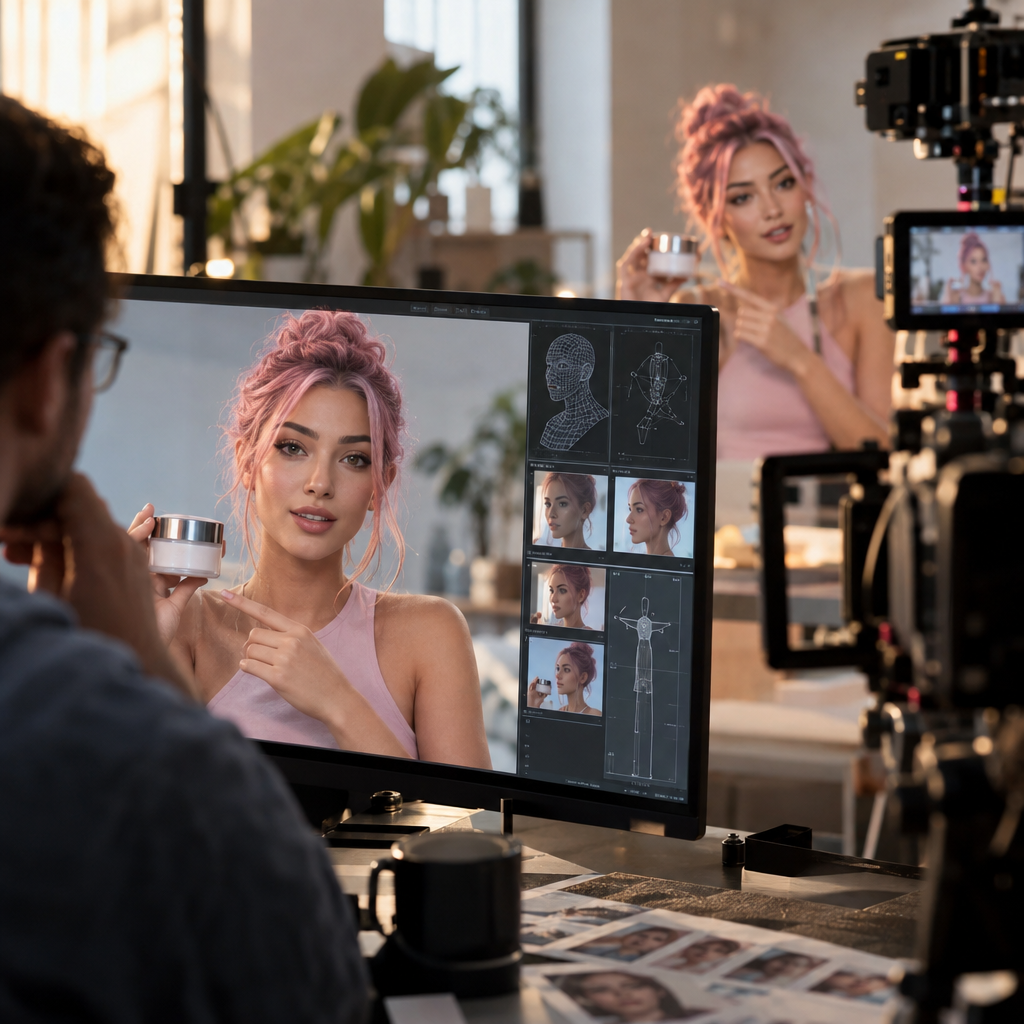
Forty three percent of marketers say they’ve already tested AI avatars or synthetic spokespeople in paid campaigns, yet fewer than one in five have a written disclosure policy for them. That gap is where lawsuits live. Synthetic media disclosure laws are no longer a theoretical compliance exercise. States have passed statutes, the FTC has sharpened its guidance, and platforms are rolling out labeling tools that make “we didn’t know” an expensive excuse.
If your brand has run a single campaign featuring a digital human, a voice clone, or a deepfaked spokesperson pitching a product they never touched, this is the article to forward to legal before your next creative review.
What Actually Counts as “Synthetic Media” Here
Regulators and platforms define synthetic media broadly, and that’s intentional. It covers AI generated avatars that deliver scripted endorsements, voice clones trained on a real person’s speech patterns, fully synthetic spokespeople with no human source at all, and digitally altered footage that makes a real creator appear to say or do something they didn’t. If an audience could reasonably mistake the output for an authentic human performance or statement, it likely falls under disclosure requirements somewhere in your operating footprint.
That last clause matters. Your operating footprint isn’t just where your headquarters sits. It’s every state and country where your ad runs, because synthetic media rules are being written state by state in the U.S., with no uniform federal standard yet.
A campaign can be fully compliant in Texas and legally exposed in California simply because the avatar disclosure threshold differs by state, not by platform.
The Patchwork Problem: No Single Rulebook
California, Illinois, and a handful of other states have enacted laws specifically addressing synthetic performers and AI generated likenesses, often building on existing right of publicity statutes. Some require explicit on screen or verbal disclosure whenever a synthetic likeness is used commercially. Others focus narrowly on political or election content and leave commercial endorsements in a gray zone, which brands have been all too happy to exploit until now.
Meanwhile, the FTC’s position has stayed consistent in spirit even as the technology shifted underneath it: if an endorsement could mislead a reasonable consumer about who or what is speaking, it needs clear disclosure. The agency has already brought enforcement actions tied to AI generated reviews and fake endorsers, signaling it views synthetic spokespeople as a natural extension of its existing endorsement guidance, not a loophole around it. You can review the FTC’s current guidance directly at ftc.gov.
Outside the U.S., the UK’s Information Commissioner’s Office has weighed in on AI generated content largely through a data protection lens, particularly where synthetic voices or faces are built from real people’s biometric data without clear consent. Check current guidance at ico.org.uk before running any campaign that trains an avatar on a real creator’s likeness.
For a deeper look at how these overlapping statutes interact with existing ad rules, our breakdown of state AI marketing rules walks through the privacy angle most legal teams miss on first pass.
Why AI Avatars Are a Different Risk Category Than Human Influencers
Human influencer disclosure is a solved problem, mostly. You know the rules: hashtag it, tag it, put it in the first three lines. AI avatars break that playbook in three specific ways.
First, there’s no real person to hold accountable for the statement, which shifts nearly all liability onto the brand and its agency. Second, synthetic spokespeople can be deployed at a scale and speed no human roster could match, meaning a disclosure mistake doesn’t happen once, it happens across hundreds of ad variants simultaneously. Third, audiences are measurably worse at detecting synthetic content than platforms assume. A recent Statista survey on AI content trust found a majority of consumers couldn’t reliably identify AI generated video when it wasn’t labeled, which is exactly the consumer confusion regulators are trying to prevent.
This is also why we’ve written separately about state AI liability exposure for creator scoring tools. The underlying legal theory is similar: when a machine stands in for a human judgment, the brand that deployed it inherits the risk that human would normally absorb.
Disclosure Isn’t Just a Label, It’s a Workflow
Slapping “AI generated” in a video description after the fact doesn’t satisfy most state requirements, and it definitely doesn’t satisfy the FTC’s “clear and conspicuous” standard. Disclosure needs to be baked into production, not bolted on during publishing.
A workable framework looks like this:
- Disclose at the source, not just the platform. If your avatar is speaking on camera, the disclosure should appear in the same frame, not buried in a caption the platform might truncate.
- Match disclosure language to the medium. A voice-only ad needs an audible disclosure, since a visual tag does nothing for a podcast listener.
- Audit your vendor contracts. Many AI video and avatar vendors don’t guarantee compliance, they guarantee output. That distinction belongs in writing before you sign anything.
- Keep a disclosure log per asset. When a regulator or platform asks how a specific ad was labeled, “we think we did it correctly” isn’t an answer that holds up.
Our piece on vetting generative AI video vendors covers the contract language worth adding before your next avatar campaign goes into production, and it pairs well with this disclosure checklist.
Platforms Are Moving Faster Than Statutes
Meta, TikTok, and YouTube have all rolled out some version of mandatory AI content labeling, sometimes ahead of the law itself. Meta’s “AI info” label and TikTok’s content credentials tagging mean the platform can flag your content as synthetic even if you never disclosed it yourself, which looks far worse to an audience than a voluntary label would have. You can review Meta’s current policy framework at business.meta.com and TikTok’s ad policies at ads.tiktok.com.
Letting a platform auto-flag your content as synthetic is reputationally worse than disclosing it yourself, because it reads as concealment rather than compliance.
This dynamic mirrors what we’ve seen with the Instagram paid partnership toggle, where platform mechanics and FTC expectations don’t always line up perfectly, leaving brands to bridge the gap manually. The safest posture is to assume platform labeling is a floor, not a ceiling, and disclose beyond what the interface technically requires.
Metadata Is Becoming the Paper Trail Regulators Want
As enforcement matures, expect regulators to ask not just “did you disclose” but “can you prove it, and can you prove it consistently across every platform the asset touched.” That’s pushing synthetic media compliance toward metadata standards like C2PA content credentials, which embed provenance information directly into the file.
Brands running avatar campaigns across multiple platforms should look closely at cross-platform metadata standards, since a disclosure that lives only in a caption disappears the moment a user screenshots or reposts the content. Metadata travels with the file. Captions don’t.
Building the Internal Playbook
Legal, brand safety, and creative teams need a shared checklist before any synthetic spokesperson campaign launches. At minimum, that means confirming jurisdiction specific disclosure requirements for every market the ad will run in, verifying the avatar vendor’s data sourcing and consent documentation, embedding disclosure in the asset itself rather than relying on platform UI, and logging every published version for audit purposes.
None of this needs to slow down production once it’s systematized. According to HubSpot’s marketing operations research, teams that build compliance checkpoints into creative workflows ship campaigns faster over time, not slower, because they stop re-litigating the same legal questions on every brief.
Agencies managing multiple avatar vendors should also revisit sourcing liability directly. Our guide on AI creator sourcing liability breaks down what contract language actually protects you versus what just sounds protective.
The Takeaway
Treat synthetic media disclosure as a production requirement, not a legal afterthought: build the label into the asset, document every version, and assume platform tools are the minimum bar, not the finish line. Brands that get ahead of this now will be running compliant avatar campaigns while competitors are still explaining themselves to a state attorney general.
FAQs
Do AI avatar endorsements legally require disclosure in every state?
Not uniformly. A growing number of states have specific synthetic media or AI likeness statutes, while others rely on existing advertising and right of publicity law to cover the same ground. Brands running national campaigns should assume the strictest applicable state standard, since that’s the one most likely to trigger enforcement.
Does the FTC treat AI avatars differently from human influencers?
The FTC’s core standard stays the same: disclosures must be clear and conspicuous enough that a reasonable consumer isn’t misled. With AI avatars, the concern shifts toward whether consumers understand they’re watching a synthetic spokesperson at all, not just whether a paid partnership exists.
Is a caption disclosure enough for a synthetic avatar video?
Usually not. Captions can be cropped, truncated, or lost when content is reposted or clipped. Embedding disclosure visually or audibly within the asset itself is the safer standard, and it holds up better if a platform or regulator reviews the content later.
Who is liable if an AI avatar makes a false or exaggerated claim?
Liability typically falls on the brand and agency that deployed the avatar, since there’s no human endorser to hold separately accountable. This makes script review and claims substantiation even more critical than with human talent.
Can platform AI labels replace a brand’s own disclosure?
Platform labels are a baseline, not a substitute. Relying solely on automatic tagging risks inconsistent labeling across formats and reposts, and it can look like concealment if the platform flags content you didn’t disclose yourself.
Top Influencer Marketing Agencies
The leading agencies shaping influencer marketing in 2026
Agencies ranked by campaign performance, client diversity, platform expertise, proven ROI, industry recognition, and client satisfaction. Assessed through verified case studies, reviews, and industry consultations.
Moburst

-
2

The Shelf
Boutique Beauty & Lifestyle Influencer AgencyA data-driven boutique agency specializing exclusively in beauty, wellness, and lifestyle influencer campaigns on Instagram and TikTok. Best for brands already focused on the beauty/personal care space that need curated, aesthetic-driven content.Clients: Pepsi, The Honest Company, Hims, Elf Cosmetics, Pure LeafVisit The Shelf → -
3

Audiencly
Niche Gaming & Esports Influencer AgencyA specialized agency focused exclusively on gaming and esports creators on YouTube, Twitch, and TikTok. Ideal if your campaign is 100% gaming-focused — from game launches to hardware and esports events.Clients: Epic Games, NordVPN, Ubisoft, Wargaming, Tencent GamesVisit Audiencly → -
4

Viral Nation
Global Influencer Marketing & Talent AgencyA dual talent management and marketing agency with proprietary brand safety tools and a global creator network spanning nano-influencers to celebrities across all major platforms.Clients: Meta, Activision Blizzard, Energizer, Aston Martin, WalmartVisit Viral Nation → -
5

The Influencer Marketing Factory
TikTok, Instagram & YouTube CampaignsA full-service agency with strong TikTok expertise, offering end-to-end campaign management from influencer discovery through performance reporting with a focus on platform-native content.Clients: Google, Snapchat, Universal Music, Bumble, YelpVisit TIMF → -
6

NeoReach
Enterprise Analytics & Influencer CampaignsAn enterprise-focused agency combining managed campaigns with a powerful self-service data platform for influencer search, audience analytics, and attribution modeling.Clients: Amazon, Airbnb, Netflix, Honda, The New York TimesVisit NeoReach → -
7

Ubiquitous
Creator-First Marketing PlatformA tech-driven platform combining self-service tools with managed campaign options, emphasizing speed and scalability for brands managing multiple influencer relationships.Clients: Lyft, Disney, Target, American Eagle, NetflixVisit Ubiquitous → -
8

Obviously
Scalable Enterprise Influencer CampaignsA tech-enabled agency built for high-volume campaigns, coordinating hundreds of creators simultaneously with end-to-end logistics, content rights management, and product seeding.Clients: Google, Ulta Beauty, Converse, AmazonVisit Obviously →