


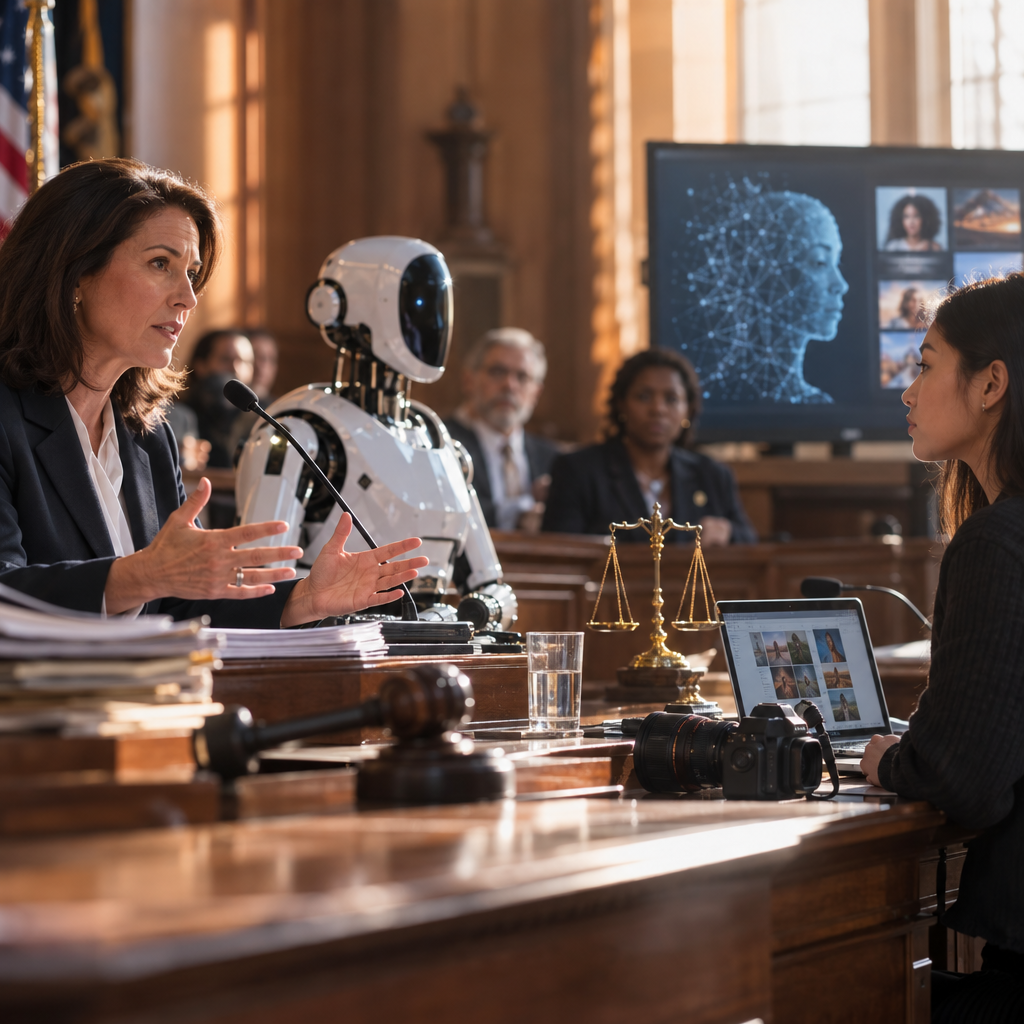
Twenty-six states now have AI-specific liability statutes on the books or moving through legislatures, and not one of them was written with influencer marketing in mind. Yet the creator decisioning tools your team uses to score talent, predict engagement, and allocate budget are exactly the kind of “automated decision systems” these laws target. If you’re running campaigns across state lines (and who isn’t), state AI liability laws are quietly becoming a brand risk issue nobody flagged in the vendor contract.
The Patchwork Nobody Budgeted For
Marketing compliance teams spent the last few years mapping state privacy laws. Now they’re staring down a second, messier layer: state AI liability statutes that regulate how automated systems make consequential decisions about people. Colorado’s AI Act, Illinois’s amendments to its Human Rights Act covering algorithmic discrimination, and Texas’s Responsible AI Governance framework all share a common thread. They require businesses deploying “high risk” automated decision systems to document how those systems work, test for bias, and give affected parties a way to understand or contest outcomes.
Here’s the catch for brand teams: most of these laws define “consequential decision” broadly enough to sweep in creator selection, pay rate determination, and campaign eligibility scoring. A tool that ranks creators by predicted conversion rate and auto-excludes anyone below a threshold is making a consequential decision about that creator’s economic opportunity. That’s precisely the scenario these laws were built to catch, even though lawmakers were thinking about hiring algorithms and loan approvals, not influencer marketing platforms.
If your creator decisioning tool can’t explain why it ranked one creator above another, you don’t have an efficiency advantage. You have an unexplainable liability sitting inside your martech stack.
Creator Decisioning Tools: Where the Exposure Actually Lives
Let’s be specific about what “creator decisioning tools” means in this context, because vagueness is how legal risk slips through. We’re talking about:
- AI-driven influencer discovery platforms that score creators on predicted performance
- Budget allocation engines that auto-distribute spend across a roster based on algorithmic forecasts
- Fraud and brand-safety filters that disqualify creators based on audience quality signals
- Content approval systems that flag or auto-reject creator drafts before human review
Each of these makes a decision that affects a real person’s income and opportunity. Under emerging state frameworks, that triggers documentation and transparency obligations: impact assessments, bias audits, and in some states, a disclosure requirement telling the creator an algorithm was involved in the decision. Sound familiar? It should. This is the same transparency logic that reshaped disclosure standards across platforms, just applied one layer deeper, to the decisioning infrastructure rather than the content itself.
Most brands have no idea whether their influencer marketing platform even keeps the kind of audit trail these laws demand. That’s not a hypothetical gap. It’s the gap regulators are specifically designed to find.
Which States Are Setting the Pace
Colorado’s law remains the most comprehensive template, requiring “reasonable care” to avoid algorithmic discrimination and mandating impact assessments for high-risk systems. California has layered AI transparency requirements on top of its existing privacy framework, extending obligations around automated decision-making technology to a wide swath of commercial applications. Illinois continues to expand protections around algorithmic bias in contexts affecting economic opportunity, a category creator payment and selection tools fit into more comfortably than most brands would like.
Texas took a lighter-touch approach with its Responsible AI Governance Act, focusing on government use cases but signaling private-sector rules are coming next. Utah passed an AI Policy Act requiring disclosure when consumers interact with generative AI, a provision with obvious implications for AI-assisted creator content and virtual influencers.
The pattern across all of these: transparency, documentation, and a path for impacted individuals (in this case, creators) to understand how a decision was made about them. None of these states coordinated with each other. That’s the patchwork problem in a nutshell, and it mirrors exactly what happened with state-level AI marketing rules more broadly, a trend we unpacked in state AI marketing rules.
Why This Isn’t Just a Legal Problem
It’s tempting to hand this off entirely to the legal team and move on. Resist that urge. The operational reality is that your influencer platform vendor, not your in-house team, controls most of the technical levers these laws regulate: model documentation, bias testing, audit logging. If your vendor can’t produce that documentation on request, you inherit the liability regardless of who built the algorithm.
This is the same dynamic we’ve seen play out with generative AI video vendors, where brands discovered too late that their production partner’s AI tools carried undisclosed training data risks. Creator decisioning tools are the next frontier of that same vetting problem, just applied to talent selection instead of content generation.
Marketers love to talk about efficiency gains from AI-powered creator matching. Fair enough, the data backs it up. eMarketer’s research consistently shows AI-assisted discovery tools cut campaign setup time significantly. But efficiency and compliance aren’t mutually exclusive. You can have both if you ask the right questions before signing the contract, not after a state attorney general sends one.
Building a Compliance Framework That Doesn’t Slow You Down
Here’s where practical steps matter more than legal theory. A few moves that actually reduce exposure without gutting your program’s speed:
- Demand model documentation from vendors. Ask specifically how creator scores are calculated, what data feeds the model, and whether the vendor has run a bias audit. If they can’t answer, that’s your answer.
- Build an audit trail for every algorithmic decision. Who got selected, who got excluded, and why. This is the same discipline we cover in AI approval audit trails, and it applies directly to decisioning tools, not just content sign-off.
- Classify your tools by risk level. A discovery tool that surfaces suggestions for human review carries less liability than one that auto-executes payment or exclusion decisions. Know which category each tool in your stack falls into.
- Map your vendor contracts against state requirements. Most influencer platform agreements were written before these statutes existed. Revisit them with the same scrutiny applied to creator platform data audits.
- Keep a human in the loop for consequential decisions. Full automation of pay rate or eligibility decisions is where the legal exposure concentrates fastest.
None of this requires abandoning AI-powered creator tools. It requires treating them like the regulated decision systems they’ve become, rather than the neutral productivity software they were marketed as.
The Hallucination Problem Compounds the Liability
There’s a second layer worth flagging: AI decisioning tools don’t just rank creators, they sometimes generate flawed data about them. Inflated engagement predictions, miscategorized audience demographics, fabricated brand safety scores. When those errors feed into a consequential decision, you’re not just facing an AI liability claim, you’re facing the same exposure we detailed in AI hallucinated product claims, except applied to the creator’s professional reputation rather than a product’s features.
Brands that skip vendor validation on this front are stacking two liability categories on top of each other. That’s an expensive mistake to discover during a state investigation rather than a vendor review meeting.
Industry benchmarking from Statista shows AI adoption in influencer marketing platforms accelerating faster than compliance infrastructure is catching up, a gap that regulators in states like Colorado and California have explicitly cited as justification for mandatory impact assessments. The FTC has also signaled increased scrutiny of automated endorsement and matching tools, reinforcing that this isn’t purely a state-level concern.
What Brand Teams Should Do Before Next Quarter’s Campaign Planning
Run a quick inventory: list every tool in your influencer workflow that makes an automated recommendation or decision, note which state’s residents it affects, and flag any tool without documented bias testing. That single exercise will surface most of your exposure in an afternoon, long before a regulator or a plaintiff’s attorney does it for you.
Frequently Asked Questions
Do state AI liability laws actually apply to influencer marketing platforms?
Yes, if the platform makes or materially influences a consequential decision, such as creator selection, pay determination, or campaign eligibility. Most current statutes define “high-risk automated decision system” broadly enough to include these use cases, even though lawmakers weren’t thinking specifically about influencer marketing when drafting them.
Which state has the strictest AI liability requirements for marketing tools right now?
Colorado’s AI Act is currently the most comprehensive, requiring documented impact assessments and reasonable care standards for high-risk systems. California’s layered privacy and AI transparency rules are close behind, and Illinois continues to expand algorithmic discrimination protections tied to economic opportunity.
Who is liable if a vendor’s AI tool causes a compliance violation, the brand or the platform?
Both can be, depending on the contract and the state. Brands typically can’t fully offload liability to a vendor, especially if they continued using a tool after becoming aware of documentation gaps. This is why vendor contract review matters as much as the legal statute itself.
What documentation should brands request from AI creator discovery vendors?
Ask for model documentation explaining scoring criteria, evidence of bias testing or impact assessments, data sources used to train or inform the model, and a clear audit trail showing how individual decisions were generated. If a vendor can’t produce these, treat that as a red flag, not a formality.
Does this affect small and mid-size brands, or just large advertisers?
It affects anyone using automated decisioning tools to manage creator relationships, regardless of company size. Several state statutes apply based on the nature of the automated decision rather than company revenue thresholds, so smaller brands using off-the-shelf AI discovery tools carry the same documentation obligations as larger advertisers.
Next step: Before your next campaign cycle, pull the model documentation from every AI-powered creator tool in your stack. If a vendor can’t show you how it scores, ranks, or excludes creators, that’s the liability gap you need to close first.
Frequently Asked Questions
Do state AI liability laws actually apply to influencer marketing platforms?
Yes, if the platform makes or materially influences a consequential decision, such as creator selection, pay determination, or campaign eligibility. Most current statutes define “high-risk automated decision system” broadly enough to include these use cases, even though lawmakers weren’t thinking specifically about influencer marketing when drafting them.
Which state has the strictest AI liability requirements for marketing tools right now?
Colorado’s AI Act is currently the most comprehensive, requiring documented impact assessments and reasonable care standards for high-risk systems. California’s layered privacy and AI transparency rules are close behind, and Illinois continues to expand algorithmic discrimination protections tied to economic opportunity.
Who is liable if a vendor’s AI tool causes a compliance violation, the brand or the platform?
Both can be, depending on the contract and the state. Brands typically can’t fully offload liability to a vendor, especially if they continued using a tool after becoming aware of documentation gaps. This is why vendor contract review matters as much as the legal statute itself.
What documentation should brands request from AI creator discovery vendors?
Ask for model documentation explaining scoring criteria, evidence of bias testing or impact assessments, data sources used to train or inform the model, and a clear audit trail showing how individual decisions were generated. If a vendor can’t produce these, treat that as a red flag, not a formality.
Does this affect small and mid-size brands, or just large advertisers?
It affects anyone using automated decisioning tools to manage creator relationships, regardless of company size. Several state statutes apply based on the nature of the automated decision rather than company revenue thresholds, so smaller brands using off-the-shelf AI discovery tools carry the same documentation obligations as larger advertisers.
Top Influencer Marketing Agencies
The leading agencies shaping influencer marketing in 2026
Agencies ranked by campaign performance, client diversity, platform expertise, proven ROI, industry recognition, and client satisfaction. Assessed through verified case studies, reviews, and industry consultations.
Moburst

-
2

The Shelf
Boutique Beauty & Lifestyle Influencer AgencyA data-driven boutique agency specializing exclusively in beauty, wellness, and lifestyle influencer campaigns on Instagram and TikTok. Best for brands already focused on the beauty/personal care space that need curated, aesthetic-driven content.Clients: Pepsi, The Honest Company, Hims, Elf Cosmetics, Pure LeafVisit The Shelf → -
3

Audiencly
Niche Gaming & Esports Influencer AgencyA specialized agency focused exclusively on gaming and esports creators on YouTube, Twitch, and TikTok. Ideal if your campaign is 100% gaming-focused — from game launches to hardware and esports events.Clients: Epic Games, NordVPN, Ubisoft, Wargaming, Tencent GamesVisit Audiencly → -
4

Viral Nation
Global Influencer Marketing & Talent AgencyA dual talent management and marketing agency with proprietary brand safety tools and a global creator network spanning nano-influencers to celebrities across all major platforms.Clients: Meta, Activision Blizzard, Energizer, Aston Martin, WalmartVisit Viral Nation → -
5

The Influencer Marketing Factory
TikTok, Instagram & YouTube CampaignsA full-service agency with strong TikTok expertise, offering end-to-end campaign management from influencer discovery through performance reporting with a focus on platform-native content.Clients: Google, Snapchat, Universal Music, Bumble, YelpVisit TIMF → -
6

NeoReach
Enterprise Analytics & Influencer CampaignsAn enterprise-focused agency combining managed campaigns with a powerful self-service data platform for influencer search, audience analytics, and attribution modeling.Clients: Amazon, Airbnb, Netflix, Honda, The New York TimesVisit NeoReach → -
7

Ubiquitous
Creator-First Marketing PlatformA tech-driven platform combining self-service tools with managed campaign options, emphasizing speed and scalability for brands managing multiple influencer relationships.Clients: Lyft, Disney, Target, American Eagle, NetflixVisit Ubiquitous → -
8

Obviously
Scalable Enterprise Influencer CampaignsA tech-enabled agency built for high-volume campaigns, coordinating hundreds of creators simultaneously with end-to-end logistics, content rights management, and product seeding.Clients: Google, Ulta Beauty, Converse, AmazonVisit Obviously →