


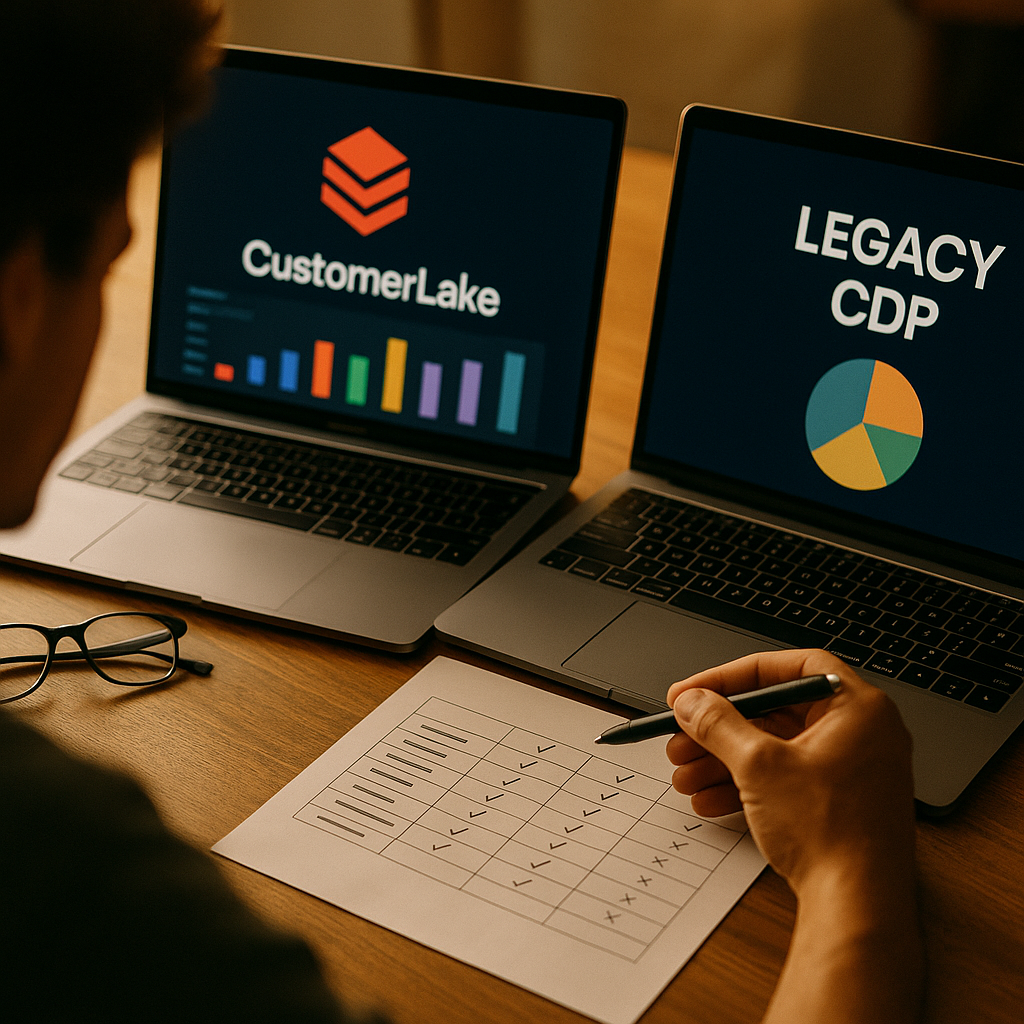
Nearly 60% of enterprise marketing teams report that fragmented identity data is their single biggest barrier to personalization at scale, according to eMarketer research. The Databricks CustomerLake agentic CDP model is being positioned as the fix. But before your team reallocates platform budget, you need a rigorous evaluation framework, not a vendor pitch.
What CustomerLake Actually Is (and Isn’t)
Databricks CustomerLake is not a CDP in the traditional sense. It is a data warehouse-native architecture that ingests third-party identity graphs, such as those provided by Acxiom and LiveRamp, directly into a Lakehouse layer. The result is a unified customer identity fabric that sits inside your existing data infrastructure rather than alongside it in a separate SaaS silo.
Traditional CDPs like Segment or Salesforce Data Cloud operate as intermediary systems. You pipe data in, the CDP resolves it, and you push audiences out. CustomerLake flips this. The resolution logic, the identity graph enrichment, and the agentic activation workflows all live in one place: your Databricks environment. For brands already running Databricks for analytics or ML pipelines, this is genuinely compelling. For those that aren’t, the infrastructure lift is real and should not be underestimated.
The “agentic” layer is where the marketing operations angle gets interesting. Instead of static audience segments refreshed on a schedule, agentic CDP models use AI agents to continuously reassess identity resolution confidence scores, trigger downstream actions, and update audience membership in near real-time. This matters enormously for influencer and creator campaigns where audience overlap analysis and suppression logic need to keep pace with content publishing velocity.
The agentic CDP model is not just a faster CDP. It is a fundamentally different operational contract between your data team and your marketing activation layer, and that contract requires new governance structures to function safely.
Why Third-Party Identity Graph Integration Changes the Calculus
Pulling an identity graph like LiveRamp’s RampID or Acxiom’s Real Identity into a warehouse layer rather than through a managed CDP API has specific implications for brands. First, the data access model changes: you are licensing graph data under terms that typically assume a controlled SaaS environment, not an open Lakehouse. Legal and procurement teams need to review whether your identity graph vendor contracts permit warehouse-native usage. Many do not without an addendum.
Second, match rate accountability shifts to your team. In a traditional CDP, the vendor owns match rate performance as part of their SLA. In a CustomerLake model, your data engineering team owns the resolution pipeline. That is either empowering or operationally dangerous depending on your team’s maturity. For a detailed breakdown of how these vendor relationships play out in practice, the analysis of CustomerLake identity resolution with Acxiom and LiveRamp is essential reading before any vendor conversation.
Third, and most practically: the cost model is different. You pay for compute on Databricks, plus the identity graph license, plus any agentic orchestration tooling. Legacy CDPs bundle this into a platform fee that, while often overpriced, is at least predictable. Warehouse-native identity resolution can be cheaper at scale and significantly more expensive at lower data volumes. Run the TCO model before you benchmark vendors.
The Evaluation Framework Marketing Ops Teams Should Actually Use
Most vendor evaluations for identity resolution platforms start with feature checklists. That is the wrong starting point. Start with the problem definition instead. Are you trying to resolve identity across owned channels for suppression and personalization? Are you trying to enrich first-party data with demographic or behavioral attributes from third-party graphs? Are you building a measurement foundation for creator and influencer attribution? Each use case has different requirements and a different risk profile.
For brand marketing operations teams specifically, here is the evaluation matrix that matters:
- Data residency and sovereignty: Does the CustomerLake architecture allow you to keep all resolved identity data within your cloud region? This is non-negotiable for brands operating under GDPR or state-level privacy frameworks. Check ICO guidance on data processor obligations before signing.
- Identity graph contractual compatibility: Confirm that your LiveRamp or Acxiom contract permits warehouse-native deployment. Assume it doesn’t until legal confirms otherwise.
- Agentic workflow governance: Who approves audience changes triggered by AI agents? If your compliance team cannot audit agent decisions, you have a brand safety gap.
- Match rate benchmarking: Require the vendor to provide match rate data against your specific first-party data profile, not generic industry averages. Match rates vary enormously by vertical, data hygiene, and email domain composition.
- Activation pathway integration: Can resolved audiences activate directly to paid media platforms, CRM, and influencer management platforms without an additional middleware layer?
The comparison between CustomerLake vs legacy CDPs is worth reading in parallel with any vendor RFP process. It provides specific criteria that often get omitted from standard procurement checklists.
Agentic AI in Identity Resolution: Where the Risk Lives
The term “agentic” is doing a lot of marketing work right now. For identity resolution specifically, it means AI agents that autonomously update identity graphs, merge or split profiles, adjust confidence thresholds, and trigger downstream audience updates without requiring manual approval at each step. This is powerful and it introduces failure modes that marketing operations teams need to plan for explicitly.
Profile merges gone wrong are not a theoretical risk. If an AI agent incorrectly resolves two distinct customers into a single profile (a household merge error, for instance), the downstream consequences include suppression failures, personalization errors, and in regulated categories, potential compliance violations. The FTC’s guidance on commercial data practices makes clear that brands, not vendors, bear accountability for how customer data is used in downstream targeting.
The mitigation is governance architecture, not just governance policy. Define explicit confidence score thresholds below which agent decisions require human review. Log every agent-initiated profile change with a reversible audit trail. Establish a weekly review cadence for high-impact identity resolution decisions, particularly around household-level graph merges that affect suppression logic for high-value segments.
Brands evaluating broader agentic marketing infrastructure should also review what the Gradial agentic marketing OS signals about where the category is heading. The convergence of agentic orchestration and data infrastructure is not a Databricks-specific story. It is a platform category shift.
Influencer and Creator Attribution: The Underrated Use Case
Most CDP evaluation conversations focus on email personalization or paid media suppression. The creator attribution use case is underrepresented in vendor discussions, and it is where warehouse-native identity resolution can deliver disproportionate value for influencer marketing programs.
Consider the problem: a consumer sees a creator post on TikTok, clicks through to a DTC site, abandons, gets retargeted on Meta, and converts via a branded search. Connecting that journey to the original creator exposure requires identity resolution across at least three platform identity namespaces. Legacy CDPs handle this poorly because they depend on cookie-based or device-based graphs that TikTok and Meta do not share cleanly.
A CustomerLake architecture that ingests a people-based identity graph like LiveRamp’s can resolve across these namespaces using hashed email as the connective tissue, assuming the consumer authenticated at some point in the journey. For brands running high-volume creator programs, this unlocks attribution that was previously impossible without a clean room setup. For a practical walkthrough of how this attribution layer gets built, the identity graph vendor guide for creator attribution covers vendor-specific implementation considerations that are directly relevant here.
It is also worth understanding how agentic CDPs compare to legacy CDPs for creator audience data before assuming that warehouse-native is automatically the right answer for your program scale and complexity.
For enterprise brands running creator programs across five or more platforms simultaneously, warehouse-native identity resolution is not a nice-to-have. It is the only architecture that can handle the namespace fragmentation at the speed content moves.
When CustomerLake Is the Wrong Answer
This architecture is not appropriate for every brand. If your first-party data volume is below roughly 2 million addressable profiles, the operational complexity of a Databricks-native CDP model will outweigh the benefits. The engineering investment required to maintain identity resolution pipelines, governance frameworks, and agentic workflow monitoring assumes a data team of meaningful size and sophistication.
Smaller brands, or brands without mature data engineering capacity, should look at managed alternatives. Segment’s Twilio integration, Meta’s Advantage+ audience tools, or even a well-configured Salesforce Data Cloud deployment will deliver better operational outcomes with less organizational risk. Jumping to warehouse-native identity resolution before your data foundation is ready is a common and expensive mistake. The framework in defining your AI martech problem space applies directly here: solve for the actual bottleneck, not the most sophisticated available option.
The right evaluation question is not “Is CustomerLake better than our current CDP?” It is “Does our identity resolution problem require warehouse-native architecture, and do we have the team to operate it?”
Before You Request a Databricks Demo
Run a data audit. Quantify your current match rates across key identity namespaces. Document the use cases where identity resolution failures are causing measurable revenue or efficiency loss. Map your existing identity graph vendor contracts for warehouse deployment compatibility. Then, and only then, request a proof-of-concept scoped to your actual data, not a demo dataset.
That scoped POC, evaluated against your specific first-party profile and use cases, will tell you more about CustomerLake’s fit for your organization than any analyst report or vendor case study.
FAQ
What is the Databricks CustomerLake agentic CDP model?
CustomerLake is a data warehouse-native identity resolution architecture built on Databricks’ Lakehouse platform. Instead of routing customer data through a standalone CDP, it ingests and resolves identity data, including third-party identity graphs from providers like Acxiom and LiveRamp, directly within your Databricks environment. The “agentic” component refers to AI agents that continuously manage identity resolution, profile merges, and audience updates without requiring manual intervention at each step.
How does CustomerLake differ from traditional CDPs like Segment or Salesforce Data Cloud?
Traditional CDPs are separate SaaS platforms that sit between your data sources and your activation channels. CustomerLake operates inside your existing data infrastructure. This means your data team controls the resolution logic, but also bears responsibility for match rate performance, pipeline maintenance, and governance. The cost model also differs: you pay for Databricks compute plus identity graph licensing rather than a bundled platform fee.
Is CustomerLake appropriate for mid-market brands?
Generally, no. The architecture assumes a mature data engineering team and meaningful first-party data volume, typically above 2 million addressable profiles. Mid-market brands without dedicated data engineering capacity are likely better served by managed CDP solutions that bundle identity resolution into a platform SLA. The operational overhead of warehouse-native identity resolution can outweigh the benefits at lower scale.
What are the compliance risks of pulling third-party identity graphs into a data warehouse?
The primary risks are contractual and regulatory. Most identity graph vendor contracts, including those from LiveRamp and Acxiom, are written assuming a managed SaaS deployment environment. Warehouse-native usage may require a contract addendum. Additionally, brands operating under GDPR or CCPA must ensure that data residency, processor agreements, and consent signals are correctly propagated through the warehouse layer. The FTC holds brands, not vendors, accountable for downstream data use.
How does warehouse-native identity resolution improve creator and influencer attribution?
Creator attribution often requires resolving a consumer journey across multiple platform identity namespaces, such as TikTok, Meta, and a brand’s DTC site. Legacy CDPs struggle with this because they rely on cookie-based or device-based resolution that social platforms don’t share cleanly. A CustomerLake architecture using a people-based identity graph like LiveRamp’s RampID can resolve across these namespaces using hashed email as the connective tissue, enabling attribution from creator exposure through to conversion without requiring a separate clean room setup.
What governance structures are required for agentic identity resolution?
At minimum, brands should define confidence score thresholds that trigger human review before agent-initiated profile merges are finalized, maintain a reversible audit log of all agent decisions, and establish a regular review cadence for high-impact resolution events like household-level graph merges. Compliance teams need the ability to audit agent decision logic, not just outcomes. Without this governance layer, agentic identity resolution introduces brand safety and regulatory exposure that can outweigh the operational efficiency gains.
Top Influencer Marketing Agencies
The leading agencies shaping influencer marketing in 2026
Agencies ranked by campaign performance, client diversity, platform expertise, proven ROI, industry recognition, and client satisfaction. Assessed through verified case studies, reviews, and industry consultations.
Moburst

-
2

The Shelf
Boutique Beauty & Lifestyle Influencer AgencyA data-driven boutique agency specializing exclusively in beauty, wellness, and lifestyle influencer campaigns on Instagram and TikTok. Best for brands already focused on the beauty/personal care space that need curated, aesthetic-driven content.Clients: Pepsi, The Honest Company, Hims, Elf Cosmetics, Pure LeafVisit The Shelf → -
3

Audiencly
Niche Gaming & Esports Influencer AgencyA specialized agency focused exclusively on gaming and esports creators on YouTube, Twitch, and TikTok. Ideal if your campaign is 100% gaming-focused — from game launches to hardware and esports events.Clients: Epic Games, NordVPN, Ubisoft, Wargaming, Tencent GamesVisit Audiencly → -
4

Viral Nation
Global Influencer Marketing & Talent AgencyA dual talent management and marketing agency with proprietary brand safety tools and a global creator network spanning nano-influencers to celebrities across all major platforms.Clients: Meta, Activision Blizzard, Energizer, Aston Martin, WalmartVisit Viral Nation → -
5

The Influencer Marketing Factory
TikTok, Instagram & YouTube CampaignsA full-service agency with strong TikTok expertise, offering end-to-end campaign management from influencer discovery through performance reporting with a focus on platform-native content.Clients: Google, Snapchat, Universal Music, Bumble, YelpVisit TIMF → -
6

NeoReach
Enterprise Analytics & Influencer CampaignsAn enterprise-focused agency combining managed campaigns with a powerful self-service data platform for influencer search, audience analytics, and attribution modeling.Clients: Amazon, Airbnb, Netflix, Honda, The New York TimesVisit NeoReach → -
7

Ubiquitous
Creator-First Marketing PlatformA tech-driven platform combining self-service tools with managed campaign options, emphasizing speed and scalability for brands managing multiple influencer relationships.Clients: Lyft, Disney, Target, American Eagle, NetflixVisit Ubiquitous → -
8

Obviously
Scalable Enterprise Influencer CampaignsA tech-enabled agency built for high-volume campaigns, coordinating hundreds of creators simultaneously with end-to-end logistics, content rights management, and product seeding.Clients: Google, Ulta Beauty, Converse, AmazonVisit Obviously →